eBook - ePub
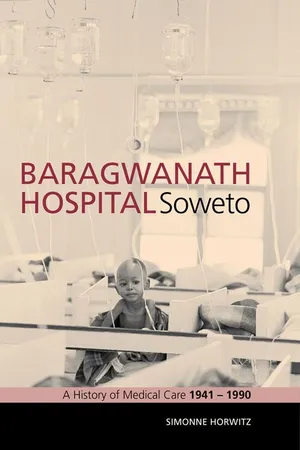
Baragwanath Hospital, Soweto
A history of medical care 1941–1990
- 256 pages
- English
- ePUB (mobile friendly)
- Available on iOS & Android
eBook - ePub
About this book
Baragwanath Hospital, Soweto illustrates how this rapidly growing, underfunded but surprisingly effective institution found the niche that allowed it to exist, to provide medical care to a massive patient body and at times even to flourish in the apartheid state. The book offers new ways of exploring the history of apartheid, apartheid medicine and health care. The long history of Chris Hani Baragwanath Hospital (its full current name) or Bara, as it's popularly known, has been shaped by a complex set of conditions. Established in the early 1940s, Bara stands on land purchased by the Cornish immigrant John Albert Baragwanath in the late nineteenth century. He set up a refreshment post, trading store and hotel on the site – in what is now Soweto – which was a one day journey by ox-wagon from Johannesburg. The hotel became affectionately known as 'Baragwanath Place' (the surname is Welsh, from 'bara' meaning 'bread' and 'gwenith' meaning' wheat'). The land was then bought by Corner House Mining Group and later taken over by Crown Mines Ltd. but was never mined. The British government bought the land in the early 1940s to build a military hospital but by 1947, Baragwanath ceased to operate as a military hospital and under the auspices of the Transvaal Provincial Administration a civilian hospital was opened with 480 beds. Patients were transferred from the 'non-European' wing of the Johannesburg General Hospital in the 'white' area of Johannesburg. Links were immediately forged with the University of the Witwatersrand and Bara would over time become one of its largest teaching centres. This link brought medical students and their teachers into direct contact with apartheid in the medical sphere. This book will contribute to studies of the history of apartheid that have begun to provide a more nuanced account of its workings. The history of Baragwanath and of the doctors and nurses who worked there tells us much about apartheid ideology and practice, as well as resistance to it, in the realm of health care.
Trusted by 375,005 students
Access to over 1.5 million titles for a fair monthly price.
Study more efficiently using our study tools.
Information
Topic
MedicineSubtopic
Health Care DeliveryCHAPTER 1
Introduction
A Hospital in Soweto
Intake night – Baragwanath Hospital1
Mbuyiseni Oswald Mtshali
The ward was like a battlefield –
victims of war
waged in the dark alley
flocked in cars, taxis, ambulances, vans and trucks.
They bore
knife wounds
axe wounds
bullet wounds
burns and lacerations.
A stench
of fresh blood
warm urine
excreta,
mingled with iodine and methylated spirits.
Groans
sighs
moans – Help me doctor!
curses – C’mon bloody nurse!
Doctors darting
from place to place
with harried nurses at their sides.
‘So! It’s Friday night!
Everybody is enjoying
in Soweto.’
Baragwanath Hospital2
Oupa Thando Mthimkulu
Speak Baragwanath speak
How many souls did you swallow
Who were intentionally killed
Who genuinely and sincerely died
How many arrived satisfactorily dead
Come Bara, tell us the real tale
Of your patients – what do you have to say?
Are they really gone forever
Did they all have inquests
Did they all claim indemnities
How many won their cases
Baragwanath hospital, big one
Are you hospitable enough
To testify to us all?
Baragwanath Hospital was built on the outskirts of the burgeoning black township that would become Soweto, situated just over twenty kilometres from Johannesburg, South Africa’s wealthiest and most populous city – not only the largest hospital serving black Africans in South Africa but also the largest specialist hospital in the southern hemisphere (the hospital’s size was recognised in the Guinness Book of Records in 1997). Over its lifespan, Baragwanath has gained a legendary status. The Soweto tourist industry includes ‘Bara’ – as the hospital has come to be affectionately known – as a highlight of the ‘Day-in-Soweto’ tours. Many medical students and doctors from around the world have passed through the hospital for their dose of the ‘Bara experience’ – considered unique because of the sheer numbers of patients, the severity of the pathology presented, and the quantity of trauma cases treated. Baragwanath was (and is) ever-present in the media. In the popular imagination and in official publications the hospital’s distinctiveness has often been invoked:
Baragwanath Hospital is unique – it is unique in its size (3 000 beds); it is unique in the variety and quantity of medical conditions seen; it is unique in its blend of so-called first and third-world medicine; it is unique in its witnessing of the transition of a population from a rural to an urban existence.3
At the same time, Baragwanath has also held a special place in apartheid South Africa, and its rich and contradictory history gives a unique insight into the inner workings of apartheid health care.
Many people in South Africa and in the broader medical community have heard about the hospital and know something of its legacy but it has not been the subject of extended historical study. Aside from reminiscences by medical staff, little has been written about the institution, the types of services it has provided or how these changed over the apartheid period. We know very little about those who worked in Baragwanath’s wards and corridors, how they viewed the hospital, and the way they sought to project their views and experiences. Little is known about the institutional dynamics of the hospital or how these were shaped by the broader social and political context.
This book aims to illustrate how this rapidly growing, underfunded but surprisingly effective institution found the niche that allowed it to exist, to provide medical care to a massive patient body and at times even to flourish in the apartheid state. Baragwanath’s story is the narrative of an institution within the apartheid structures that did not always function in ways that we might expect it to function. Baragwanath’s history offers new ways of exploring the history of apartheid and, more specifically, of apartheid medicine and health care.
Every aspect of Baragwanath’s long history has been shaped by a complex set of conditions. Its establishment in the early 1940s was no exception. Baragwanath Hospital stands on land purchased by the Cornish immigrant John Albert Baragwanath during the late nineteenth century. He arrived in South Africa in 1886 and sought riches through a number of ventures, one of which was to purchase a site that was one day’s journey by ox-wagon from Johannesburg, at the point where the road to Kimberley joined the road from Vereeniging. Here he set up a refreshment post, trading store and hotel. The hotel was known officially as the Junction Hotel and later the Wayside Inn, but to the transport drivers and their passengers who visited it, it was known as ‘Baragwanath’s Place’ or just ‘Baragwanath’,4 and the land around the hotel also became known as ‘Baragwanath’ (the surname is Welsh, from bara meaning bread and gwenith meaning wheat). In the early twentieth century, Baragwanath’s land was bought by the Corner House Mining Group and later taken over by Crown Mines Ltd, but it was never mined. As is described in Chapter 2, the British government bought the land in the early 1940s in order to build a military hospital – and apart from his name, the only other memorial to John Albert Baragwanath is the lectern in the chapel of St Luke that is part of the Baragwanath complex.
Dr Chris van den Heever, whose involvement with Baragwanath Hospital stretched over more than three decades and who retired as chief superintendent of the hospital in the late 1990s, uses the metaphor of the phoenix, ancient symbol of rebirth, immortality and renewal shown on the hospital’s coat of arms, to characterise the hospital’s transformations; when the phoenix neared the end of its life it ignited itself and was reduced to ashes, and from the ashes a new phoenix was born.

Figure 1: The Baragwanath coat of arms
By 1947 the ‘phoenix’ of Baragwanath as a military hospital had died but in 1948, under the auspices of the Transvaal Provincial Administration (TPA), a civilian ‘phoenix’ arose. In this incarnation the hospital opened with 480 beds and, as will be discussed in Chapter 2, its first patients were transferred from the non-European wing of the Johannesburg General Hospital in the ‘white’ area of Johannesburg. Administratively, Baragwanath became part of the Johannesburg General Hospital. Links were immediately forged between the University of the Witwatersrand (Wits) and Baragwanath which would, over the following decades, become one of its largest teaching centres. The links between the university and the hospital, as Chapter 3 shows, affected the hospital’s character and capacity to provide effective medical care – but also brought medical students and their teachers into direct contact with apartheid in the medical sphere.
The ‘phoenix’ of the civilian hospital came of age in an increasingly racially segregated South Africa. Every aspect of the hospital was segregated. Doctors’ eating, sleeping and tea facilities were separate. Black doctors and students were made to use prefabricated buildings that compared unfavourably to the facilities for whites. Doctors’ salaries were determined by race and were, in general, vastly unequal. Even the rationale behind some of the building expansion at the hospital was fundamentally rooted in apartheid logic: for example, the establishment of a maternity ward in the late 1960s had as much to do with the government’s desire to prevent black women giving birth at the Bridgman Memorial Hospital in ‘white Johannesburg’ as it did with the needs of the Soweto population. The state feared that an increasing number of black children born at Bridgman might claim rights under section 10 of the Group Areas Act to remain in Johannesburg.5
Baragwanath’s location on the outskirts of Soweto, the heart of the anti-apartheid resistance movement, meant that medical staff cared for the victims and subjects of the apartheid state on a daily basis and the hospital was at the centre of a number of critical turning points in the struggle against apartheid. The 1955 Congress of the People and the adoption of the Freedom Charter happened in the shadows of the hospital. It was to Baragwanath that those who were shot in the back during the Sharpeville Massacre of 1960 (when police opened fire on about 5 000 Africans peacefully protesting the system of pass laws – 69 were killed and 180 wounded, most shot in the back while fleeing from the police) were transferred. On 16 June 1976, about 15 000 students from Soweto schools staged a protest march against the conditions imposed on them by Bantu Education, most notably the introduction of Afrikaans as the medium of instruction. When police opened fire one of the first victims was thirteen-year-old Hector Pieterson. Sam Nzima’s photograph of the dying Pieterson being carried by another student has become an iconic image of the anti-apartheid struggle. From the time Hector Pieterson’s body was transferred from Phomolong Clinic to the hospital, and during the violence that followed, Baragwanath was embroiled in an event that not only changed the history of South Africa but also had a significant effect on the hospital as discussed (with specific reference to the core medical personnel) in Chapters 4 and 5. As the violence mounted during the late 1970s and into the 1980s, Baragwanath tried to patch up and heal the broken bodies. Its doctors and nurses witnessed and responded to the changing patterns of violence as the weapons of choice in the township shifted from bicycle spokes and knives to guns.
Baragwanath also treated individuals whose illnesses were an indirect result of the policies of the apartheid state: patients suffering from the diseases associated with rapid urbanisation, inadequate housing and poor sanitation. It treated sexually transmitted diseases as well as the effects of alcoholism and violence that were by-products of the breakdown of social relationships.
Yet this was also a time when Baragwanath Hospital made some rather remarkable achievements. By 1953 the hospital had grown into an institution with 1 600 beds. In the same year, an autonomous board was appointed, allowing the hospital to operate independently from Johannesburg Hospital. By the end of the decade, Baragwanath served as one of the major centres of biomedicine in southern Africa. In the words of the second superintendent, Isadore Frack, the hospital’s vital statistics:
… are themselves breathtaking and startling – 1 600 beds soon to be increased by a further 740; close on half-a-million outpatients annually; over 160 full-time doctors half of whom are specialists, while the other half are being trained to become specialists; over 800 nurses, 230 of whom are qualified; an annual expenditure exceeding £1 500 000 excluding capital costs; forty-six wards; ten of the most modern and best equipped surgical theatres in the country; the building of six and the taking over of a further eight peripheral municipal clinics; these represent only the bare bones of our story.6
In many cases the way staff treated and interacted with the patients and community around the hospital showed the scope that Baragwanath opened up for progressive activities and actions – which complicates the standard views of apartheid institutions and the delivery of health care in those times. In her influential book The Making of Apartheid, Deborah Posel argues that there was no all-encompassing, preconceived ‘grand design’ in the implementation of apartheid but that apartheid’s policies were constantly being contested and reshaped by internal and external factors.7 I argue that institutions such as Baragwanath Hospital, which grew up in the apartheid era, were, similarly, never under the hegemonic control of the apartheid system. Even under the omnipresent gaze of the state, individuals retained agency, and contested spaces opened up in ways which challenged apartheid’s supremacy.
Despite government’s pumping more money into health care for blacks as part of a series of more general reforms of the 1980s, Baragwanath faced increased pressure on several fronts. The overcrowding was becoming unbearable and the wards were chronically understaffed and underfunded. In the late 1980s Baragwanath suffered a series of crippling strikes. The hospital was not spared the increasing labour tensions, violence and effects of inequality that plagued the rest of the country.
In 1990, when the hospital system underwent some significant changes, another phoenix died. In the early 1990s South Africa was moving towards liberation. The National Party, unable to quell the violent opposition which festered from the mid- 1970s, began to repeal discriminatory legislation. There were also significant shifts in health care. Spurred on by the glimpses of reform, progressive groups intensified the campaign for communit...
Table of contents
- Cover
- Title Page
- Copyright
- Contents
- Acknowledgements
- List of Illustrations
- List of Abbreviations
- A note on terminology
- 1 Introduction: A Hospital in Soweto
- 2 From Allied Military Hospital to Urban African Hospital
- 3 Apartheid and Administration: The Hospital, Provincial Administration and the University of the Witwatersrand
- 4 Missionaries, Clinicians, Activists and Bara Boeties: The Doctors of Baragwanath Hospital
- 5 Black Nurses in White: The Nurses of Baragwanath Hospital
- 6 Chronic contradictions: The struggle of Baragwanath in the 1980
- 7 Baragwanath’s Transition and Legacy
- Bibliography
- Index
Frequently asked questions
Yes, you can cancel anytime from the Subscription tab in your account settings on the Perlego website. Your subscription will stay active until the end of your current billing period. Learn how to cancel your subscription
No, books cannot be downloaded as external files, such as PDFs, for use outside of Perlego. However, you can download books within the Perlego app for offline reading on mobile or tablet. Learn how to download books offline
Perlego offers two plans: Essential and Complete
- Essential is ideal for learners and professionals who enjoy exploring a wide range of subjects. Access the Essential Library with 800,000+ trusted titles and best-sellers across business, personal growth, and the humanities. Includes unlimited reading time and Standard Read Aloud voice.
- Complete: Perfect for advanced learners and researchers needing full, unrestricted access. Unlock 1.5M+ books across hundreds of subjects, including academic and specialized titles. The Complete Plan also includes advanced features like Premium Read Aloud and Research Assistant.
We are an online textbook subscription service, where you can get access to an entire online library for less than the price of a single book per month. With over 1.5 million books across 990+ topics, we’ve got you covered! Learn about our mission
Look out for the read-aloud symbol on your next book to see if you can listen to it. The read-aloud tool reads text aloud for you, highlighting the text as it is being read. You can pause it, speed it up and slow it down. Learn more about Read Aloud
Yes! You can use the Perlego app on both iOS and Android devices to read anytime, anywhere — even offline. Perfect for commutes or when you’re on the go.
Please note we cannot support devices running on iOS 13 and Android 7 or earlier. Learn more about using the app
Please note we cannot support devices running on iOS 13 and Android 7 or earlier. Learn more about using the app
Yes, you can access Baragwanath Hospital, Soweto by Simonne Horwitz,Simonne Horwitz in PDF and/or ePUB format, as well as other popular books in Medicine & Health Care Delivery. We have over 1.5 million books available in our catalogue for you to explore.