Essays that address the question: how can people and class agency change this destructive course of history?
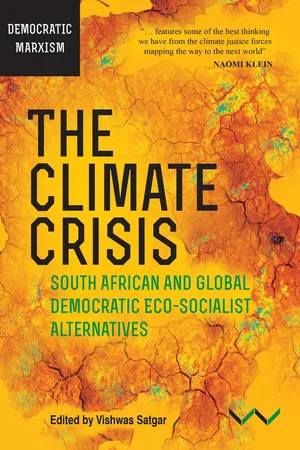
Capitalism's addiction to fossil fuels is heating our planet at a pace and scale never before experienced. Extreme weather patterns, rising sea levels and accelerating feedback loops are a commonplace feature of our lives. The number of environmental refugees is increasing and several island states and low-lying countries are becoming vulnerable. Corporate-induced climate change has set us on an ecocidal path of species extinction. Governments and their international platforms such as the Paris Climate Agreement deliver too little, too late. Most states, including South Africa, continue on their carbon-intensive energy paths, with devastating results. Political leaders across the world are failing to provide systemic solutions to the climate crisis. This is the context in which we must ask ourselves: how can people and class agency change this destructive course of history? Volume three in the Democratic Marxism series, The Climate Crisis investigates eco-socialist alternatives that are emerging. It presents the thinking of leading climate justice activists, campaigners and social movements advancing systemic alternatives and developing bottom-up, just transitions to sustain life. Through a combination of theoretical and empirical work, the authors collectively examine the challenges and opportunities inherent in the current moment. This volume builds on the class-struggle focus of Volume 2 by placing ecological issues at the centre of democratic Marxism. Most importantly, it explores ways to renew historical socialism with democratic, eco-socialist alternatives to meet current challenges in South Africa and the world.
eBook - ePub
Climate Crisis, The
South African and Global Democratic Eco-Socialist Alternatives
- 372 pages
- English
- ePUB (mobile friendly)
- Available on iOS & Android
eBook - ePub
Climate Crisis, The
South African and Global Democratic Eco-Socialist Alternatives
About this book
Information
CHAPTER
1
THE CLIMATE CRISIS AND SYSTEMIC ALTERNATIVES
Climate change is the most serious challenge we face as a species. Despite numerous warnings – scientific studies, United Nations (UN) declarations, books, movies, progressive media reporting – global leadership has failed humanity. After more than twenty years of multilateral negotiations, we have not developed the solutions to solve the climate crisis decisively. Instead, we have continued emitting pollutants and intensively using fossil fuels and, as a result, have been recording the hottest years on the planet. The last two decades in the fight against the climate crisis have merely confirmed, at a common sense level, an Anthropocene-centred theory: as a geological force, we humans are heating the planet. A heating planet, induced by human action, unhinges all our certainties and places everything in jeopardy. It challenges our fixation with growth economics, ‘catch-up’ development and every conception of modern progress that has incited our imaginations. Most fundamentally, it prompts us to ask: has globalised capitalism lost its progressiveness? Is today's fossil fuel-driven, hi-tech, scientific, financialised and post-Fordist industrial world leading humanity down a path of ecocidal destruction? How do we survive the climate crisis?
These are the central questions of this volume, which deals with one dimension of the systemic crises of accumulation related to contemporary capitalism. This thematic focus also builds on the previous volume in the series, entitled Capitalism's Crises: Class Struggles in South Africa and the World. Without falling into the trap of catastrophism, end-of-times millenarianism or apolitical acquiescence, this volume treats the climate crisis as an emergency, demanding transformative politics and systemic reforms to remake how we produce, consume, finance and organise social life – it calls for civilisational transformation. It draws from and highlights the analysis, concepts and systemic alternatives emerging at the frontiers of climate justice politics and its convergence with broader anti-systemic movements. Like previous volumes in this series, there is an attempt to think with and learn from grassroots movements. Thus, many of the contributors in this volume are engaged activist scholars, grassroots activists and movement leaders.
At the same time, this volume places Marxism in dialogue with contemporary anti-capitalism in a manner that draws on its ideological and movement potentials. Marxism in the twentieth century as ruling ideology, mostly as Marxism–Leninism, has privileged Promethean growth, vanguardist authoritarianism and catch-up industrialisation, and at the same time has been ruinous to the environment. This volume articulates a Marxism that is post-productivist, resituates nature at the centre of Marxism, confronts the patriarchal and racist oppressions inherent to capitalism, challenges contemporary imperialism and appreciates the need to think and act democratically. In this journey, Marxism is shaped by its own self-reflexivity, by contemporary anti-capitalism and the challenge of confronting the climate contradiction. It is tested as an intellectual resource to be open and serve as the basis for a new future: a democratic eco-socialist world and South Africa.
THE CLIMATE CRISIS AS A SYSTEMIC CRISIS OF CAPITALIST ACCUMULATION
In 1988, National Aeronautics and Space Administration (NASA) scientist James Hansen drew attention to the heating of the Earth's temperature, otherwise known as the ‘greenhouse effect’ or climate change (see Washington Post, 3 August 2012). Yet the US refused to adopt the Kyoto Protocol, which locked in ‘common but differentiated responsibilities’ (Art. 3.1) for industrial countries (even this did not go far enough). Instead, the US has worked systematically to scuttle the Kyoto Protocol. Hansen, writing in the 13 July 2006 issue of the New York Review of Books, cautioned that the world has a decade to alter the trajectory of greenhouse gas (GHG) emissions or face irreversible changes which will bring disastrous consequences. Since this plea was made, another decade has been lost and today geologists and climate scientists are talking about a new world of unpredictable and no-analogue climatic conditions: the Anthropocene. Put simply, we are entering a world in which humans have altered planetary conditions, including our climate, breaking a 10 000-year pattern of relatively stable climate known as the Holocene.
For many, the climate crisis is a complex scientific problem. At one level it is, and it is very different from daily or seasonal variability in weather. The science of climate change has confirmed, with the measurement of GHGs and in the language of the UN Framework Convention on Climate Change (UNFCCC), that ‘human induced climate change’ is happening (IPCC 2014: 48). In 2015, we broke the halfway mark towards catastrophic climate change. This was confirmed by the World Meteorological Organisation, which broadcast to the world that planetary temperatures have reached a 1°C increase higher than the period prior to the Industrial Revolution.1 We have concentrated carbon, at over 400 parts per million, taking us rapidly closer to a 2°C increase in planetary temperature.2 With this shift, extreme weather events such as droughts, hurricanes, heatwaves, drier conditions enabling fires and floods are becoming more commonplace. Sea levels are also rising, placing many low-lying communities, populous coastal cities and island states in jeopardy. Moreover, climate change on this scale within the Earth system is not expected to unfold in a linear way. Instead, it can potentially happen abruptly or through feedback loops, further accelerating runaway climate change. For example, methane release from the Arctic ice sheet, carbon saturation in our oceans and the destruction of rain forests all feed into the climate change crisis. As we fail to address the climate crisis, it becomes more complex and more costly.
The much-vaunted UN climate negotiations, particularly the Conference of the Parties in Paris during December 2015 (COP21), promised to confirm a clear purpose and political will to ensure we overcome the climate crisis. The Paris Agreement makes a call for urgent action to prevent a 2°C increase in planetary temperature, with an emphasis on efforts to keep temperature increases below 1.5°C, at pre-industrial levels (UNFCCC 2015). Despite the promises, these targets will not be realised. As things stand, most voluntary national commitments will lead to an overshoot of 2°C. The most up-to-date analysis of national pledges suggests that these are consistent with a temperature rise of 2.6–3.1°C above pre-industrial levels (Darby 2016). Moreover, while this Agreement came into force on 4 November 2016 it will only build momentum from 2020 onwards, thus losing another four years in the context of two decades of failed action. It is also expected, given the current emission rate and trajectory, that 1.5°C will be breached sooner than expected. In a recent study it was confirmed, ‘The window for limiting warming to below 1.5C with high probability and without temporarily exceeding that level already seems to have closed’ (Rogelj et al. 2016: 631).
The 2°C threshold discussed in the Paris Agreement is far from being a protective barrier. Instead, it is a dangerous threshold taking the human world to the brink. Studies on tipping points (like the Arctic becoming ice free or major retreats in glaciers in the Himalayas) show that eighteen out of thirty-seven abrupt changes will happen by a 2°C change or less (Drijfhout 2015). Put more bluntly, a 2°C increase in planetary temperature is extremely dangerous. For vulnerable nations, contributing less than two per cent of current global GHG emissions, a 2°C target is nothing short of catastrophic.3 With the current increase in global temperature, major consequences beyond their capabilities have already come to the fore for the most vulnerable twenty countries in the world, representing 700 million people and including poor, arid, landlocked, mountainous and small island states from Africa, Asia, the Caribbean, Latin America and the Pacific. These experiences provide us with a window into the future. According to the Vulnerable 20 (or V20), this is what they are already facing:4
- An average of more than 50 000 deaths per year since 2010, a number expected to increase exponentially by 2030;
- Escalating annual losses of at least 2.5% of their GDP potential per year, estimated at US$45 billion since 2010, a number expected to increase to close to US$400 billion in the next twenty years;
- More than half the economic impact of climate change by 2030 and over eighty per cent of its health impact for V20 and other low-emitting developing countries;
- A doubling in the number of extremely hot days and hot nights in the last fifty years as the planet has warmed appreciably;
- Countless extreme events which include typhoons with wind speeds that are around ten per cent stronger than they were in the 1970s, translating into more than a thirty per cent increase in destructiveness;
- Sea-level rise that will partially or completely submerge the island nations of Kiribati, Maldives and Tuvalu, displacing at least 500 000 people;
- The displacement of up to forty million people due to the inundation of low-elevation land resulting from climate change-driven sea-level rise;
- The threat of increasingly devastating and more frequent disasters, such as storms, flooding and drought.
This leads us to ask: what is the Paris Agreement really all about? What are its limits and contradictions? How does its political economy work against us solving the biggest problem facing the human race?
First, the Paris Agreement abandons the Kyoto Protocol commitment to ‘common but differentiated responsibilities’ despite formally declaring its commitments to the Protocol. The Kyoto Protocol explicitly placed a greater burden on rich industrialised countries. The Paris Agreement, by contrast, provides for voluntary and nationally determined commitments, which should not be confused with nationally binding and regulated commitments. Yet there are historical and contemporary inequalities regarding carbon emissions. Some of the rich industrialised countries of the global North have been polluting since the advent of the Industrial Revolution, in the context of uneven processes of capitalist development and imperial international relations. These countries carry a climate debt. However, climate debt and climate reparations do not feature in the Paris Agreement. Instead, there is a paltry commitment of US$100 billion from developed countries for mitigation and adaptation, which pales in comparison to the finance injected into the crisis-prone financial system. What this means is that those who have created (and continue to create) the problem, are off the hook. Without regulated commitments for reductions in GHG emissions based on historical climate debt, this inequality will not be addressed and emerging polluters, like China, will only commit to and act on what suits their interests. Moreover, the argument of industrialising countries for industrial development space cannot be addressed in the interests of the planet and all of humanity unless industrialised countries address the historic climate debt and aggressively lead the cutback in emissions through regulation. The Paris Agreement fails to do this, which means it is a ‘business as usual’ trajectory for globalised and fossil fuel-driven industrial development, including global shipping and airplane emissions. Transportation emissions are not even mentioned in the Paris Agreement. In short, the Agreement has turned its back on common but differentiated responsibilities. A tenuous voluntary pledge system, favoured by the US, one of the leading carbon emitters, has been entrenched despite the world running out of time.
Second, the carbon space (or budget) in the Paris Agreement for developed and developing countries is left to each country to manage, in a global political economy in which competition rules. No country in this globalised race is going to surrender any advantages to address the climate crisis unless there are reciprocal and harmonised commitments. At the same time, if the pledge and review system falters, with some countries doing more than others, this is likely to cause consternation against free riders, which could undermine the mechanism. In the context of economic stagnation, corporate capture of political systems and the entrenched power of fossil fuel interests, the Paris Agreement is already being bypassed to ensure profit rates are protected and global accumulation is maintained. The geopolitics of domestic interests will constantly threaten and push back the pledge and review mechanism. For instance, despite Barack Obama's rhetoric in praising this Agreement, the US ruling class did not support him. Instead, their approach was to keep the globalised capitalist system going on a ‘business as usual’ path despite the climate crisis.5 Donald Trump, on the other hand, has given the go-ahead to expand fossil fuel pipeline development (the Dakota Access and Keystone XL), rolled back Obama's modest Clean Power Plan, weakened the Environmental Protection Agency and withdrawn the US from the Paris Agreement. Ironically, the Paris Agreement was not even a legally binding agreement and gave the US room to bring whatever it wanted into the multilateral process. With climate change denialism back on the agenda in the US, and the world's climate being pushed into greater corporate-induced chaos, the US under Trump will seek to protect ‘lifeboat’ America at all costs. As a result, a more securitised response is likely to come to the fore, from both the US and other wealthy countries. The only way to challenge this is if the geopolitics of international trade, finance and development is redefined. A climate-driven world cannot be held hostage by the whims of the US-led bloc. If we are to save life on Earth, neoliberalised global accumulation and the current policies of globally competitive capitalist development have to be abandoned. Given the climate emergency, a new political economy has to emerge to replace global competition. This requires ‘just transitions’ (discussed below) at various scales and tempos to deal with the disproportionate impacts of the climate crisis on vulnerable, poor societies, the working classes and peasantries, who are already bearing the brunt of a highly unequal world. The Paris Agreement is not up to this task and is not moving the world in this direction. With Trump, supported by fossil capital and finance, the Paris Agreement is going to be a symbolic rallying point for only some countries. In fact, the crisis of climate multilateralism has become worse and reflects a crisis of global leadership.
Third, and rather obvious, the Paris Agreement reflects a balance of forces in favour of greening capitalism. This illusion comes through the false solutions embedded in the Agreement, which include carbon trading, reforestation and preventing forest degradation and offset mechanisms (UNFCCC 2015). These solutions have been part of multilateral negotiations for the past two decades and have not worked in their implementation. Carbon trading is a clear example in this regard (Bond 2012). As we run out of time, techno-fixes become more appealing than system change. So, contrary to Anthropocene theory, which suggests that we are all responsible for the climate crisis, it is actually the capitalist system and its class champions that are responsible for the climate crisis. A system that has produced a systemic problem cannot solve the problem, given that this is a carbon-based capitalist civilisation. Nothing short of the fundamental decarbonisation of production, consumption, finance and every life world on this planet will save human and non-human nature. The Paris Agreement falls short of this imperative.
Fourth, it has become increasingly clear through numerous studies that if we extract more fossil fuels we are going to breach 2°C of planetary heating. In the most recent study done on this and cited by Bill McKibben (2016), the conclusion is simple: keeping temperature increases below 2°C requires zero extraction of fossil fuels. We have reached the limits of drilling, digging and extracting if we want to survive. More shocking is the silence of the Paris Agreement about carbon corporations and the need to restrict their activities, even as a minimum gesture to incite hope and encourage a global shift away from fossil fuels. What is patently clear is that the Agreement has not addressed the most immediate and obvious driver of climate change. Instead, by failing to spotlight carbon corporations (oil, gas, coal) it has given warrant for more deadly emissions. Fracking, tar sands, deep-water drilling and other new frontiers of complex hydrocarbons are all expanding. Trump and his class allies have given further momentum to this. This ‘business as usual’ approach is the face of eco-fascism and imperial ecocide. It is the biggest failing of the Paris Agreement, as it does not address the major obstacle to renewable energy systems and a transformative just transition.
The world is facing a perilous future, with a 1°C increase in temperatures since pre the Industrial Revolution already providing signs of what the ‘no-analogue world’ will bring. A hotter planet means the conditions to sustain human and non-human life will become ever more difficult. Global ruling classes have failed humanity and all life on the planet. We have a stark choice: end capitalism or perish. It is in this context that the rising climate justice movement is crucial, together with its potential to unite red-green forces,6 advance deep just transitions and build systemic alternatives from below. Building this movement is our only hope for the future. The climate justice movement will not guarantee our...
Table of contents
- Cover
- Title
- Copyright
- Contents
- Tables and Box
- Acknowledgements
- Acronyms and Abbreviations
- Chapter 1: The Climate Crisis and Systemic Alternatives
- Part One: The Climate Crisis as Capitalist Crisis
- Part Two: Democratic Eco-Socialist Alternatives in the World
- Part Three: Democratic Eco-Socialist Alternatives in South Africa
- Conclusion: Vishwas Satgar
- Contributors
- Index
Trusted by 375,005 students
Access to over 1.5 million titles for a fair monthly price.
Study more efficiently using our study tools.
Frequently asked questions
Yes, you can cancel anytime from the Subscription tab in your account settings on the Perlego website. Your subscription will stay active until the end of your current billing period. Learn how to cancel your subscription
No, books cannot be downloaded as external files, such as PDFs, for use outside of Perlego. However, you can download books within the Perlego app for offline reading on mobile or tablet. Learn how to download books offline
Perlego offers two plans: Essential and Complete
- Essential is ideal for learners and professionals who enjoy exploring a wide range of subjects. Access the Essential Library with 800,000+ trusted titles and best-sellers across business, personal growth, and the humanities. Includes unlimited reading time and Standard Read Aloud voice.
- Complete: Perfect for advanced learners and researchers needing full, unrestricted access. Unlock 1.5M+ books across hundreds of subjects, including academic and specialized titles. The Complete Plan also includes advanced features like Premium Read Aloud and Research Assistant.
We are an online textbook subscription service, where you can get access to an entire online library for less than the price of a single book per month. With over 1.5 million books across 990+ topics, we’ve got you covered! Learn about our mission
Look out for the read-aloud symbol on your next book to see if you can listen to it. The read-aloud tool reads text aloud for you, highlighting the text as it is being read. You can pause it, speed it up and slow it down. Learn more about Read Aloud
Yes! You can use the Perlego app on both iOS and Android devices to read anytime, anywhere — even offline. Perfect for commutes or when you’re on the go.
Please note we cannot support devices running on iOS 13 and Android 7 or earlier. Learn more about using the app
Please note we cannot support devices running on iOS 13 and Android 7 or earlier. Learn more about using the app
Yes, you can access Climate Crisis, The by Mateo Martínez Abarca,Alberto Acosta,Brian Ashley,Nnimmo Bassey,Andrew Bennie,Patrick Bond,Jacklyn Cock,David Fig,Dorothy Grace Guerrero,Hein Marais,Desné Masie,Athish Satgoor,Pablo Sólon,Christelle Terreblanche,Michelle Williams,Devan Pillay, Vishwas Satgar in PDF and/or ePUB format, as well as other popular books in Economics & Political Economy. We have over 1.5 million books available in our catalogue for you to explore.