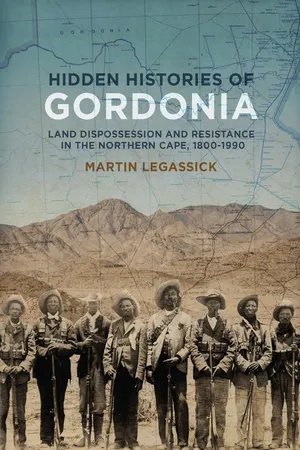
The Gordonia region of the Northern Cape province has received relatively little attention from historians. In Hidden Histories of Gordonia: Land dispossession and resistance in the Northern Cape, 1800–1990, Martin Legassick explores aspects of the generally unknown 'brown' and 'black' history of the region. Emphasising the lives of ordinary people, his writing is also in part an exercise in 'applied history' – historical writing with a direct application to people's lives in the present.
Tracing the indigenous history of Gordonia as well as the northward movement of Basters and whites from the western Cape through Bushmanland to the Orange River, the book presents accounts of family histories, episodes of indigenous resistance to colonisation, and studies of the ultimate imposition of racial segregation and land dispossession on the inhabitants of the region. A recurrent theme is the question of identity and how the extreme ethnic fluidity and social mixing apparent in earlier times crystallised in the colonial period into racial identities, until with final conquest came imposed racial classification.
eBook - ePub
Hidden Histories of Gordonia
Land dispossession and resistance in the Northern Cape, 1800–1990
- 436 pages
- English
- ePUB (mobile friendly)
- Available on iOS & Android
eBook - ePub
Hidden Histories of Gordonia
Land dispossession and resistance in the Northern Cape, 1800–1990
About this book
Information
CHAPTER 1
THE PREHISTORY OF GORDONIA
The Orange River valley must have acted as a magnet, drawing people to its banks from the earliest times. Its first occupants were hunter-gatherers (presumably ancestors of the Bushmen), who were supplemented from about 500 AD by (Khoi) pastoralists who dispersed east and west along the Orange River – from where many migrated to what are now the Western and Eastern Cape provinces some five hundred years later.1 Those pastoralists that remained along the Orange included those becoming Nama (on the lower reaches towards the coast – where the Great Nama eventually turned north and the Little Nama south) and those becoming Einiqua (on the middle reaches around the later settlement of Upington). In the late 18th century, at least, 100 kilometres of river upstream from the later settlement of Pella, land inhabited only by Bushmen, separated Nama from Einiqua. To the north-east of these middle reaches, towards the better watered Highveld, could be found Sotho-Tswana peoples. Southernmost among them was the Barolong kingdom which grew strong after 1600, trading as far as Delagoa Bay.2 Skeletal remains of graves on the Orange River show ‘evidence of gene flows between local Khoesan and the neighbouring black African peoples… a dynamic population trading and mixing generally with the Tswana peoples beyond the Orange River’.3
Around the 1690s some of the Khoi who had gone to the western Cape region (the ‘Great Korana’), now called the Gorachoqua, returned to the Orange as the Left-Hand Korana, and, it is said, destroyed the cordiality which had existed between the Orange River Khoi and the Bushmen. In a series of wars they established themselves eastward up to the surrounds of the present-day Kimberley.4 Fifty years later other Gorachoqua, who became known as the Right-Hand Korana or Kora, led by the Taaibosch chiefdom, also returned to the Orange (via an intermediate period of settlement in the Sneeuwberg) and settled at the later Griquatown, provoking the wrath of the Barolong king Tau. They brought with them trade links with the western Cape.5
With the return of these Korana from the western Cape, some of the Orange River Khoi of the eastern and the middle river became intermingled with or renamed themselves ‘Korana’, also known as ‘Little Korana’. Around the same time, towards the end of the 18th century, the ‘Batlhaping’ – the name was originally a term of Barolong disparagement applied indiscriminately to fish-eaters – acquired a common identity under the unifying rule of a member of a Barolong sub-dynasty, Molehabangwe, who married a Korana woman.6 In defence against the Barolong, a close alliance developed between the Tlhaping and the Right-Hand (Taaibosch) Korana. Tau, the Barolong king, was killed in battle and the combined Korana and Tlhaping settled at Nokaneng, at the south end of the Langeberg.7
This took place at about the time of the first European visits to the middle Orange that provided written accounts, by H.H. Wikar in 1778–9 and Robert Gordon in 1779. They were guided by brown people. According to Wikar and Gordon, the most westerly of the sub-divisions of the ‘Einaqua’ were the ‘Namnykoa’, divided into three homesteads, living just above the Aughrabies Falls, with 40 huts. Higher up were the Kaukoa (also known as Kauk Eijs, Cutting Kraal, or Snijersvolk) on the (later) Skanskop and other islands west of present-day Keimoes, with 20 huts. Three hours eastward were the Aukokoa (Narrow Cheeks or Nouwangen) on (the later) Cannon Island and other islands east of Keimoes, in 23 huts. Another seven-and-a-half hours’ journey east – around the site of present-day Upington – were the Gyzikoa (Twin Kraal) people, a mixture of Korana and Tlhaping, with two homesteads comprising 37 huts.
Near Kheis (opposite the present Groblershoop) were the Kouringeis (Little Korana, Hoogstanders or Proud People). They had three homesteads, one of them with some 49 huts. Like the Gyzikoa, some were of part-Tswana descent. The first of the Korana proper lived higher on the river: the Hoeking Eis (Scorpion Kraal), a branch of the Great Korana, at present-day Koegasbrug below Prieska, with about 20 huts. Above them were the Nokukeis. Most were trading with Tswana peoples. Further Korana groups, Wikar and Gordon were told, lived to the east, both north and south of the Orange, perhaps as far as the Zeekoei River. This included the Taaibosch chiefdom, together with Tlhaping, at Nokaneng, and the Left-Hand Korana near present-day Pniel and Barkly West.8
Over the ensuing decades, there was a dramatic transformation in the lifestyles and occupancy of this area. As a result of pressures from the south, the relative peace and stability were replaced by an era of violent insecurity.
Oorlams, Basters and whites
Nigel Penn’s book, The forgotten frontier: colonist and Khoisan on the Cape’s northern frontier in the 18th century, tells the story of colonial expansion northward through the 18th century, which reduced most of the indigenous population to serfs for white landowners when they were not simply exterminated.9 From after 1739, he shows, colonial frontierspeople moved northward and eastward to encompass ten times the area by 1770.10 The expansion continued thereafter. The colonial boundaries declared in 1798, 1805 and 1824 dipped sharply from the coast to the middle Roggeveld, reflecting, if imperfectly, the limits of colonial settlement at these points in time. In 1808 the northern part of Stellenbosch district was declared the new magistracy of Tulbagh, and in 1822 the seat of the magistracy was moved to Worcester; in 1837 Clanwilliam was split off as a separate magistracy. In 1818 the magistracy of Beaufort (later Beaufort West) was declared to the east of the Tulbagh/Worcester/Clanwilliam area. The territory east of Namaqualand and north-east of the 1798/1824 boundaries – from the Hantam, Roggeveld and Nieuweveld in the south, up to the Orange River in the north – became known as ‘Bushmanland’.
There were some of the indigenous population who escaped the fate of enserfdom or extermination. Moreover in the north the initially predominant independent frontierspeople were brown – identifying themselves as Basters or Oorlams (or, later, Griqua). In comparison, white colonisation of the north was sparse. For example, the white population of Stellenbosch district, stretching northward from the western Cape, was 7 256 in 1798, most of them concentrated around the town itself.11 White occupancy of Namaqualand started from the 1740s though the first loan farms were only registered from 1750 – by which time most white settlement had been diverted eastward.12 White occupation of the Hantam (around present-day Calvinia) took place first in 1750 and by the early 1780s some of the richest agricultural families in the Cape had loan farms in this area.13 By 1777 farms were registered to white owners north of the Koperberge and by 1776 on the Orange River around the later Pella.14
Though Basters, the progeny of colonist-Khoi intercourse, had their origin in the 17th century the term only appears to have become common in the mid-18th century.15 Eighteenth-century Cape society, based on enslavement of blacks, was not a society of equals but of gradations of status along lines of wealth, gender, links with Europe, religion and ethnicity/colour.16 A ‘Baster’ was different from a ‘Dutchman’ and the distinction became more pronounced through the century. The best life-chance for Basters, of course, was to become regarded as colonists themselves, registered landowners, members of the Christian church – to ‘pass as white’ in the words of more recent times. Many succeeded in this – a better fate than most people of colour were enduring.
By the mid-18th century Basters were well established in the Hantam and in Namaqualand, with families moving to these areas from further south.17 In Namaqualand in the 1770s Gordon remarked how the majority of white farmers settled along the Groene R...
Table of contents
- Cover
- Title Page
- Copyright Page
- Dedication
- Contents
- Acknowledgements
- Acronyms and abbreviations
- Illustrations
- Preface
- Chapter 1. The prehistory of Gordonia
- Chapter 2. The Baster settlement of Gordonia and its decline
- Chapter 3. The will of Abraham and Elizabeth September: a struggle forland in Gordonia, 1898–2014
- Chapter 4. From prisoners to exhibits: representations of Bushmen of the northern Cape, 1880–1900
- Chapter 5. South African human remains and the politics of repatriation: reconsidering the legacy of Rudolf Pöch
- Chapter 6. The early history of the brown Afrikaners in Riemvasmaak
- Chapter 7. The battle of Naroegas
- Chapter 8. The Marengo rebellion and Riemvasmaak, 1903–1907
- Chapter 9. The racial division of Gordonia, 1921–1930
- Chapter 10. Keidebees and Blikkies locations, Upington, 1894–1974
- Chapter 11. ‘All my powers have been swallowed by Upington’: the life andtimes of Alfred Gubula
- References
- Index
Trusted by 375,005 students
Access to over 1.5 million titles for a fair monthly price.
Study more efficiently using our study tools.
Frequently asked questions
Yes, you can cancel anytime from the Subscription tab in your account settings on the Perlego website. Your subscription will stay active until the end of your current billing period. Learn how to cancel your subscription
No, books cannot be downloaded as external files, such as PDFs, for use outside of Perlego. However, you can download books within the Perlego app for offline reading on mobile or tablet. Learn how to download books offline
Perlego offers two plans: Essential and Complete
- Essential is ideal for learners and professionals who enjoy exploring a wide range of subjects. Access the Essential Library with 800,000+ trusted titles and best-sellers across business, personal growth, and the humanities. Includes unlimited reading time and Standard Read Aloud voice.
- Complete: Perfect for advanced learners and researchers needing full, unrestricted access. Unlock 1.5M+ books across hundreds of subjects, including academic and specialized titles. The Complete Plan also includes advanced features like Premium Read Aloud and Research Assistant.
We are an online textbook subscription service, where you can get access to an entire online library for less than the price of a single book per month. With over 1.5 million books across 990+ topics, we’ve got you covered! Learn about our mission
Look out for the read-aloud symbol on your next book to see if you can listen to it. The read-aloud tool reads text aloud for you, highlighting the text as it is being read. You can pause it, speed it up and slow it down. Learn more about Read Aloud
Yes! You can use the Perlego app on both iOS and Android devices to read anytime, anywhere — even offline. Perfect for commutes or when you’re on the go.
Please note we cannot support devices running on iOS 13 and Android 7 or earlier. Learn more about using the app
Please note we cannot support devices running on iOS 13 and Android 7 or earlier. Learn more about using the app
Yes, you can access Hidden Histories of Gordonia by Martin Legassick in PDF and/or ePUB format, as well as other popular books in History & African History. We have over 1.5 million books available in our catalogue for you to explore.