An explanation of the New Growth Plan and alternatives to neo-liberal and capitalist development in South Africa
In this second volume of the New South African Review, the New Growth Path adopted by the South African government in 2010 provides the basis for a dialogue about whether 'decent work' is the best solution to South Africa's problems of low economic growth and high unemployment. There are investigations into rising inequality against the backdrop of the failings of Black Economic Empowerment; 'greening the economy', with emphasis on biofuels; the crisis of acid mine drainage on the Witwatersrand; possibilities for participatory forms of government; civil society activism; transformation of the print media and the SABC; the crisis in child care in public hospitals; the relationship between the police and a township community; the problems related to the absence of legislation to govern the powers of traditional authorities over land allocation; and assessments of the state of opposition political parties and the ANC Alliance. Asking whether the New Growth Plan reflects a set of new policies or an attempt to re-dress old (com)promises in new clothes, this volume brings together different voices in debate about possibilities for alternatives to neo-liberal and capitalist development in South Africa.
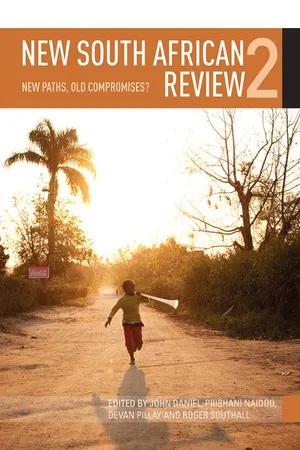
eBook - ePub
New South African Review 2
New paths, old compromises?
- 488 pages
- English
- ePUB (mobile friendly)
- Available on iOS & Android
eBook - ePub
New South African Review 2
New paths, old compromises?
About this book
Information
PART 1: POLITICS AND INTERNATIONAL
INTRODUCTION
The Zuma presidency: The politics of paralysis?
That the ANC will become another ZANU is possible, but by no means certain, even if the entrenchment of a one-party dominant system is likely to continue generating a range of democratic deficits in South Africa.
(James Hamill and John Hoffman in Chapter 2 in this volume)
The intent of the Zuma presidency, according to the Congress of South African Trade Unions (Cosatu) and the South African Communist Party (SACP), both of which played vital roles in bringing about its political ascendancy, was to create a government that would be less remote, more responsive and closer to the people, and which would, above all, implement a shift in economic policy that would create more jobs and be more pro-poor. In short, we were led to believe that Thabo Mbeki’s conservative macroeconomic policies would give way to Zuma’s more activist, interventionist ‘developmental state’. The reality, however, has fallen dismally short of such expectations. Popular anger has been stirred by the personal extravagance of countless government officials, including members of the cabinet. Corruption appears rampant. Key agencies of the state, notably the police, seem unaccountable, if not out of control – an entity as in apartheid days, more to be feared than relied upon. The capacity of local governments in numerous ANC-run councils seems on the verge of collapse. The global recession has bit deeply, causing continuing job losses and spreading indebtedness while a high rand is stimulating higher prices, notably of food. Although some movement towards a significantly different, perhaps employment-creating, industrial path has been presaged by the government’s New Growth Path, official policy seems as largely beholden to the market as ever – except insofar as its penchant for ramping up regulations and controls in areas such as mining seems designed to discourage rather than facilitate foreign investment.
Amid this evidence of stasis and looming crisis, Zuma himself appears indecisive and weak. Brought to power by a coalition of those at odds with Mbeki rather than merely of the left, he has seemed to devote more effort to shoring up his position (and promoting the material interests of his family, his friends and his home village) within the ANC than to meeting the challenges of government; he seems so beholden to the diverse constituents of the alliance that enabled him to unseat Mbeki that he seems reluctant to offend any of them. Having, it seems, reneged on his pledge to serve only one term as president, he has plunged the ANC back into a succession struggle, with rivals scheming to unseat him at the ANC’s five-yearly conference in December 2012 (although, as ever, the ANC publicly denies what is plain for all to see). So it is that Zuma fiddles while South Africa stumbles along a path of political uncertainty. An unknowing observer studying the recent 2011 local government election campaign of the ANC could be forgiven for concluding that Julius Malema held the party’s presidency and not the hapless Zuma, who seems to have lost the brilliant politicking touch he so adroitly displayed in the 2009 national elections.
In 1976, Soweto erupted, taking the then exiled ANC as much by surprise as the then National Party government and fundamentally shifting the terrain of South African politics as, over the following decade and a half, popular resistance was to render the continuance of white minority rule unsustainable. The eventual outcome was the celebrated compromise between popular forces and the white state in 1994, resulting in a liberal democratic constitution which balanced minority protection against majority rule, sought to render government accountable under a system of constitutional rule, and entrenched myriad individual, human and social rights. It has been in many ways remarkable: South Africa has now conducted four free and generally fair general elections; there is freedom of speech and extensive and critical debate; on significant occasions the constitutional and other courts have held government to account; and for all the criticisms of the government’s economic strategy there has been a concerted expansion of grants and benefits to the poor. No one seriously questions whether South Africa in 2011 is a better place to live in than in 1976, even though there are many people at the bottom of the social pile who have only seen limited change or no change at all. Nonetheless, there is widespread concern that the ANC, the party of liberation, has become the major problem in regard to the health and prospects of South African democracy.
It is commonplace that the ANC has struggled to transit from a liberation movement to just another political party within a liberal democracy. Nonetheless, the ANC has become the ‘dominant party’, one which dominates South Africa not only electorally but by setting the national agenda. The fundamental thrust of such opinions is that the ANC views itself as the embodiment of a ‘historical project’ whereby, as the representative of the popular will as demonstrated by the liberation struggle, it has earned the right to rule irrespective of its performance. With such a worldview, and with party interests having deeply penetrated the functioning of the state (and particularly its security organs), it is hardly surprising that it interprets criticism of the ruling party not as healthy or normal but as originating from reactionary (read racist) motivations or, if from within the popular movement, from treachery or misconception. From such a perspective, ambition and competition for high office is not normal and healthy but treacherous, if not treasonable. And it should not be forgotten that the ANC is a member of that family of African liberation movements-cum-ruling parties – among them Zimbabwe’s African National Union Patrotic Front (Zanu PF) and Angola’s Popular Movement for the Liberation of Angola (MPLA) – most of which have abrogated democracy and trampled on human rights in their respective domains. The ANC is neither of these two corrupt and authoritarian entities. But the ANC in power (or individual members of the government, notably the minister of Defence, Lindiwe Sisulu) have displayed a disturbing arrogance, a contempt for media criticism and a total disdain for popular opinion and for parliament’s role of oversight. Worse, Zuma’s own rise to power was in the teeth of evidence that he had been deeply implicated in the corruption of the 1998 arms deal, and was achieved on the back of a populist campaign conducted by his supporters which severely compromised the integrity of the state’s security services and undermined the authority of the courts.
Nevertheless, any serious analysis of the ANC in power suggests that it is a much more complicated animal than the assessment of it as a self-justifying liberation movement implies. Overall, in its tenure of seventeen years in power, it has remained true to the tenets of electoral democracy and, as Zuma’s displacement of Thabo Mbeki as party president at Polokwane in December 2007 demonstrated, it is to a reasonable degree responsive to popular opinion – or at least that which is channelled through its own structures. But will it stay true to this tradition? How will it respond to that ultimate democratic test – the prospect of, or the reality of, losing political power? Will it follow the catastrophic Kenyan-Zimbabwean path or that of Ghana in more recent times?
The chapters that follow in this section of the New South African Review illustrate and explore the character of the ANC while also demonstrating the complexity of South African society. In their contribution, British observers of the African political economy, James Hamill and John Hoffman, discuss the suggestion initially made by Jeremy Cronin (deputy general secretary of the SACP) in 2002: that the ANC had become subject to a condition he dubbed ‘Zanufication’, meaning that under Thabo Mbeki it had come to display authoritarian and corrupting behaviours and tendencies similar to the ruling Zanu PF in Zimbabwe. Cronin had implied, further, that South Africa under Mbeki was in danger of pursuing a trajectory of political and economic meltdown analogous to what was then occurring in Zimbabwe; from such a perspective, South Africa was in danger of becoming another failing African country, with enormous consequences for the region. Hamill and Hoffman, however, indicate that there are some disturbing similarities within the ANC, notably a tendency towards political intolerance, but they also point out major differences. They note South Africa’s strongly democratic constitution ‘jealously guarded by its constitutional court … buttressed by a powerful legal profession and a highly critical and feisty media’. They point out that whereas Mugabe has established a highly personalised rule which has brusquely ignored all constitutional constraints, the ANC has not only acted to ensure adherence to its constitutional prescription that no party president should serve more than two five-year terms, but it also has in place – and has used – internal party mechanisms whereby incumbent leaders can legitimately be challenged and overthrown.
Nonetheless, Hamill and Hoffman note that the political prospect for South Africa is not simply either Zanufication or strict adherence to constitutionalism. The ANC is also the focus of Devan Pillay’s contribution, in the context of its historic development as an alliance of classes. Taking as his cue the elaboration of the theory of the National Democratic Revolution (NDR) whereby South Africa’s diverse classes and races among the politically oppressed came together in alliance under the leadership of the ANC, he argues that the party has very self-consciously become an embodiment of political ambiguity and of the varying interests of different classes. Thus, whereas critics to the left of the ANC-Cosatu-SACP Tripartite Alliance now argue that the theory of the NDR provides a framework for a conservative class alliance of white and black capitalists and a black middle class to pursue market-driven policies contrary to the interests of the impoverished mass of South Africans, supporters of the alliance argue that –despite manifold tensions – it holds the political centre together, and prevents South Africa from becoming victim to a politics of blatant and unprincipled factional struggle for resources. The ANC is many things to many people. Despite its failings and faults, it continues to retain the electoral support of its historic constituencies – with the least advantaged by its policies, the working class and the poor, not yet ready to abandon the ‘party of Mandela’.
Pillay argues that, given electoral difficulties which any self-proclaimed party of the left would have in confronting the ANC, Cosatu – although disposed to establishing linkages with civil society organisations, and tendencies critical of the government – remains committed to using its experience in propelling Zuma to power to continue to push the ruling party in a direction favourable to the working class. Again, however, he observes the political ambiguity of the ANC, discussing how the SACP’s direct involvement in the Zuma government has placed it much closer to the centre of power and increasingly distant from Cosatu. From this, it is inferred, the struggles for influence, position, and policy will continue within – are indeed inherent to – the ANC. Pillay does not directly link Zuma’s personal lack of authority and decisiveness to the historic ambiguity of the ANC as an alliance of contending class forces, yet his analysis does provide an insight into why the ruling party has lapsed into a politics of paralysis, leaning simultaneously to right and left. The danger, as Pillay points out, is that South Africa may soon hit up against the limits to its present development model, and that its present failure to shift away from dependence upon the ‘minerals-energy complex’ and to develop an alternative path of sustainable industrialisation will lead, in relatively short order, to the inability to fund its extensive provision of social grants to the poor.
Does the focus by Pillay (and the left in general) upon relationships between the working class (or working poor) and the ANC betray an urban bias, one which loses sight of the fact that a huge portion of the ruling party’s constituency resides in the countryside, notably within the former bantustans? To what extent, one might ask, are traditional leaders a vital component of the ANC Alliance? And just what is the connection between the ANC and the rural poor? Leslie Bank and Clifford Mabhena, analysing the implications of the overturning of the government’s Communal Land Rights Act (CLRA) by the Constitutional Court in May 2010 on the grounds that it made it too easy for the tribal authorities of the former bantustans to reconstitute themselves (and to become, in effect, a fourth tier of government), pose such questions and provide an important insight into basis of ANC rule in rural areas, most particularly the former Transkei region of the Eastern Cape.
The CLRA had sought a compromise between a shift to individual, freehold tenure in communal areas and a retention of communal-tenure regimes, on the grounds that they offered some protection for the poor. After years of deliberation, the CLRA sought to find a balance between giving people real and secure land rights, while recognising that in some areas traditional government had continued to work effectively and that it would be counterproductive to destroy functioning systems. The Act stopped short of giving rural people individual ownership rights, proposing instead the idea of permanent rights, and also allowing for a system of ‘commonhold’, where groups took control of land as collective units. However, because this was thought by various NGOs, land activists and rural communities to provide for a reassertion of the chiefs’ power, the CLRA ended up in the constitutional court and, consequent to a contrary judgment, the government is now having to rework the law so that it conforms to constitutional principles.
Bank and Mabhena untangle the strands of this very complicated story. Basing their analysis upon a detailed survey conducted in 2007–2008, they demonstrate that traditional authorities remain firmly in control of rural land allocation across the Eastern Cape, and that most rural households believe that they should continue to direct the process. On the other hand, there is considerable support at household level for more individual title to land within a system of ‘commonhold’. Meanwhile, the level of de-agrarianisation within the former homeland areas has reached such a level that an overwhelming number of rural households are heavily dependent upon social grants provided by the government, and herein lies a major reason for the strong support which inhabitants of rural areas continue to give to the ANC. Against that, there lies deep discontent with rural development policies and, in particular, popular anger, directed at the democratically-elected local authorities and councillors who are widely seen as incompetent and corrupt. In contrast, chiefs are seen as far more responsive to their local communities (as indeed, to an extent, they had been forced to be under apartheid), resulting in considerable nostalgia for the era of Kaiser Matanzima, the long-time ruler of the Transkei bantustan. Bank and Mabhena are, however, careful to stress that this does not imply that rural dwellers want to go back to the political authoritarianism of Matanzima’s rule. Rather, the nostalgia is an expression of a sense of social marginalisation felt by the rural poor, and the fact that traditional leaders have – under the ANC, and in contrast to local councils – reinvented themselves as community builders, consensus seekers and intermediaries between state and society. Their representative organ, the Congress of Traditional Leaders of South Africa (Contralesa), has proved to be among the most effective of the civil society groupings spawned by the post-apartheid dispensation. Hence the importance to the ANC of Jacob Zuma, a populist of rural origin with strong traditionalist tendencies, who can shore-up or even win new support for the party from the chieftaincy and from their rural subjects.
The analysis of Pillay and that of Bank and Mabhe...
Table of contents
- Cover
- Title
- Copyright
- Contents
- Preface
- Introduction: New paths, old (com)promises?
- Part 1: Politics and International
- Part 2: Economy and Society
- Part 3: Environment
- Part 4: Media
- Contributors
- Index
Trusted by 375,005 students
Access to over 1.5 million titles for a fair monthly price.
Study more efficiently using our study tools.
Frequently asked questions
Yes, you can cancel anytime from the Subscription tab in your account settings on the Perlego website. Your subscription will stay active until the end of your current billing period. Learn how to cancel your subscription
No, books cannot be downloaded as external files, such as PDFs, for use outside of Perlego. However, you can download books within the Perlego app for offline reading on mobile or tablet. Learn how to download books offline
Perlego offers two plans: Essential and Complete
- Essential is ideal for learners and professionals who enjoy exploring a wide range of subjects. Access the Essential Library with 800,000+ trusted titles and best-sellers across business, personal growth, and the humanities. Includes unlimited reading time and Standard Read Aloud voice.
- Complete: Perfect for advanced learners and researchers needing full, unrestricted access. Unlock 1.5M+ books across hundreds of subjects, including academic and specialized titles. The Complete Plan also includes advanced features like Premium Read Aloud and Research Assistant.
We are an online textbook subscription service, where you can get access to an entire online library for less than the price of a single book per month. With over 1.5 million books across 990+ topics, we’ve got you covered! Learn about our mission
Look out for the read-aloud symbol on your next book to see if you can listen to it. The read-aloud tool reads text aloud for you, highlighting the text as it is being read. You can pause it, speed it up and slow it down. Learn more about Read Aloud
Yes! You can use the Perlego app on both iOS and Android devices to read anytime, anywhere — even offline. Perfect for commutes or when you’re on the go.
Please note we cannot support devices running on iOS 13 and Android 7 or earlier. Learn more about using the app
Please note we cannot support devices running on iOS 13 and Android 7 or earlier. Learn more about using the app
Yes, you can access New South African Review 2 by John Hoffman,Paul Hoffman,Malose Langa,Don Lindsay,Clifford Mabhena,Rajohane Matshedisho,Devan Pillay,Haroon Saloojee,Vishwas Satgar,Christopher Saunders,Khadija Sharife,Kate Skinner,Roger Southall,Neil Southern,Karl von Holdt,Edward Webster,Michelle Williams, John Daniel,Prishani Naidoo,Roger Southall, Devan Pillay in PDF and/or ePUB format, as well as other popular books in Politics & International Relations & Political Economy. We have over 1.5 million books available in our catalogue for you to explore.