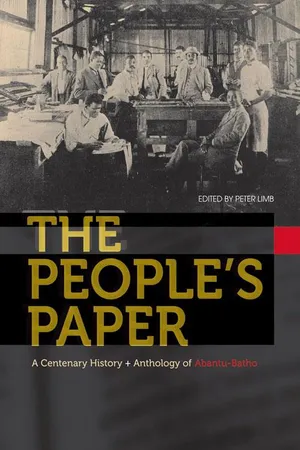
This much-awaited volume uncovers the long-lost pages of the major African multilingual newspaper, Abantu-Batho.
Founded in 1912 by African National Congress (ANC) convenor Pixley Seme, with assistance from the Swazi Queen, it was published up until 1931, attracting the cream of African politicians, journalists and poets Mqhayi, Nontsisi Mgqweth, and Grendon. In its pages burning issues of the day were articulated alongside cultural by-ways. The People's Paper - comprising both essays and an anthology - explores the complex movements and individuals that emerged in the almost twenty years of its publication. The essays contribute rich, new material to provide clearer insights into South African politics and intellectual life. The anthology unveils a judicious selection of never-before published columns from the paper spanning every year of its life and drawn from repositories on three continents. Abantu-Batho had a regional and international focus, and by examining all these dynamics across boundaries and disciplines, The People's Paper transcends established historiographical frontiers to fill a lacuna that scholars have long lamented.
eBook - ePub
The People’s Paper
A centenary history and anthology of Abantu-Batho
- 560 pages
- English
- ePUB (mobile friendly)
- Available on iOS & Android
eBook - ePub
The People’s Paper
A centenary history and anthology of Abantu-Batho
About this book
Part I: Essays
OVERVIEW
A Centenary History of Abantu-Batho, the People’s Paper
ABANTU-BATHO: A VERY SHORT INTRODUCTION
The 2012 centenary of the African National Congress (ANC) is also that of the closely allied newspaper, Abantu-Batho (The People). This little-studied weekly was established in October 1912 by the convener of the ANC, Pixley ka Isaka Seme, with financial assistance from the Queen Regent of Swaziland, Labotsibeni. It attracted as editors and journalists some of the best of a rising company of African intellectuals, political figures and literati such as Cleopas Kunene, Saul Msane, Richard Victor Selope Thema, T. D. Mweli Skota, Robert Grendon, S. E. K. Mqhayi and Nontsizi Mgqwetho. In its pages important themes of the day, from the pass laws, Land Act and the World War to strikes and socialism, the founding of Fort Hare, the rights of black women and Garveyism were articulated, just as mundane events such as football matches, marriages and church gatherings were reported. It was also a forum for letters and literary contributions, some of the highest calibre, others of a plebeian bluntness.
A dynamic black press had already been established in some cities and towns by 1912. The ability to spread news in a printed format had once been a virtual monopoly of the colonial state or the missions, but the rise of a black-owned and -edited press challenged this, just as the spread of new communications and news agencies opened up space to share ideas more freely. In the latter-half of the nineteenth century, a nascent African intelligentsia developed letter-writing networks1 and then, having few publication outlets, created their own regional newspapers such as Imvo Zabantsundu (Native Opinion, 1884–) of J. T. Jabavu, Izwi Labantu (Voice of the People, 1897–1909) of A. K. Soga, Koranta ea Becoana (Bechuana Gazette, 1901–08) and Tsala ea Batho (The People’s Friend, 1910–15) of Solomon Tshekisho Plaatje, and Ilanga lase Natal (Natal Sun, 1903–) of John Langalibalele Dube, plus several weeklies printed across the border in Basutoland (now Lesotho).2 The editorial politics of these weeklies was always strictly within constitutional limits, but in favour of extending black rights. Like Abantu-Batho, their circulation and readership (see below) were modest, but their impact on emergent political bodies was large. Their relationship to Abantu-Batho was sometimes stiff – after all, they were commercial (and often political) rivals, sometimes more intimate, but often they swapped or reproduced one another’s stories, a practice that has greatly assisted the realisation of this book.
In the Transvaal this press was slower to emerge in the face of harsh anti-black laws, but in the first decade after the South African War, pioneer black newspapers helped inculcate reading habits and impart journalistic skills, thus starting to create an audience and forge a foundation on which Abantu-Batho could soon build. In Pietersburg (now Polokwane), the short-lived Leihlo la Babathso (Native Eye, 1903–08) of Simon Phamotse and Levi Khomo gave voice to the Transvaal Native Vigilance Association.3 Then from Johannesburg in 1910 came the weeklies Motsoalle (Friend, later Moromioa, or Messenger) of Daniel Simon Letanka in Setswana/Sepedi and Umlomo wa Bantu-Molomo oa Batho (People’s Mouthpiece) of Levi Thomas Mvabaza with Saul Msane in English/isiXhosa/ Sesotho. Both broadsheets would merge (in 1912 and 1916, respectively) in a new paper tied to the Transvaal Native Congress (TNC) and South African Native National Congress (SANNC, ANC from 1923), whose founding, and that of its public voice, Abantu-Batho, trumpeted a rival legitimacy.
Africans soon made good use of these papers to communicate and to organise politically, for, while commercial ventures and moderate in tone, they had to operate in a society that discriminated harshly against black people.4 A new political culture primarily articulated via the black press and public meetings was emerging.5
All these members of the black Fourth Estate remained under close neocolonial scrutiny. As with the subaltern press in other colonial situations, state censors would closely monitor Abantu-Batho6 and government officials hauled managing editor Seme before them to explain stridently anti-imperial wartime editorials.7 Still, as long as it did not become too radical, the state could use the black press for conveying official notices and managing unrest. In 1905 the South African Native Affairs Commission saw it as ‘an infant press’, yet ‘fairly accurate in tracing the course of passing events and useful in extending the range of Native information’.8 Yet, given its physical existence on the Rand, in the centre of the country’s political storms, and its centrality to Congress and vernacular discourses – at the very ‘point of intersection between political intelligence and indigenous knowledge [where] colonial rule was at its most vulnerable’9 – there was every chance it would become more radical – and it did.
The idea of a new, multilingual newspaper with a truly national focus was raised, probably by Seme, at a meeting in Johannesburg in 1911 connected with the South African Native Convention, which led to the January 1912 launch of the SANNC.10 That Abantu-Batho from its launch later that year to its end in 1931 would be adopted at various times as an organ of Congress, and would articulate its policies and promote its campaigns flowed from the fact that the movement’s founder, Seme, had also founded the paper. The 1919 constitution of the TNC registers Abantu-Batho as its organ and in the late 1920s it became the national ANC mouthpiece.
Yet it was much more than a mere party ‘organ’. The very title Abantu-Batho – The People, from ‘ntu’ (Nguni) and ‘batho’ (Sesotho-Setswana) – spoke meaningfully to readers in a wide range of African languages11 – it published simultaneously and in some depth in Sesotho, isiXhosa, and isiZulu, with some Setswana, as well as in English – and clearly to the vision of ANC founders for unity and nation building.12 The term ‘people’ (like ‘nation’), invokes fraught and contested concepts used and abused by populists of many persuasions (see below). There were, of course, many ‘peoples’, just as one can also characterise other weeklies, such as Imvo and Ilanga, as ‘people’s papers’. Neither do we suggest that if some other newspapers were not official organs of Congress, then they could not represent certain peoples, or indeed the collective ‘people’. However, Abantu-Batho claimed a wider mantle, a national focus (even if it sometimes fell short of this aim), and the term had a ‘naming, identifying’13 role that sought to recapture African dignity lost under colonialism. It was a call to arms for editors to vigorously defend the causes espoused by ‘the people’, a mission executed in editorials (and associated campaigns) on land, civic and human rights. Looked at retrospectively, it was this sort of vigorous, popular approach epitomised by Abantu-Batho that would eventually mobilise wide sections of ‘the people’ to overcome colonialism and apartheid.
Over the 19 years of its existence this paper played an important role in influencing and reflecting African political thought and intellectual life in South Africa and beyond. Its history is a fascinating and complex story, a remarkable window into social and intellectual life and political culture in the early twentieth century. Here too we see the triumphs and failures of its own editors, together with political leaders, as African nationalist networks were forged and tempered, as moderates and radicals alike absorbed, adapted and re-cast new ideas and forms of discourse, grappled with issues of tolerance and democracy, and networked across different social classes and peoples to try to forge new social, ethnic, and political identities and viable social forces. If the relatively narrow social base (and material resources) of the newspaper, like that of the SANNC, meant that it never entirely or consistently lived up to its populist ambitions in the period,14 then it accomplished a great deal in setting the pace for and broadening the focus of the black press.
The weekly went through various phases, some more radical and others more moderate, and had a wide range of editors (see further below) before it ceased publication in July 1931. This introduction and the first pair of chapters outline the broad contours and contexts of Abantu-Batho’s hitherto hidden rich history, historiography, structure and thematic content. These themes are then taken up in detail by the book’s contributors. The concluding chapter assesses the legacy of the ‘People’s Paper’.
SOURCES AND HISTORIOGRAPY
Many writers mention in passing the appearance of Abantu-Batho, but the date of its first issue has left few traces. Such uncertainty15 is typical of many aspects of its history, from its printing presses to the date of its demise. But contemporaries took note of its arrival. In 1917 the young S. (Seetsele) Modiri Molema, studying medicine in Glasgow, wrote a book (not published until 1920) remarkable for its time in which he mentioned the birth of ‘Abantu or Batho … edited and published by a competent staff comprising Messrs. Kunene and Soga16 at Johannesburg’.17 Other contemporaries also noted its significance, claim to be a nation-wide paper and forthrightness. Charles Dawbarn spent a year in South Africa in 1920 and it was clear to him that Abantu-Batho was ‘under no illusion’ of the hypocrisy of labour relations: ‘The causes of the [1920] strike are neither mysterious nor under-hand; they are perfectly plain and self-evident: namely, the high cost of living.’18 By 1926 Edwin Smith, literary superintendent of the British and Foreign Bible Society, recorded the newspaper’s assertion to be the largest circulating African-language paper in the land.19
Young communist Eddie Roux, himself a journalist on the South African Worker, ‘called often at the office of the Abantu-Batho, the organ of the African National Congress. There I met two educated Africans, Dunjwa and Letanka. With them I could converse with ease.’20 After retiring from left-wing politics, Roux wrote a short article on the black press, stressing that Abantu-Batho was ‘perhaps the most interesting’ of all, its name ‘a happy Nguni-Sotho bilingualism’.21 His points about its achievements carried over into his influential book, Time Longer than Rope (1948), in which he heralds its formation as ‘one of the most outstanding’ achievements of the ANC. It unified many small papers; attracted outstanding journalists; achieved ‘wide popularity’; ‘did more perhaps than any other organ to break down tribal bar...
Table of contents
- Cover
- Title
- Copyright
- Contents
- Contributors
- Acknowledgements
- Preface
- List of Abbreviations and Acronyms
- List of Illustrations
- PART I: Essays
- PART II: Anthology
Trusted by 375,005 students
Access to over 1.5 million titles for a fair monthly price.
Study more efficiently using our study tools.
Information
Publisher
Wits University PressYear
2012Topic
HistoryPrint ISBN
9781868145713
Subtopic
African HistoryeBook ISBN
9781868148509
Index
HistoryFrequently asked questions
Yes, you can cancel anytime from the Subscription tab in your account settings on the Perlego website. Your subscription will stay active until the end of your current billing period. Learn how to cancel your subscription
No, books cannot be downloaded as external files, such as PDFs, for use outside of Perlego. However, you can download books within the Perlego app for offline reading on mobile or tablet. Learn how to download books offline
Perlego offers two plans: Essential and Complete
- Essential is ideal for learners and professionals who enjoy exploring a wide range of subjects. Access the Essential Library with 800,000+ trusted titles and best-sellers across business, personal growth, and the humanities. Includes unlimited reading time and Standard Read Aloud voice.
- Complete: Perfect for advanced learners and researchers needing full, unrestricted access. Unlock 1.5M+ books across hundreds of subjects, including academic and specialized titles. The Complete Plan also includes advanced features like Premium Read Aloud and Research Assistant.
We are an online textbook subscription service, where you can get access to an entire online library for less than the price of a single book per month. With over 1.5 million books across 990+ topics, we’ve got you covered! Learn about our mission
Look out for the read-aloud symbol on your next book to see if you can listen to it. The read-aloud tool reads text aloud for you, highlighting the text as it is being read. You can pause it, speed it up and slow it down. Learn more about Read Aloud
Yes! You can use the Perlego app on both iOS and Android devices to read anytime, anywhere — even offline. Perfect for commutes or when you’re on the go.
Please note we cannot support devices running on iOS 13 and Android 7 or earlier. Learn more about using the app
Please note we cannot support devices running on iOS 13 and Android 7 or earlier. Learn more about using the app
Yes, you can access The People’s Paper by Grant Christison,Paul Landau,Peter Limb,Christopher Lowe,Sarah Mkhonza,Sifiso Mxolisi Ndlovu,Jeff Opland,Chris Saunders,Robert Trent Vinson, Peter Limb, Grant Christison in PDF and/or ePUB format, as well as other popular books in History & African History. We have over 1.5 million books available in our catalogue for you to explore.