An explanation of the unique role of the book and book collecting in South Africa due to the apartheid
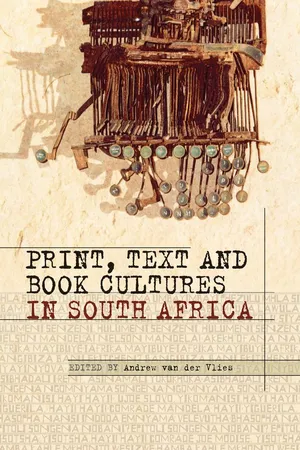
This book explores the power of print and the politics of the book in South Africa from a range of disciplinary perspectives- historical, bibliographic, literary-critical, sociological, and cultural studies. The essays collected here, by leading international scholars, address a range of topics as varied as: the role of print cultures in contests over the nature of the colonial public sphere in the nineteenth century; orthography; iimbongi, orature and the canon; book- collecting and libraries; print and transnationalism; Indian Ocean cosmopolitanisms; books in war; how the fates of South African texts, locally and globally, have been affected by their material instantiations; photocomics and other ephemera; censorship, during and after apartheid; books about art and books as art; local academic publishing; and the challenge of 'book history' for literary and cultural criticism in contemporary South Africa.
- 488 pages
- English
- ePUB (mobile friendly)
- Available on iOS & Android
eBook - ePub
Print, Text and Book Cultures in South Africa
About this book
Information
Topic
Lingue e linguisticaSubtopic
Editoria1.1
Print, Text and Books in South Africa
ANDREW VAN DER VLIES
I
In a late chapter in Boyhood (1998 [1997]), the first of J. M. Coetzee’s fictionalised—or autre-biographical1—memoirs, the child protagonist, John (who is based on Coetzee, although not entirely congruent with him), has suggestive encounters with two machines. With his mother and brother, John visits his great-aunt Annie in the Volkshospitaal in Cape Town and stays briefly in the old woman’s flat in the southern suburbs. Here, in her storeroom, he comes across “the book press”. Persuading his younger brother “to lay his arms in the bed of the press”, John turns the screw so that his brother’s “arms are pinned and he cannot escape”, then they reverse roles and, his own arms pinned, John ponders: “One or two more turns … and the bones will be crushed. What is it that makes them forbear, both of them?” (Coetzee 1998, 118–19). Immediately after this episode, John remembers visiting a farm near Worcester some years previously, where the brothers had stumbled on a machine for grinding maize. He recalls that he had coaxed his brother similarly into placing his hand “down the funnel where the mealie-pits were thrown in”, had “turned the handle”, and, momentarily, “before he stopped … could feel the fine bones of the fingers being crushed” (Coetzee 1998, 119).
Coetzee’s suggestive linking of the press and the grinder associates technologies of temporal and spiritual sustenance: the grinder produces food; the book press had been used to print multiple copies of a “squat book in a red binding” by his great-grandfather, Annie’s father (translated from German into Afrikaans by her), with a portentously spiritual title, “Deur ’n gevaarlike krankheid tot ewige genesing, Through a Dangerous Malady to Eternal Healing” (Coetzee 1998, 117). The association forged between machines raises the spectre of treachery and cruelty, linking the machinery of the press with an altogether different machine, capable of doing physical harm. (One cannot help but wonder whether Coetzee had Kafka’s suggestive story about authority, writing, punishment and complicity, “In the penal colony”, at the back of his mind.) This is richly suggestive for any study of print cultures in Southern Africa, a region in which (as with other colonial contexts) the arrival of the printing press is linked inextricably with processes that forced autochthonous peoples into difficult encounters with modernity—encounters that may have precipitated “progress”, but that also involved a great deal of psychological and cultural harm. The development of orthographies for regional vernaculars, most often by missionaries intent on conversion, wrought immense changes in the lives of black South Africans. Leon de Kock points out in his essay in this collection how “printing and piercing, literacy and lubricity, disinterested information and deadly inculcation” are often co-implicated in representations of these processes (52). The passages from Boyhood above reflect on the costs or the potential misuse of such technologies, and also on the implications—and implicatedness—of writing within discourses of power and authority more broadly.
These are themes that recur in Coetzee’s oeuvre too. For example, in Youth (2002), the second of his autre-biographical “Scenes from Provincial Life”, John is a disaffected computer programmer in London in the 1960s. He also spends time in the British Museum’s reading room, undertaking research for his thesis supervisor in Cape Town and occasionally allowing
himself the luxury of dipping into books about the South Africa of the old days, books to be found only in great libraries, memoirs of visitors to the Cape like Dapper and Kolbe and Sparrman and Barrow and Burchell, published in Holland or Germany or England two centuries ago (Coetzee 2002, 136–37).
John dreams of writing a book about the early years of the Cape, in the vein of Burchell’s Travels, and ponders how he might “give to the whole the aura that will get it onto the shelves and thus into the history of the world: the aura of truth” (Coetzee 2002, 138). Is it these encounters, the reader is invited to wonder, that will prompt John—if indeed he is Coetzee—to write Dusklands a decade later?
It should not surprise us that Coetzee so movingly renders characters, existing in some complex relationship to his own younger self, who respond so strongly to the materiality of books—in Boyhood, John displays close attention to the material appearance of Ewige genesing, noting that it is “printed on the thick, coarse paper used for Afrikaans books that looks like blotting-paper with flecks of chaff and fly-dirt trapped in it” (Coetzee 1998, 117)—and who register the power of print in propagating influential discursive constructions of place (particularly colonial space). Of all South African-born writers and intellectuals of the past half century, Coetzee has been the most astutely and rigorously concerned with the intimate relations between language and power, and in the predicaments of writing—in both senses of the word: the stresses under which the literary is placed in periods of political emergency (Coetzee 1988; McDonald 2004) and the implications of those institutions claiming the right to control knowledge, interpretation or expression. Both inevitably involve a concern with the politics of print cultures in South Africa—a subject that Coetzee himself tried to teach, albeit briefly, at the University of Cape Town (UCT). In his prospectus for a module entitled “The Book in Africa”, proposed for 1980, he suggested that students on the course might investigate a number of topics, among them issues specific to local and national book production and consumption (“the location of bookstores in the Cape Peninsula and the types of clientele they serve”; “library services in the black residential areas of the Cape Peninsula”; “the histories” and “editorial policies” of a selection of South African literary magazines; the publication of children’s books in English, Afrikaans, and African languages in the country—“to what extent [are they] South African in conception, authorship, and production[?]”, Coetzee asked). However, there were also topics with a pan-African and global focus, for example the role of “expatriate or multinational publishing houses in Africa” or comparisons between mass reading in Britain in the early nineteenth century and among black South Africans in the mid-twentieth century (Coetzee 1980/81). Students would be encouraged to contemplate the seminal changes brought to Africa by the printing press. “If we accept (following [Walter] Ong, [Marshall] McLuhan, [Jack] Goody) that print changes modes of thought”, Coetzee (1980/81) wrote, “then printing can be seen as the agent whereby the world is modernized. The print industry and the print habit become the most important modernizing agents.”
This, notes Peter McDonald (2012, 801), sounds very like the theses of a number of histories of the effects of the advent of print in Europe published in the 1970s—like Elizabeth Eisenstein’s influential The Printing Press as an Agent of Change (1979), which advanced grand claims for the influence of print on the spread of Enlightenment ideas—although Coetzee would no doubt have been in sympathy, too, with more recent studies that are less Whiggish in their teleological conspectus (see Johns 1998) and that acknowledge the very different conditions that exist in colonial societies (see Ballantyne 2007). It is, however, noteworthy, McDonald comments, that nowhere in Coetzee’s course description does he refer to any of the significant studies then beginning to define what scholars now generally refer to as Book History, or History (or Histories) of the Book (I will henceforth refer to “book history” without the canonising capitals), although most would recognise similarities between Coetzee’s aims and this interdisciplinary field. Although the module was not offered in the following year (McDonald suggests that this had to do with the conservative literary critical ethos in UCT’s English Department and with the relative risk final-year undergraduate students, used to more traditional course models, would likely have ascribed to Coetzee’s), it is clear that Coetzee was at least an early fellow traveller with a field whose challenges have encouraged a great deal of historical and literary scholarship in the last 30 years (see McDonald 2012, 800–3). For the purposes of emphasising not only the contributions to knowledge made by the chapters in this volume, but also their provocations—and their methodological usefulness—for studies of colonial and post-colonial cultures of script, print and the book more generally, I will linger momentarily on the contours of this field, which has only recently come overtly to affect scholarship about print and text studies in and of South and Southern Africa.
* * *
One of the early leading thinkers in the emerging field of book history—one of those not cited by Coetzee—was French social historian Roger Chartier. In his essay “Laborers and voyagers: From the text to the reader” (1992), Chartier manages to state plainly some of the key tenets animating this relatively new scholarly endeavour. Quoting Michel de Certeau’s claim in The Practice of Everyday Life that texts only have meaning through readers and that they change as readers bring new expectations and modes of reading to the text, he argues as follows:
Readers, in fact, never confront abstract, idealized texts detached from any materiality. They hold in their hands or perceive objects and forms whose structures and modalities govern their reading or hearing, and consequently the possible comprehension of the text read or heard (Chartier 1992, 50).
A text can therefore never be approached purely as only a semantic field (the view that had, Chartier notes caustically, hitherto dominated “not only structuralist criticism in all its variants but also literary theories concerned with reconstructing the modes of reception of works”); rather, “it is necessary to maintain that forms produce meaning, and that even a fixed text is invested with new meaning and being … when the physical form through which it is presented for interpretation changes” (Chartier 1992, 50–51). “The task of the historian”, he argues, ought accordingly to be “to reconstruct the variations that differentiate the ‘readable space’ (the texts in their material and discursive forms) and those which govern the circumstances of their ‘actualization’ (the readings seen as concrete practices and interpretive procedures)” (Chartier 1992, 50). “Authors do not write books”, Chartier (1992, 53) suggests usefully, “they write texts which become objects copied, handwritten, etched, printed, and today computerized.”
Robert Darnton, one of the earliest proponents of book history in North America (although himself primarily a scholar of ancien régime and Enlightenment French print and book histories), concurs with Chartier: “typography as well as style and syntax determine the ways in which texts convey meanings”; any “history of reading” should “take account of the ways that texts constrain readers as well as the ways that readers take liberties with texts” (Darnton 2002, 21; see also Darnton 1990). The suggestion is that historians—indeed, students of culture generally—ought to consider as their proper remit “the text itself, the object that conveys the text, and the act that grasps it” (Chartier 1989, 161). They—we—need to ascertain and describe the material form of any text that readers have encountered, to ask how readers encountered it and what they did with it, and to be alert to how this might have changed from one community (and text) to the next (and the next instantiation of a text) over time. It is in the “gap” between idealised text and materiality, Chartier (1992, 53) insists, that “meaning is constructed”.
Some Anglo-American literary critics who were also textual scholars had in fact been making similar suggestions in the late 1970s and the 1980s. With reference to his own work on Romantic and Victorian poets, for example, Jerome McGann argued that scholars ought to consider not only a literary work’s historical contexts, but also the history of what he called its “textualizations” (McGann 1985, 10; cf. McGann 1991, 9). How, scholars like McGann asked, does the text of a canonical nineteenth-century English poem or novel that is studied by university undergraduates in a scholarly edition differ from the text of the novel encountered by its first readers? To the bibliographer and scholarly editor’s question “how is this text different from this one?”, critics attuned to what was coming to be known as book history added such questions as “how has each instance of publication changed the text and affected the meaning?” Also: how has this text—with or without variation—been rendered a different work by virtue of textual variations, but also through changing format, typography, and different co- or paratexts: those “fringes” or margins of text, images, or other apparatus (cover, blurbs, dedications, glossaries and so on) that constitute, Gérard Genette (1997, 2) argues, “a zone not only of transition but also of transaction”?
Chartier and others in the early wave of influential book historians drew on the methodology of the French Annales school of socio-economic history. A seminal engagement of this school with the history of print came with Lucien Febvre and Henri-Jean Martin’s 1958 L’apparition du livre, translated as The Coming of the Book: The Impact of Printing 1450–1800 (1976). The field gained its own scholarly journal, the Revue française d’histoire du livre (new series, 1971), and it is worth noting that English has tended to use the form of the direct translation of the French (“history” and “book” both in the singular).2 As Robert Darnton (2002, 10), who did so much to bring together Anglo-American and French bibliographic and historiographic traditions, explains, what these Annales-influenced scholars did was to attempt to “uncover the general pattern of book production and consumption over long stretches of time” rather than to offer detailed bibliographic analysis.
A key call to constitute a break from traditional analytical and descriptive bibliography that had long been a sub-field of literary and historical studies came from an Oxford professor of bibliography and textual criticism, New Zealand scholar Don (D. F.) McKenzie, whose 1985 Panizzi Lectures at the British Library came at a seminal moment in the evolution of book history and helped to constitute the field for a growing number of scholars in the later 1980s. McKenzie (1986, 10) argued that bibliography could not and should not “exclude from its own proper concerns the relation between form, function and symbolic meaning”. As hitherto undertaken in Britain and the United States in particular, bibliography had often merely described the effects of the “technical … processes of transmission”, he contended, but it should hitherto also consider the relationship between these and the “social” processes involved (McKenzie 1986, 13). McKenzie memorably showed the ramifications of this kind of analysis in a detailed account of misreadings of Congreve, including, ironically, in Wimsatt and Beardsley’s influential essay “The intentional fallacy”, which had argued (among other things) that the literary scholar...
Table of contents
- Cover
- Title Page
- Copyright
- Table of Contents
- Acknowledgements
- Abbreviations and acronyms
- 1. Introductory
- 2. Print Cultures and Colonial Public Spheres
- 3. Local/Global: South African Writing and Global Imaginaries
- 4. Three Ways of Looking at Coetzee
- 5. Questions of the Archive and the Uses of Books
- 6. Orature, Image, Text
- 7. Ideological Exigencies and the Fates of Books
- 8. New Directions
- Contributors
- Index
Trusted by 375,005 students
Access to over 1.5 million titles for a fair monthly price.
Study more efficiently using our study tools.
Frequently asked questions
Yes, you can cancel anytime from the Subscription tab in your account settings on the Perlego website. Your subscription will stay active until the end of your current billing period. Learn how to cancel your subscription
No, books cannot be downloaded as external files, such as PDFs, for use outside of Perlego. However, you can download books within the Perlego app for offline reading on mobile or tablet. Learn how to download books offline
Perlego offers two plans: Essential and Complete
- Essential is ideal for learners and professionals who enjoy exploring a wide range of subjects. Access the Essential Library with 800,000+ trusted titles and best-sellers across business, personal growth, and the humanities. Includes unlimited reading time and Standard Read Aloud voice.
- Complete: Perfect for advanced learners and researchers needing full, unrestricted access. Unlock 1.5M+ books across hundreds of subjects, including academic and specialized titles. The Complete Plan also includes advanced features like Premium Read Aloud and Research Assistant.
We are an online textbook subscription service, where you can get access to an entire online library for less than the price of a single book per month. With over 1.5 million books across 990+ topics, we’ve got you covered! Learn about our mission
Look out for the read-aloud symbol on your next book to see if you can listen to it. The read-aloud tool reads text aloud for you, highlighting the text as it is being read. You can pause it, speed it up and slow it down. Learn more about Read Aloud
Yes! You can use the Perlego app on both iOS and Android devices to read anytime, anywhere — even offline. Perfect for commutes or when you’re on the go.
Please note we cannot support devices running on iOS 13 and Android 7 or earlier. Learn more about using the app
Please note we cannot support devices running on iOS 13 and Android 7 or earlier. Learn more about using the app
Yes, you can access Print, Text and Book Cultures in South Africa by Andrew van der Vlies in PDF and/or ePUB format, as well as other popular books in Lingue e linguistica & Editoria. We have over 1.5 million books available in our catalogue for you to explore.