A study of the 'Cradle of Humanity and its history.
The 'Cradle of Humankind' (COH), bordering Gauteng and the North-West Province, was declared a World Heritage Site for the wealth of the human and animal fossils found there. Research based on fossils found in the area as well as signs of early human habitation have shed new light on the evolution of humankind and on the significant role that southern Africa played in the development of modern humans. A Search for Origins aims to provide an overview of the history of the COH, and of the important discoveries that have been made there, for a non-specialist audience. A number of general accounts have been written which have concentrated on the palaeontological discoveries made there. No systematic account written by specialists in their disciplines has, however, been published about the wider history of the COH and surrounding areas. In particular, no overview spanning the evolution of early plant and animal life, human development and recent and colonial history as reflected in discoveries linked to the COH, has been attempted. This edited volume frames the scientific advances that have been made in the COH against the intellectual and political background out of which they emerged. The multi-disciplinary approach - from a wide range of specialists -is innovative and ground-breaking.
eBook - ePub
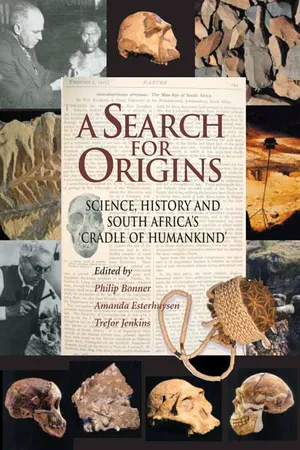
A Search for Origins
Science, history and South Africa's 'Cradle of Humankind'
- 332 pages
- English
- ePUB (mobile friendly)
- Available on iOS & Android
eBook - ePub
A Search for Origins
Science, history and South Africa's 'Cradle of Humankind'
About this book
Information

PART 1
INTRODUCTION
AFRICA IS SELDOM WHAT IT SEEMS
Philip Bonner
The ‘Cradle of Humankind’ opens windows onto many pasts: onto the origins and evolution of humanity; onto the ever-expanding frontiers of science in the fields of palaeontology, geology and genetics; onto the remarkable group of scientists that drove these frontiers forward; onto several of the most momentous and formative moments of South Africa’s more recent history, including its peopling by its present African population; and onto the often strange, sometimes tortured psyche of a large slice of white South Africa after it came to dominate the sub-continent in the late nineteenth century. The ‘Cradle of Humankind’ can thus deservedly claim a special status among the heritage sites recording South Africa’s past, offering as it does a privileged vantage point from which to understand what it means to be human and what it meant and currently means to be South African.
Part of the enduring appeal of the Cradle is that what it means and what it stands for are in a constant state of motion or flux. The boundaries of science at the Cradle are regularly pushed forward through new fossil discoveries, as can be seen most graphically perhaps in Ron Clarke’s unique discovery of a near-complete early hominid skeleton, which has been nicknamed ‘Little Foot’, and through entirely new domains of science previously unimagined (such as DNA studies). Even though early hominid fossils were recognised at Taung and Sterkfontein in the 1920s and 1930s, their true antiquity and hence significance was only grasped after the Second World War. Similarly, the way in which the Cradle region marks and bears witness to many of the key phases of more recent South African history has only been perceived by scholars in the last thirty years, and has still to filter fully into the wider public consciousness. One purpose of this volume is indeed to help make this knowledge more public.
Partly because of these scholarly and scientific advances, partly because of political shifts, the place of the Cradle in South Africa’s public life has also been subject to change. The paradoxes that this raises are noted in Saul Dubow’s chapter in this volume. One of the prime patrons of the Cradle’s claim to be the site of the origins of humanity was South Africa’s four-times prime minister and public intellectual, Jan Christiaan Smuts. It was Smuts who in 1925 gave the Sterkfontein area the name which subsequently stuck – ‘The Cradle of Mankind’ (though it would later be amended to ‘Cradle of Humankind’ to reflect a political commitment to inclusivity). However, as Dubow shows, Smuts saw in the Cradle a kind of charter for white domination in South Africa. It was white South African science that first understood the revolutionary significance of the Cradle’s fossils, which not only placed local scientists on a par with those in Europe and America, but also attested to a collective white claim to superiority and domination over the majority of South Africa’s black population. This is an issue that will be returned to later in this introduction and in the introductions to Parts 4 and 5. From the 1950s on, these assertions of white/ European racial distinctiveness and superiority have been challenged by scientists and geneticists in South Africa, notably Phillip Tobias, Trefor Jenkins and Himla Soodyall (all contributors to this volume). Public consciousness lagged behind, but began to catch up in the course of the momentous political transformations of the 1980s and 1990s. Since then the Cradle has become a national icon of a different sort, as a site of reverence and pilgrimage for all of South Africa’s – and indeed the world’s – citizens, black, brown and white – the place of their beginning. No doubt newer ideas and further changes will unfold. As President Mbeki observed in an evocative phrase, in his address at the opening of the Maropeng Heritage Centre at the Cradle, ‘Africa is seldom what it seems.’
The Cradle area cannot be divorced from its immediate neighbour to the west, the Magaliesberg valley and hills, with which it has enjoyed an intimate association. A constant traffic passed between these two areas from the earliest times. For much of its existence the warmer, wetter and more naturally blessed Magaliesberg teemed with game, fauna and life of all sorts. The Cradle, by contrast, was a colder, drier, less well-favoured environment, even in the wetter periods like the Pleistocene in which, as Marion Bamford describes in Chapter 5, lianas and forest shrubs flourished around its rim. In cold periods like the mid-Holocene (6 000–4 000 years ago) it appears to have been abandoned altogether. In the massive sweeps of evolutionary time in between, however, the Cradle/Magaliesberg area constituted a fertile habitat exploited by our hominid ancestors. From the time of the more versatile generalist Homo ergaster (see Chapter 6 by Amanda Esterhuysen), hominids must have spent the bulk of their time in the Magaliesberg region, only venturing into the Cradle area intermittently or at specific times of the year.
One feature which clearly distinguished the Cradle from the Magaliesberg was its distinctive geology, which allowed extensive caves to develop among its dolomitic formations and in which large quantities of travertine or limestone built up. During the time of the earliest australopithecine hominids, these caves were the lair of predators like (giant) hyenas and big cats. Our relatively small-framed early hominid ancestors presented a natural prey for these cats, and therefore gave the caves a wide berth, but the remains of those killed and dismembered were often dragged or washed into the caves to be deposited in the lowest hominid fossil-bearing geological members. Later species of hominid who had mastered the use of fire camped on the rims of these caverns, around the protective circle of flames towards which predators dared not venture (see CK [Bob] Brain’s discussion of fire, in the interview extract included in Chapter 6). These hominids, too, sometimes fell into the caves, or their remains were washed in, ending up as part of the breccia that was later located there. One of the abiding ironies of the history of this area is thus that the area labelled the Cradle could probably be more appropriately called the Grave.
The Cradle has been the scene of numerous epic battles since the dawning of human time, not only between the australopithecines and the great cats (see Chapter 3 by Kevin Kuykendall), but also between early Homo and later australopithecines (see Kathy Kuman as cited in Chapter 6), between many African chiefdoms that settled or tried to settle in the interior and those on the north-moving frontier (in the period sometimes dubbed the difaqane – see Chapters 10 and 11 by Simon Hall and Jane Carruthers), between African chiefdoms and Boers in the early stages of the Great Trek (see Chapter 11) and between Boers and Britons in the South African War of 1899–1902 (formerly known as the Anglo-Boer War – see Chapter 14 by Vincent Carruthers). The Cradle thus provides a lens through which to view and comprehend a series of absolutely pivotal and formative moments of South African prehistory and history. Each finds a place in this volume.
The scientific history of the Cradle is peopled by a cast of larger-than-life personalities – Raymond Dart and Robert Broom up to the late 1940s, Phillip Tobias, Bob Brain and Revil Mason thereafter. On the whole, the pre-war personalities were more colourful and/or eccentric. A substantial literature documents their achievements, but even that which indulgently records their foibles tends to cast them in a heroic mould. Yet, no less than Africa generally, these celebrated figures are seldom what they seem. Inevitably their characters were in one way or another flawed; inevitably they had imbibed some of the intellectual ethos and social climate of their time. In pre-war South Africa this inevitably meant that they harboured some sense or other of white superiority which we would now label prejudice. In this they were simply creatures of their time, sharing in the failings of a whole generation, and do not deserve to be individually or excessively blamed. What merits recognition in this context is that they were at least partially able to break through and break free of the intellectual and social straitjacket of their era.
From a scientific point of view, their contributions are both unquestionable and unshakeable: they caused paradigmatic shifts. This was eventually recognised not only by scientists but also in a wider public sphere. Dart, Brain and most recently Lewis-Williams (a student of culturally modern humans), whose writings apply to but are not specifically generated by the Cradle (and whose work is discussed in Chapter 8 by David Pearce), have through the books of popular writers – whose minds were gripped by both the science and the personalities of their subjects – left a huge imprint on the popular imagination: Dart, through Robert Ardrey who wrote the hugely successful and influential African Genesis; Brain, through Bruce Chatwin, the doyen of popular travel writers in the 1970s and 1980s, who wrote an almost adulatory account of him in The Songlines; and Lewis-Williams through the international best-selling author Graham Hancock, who recently lionised his breakthrough research into San art and San cultures in the book Supernatural.
Towering above all these larger-than-life figures was South African prime minister and philosopher–statesman Jan Christiaan Smuts, whose command of numerous fields of scientific knowledge is noted by Dubow. It was Smuts who recognised the veracity and importance of Dart’s interpretations of the Taung skull; it was Smuts who patronised South African palaeontology and archaeology between the 1920s and 1940s, so giving it an international head start. It was Smuts who appointed Broom to a new position in the Transvaal Museum, thereby making possible the discovery of the first australopithecines to have been recovered since the 1924 discovery of the Taung skull, firstly in 1936 at Sterkfontein, and later of ‘Mrs Ples’, in 1947; and it was Smuts who financed Broom’s 1946 monograph which finally convinced the world of the paradigmatic shift regarding human evolution first heralded by Dart.
If Smuts can be considered an intellectual giant of his era, he too was not free of the prevailing prejudices of his time that asserted the truth of white supremacy and black inferiority, which in turn justified white domination. While Smuts could outrage Europe by proclaiming Africa the birthplace of humankind, thereby rudely displacing it as one centrepiece of human evolution, he simultaneously sought to perfect a system of racial discrimination and racial subordination that went by the name of segregation, which systematically discriminated against and denigrated South Africa’s blacks and out of which apartheid emerged. It is hugely paradoxical, from our current perspective, that Smuts could simultaneously entertain these two sets of ideas and beliefs. Part of this apparent confusion can be explained by reference to the growing ‘poor white problem’ in South Africa, which will be discussed a little later in this introduction. Part of it flowed from the perception which Dubow discusses in his chapter that a belief in a linked evolutionary past is very different from a universal sense of humankind. Still another part of it can be explained by related intellectual and biological theories of degenerationism. As is noted in the introductions to Parts 4 and 5, Smuts shared the view of many of his scientific contemporaries that humankind had not only evolved in the African interior, but had subsequently degenerated there as well. Having first rejected what later was called creationism, he now resolved the intellectual dilemma with which this presented him over the issue of race, by embracing the idea of degenerationism: while those early humans first stagnated and then degenerated inside Africa, the higher stages of evolution were accomplished by those other enterprising hominids who migrated out of Africa into Europe and Asia. All subsequent achievements and advances which occurred on the African continent were then credited to a flow of reverse migrations from the north as, for example, Smuts believed was the case with regard to the early civilisation of Mapungubwe, in the northern region of South Africa. For him (and for Dart), Mapungubwe was the work of superior immigrant ‘Boskop Man’ (who turned out to be a fiction) who was allegedly responsible for the fine line engravings found on rocks in various parts of South Africa, before this tradition degenerated in turn (Dubow 1995). This indeed was the fate of all initially superior black immigrant groups from the north, which presumably made them unworthy of serious attention or study.
The segregationist thrust in Smuts’s thinking was driven forward and buoyed up by the threat to white domination supposedly presented by poor whites. This theme is discussed in the introduction to Part 5 and in Chapter 15 by Tim Clynick. Poor whites were perceived by Smuts and most of his political generation as the soft underbelly of white supremacy. Already consigned to minority status compared to blacks, white South Africa considered the loss of a significant number of its citizenry to poor-whitism (a condition into which a huge 50 per cent of Afrikaners were deemed to have sunk by the early 1930s) as a factor that would profoundly imperil white dominance. A host of projects were initiated to provide protected employment to poor whites, which almost always simultaneously discriminated against blacks. The flagship of these was the Hartbeespoort Dam, an irrigation scheme directly opposite the Cradle, which is discussed in Chapter 15. The job reservation and white labour policies at the centre of the Hartbeespoort and other schemes gave extensive artificial protection to whites in the face of black competition. Herein lies one of the motor forces of segregation. As noted in the introduction to Part 5, a man of Smuts’s intelligence must have recognised the inconsistency of his intellectual and political positions on white racial superiority. The core conundrum which this raised was as follows. If whites were naturally so superior to blacks, why were they so in need of artificial racial protection? It seems possible that a hidden or even subconscious thread linked and allowed Smuts to reconcile these opposing positions. That link or thread was degenerationism. A core prejudice about poor whites was that they were experiencing a process of physical, mental and moral degeneration (although critics were more likely to blame inbreeding and isolation on the frontier than the hot African sun). It was this that placed them in need of protection and segregation. Poor whites, it was constantly averred, needed to be reclaimed or saved.
The notions of degenerationism which pervaded the thinking of Smuts and much of the scientific establishment of his time possessed not the slightest scientific foundation, but they both shaped and constricted the scholarly and scientific agenda up until the Second World War. As Esterhuysen remarks in her introduction to Part 3, despite the growing list of fossil discoveries in the Cradle and elsewhere in South Africa in the 1930s and 1940s, the technological revolution associated with stone tools was still believed to have occurred outside of South Africa and then to have been imported back into the region.
It was only in the 1940s and 1950s that the lie was given to these assumptions. As Kevin Kuykendall and Goran Štrkalj observe in Chapter 2, the study of palaeontology depended on certain social and scientific prerequisites to enable it to develop. One of these was the geological data and understanding to be able to secure a rough dating of fossils. As it transpired, fossil dating was wildly adrift up until 1959. Prior to that, as Kuykendall and Štrkalj point out, the whole of human evolution had been collapsed into a period of 1 million years. Then, with the arrival of potassium argon dating, that timescale was more than doubled.
From this point on, as is discussed in some detail in Chapters 2 and 3, the pace of fossil discovery accelerated as Broom, Robinson and Brain labou...
Table of contents
- Cover
- Title Page
- Copyright Page
- Contents
- Foreword
- Part 1
- Part 2
- Part 3
- Part 4
- Part 5
- Notes, references and recommended reading
- Notes on contributors
- Acknowledgements
- Index
Trusted by 375,005 students
Access to over 1.5 million titles for a fair monthly price.
Study more efficiently using our study tools.
Frequently asked questions
Yes, you can cancel anytime from the Subscription tab in your account settings on the Perlego website. Your subscription will stay active until the end of your current billing period. Learn how to cancel your subscription
No, books cannot be downloaded as external files, such as PDFs, for use outside of Perlego. However, you can download books within the Perlego app for offline reading on mobile or tablet. Learn how to download books offline
Perlego offers two plans: Essential and Complete
- Essential is ideal for learners and professionals who enjoy exploring a wide range of subjects. Access the Essential Library with 800,000+ trusted titles and best-sellers across business, personal growth, and the humanities. Includes unlimited reading time and Standard Read Aloud voice.
- Complete: Perfect for advanced learners and researchers needing full, unrestricted access. Unlock 1.5M+ books across hundreds of subjects, including academic and specialized titles. The Complete Plan also includes advanced features like Premium Read Aloud and Research Assistant.
We are an online textbook subscription service, where you can get access to an entire online library for less than the price of a single book per month. With over 1.5 million books across 990+ topics, we’ve got you covered! Learn about our mission
Look out for the read-aloud symbol on your next book to see if you can listen to it. The read-aloud tool reads text aloud for you, highlighting the text as it is being read. You can pause it, speed it up and slow it down. Learn more about Read Aloud
Yes! You can use the Perlego app on both iOS and Android devices to read anytime, anywhere — even offline. Perfect for commutes or when you’re on the go.
Please note we cannot support devices running on iOS 13 and Android 7 or earlier. Learn more about using the app
Please note we cannot support devices running on iOS 13 and Android 7 or earlier. Learn more about using the app
Yes, you can access A Search for Origins by Phillip Bonner,Amanda Esterhuysen,Trefor Jenkins,Marion Bamford,Jane Carruthers,Vincent Carruthers,Tim Clynick,Saul Dubow,Simon Hall,Thomas N. Huffman,Kevin Kuykendall,David Pearce,Himla Soodyall,Goran Strkalj,Phillip V. Tobias,Lyn Wadley,Goran Štrkalj, Phillip Bonner,Amanda Esterhuysen,Trefor Jenkins, Phil Bonner, Amanda Esterhuysen, Trefor Jenkins, Phil Bonner, Amanda Esterhuysen in PDF and/or ePUB format, as well as other popular books in Social Sciences & Anthropology. We have over 1.5 million books available in our catalogue for you to explore.