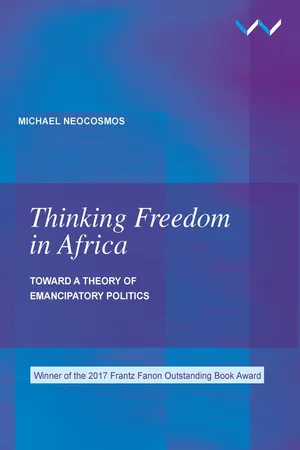
Thinking Freedom in Africa conceives an emancipatory politics beginning from the axiom that ‘people think’.
Previous ways of conceiving the universal emancipation of humanity have in practice ended in failure. Marxism, anti-colonial nationalism and neo-liberalism all understand the achievement of universal emancipation through a form of state politics. Marxism, which had encapsulated the idea of freedom for most of the twentieth century, was found wanting when it came to thinking emancipation because social interests and identities were understood as simply reflected in political subjectivity which could only lead to statist authoritarianism. Neo-liberalism and anti-colonial nationalism have also both assumed that freedom is realizable through the state, and have been equally authoritarian in their relations to those they have excluded on the African continent and elsewhere.Thinking Freedom in Africa then conceives emancipatory politics beginning from the axiom that ‘people think’. In other words, the idea that anyone is capable of engaging in a collective thought-practice which exceeds social place, interests and identities and which thus begins to think a politics of universal humanity. Using the work of thinkers such as Alain Badiou, Jacques Rancière, Sylvain Lazarus, Frantz Fanon and many others, along with the inventive thought of people themselves in their experiences of struggle, the author proceeds to analyse how Africans themselves – with agency of their own – have thought emancipation during various historical political sequences and to show how emancipation may be thought today in a manner appropriate to twenty-first century conditions and concerns.
- 650 pages
- English
- ePUB (mobile friendly)
- Available on iOS & Android
eBook - ePub
About this book
Information
PART 1
THINKING POLITICAL SEQUENCES: FROM AFRICAN HISTORY TO AFRICAN HISTORICAL POLITICAL SEQUENCES
Perhaps we should say today that, insofar as politics is concerned, the real will only be discovered by renouncing the historicist fiction – in other words, the fiction that History is on our side.
– Alain Badiou, À la recherché du réel perdu, 2015 (my translation)
An event is the sudden creation, not of a new reality, but of myriad new possibilities, none of which is a repetition of the already known. This is why it is obscurantist to say ‘this movement demands democracy’ (meaning the kind we enjoy in the West) or ‘this movement demands social improvement’ (meaning the middle prosperity of our petty bourgeoisie). Beginning from practically nothing, resonating everywhere, this popular upsurge creates unknown possibilities for the entire world.
– Alain Badiou, Le Réveil de l’histoire, 2011 (my translation)
Does history begin only from the moment of the launching of the phenomenon of class, and consequently class struggle? To reply in the affirmative would be ... to consider – and this we refuse to accept – that various human groups in Asia, Africa and Latin America were living without history or outside history at the moment when they were subjected to the yoke of imperialism.
– Amílcar Cabral, Presuppositions and objectives of national liberation in relation to social structure, 1966 (Unity and Struggle, 1980, emphasis in original)
The people and the people alone are the makers of universal history.
– Alain Badiou, Le Réveil de l’histoire, 2011 (my translation)
Chapter 1
Theoretical introduction: Understanding historical political sequences
In so far as [politics] is a sequential subjectivity, any investigation in terms of continuity and gradual unfolding is precluded, and the relations previously proposed between history and politics, wherein it was maintained that it was through history – the bearer of a notion of continuity whether in movement or by means of a dialectic – that politics became intelligible, are now broken.
– Sylvain Lazarus, Anthropologie du nom, 1996 (my translation)
The return to a state logic is a consequence of the termination of a political sequence, not its cause. Defeat is not the essence of effectuation.
– Sylvain Lazarus, Anthropologie du nom, 1996 (my translation)
THINKING THE IMMANENT EXCEPTION
Africans were integrated into European ‘modernity’ through the slave trade. Yet rather than being its pathetic victims, they were able to think as human beings and to actualise that thought during particular exceptional events. It was not simply that people opposed oppression and that rebellions took place; it was also, and more importantly, that in some cases an excessive subjectivity of freedom came to dominate their thinking. The most important of these was without doubt what has become known as the Haitian Revolution from 1791 to 1804, which was an event of world significance. Its effects would have been even more far-reaching had not the modern European and North American states banded together to fight its radical humanist consequences by each and every means available to them. They continue to do so today. I begin from this event both because of its world significance and, more prosaically, in order to utilise it as a way of illustrating some of the more important theoretical categories and concepts to be encountered throughout this book. I need, however, to provide a brief introduction to some of these categories themselves which will be deployed in this first part of the book. Two fundamental conceptual issues inform my discussion of the history of the emancipatory struggles undertaken by Africans. The first concerns the idea of the exception, what I have already referred to as the subjective ‘excess’; the second refers to the problem of rationally explaining historical time. Both, in one way or another, stem from Hegel’s philosophy.
We should begin from the idea of the exception as thought by Badiou and Rancière. Rancière, as we have seen, refers to the exception as the central feature of people who speak, who move ‘out of place’.1 In fact, this exception in politics is for him identifiable ex post facto in the form of a historical event which, in addition, is the manifestation or realisation of equality (Rancière, 1995, 2012). For Badiou, on the other hand, the exception is thought of as an event in itself – although historical, the event is potentially political. The event is what creates the possibility of excessive thought; it is purely internal to the situation, for it is always located in an ‘evental site’. An exceptional event can be recognised as it occurs. As Badiou notes, it is ‘the sudden creation of a myriad new possibilities ... none of which is a repetition of the already known’ (Badiou, 2011a, my translation). In order to be able to think this exception, however, a certain theoretical orientation towards the human capacity for understanding is necessary so that it can indeed be recognised as exceptional. In particular, Badiou insists that thinking the exception must begin with a principled distancing from empiricism and its belief that the ‘limits of knowledge’ are given by experience:
Today we have the triumph of empiricism ... The victory of empiricism is evidently the fact that any convincing argumentation is one which emphasises constraints. It is said that it is from these that one must begin. This is not the case for a principled activity; this does not mean that constraints must be ignored, but that the point of departure is the law that we propose concerning what we want, what we desire etc. ... The question of ‘changing the world’ is ... not fundamentally a question of analysing the world and of the alternative evaluation we may have of it. It is a question that essentially comes down to the opposition, between a form of thought that begins from principles and a perspective that begins from reality (Badiou, 2012c, my translation, emphasis in original).
This is a fundamental point. We must indeed insist that there are always exceptions and that it is always possible to shift the limits of knowledge. The core idea that enables the thought of exceptions is, according to Badiou (2013f), the Hegelian concept of Aufhebung (to overcome, to supersede, to exceed, to sublate). If human subjective capacity were seen as limited by experience, it would follow that there must be strict limits to human understanding. These limits are here ultimately provided, not by reason, but by the experience of what exists, to which reason is forced to comply. What this argument means is that one cannot limit thought to an empiricist position that describes and analyses the extant, without at the same time denying the possibility of exceptions to those descriptions and analyses – at least, exceptions which are immanent to the situation itself (rather than emanating from beyond its limits, from outside). What follows, according to Badiou, is that underlying all empiricist thought is a passivity that governs human subjectivity. He insists that ‘one must understand by empiricism the idea that everything must be founded on a primordial passivity amounting to cumulative external effects’ on subjectivity.2 In fact, empiricism ‘necessarily leads to a theory of the practical and cognitive limits of human capacity (the fundamental theme of the “limits of reason”)’ (2013f, my translation). Both reason and subjectivity are thus, in this perspective, constrained by experience. Exceptions are not thinkable within empiricism other than as externalities themselves.
Empiricism is characterised by an essential connection regarding what is possible within the law of the world: it is the world itself that determines what is possible. On the other hand, from an emancipatory perspective, there is always a moment when one is obliged to say that a possibility results from an active confrontation between the state of the world on the one hand and principles on the other; a moment when one can declare to be possible something which the weight of the world declares to be impossible. If the expression ‘to change the world’ is to have any meaning at all, it must be that a real change resides on an impossible point, but one which becomes possible during circumstances which are always of an exceptional nature (Badiou, 2012c, my translation, emphasis in original).
One must note the strictly conservative limits of empiricism (conservative in the etymological sense) because one cannot possibly think change within a situation or social world if one begins from description and analysis, i.e. from the demarcation of the limits of people’s lives in society, the social structures and institutions that contain and determine them, the discourses and subjectivities in which they also are forced to think by power, and so on. These are precisely the kinds of accounts that dominate in Africa today, irrespective of whether they are political-economic, structuralist or post-structuralist, postcolonial, nationalist or neo-liberal in persuasion (see Mbembe, 2013). They are the stuff of knowledge in 21st-century Africa; I have qualified them as ‘the tyranny of the objective’, for they make it impossible to think political choices, as history and society determine all thinking (Neocosmos, 2012a: 468). Knowledge, however, must be firmly distinguished from thought, which is always excessive, beyond the ‘normal’ and the ‘habitual’, oriented towards what could be rather than simply to what exists (Lazarus, 2012). The point here, it must be emphasised, is to make an argument not for ignoring empirical evidence, but rather for not seeing it as the ultimate limit of thought; empirical evidence must be used fundamentally as a necessary reference point for reason.3 One must therefore start with an affirmation that can be rationally maintained. The rational affirmation maintained here, as I have already stated, is that people think. For Rancière – as indeed for Fanon, as we shall see – not only do people think, but they change themselves through thinking:
The great emancipatory movements have been movements in the present, ones of increased competencies, perhaps as much as and even more than movements destined to prepare another future ... These are people who become capable of things they were previously incapable of, who accomplish a break through the wall of the possible ... people do not come together in order to realise a future equality; a certain kind of equality is realised by the act of coming together (Rancière, 2012: 207, my translation).
It is this process that is referred to as ‘subjectivation’, the creation of a political subject. Given that such a process is one of exceeding identity, Rancière refers to it as a rational ‘dis-identification’: ‘Any subjectivation is a dis-identification, a tearing-away from the naturalness of place, the opening of a subject space where anyone can be counted’ (Rancière, 1995: 60, my translation). Because of ‘dis-identification’ there is always a universal aspect to emancipatory politics. Moreover, an excessive subjectivity is always connected in some way or other with a politics expressive of social place (the idea and practice of equality only exist in relation to forms of inequality), simply because excess always exceeds something and is always ‘internal’ to the situation, as Badiou (2010b: 146–7) puts it. The level of excess, of distance from the expressive (from identity) – what might be called the ‘excessive gap’ – varies in each case of subjectivation and is irretrievably marked by it, even if only in a negative way.4 The existence of excessive thought, which always includes some universal notion of human equality, along with the political principles it enunciates, defines a specific historical sequence, which, as we shall see, is not to be understood as part of a continuous unfolding over time. At the same time, it is the dialectical relation between the excessive and the expressive that regulates the ability of the excessive to sustain itself and what Lazarus (1996) calls its eventual ‘saturation’. The idea of freedom as understood by Africans within different emancipatory sequences illuminates this dialectic and in a sense helps us to understand the limits of the sequence in question.
For example, the manner in which the slaves in Haiti understood freedom in 1791 differs from how they understood it after 1796 and how the ex-slaves began to think it after 1804. In the first instance it referred to legal emancipation, in the second to national state independence. The first notion was limited by the expressive constraints of a legal conception; the second by a statist one. Similar points can be made with regard to the manner in which freedom was thought during the independence struggles in the 1950s and 1960s and also, in the South African case, in the 1980s. The expressive–excessive dialectic enables us to understand both the character of that subjectivity and its limitations; it therefore enables us to identify the limits of the historical sequence’s unfolding.
THE IDEA, POLITICAL SUBJECTIVITY AND THE PROBLEM OF OBJECTIVE HISTORICAL TIME
The second issue in any attempt to understand emancipatory political subjectivities concerns a discussion of historical analysis, for it is the discipline of history that is said to account for politics over time and thus to make it intelligible. This question concerns the problems inherent in any attempt to isolate different political sequences – particularly emancipatory sequences – in Africa that illustrate the making by Africans of their history as well as their contribution to world history as a whole. At the same time, it is also an attempt to think of possible new forms of periodisation that stress discontinuous sequential subjective singularities as opposed to the objective periodisations that usually highlight structural changes, such as forms of economy and capitalism or forms of state. These have included, for example, the divisions between merchant capitalism (16th–18th centuries), industrial capitalism (19th century), imperial or monopoly capitalism (end of 19th century to mid-20th century) and globalisation (1973 to the present). They have also included periodisation in terms of the distinctions between ‘traditional–modern–postmodern’ and particularly those between ‘precolonial–colonial–postcolonial’, which is the most common and seemingly the most obvious. Such periodisations stress both continuity and fundamentally objective changes; they are historicist and, as a result, force thought into specific parameters, thereby excluding different modes of thought.
It can be noted, for example, that the standard procedure of demarcating African history along the precolonial–colonial–postcolonial temporal dimension has two major consequences. Firstly, it focuses on changes in state forms and privileges European domination as the norm around which history is plotted and thought; secondly, it has had the consequence of occluding what is arguably the most important event in modern African history – the slave trade – for it cannot be contained within this view of historical change. In particular, the slave trade does not feature within histories of international migration, even though it can be seen as the first instance of ‘forced migration’ on a massive scale. Historians and economists of migration regularly fall into this obvious error, only partly because they, together with demographers, tend to understand the migratory process as a voluntary one; in fact, slavery is not thought fundamentally as a political process. For example, Adepoju (1995) uses this threefold periodisation in his discussion of the history of migration on the continent. The Atlantic slave trade simply disappears from his vision altogether. It is not seen as precolonial, as this concerns distinct African societies untrammelled by Western domination. It is not a feature of colonialism, as this concerns the political dominance of Africa by the Western powers and the construction of colonial states, beginning in the late 19th century, when the slave trade had legally ended. The result is that it simply disappears from the horizon of his inquiry altogether.
Moreover, if it is the case that Af...
Table of contents
- Cover
- Title Page
- Copyright
- Dedication
- Contents
- Foreword
- Preface
- Acknowledgements
- Introduction: Politics is thought, thought is real, people think
- Part 1. Thinking political sequences: From African history to African historical political sequences
- Part 2. Opening up the thought of politics in Africa today: Exceeding the limits of sociology: Beyond representation
- Conclusion: Reclaiming the domain of freedom
- Bibliography
- Index
Trusted by 375,005 students
Access to over 1.5 million titles for a fair monthly price.
Study more efficiently using our study tools.
Frequently asked questions
Yes, you can cancel anytime from the Subscription tab in your account settings on the Perlego website. Your subscription will stay active until the end of your current billing period. Learn how to cancel your subscription
No, books cannot be downloaded as external files, such as PDFs, for use outside of Perlego. However, you can download books within the Perlego app for offline reading on mobile or tablet. Learn how to download books offline
Perlego offers two plans: Essential and Complete
- Essential is ideal for learners and professionals who enjoy exploring a wide range of subjects. Access the Essential Library with 800,000+ trusted titles and best-sellers across business, personal growth, and the humanities. Includes unlimited reading time and Standard Read Aloud voice.
- Complete: Perfect for advanced learners and researchers needing full, unrestricted access. Unlock 1.5M+ books across hundreds of subjects, including academic and specialized titles. The Complete Plan also includes advanced features like Premium Read Aloud and Research Assistant.
We are an online textbook subscription service, where you can get access to an entire online library for less than the price of a single book per month. With over 1.5 million books across 990+ topics, we’ve got you covered! Learn about our mission
Look out for the read-aloud symbol on your next book to see if you can listen to it. The read-aloud tool reads text aloud for you, highlighting the text as it is being read. You can pause it, speed it up and slow it down. Learn more about Read Aloud
Yes! You can use the Perlego app on both iOS and Android devices to read anytime, anywhere — even offline. Perfect for commutes or when you’re on the go.
Please note we cannot support devices running on iOS 13 and Android 7 or earlier. Learn more about using the app
Please note we cannot support devices running on iOS 13 and Android 7 or earlier. Learn more about using the app
Yes, you can access Thinking Freedom in Africa by Michael Neocosmos in PDF and/or ePUB format, as well as other popular books in History & African History. We have over 1.5 million books available in our catalogue for you to explore.