A study of slave memory in South Africa using feminist, postcolonial and memory studies
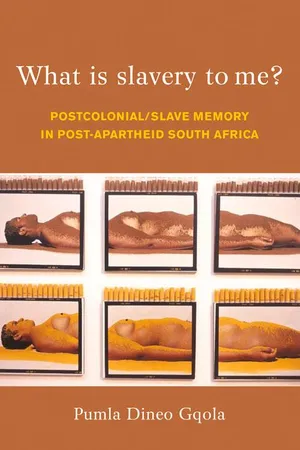
Much has been made about South Africa's transition from histories of colonialism, slavery and apartheid. 'Memory' features prominently in the country's reckoning with its pasts. While there has been an outpouring of academic essays, anthologies and other full-length texts which study this transition, most have focused on the Truth and Reconciliation Commission (TRC). What is slavery to me? is the first full-length study of slave memory in the South African context, and examines the relevance and effects of slave memory for contemporary negotiations of South African gendered and racialised identities. It draws from feminist, postcolonial and memory studies and is therefore interdisciplinary in approach. It reads memory as one way of processing this past, and interprets a variety of cultural, literary and filmic texts to ascertain the particular experiences in relation to slave pasts being fashioned, processed and disseminated. Much of the material surveyed across disciplines attributes to memory, or 'popular history making', a dialogue between past and present whilst ascribing sense to both the eras and their relationship. In this sense then, memory is active, entailing a personal relationship with the past which acts as mediator of reality on a day to day basis. The projects studies various negotiations of raced and gendered identities in creative and other public spaces in contemporary South Africa, by being particularly attentive to the encoding of consciousness about the country's slave past. This book extends memory studies in South Africa, provokes new lines of inquiry, and develops new frameworks through which to think about slavery and memory in South Africa.
eBook - ePub
What is Slavery to Me?
Postcolonial/Slave Memory in post-apartheid South Africa
- 256 pages
- English
- ePUB (mobile friendly)
- Available on iOS & Android
eBook - ePub
What is Slavery to Me?
Postcolonial/Slave Memory in post-apartheid South Africa
About this book
Information
Table of contents
- Cover
- Title Page
- Copyright
- Contents
- Acknowledgement
- Introduction: Tracing (re)memory, thinking through echoes of colonial slavery in contemporary South Africa
- 1: Remembering differently: repositioned coloured identities in a democracy
- 2: (Not) Representing Sarah Bartmann
- 3: Whiteness remixed, or remembered impurity, shame and television
- 4: ‘As a slave you have to have faith or you’ll give up’: Cape Malay/Muslim identity clusters in Cape Town
- 5: ‘Is the secret in cooking?’ Coded food, spice routes and processing Malay identities
- Conclusion: Unshackling memory, rememorying agency
- Endnotes
- References
- Index
Trusted by 375,005 students
Access to over 1.5 million titles for a fair monthly price.
Study more efficiently using our study tools.
Frequently asked questions
Yes, you can cancel anytime from the Subscription tab in your account settings on the Perlego website. Your subscription will stay active until the end of your current billing period. Learn how to cancel your subscription
No, books cannot be downloaded as external files, such as PDFs, for use outside of Perlego. However, you can download books within the Perlego app for offline reading on mobile or tablet. Learn how to download books offline
Perlego offers two plans: Essential and Complete
- Essential is ideal for learners and professionals who enjoy exploring a wide range of subjects. Access the Essential Library with 800,000+ trusted titles and best-sellers across business, personal growth, and the humanities. Includes unlimited reading time and Standard Read Aloud voice.
- Complete: Perfect for advanced learners and researchers needing full, unrestricted access. Unlock 1.5M+ books across hundreds of subjects, including academic and specialized titles. The Complete Plan also includes advanced features like Premium Read Aloud and Research Assistant.
We are an online textbook subscription service, where you can get access to an entire online library for less than the price of a single book per month. With over 1.5 million books across 990+ topics, we’ve got you covered! Learn about our mission
Look out for the read-aloud symbol on your next book to see if you can listen to it. The read-aloud tool reads text aloud for you, highlighting the text as it is being read. You can pause it, speed it up and slow it down. Learn more about Read Aloud
Yes! You can use the Perlego app on both iOS and Android devices to read anytime, anywhere — even offline. Perfect for commutes or when you’re on the go.
Please note we cannot support devices running on iOS 13 and Android 7 or earlier. Learn more about using the app
Please note we cannot support devices running on iOS 13 and Android 7 or earlier. Learn more about using the app
Yes, you can access What is Slavery to Me? by Pumla Dineo Gqola,Pumla Dineo Gqola in PDF and/or ePUB format, as well as other popular books in History & African History. We have over 1.5 million books available in our catalogue for you to explore.