In January 2009, Barack Obama became the 44th president of the United States. In the weeks and months following the election, as in those that preceded it, countless social observers from across the ideological spectrum commented upon the cultural, social and political significance of “the Obama phenomenon.” In “At this Defining Moment,” Enid Logan provides a nuanced analysis framed by innovative theoretical insights to explore how Barack Obama’s presidential candidacy both reflected and shaped the dynamics of race in the contemporary United States.
Using the 2008 election as a case study of U.S. race relations, and based on a wealth of empirical data that includes an analysis of over 1,500 newspaper articles, blog postings, and other forms of public speech collected over a 3 year period, Logan claims that while race played a central role in the 2008 election, it was in several respects different from the past. Logan ultimately concludes that while the selection of an individual African American man as president does not mean that racism is dead in the contemporary United States, we must also think creatively and expansively about what the election does mean for the nation and for the evolving contours of race in the 21st century.
eBook - ePub
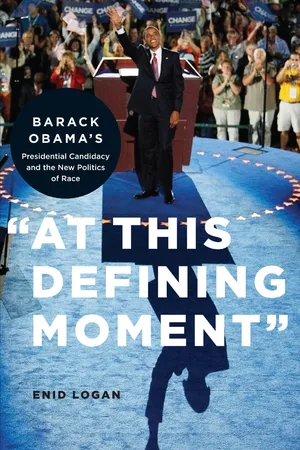
“At This Defining Moment”
Barack Obama’s Presidential Candidacy and the New Politics of Race
- 229 pages
- English
- ePUB (mobile friendly)
- Available on iOS & Android
eBook - ePub
“At This Defining Moment”
Barack Obama’s Presidential Candidacy and the New Politics of Race
About this book
Information
1
Introduction
The Landscape of Race in the 21st Century
On February 11, 2007, Senator Barack Obama, who had just the day before in Springfield, Illinois, declared his intention to run for the U.S. presidency, gave an interview with the 60 Minutes reporter Steve Kroft. Shortly into that interview, they had the following exchange:
KROFT: Your mother was white. Your father was African.
OBAMA: Right.
KROFT: You spent most of your life in a white household.
OBAMA: Yeah.
KROFT: I mean, you grew up white.
Obama’s response to this statement was quite interesting:
I’m not sure that would be true. I think what would be true is that I don’t have the typical background of African Americans. Not just because my mother was white, but because I grew up in Hawaii; I’ve spent time in Indonesia. There [were] all sorts of ethnicities and cultures that were swirling around my head as I was growing up.…
There were times where that was difficult. One of the things that helped me to resolve a lot of these issues is the realization that the African American community, which I’m now very much feel a part of, is itself a hybrid community.…
What I also realized is that the American experience is, by definition, a hybrid experience. I mean, you know, one of the strengths of this country is that we have these people coming from, you know, all four corners of the globe converging… sometimes in conflict… to create this tapestry that is incredibly strong. And so, in that sense, I feel that my background, ironically, because it’s unusual, is quintessentially American.
Undaunted by Obama’s attempts to explain his hybridity, and the hybridity of the American people in general, Kroft continued:
KROFT: You were raised in a white household?
OBAMA: Right.
KROFT: Yet, at some point, you decided that you were black?
Obama responded:
OBAMA: Well, I’m not sure I decided it.1
The present book is about this exchange, and the thousands of others like it that took place in the public sphere during the 2007–2008 presidential campaign. It is about the nation’s journey toward electing its first non-white president in its history, a time period spanning more than two centuries. It is about the awkward, fraught, and determined questionings of the nature, meaning, and authenticity of Obama’s blackness. And it is about the responses of the multiracial electorate to the narratives of national triumph, racial redemption, and post-racialism that were spun by the media and by the Obama campaign.
The key issue that is explored in this book is how Barack Obama’s presidential candidacy served to reflect and shape the dynamics of race in the contemporary United States. The study is timely and important, because the present moment constitutes a pivotal juncture in the sociopolitical life of our nation. Obama’s election will have a lasting impact on race relations in this country, and it is perceived to have ushered in a “new age” in American racial politics. Thus the conclusions that are reached concerning the meaning of race at this particular juncture are likely to set the parameters for teaching, activism, and scholarship about race for decades to come.
Theoretical Concerns
A number of prominent theorists have claimed that with regard to the issue of race, we find ourselves in a period of profound uncertainty and instability. As we move forward into the post–civil rights, post-feminist, and ever more global age, they ask, what institutional, experiential, and ideological contours will the social construct of race take on?
This question has acquired even more urgency, uncertainty, and interest with the recent election of a man socially identified as black as the president of the United States. For the last several years, scholars, pundits, and laypeople alike have furiously debated what the Obama phenomenon says about the current state of race relations in the United States, and what it portends for our future. I conceive of this project as a case study in U.S. race relations that takes the candidacy of Barack Obama as its object. The power of this particular case is that it allows for a close exploration of a number of the most pressing questions in the field of race relations at this time, including the following:

Barack Obama’s presidential bid brought each of these issues sharply into focus. From the moment he declared his candidacy in February 2007, the nation was forced to undergo a thorough reexamination of its core beliefs, subconscious fears, and highest ideals concerning the concept of race—and the place of African Americans, in particular.
Data, Methods, and Study Design
The vigorous debates about the election found in the print and online media constitute particularly fertile ground for a study of the changing politics of race in the 21st century. Thus articles, postings, and commentary gathered from the mainstream media and the blogosphere constitute the chief source of primary data used in this book.
The most frequently referenced sources include newspapers (Wall Street Journal, New York Times, Washington Times, Washington Post, Los Angeles Times, Chicago Tribune, Boston Globe, Atlanta Journal-Constitution), newsmagazines (Time, Newsweek, National Review, The Atlantic, Weekly Standard, New Republic, Monthly Review, The Nation, American Prospect ), political blogs (Townhall.com, Michelle Malkin, Daily Kos, AlterNet, Salon.com, Huffington Post, RealClearPolitics, Politico.com, Drudge Report, The Root, Jack & Jill Politics, Black Agenda Report, Jezebel, Feministing), and other major media outlets (Associated Press, Reuters, Fox News, National Public Radio, CNN, CBS News, ABC News, MSNBC).
The arguments developed in the book are based on my analysis of some 1,500 articles published or posted over an approximately three-year period. I began collecting data in earnest in November 2006, about three months before Obama declared his candidacy. That month saw the publication of the article “What Obama Isn’t: Black Like Me on Race” by the cultural critic Stanley Crouch, which was one of the first questionings of Obama’s blackness. That month the Washington Post also printed Benjamin Wallace-Wells’s influential “Is America Too Racist for Barack? Too Sexist for Hillary?” This was an early attempt to parse the differing ways that race and gender would likely play out in the election. My analysis extends well into the first three years of Obama’s presidency, during which observers continued to take stock of the historical and cultural import of Obama’s victory, and during which new controversies over race, politics, and nation would erupt.9
At each stage of reporting on the election, I focused on the ways that race figured into the stories and reports that were offered. I examined the frames—both positive and negative—used to interpret Obama’s life history, his relationship to the social construct of blackness, his appeal to voters across racial lines, and his political beliefs and affiliations. I studied the ways that ideas about race circulated through debates about the economy, gender, religion, patriotism, and foreign policy. I was particularly interested in assessments of the broader role of race in the election, and the significance of Obama’s candidacy for the nation at large. After identifying key themes found in discussions of the election, I linked these themes to wider discourses about race in American society.
One of the unique contributions of this book lies in its intersectional approach. Scholars of intersectionality have argued that in order to understand how race works in any given context, we must consider the role of other social variables as well. Race, gender, class, and sexuality do not act independently of one another, but rather interrelate and are experienced simultaneously. One of the most fascinating aspects of the 2008 presidential election was that as race came ever more to the fore, questions of gender, religion, class, age, and nation were dragged right into the middle as well. Thus, while two chapters of this book focus primarily on the variable of race, others examine race in relationship to gender and to nation.10
The Landscape of Race in the 21st Century
To set the stage for this study, we must consider the racial conditions that established the context for Barack Obama’s presidential bid. I begin with the observation that racial dynamics at present are contradictory, complicated, and in flux. The sociologist Charles Gallagher has stated that we live in a racially “schizophrenic” time. Similarly, Eduardo Bonilla-Silva writes of “the strange enigma of race in contemporary America.”11 And as Howard Winant has observed, “The contemporary United States faces a pervasive crisis of race, a crisis no less severe than those the country has confronted in the past…. The cultural and political meaning of race, its significance in shaping the social structure, and its experiential or existential dimensions all remain profoundly unresolved as the United States approaches the end of the twentieth century. As a result, the society as a whole, and the population as individuals, suffer from confusion and anxiety about the issue (or complex of issues) we call race.”12
The predominant features of the contemporary racial landscape include the following:
Persistent inequality. The important but partial gains of the civil rights movement. The contradiction, or irony, of formal legal equality and a widespread commitment to racial equality in the abstract, contrasted with profound, and in many cases deepening, inequality in education, housing, wealth, income, employment, life expectancy, child welfare, and criminal justice.13
New immigrants of color. Mass immigration from Asia, Latin America, and Africa following the elimination of national origins quotas in 1965. The development of “new racial subjects” and the emergence of Asian American and Latino pan-ethnicity. The new immigrants complicate, but do not displace, the black/white binary understanding of racial dynamics. And as Ngai writes, the new demographics “have both enhanced the politics of diversity and multiculturalism and provoked nativist sentiment and campaigns.” In the 2008 campaign, fears about immigration were especially relevant to the larger discourses of race and nation that emerged from the political right. (Among liberals however, the conversation about race was primarily a discussion about black and white.)14
Black identities. The emergence of plural black identities and complicated meanings of blackness. Of chief importance is the growing class divide among black Americans, leading to differences in identity, experience, and political ideology. Dominant understandings of blackness today are further challenged by the increasing visibility of multiracial Americans, and the presence of black immigrants from the Caribbean, Latin America, and Africa.15 Of particular relevance to the issues addressed in this book is the emergence of a highly successful cohort of “post-racial” black figures in music, sports, movies, television, and politics.
Crisis in white identity. As a number of scholars have written, the post–civil rights United States is characterized by considerable anxiety and insecurity associated with the social construct of whiteness. As whites have themselves become “racialized,” whiteness is no longer a transparent or taken-for-granted category of identity. But what it means to be white is far from clear. The anxieties of whiteness have been provoked by the demands of the racial justice movements of the 1960s, mass immigration from developing countries, the decline of American international hegemony, and shifts in popular culture toward a valorization of “diversity.”16
These changes, scholars claim, have led to a pervasive sense of white marginalization, disadvantage, and victimization.17 The range of current responses to the crisis of whiteness includes looking to one’s ethnic roots for sources of “tradition,” seeking authenticity in the cultures of others, embracing multiculturalism, rejecting multiculturalism, adopting an identity as a member of a “beleaguered minority,” or seeking to affirm the roots of the “real America” in Christianity, “small-town America,” and conservative values.18 One of the central arguments of this book is that the racial politics of both Obama’s supporters and his detractors were formulated in response to the anxieties associated with whiteness and with race in the contemporary United States.
Globalization and the construct of nation. The global dimensions of the anxieties of race must be considered as well. They stem first from the demographic and cultural shifts accompanying mass immigration from devel...
Table of contents
- Cover Page
- Title Page
- Copyright Page
- Contents
- Acknowledgments
- 1 Introduction: The Landscape of Race in the 2st Century
- 2 Post-race American Triumphalism and the Entrenchment of Colorblind Racial Ideology
- 3 Rooted in the Black Community but Not Limited to It: The Perils and Promises of the New Politics of Race
- 4 Contesting Gender and Race in the 2008 Democratic Primary
- 5 The Trope of Race in Obama’s America
- 6 Asian and Latino Voters in the 2008 Election: The Politics of Color in the Racial Middle
- 7 In Defense of the White Nation: The Modern Conservative Movement and the Discourse of Exclusionary Nationalism
- 8 Racial Politics under the First Black President
- Notes
- References
- Index
- About the Author
Trusted by 375,005 students
Access to over 1.5 million titles for a fair monthly price.
Study more efficiently using our study tools.
Frequently asked questions
Yes, you can cancel anytime from the Subscription tab in your account settings on the Perlego website. Your subscription will stay active until the end of your current billing period. Learn how to cancel your subscription
No, books cannot be downloaded as external files, such as PDFs, for use outside of Perlego. However, you can download books within the Perlego app for offline reading on mobile or tablet. Learn how to download books offline
Perlego offers two plans: Essential and Complete
- Essential is ideal for learners and professionals who enjoy exploring a wide range of subjects. Access the Essential Library with 800,000+ trusted titles and best-sellers across business, personal growth, and the humanities. Includes unlimited reading time and Standard Read Aloud voice.
- Complete: Perfect for advanced learners and researchers needing full, unrestricted access. Unlock 1.5M+ books across hundreds of subjects, including academic and specialized titles. The Complete Plan also includes advanced features like Premium Read Aloud and Research Assistant.
We are an online textbook subscription service, where you can get access to an entire online library for less than the price of a single book per month. With over 1.5 million books across 990+ topics, we’ve got you covered! Learn about our mission
Look out for the read-aloud symbol on your next book to see if you can listen to it. The read-aloud tool reads text aloud for you, highlighting the text as it is being read. You can pause it, speed it up and slow it down. Learn more about Read Aloud
Yes! You can use the Perlego app on both iOS and Android devices to read anytime, anywhere — even offline. Perfect for commutes or when you’re on the go.
Please note we cannot support devices running on iOS 13 and Android 7 or earlier. Learn more about using the app
Please note we cannot support devices running on iOS 13 and Android 7 or earlier. Learn more about using the app
Yes, you can access “At This Defining Moment” by Enid Lynette Logan in PDF and/or ePUB format, as well as other popular books in Social Sciences & Ethnic Studies. We have over 1.5 million books available in our catalogue for you to explore.