Time, it has been said, is the enemy. In an era of harried lives, time seems increasingly precious as hours and days telescope and our lives often seem to be flitting past. And yet, at other times, the minutes drag on, each tick of the clock excruciatingly drawn out. What explains this seeming paradox?
Based upon a full decade's empirical research, Michael G. Flaherty's new book offers remarkable insights on this most universal human experience. Flaherty surveys hundreds of individuals of all ages in an attempt to ascertain how such phenomena as suffering, violence, danger, boredom, exhilaration, concentration, shock, and novelty influence our perception of time. Their stories make for intriguing reading, by turns familiar and exotic, mundane and dramatic, horrific and funny.
A qualitative and quantitative tour de force, A Watched Pot presents what may well be the first fully integrated theory of time and will be of interest to scientists, humanists, social scientists and the educated public alike.
A Choice Outstanding Academic Book.
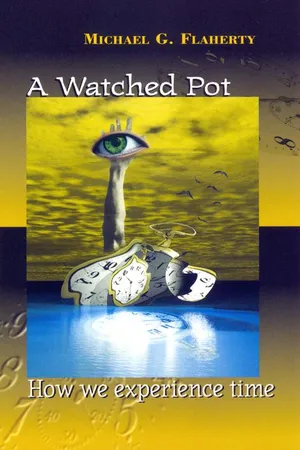
- 190 pages
- English
- ePUB (mobile friendly)
- Available on iOS & Android
eBook - ePub
About this book
Information
[1]
Introduction
AS YOU READ these words, consider the following fact: that in so doing, you are marking time. There is no need to consult your watch; its movements merely externalize and run parallel to the kaleidoscopic stream of experience that you distill into an image of duration. You inhale and exhale as the blood courses through your veins. You shift the position of your legs, and, hearing something, look up in time to see a petal drop from the flowers on your table. In like fashion, these words enter your stream of consciousness as a skein of events.1
The fundamental quality of duration is embedded in our impression that things are not as they were before; that is, that things have changed.2 Human beings are unique in part because they are capable of fusing their experience of heterogeneous events into a coherent sense of persistence. We can attend to change by remembering the past, stepping back from the present, and anticipating the future. Our clocks and calendars mark time, but they do not make time. Only human beings make time by sifting the fragmentary dynamics of experience through the reflexive “unity of consciousness.”3
On its most basic level, then, temporality is an aspect of subjectivity. This perspective is in keeping with Henri Bergson’s contention that “time is at first identical with the continuity of our inner life.”4 To be human is to be self-conscious, and therein lies the primordial feeling of duration. Put differently, human beings are aware of their own endurance, and this reflexivity gives human existence an intrinsically temporal character.5 If, however, temporality is a facet of subjectivity, then it follows that one’s sense of duration is shaped from the very outset by society because self-consciousness is generated through socialization.6
It was, of course, Emile Durkheim who recognized that the individual’s temporal experience is conditioned by the collective rhythms of society. Given his functional orientation, he emphasized that a working consensus on temporality is requisite for the maintenance of social order because consensus is constitutive of intersubjectivity and interpersonal coordination. Indeed, his macrosociological outlook is explicit where he concludes “that a common time is agreed upon, which everybody conceives in the same fashion.”7 Here, Durkheim let the matter rest, but two important qualifications must be noted.
First, socialization notwithstanding, human beings still experience duration in a seemingly idiosyncratic manner. A minute may be a minute, but is there anyone who has not had the sensation that time has passed quickly or slowly? Clocks and calendars represent cultural unanimity, and they have made for some standardization of temporality.8 Near the turn of the century, for example, Georg Simmel asserted that metropolitan “precision has been brought about through the general diffusion of pocket watches.”9 Nonetheless, standardization and socialization do not prevent individuals from intermittently experiencing personal disjuncture with the time of clocks and calendars. One could argue, in fact, that the experience of personal disjuncture is made more visible by viewing it against the backdrop of temporal orthodoxy.
Second, social reality is not the monolithic entity that Durkheim makes it out to be. In his seminal essay, “The Perception of Reality,” William James describes several “worlds” or “sub-universes” of social reality.10 He observes that the world of science is not the same as the world of religion, and that the world of religion is not the same as the world of common sense. This way of thinking especially influenced the work of Alfred Schutz, whose essay, “On Multiple Realities,” picks up where the writings of James leave off.11 For Schutz, social reality is partitioned into “finite provinces of meaning,” each of which is characterized by “a specific time-perspective.”12 For instance, divergent forms of temporal experience help to distinguish dreams from the wide-awake world of everyday life. In turn, Erving Goffman was influenced by both James and Schutz when he wrote Frame Analysis: An Essay on the Organization of Experience.13 Goffman argues that one does not know how to act until one has defined, or “framed,” the situation at hand. By classifying situations in this fashion, human beings define a multiplicity of realities, each of which is invested with its own kind of meaning—such as a trial, versus a mock trial in law school, versus the cinematic portrayal of a mock trial in law school.
Various students of temporality have asserted that lived duration assumes the appearance of idiosyncrasy when, in actuality, it is structured by the pluralistic properties of social reality. Thus, Georges Gurvitch describes “multiple manifestations of time,” and Edward Hall points out that temporal experience is “situation- as well as culture-dependent.”14 In contrast to these static formulations, Alfred Schutz and Thomas Luckmann emphasize the dynamic relationship between lived duration and the process of social interaction:
The temporal articulation of the stream of consciousness is determined by the tension of consciousness, which alters with transitions from one province of reality with finite meaning-structure to another, as well as, to a lesser extent, with transitions from one situation to another within the everyday life-world.15
Yes, but how does this transpire? We go from work to play, from civility to violence, from indifference to religious or political fervor, from dreams to the wide-awake stance of public accessibility. Our experience of duration is thought to change as we step from one realm of social reality to another, or as the immediate situation mutates into a new form of interaction. Obviously, Schutz and Luckmann’s statement does not take us very far, but little has been done to extend our understanding beyond their promising insight.
In this book, I address the following question: How is the perceived passage of time shaped by the individual’s transition from one to another situation or realm of social reality? This question implicates the interplay of subjectivity and objectivity in temporal experience. My response to this question is based upon the theoretical traditions of symbolic interactionism, microstructuralism, phenomenology, and ethnomethodology. In particular, I will be concerned with a “phenomenological analysis of time-consciousness.”16 I want to know how processes associated with self and situation condition the perceived passage of time. Such knowledge will not only advance the study of temporality and social psychology, but will also help us understand often uncanny experiences in everyday life.
The Backdrop: Temporality and Society
Ulysses, by James Joyce, is 783 pages in length.17 Yet that book recounts only one day in the lives of its two primary characters. How much human experience can fit within a single day? How much in a single hour, or, for that matter, in any standard unit of temporality? For now, it may be impossible to answer these questions with any specificity, but this much is certain: there is fluctuation in the density of experience (i.e., conscious information processing) per standard temporal unit, and that fluctuation is governed by the interplay of self and situation. There is, nonetheless, a tendency for sociological students of temporality to gloss over the basic fact that what feels like minutes for one person may feel like hours for another. This offhand treatment is remarkable because even the most cursory reflection indicates that variation in the experience of time does not occur because there are different kinds of people but because people find themselves in different kinds of circumstances.
One might think that, with his penchant for the study of mind and self, this topic would have been of interest to George Herbert Mead.18 Such is not the case. In fact, Mead is mute on the subject of duration, but he has much to say about how temporality figures in the dynamics of self-consciousness and social interaction. Mead’s interest in temporality stems from a desire to use evolutionary principles in an analysis of mind, with the latter viewed as an ongoing adaptation to changing circumstances.19 Consequently, Mead has to account for the emergence of new forms of consciousness. As he puts it, the “novelty of every future demands a novel past.”20 Mead fundamentally alters the stimulus-response arc of behaviorism by insisting that, in human interaction, there is an intervening moment—the “specious present”—during which the individual interprets the situation and self-consciously considers alternative lines of action.21 Furthermore, he emphasizes that the resulting “response … is something that is more or less uncertain.”22 Mead is intent on showing how human beings redefine the past from the standpoint of the present, and how such redefinitions create the possibility of novel futures.23 In this manner, he tries to reconcile determinism and emergence.
It is unlikely that Mead would have endorsed research on a possible link between the volume of experience and perception of the passage of time, although such research is implied by his own tenets. He contends that “the unit of existence in human experience is the act.”24 According to Mead, the act is composed of four phases: impulse, perception, manipulation, and consummation.25 As but one phase among four, perception does not warrant separate attention beyond the part it plays in the social act. And, from Mead’s standpoint, experience is embedded within the social act because experience proceeds through self-reflection: “Action of the organism with reference to itself is, then, a precondition of the appearance of an object in its experience.”26 Moreover, Mead tells us that experience can only be grasped from a particular social perspective: “experience … has its character over against actual or possible audiences or observers whose selves are essential to the existence of our own selves.”27
Mead’s subordination of experience to action does not square with his own argument that action is prefigured in self-consciousness as one considers various hypothetical solutions to the problem at hand. Perhaps his pragmatism is showing. A particular aspect of experience may or may not lead to consummation of the act; it may or may not have practical (i.e., behavioral) effects. Nevertheless, there is more to life than solving problems, and, with Norman Denzin, I would assert that Mead’s position unnecessarily restricts the symbolic interactionist enterprise:
By placing priority on the act, Mead shifted attention off the ongoing flow of temporal experience that shapes the context wherein the act supposedly occurs. For him … the act takes precedence over the moment…. The act, not temporal experience, thus becomes the key concept for Mead, and by implication the generations of interactionists who have followed him.28
If we change the emphasis from action to consciousness, then we can examine a crucial facet of human experience—variation in the perceived passage of time—that has no place in Mead’s theoretical framework.29
“There is a certain temporal process going on in experience,” states Mead.30 I will show that there is also a certain experiential process going on in temporality. This change in emphasis implicates the writings of phenomenologists.31 During the last years of Mead’s life (he died in 1931), European phenomenologists were taking up the topic of temporality in more direct fashion than he did. For example, Martin Heidegger is critical of the way ordinary speech depicts time as if it were autonomous from human existence, and he views temporality as an “integral part of human experience.”32 It follows that variation in temporal experience reflects variation in social conditions. Thus, Heidegger proposes that “time … functions as a criterion for distinguishing realms of Being.”33 This proposition mandates the investigation of subjective and situated processes that shape the perceived passage of time.
Consciousness is composed of successive experiences: “By thinking, we move through time.”34 But how is it that we perceive duration in successive experiences? Edmund Husserl suggests that the essence of duration can be found in the interplay of “memory and expectation.”35 He points out that we only ever hear one note at a time when listening to a song. Our grasp of the melody results from our ability to remember previous notes and anticipate those which are yet to be played. Husserl differentiates memory into primary remembrance or “retention” and secondary remembrance or “recollections.” Each particular note of the melody is perceived now, that is, in the present, but Husserl observes that each moment perceived as the present draws behind itself “a comet’s tail of retentions.”36 This is in contrast to our recollection of those past events that are not immediately related to the present. Similarly, he differentiates anticipation into primary expectation (or “protention”) and secondary expectation. Husserl concludes that human beings have a “temporally constitutive consciousness” which produces the experience of duration by integrating perception, memory, and anticipation.37
Eugène Minkowski provides us with the concept of “lived time,” by which he refers to the experience of duration.38 His primary interests concern disjunctures between lived time and the time of clocks and calendars. He is especially attuned to such disjunctures as a consequence of his in...
Table of contents
- Cover Page
- Title Page
- Copyright Page
- Dedication
- Contents
- Acknowledgments
- 1. Introduction
- 2. Paradoxical Variation
- 3. Protracted Duration
- 4. Theory Construction
- 5. Temporal Compression
- 6. Conclusion
- Methodological Appendix
- Notes
- Index
- About the Author
Trusted by 375,005 students
Access to over 1.5 million titles for a fair monthly price.
Study more efficiently using our study tools.
Frequently asked questions
Yes, you can cancel anytime from the Subscription tab in your account settings on the Perlego website. Your subscription will stay active until the end of your current billing period. Learn how to cancel your subscription
No, books cannot be downloaded as external files, such as PDFs, for use outside of Perlego. However, you can download books within the Perlego app for offline reading on mobile or tablet. Learn how to download books offline
Perlego offers two plans: Essential and Complete
- Essential is ideal for learners and professionals who enjoy exploring a wide range of subjects. Access the Essential Library with 800,000+ trusted titles and best-sellers across business, personal growth, and the humanities. Includes unlimited reading time and Standard Read Aloud voice.
- Complete: Perfect for advanced learners and researchers needing full, unrestricted access. Unlock 1.5M+ books across hundreds of subjects, including academic and specialized titles. The Complete Plan also includes advanced features like Premium Read Aloud and Research Assistant.
We are an online textbook subscription service, where you can get access to an entire online library for less than the price of a single book per month. With over 1.5 million books across 990+ topics, we’ve got you covered! Learn about our mission
Look out for the read-aloud symbol on your next book to see if you can listen to it. The read-aloud tool reads text aloud for you, highlighting the text as it is being read. You can pause it, speed it up and slow it down. Learn more about Read Aloud
Yes! You can use the Perlego app on both iOS and Android devices to read anytime, anywhere — even offline. Perfect for commutes or when you’re on the go.
Please note we cannot support devices running on iOS 13 and Android 7 or earlier. Learn more about using the app
Please note we cannot support devices running on iOS 13 and Android 7 or earlier. Learn more about using the app
Yes, you can access A Watched Pot by Michael G. Flaherty in PDF and/or ePUB format, as well as other popular books in Social Sciences & Sociology. We have over 1.5 million books available in our catalogue for you to explore.