2009 Choice Outstanding Academic Title
2009 Association of American University Presses Award for Jacket Design
The stories of 70 women living in the aftermath of breast cancer
Chemo brain. Fatigue. Chronic pain. Insomnia. Depression. These are just a few of the ongoing, debilitating symptoms that plague some breast-cancer survivors long after their treatments have officially ended. While there are hundreds of books about breast cancer, ranging from practical medical advice to inspirational stories of survivors, what has been missing until now is testimony from the thousands of women who continue to struggle with persistent health problems.
After the Cure is a compelling read filled with fascinating portraits of more than seventy women who are living with the aftermath of breast cancer. Emily K. Abel is one of these women. She and her colleague, Saskia K. Subramanian, whose mother died of cancer, interviewed more than seventy breast cancer survivors who have suffered from post-treatment symptoms. Having heard repeatedly that "the problems are all in your head," many don't know where to turn for help. The doctors who now refuse to validate their symptoms are often the very ones they depended on to provide life-saving treatments. Sometimes family members who provided essential support through months of chemotherapy and radiation don't believe them. Their work lives, already disrupted by both cancer and its treatment, are further undermined by the lingering symptoms. And every symptom serves as a constant reminder of the trauma of diagnosis, the ordeal of treatment, and the specter of recurrence.
Most narratives about surviving breast cancer end with the conclusion of chemotherapy and radiation, painting stereotypical portraits of triumphantly healthy survivors, women who not only survive but emerge better and stronger than before. Here, at last, survivors step out of the shadows and speak compellingly about their "real" stories, giving voice to the complicated, often painful realities of life after the cure.
This book received funding from the Susan G. Komen Foundation.
eBook - ePub
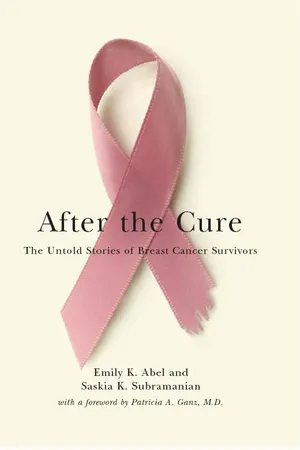
After the Cure
The Untold Stories of Breast Cancer Survivors
- 203 pages
- English
- ePUB (mobile friendly)
- Available on iOS & Android
eBook - ePub
About this book
Information
Topic
SozialwissenschaftenSubtopic
Genderforschung 1
“Standing on New Ground”
ALTHOUGH MEDICAL RESEARCHERS have begun to investigate a number of posttreatment symptoms, we wanted to know how survivors themselves understood their various complaints. Greta Shaw began by discussing a problem that is virtually absent from the existing literature:
One of the roughest things is that a month after I finished radiation I woke up with a salty taste in my mouth. The salty taste in my mouth has basically stayed and never left. Certain days are worse than others, and along with the saltiness as time went on I have this area on the side of my tongue that feels like it’s a sore, and it never goes away. My whole entire mouth area has given me a lot of problems. I even have a huge thing on the side of my face that’s kind of always there inside, you know, where the gum is. That always bothers me, and this past week, oddly enough, there was a huge, ulcerated kind of canker sore on that area as well. It comes and goes and gets worse at different times. But it really is very, very painful. And I can’t even tell you how many doctors I have been to for this, numerous doctors.… I’ve cried in doctors’ offices over this. And because you don’t see all that much, they don’t think that there’s a lot of pain. You can kind of see a little bit, but nothing like, “Wow, it’s there.” And sometimes even my mouth will like quiver with all of the trauma of this area. It will have little spasms. It’s altered my taste buds; things don’t taste like they did. I don’t crave like everybody else does. I just go, “Oh, that sounds OK.” Nothing sounds that great. Believe it or not, it’s really been one of the worst and hardest things to live with. Sometimes I feel like I just have to put something in my mouth to just try to curb it, because it gets so intense. It’s painful, it burns, and it’s salty, and it’s just bizarre.
Like many women, Greta faces several problems simultaneously. When we asked if she had any other symptoms, she responded,
Yeah! That’s the one that’s the weirdest, the most peculiar. But of course I have. I went into chemo-induced menopause. That has been, of course, very tough. It’s what they call crash menopause, and the symptoms just come on overnight. And when it happens you don’t even know if it’s the chemo or what’s going on. So in hindsight, when I look back, a lot of the stuff I have been feeling may have been due to the menopause, with all the hot flashes and sweats and that whole thing.
I’ve had all the symptoms of menopause, horrible, horrible, horrible vaginal dryness, which I know is a huge thing. It’s just ridiculous. Actually I’m unable to have sexual intercourse right now. It’s too painful. And I would love to know if that’s really common because my gynecologist is saying, “Yes, it’s common, it’s common,” but she kind of doesn’t understand why it isn’t maybe a little bit better than it is. Like when I have my pap [smears] and stuff, it’s really painful now.
I’m always afraid to even try anything just because it’s so painful. It’s ridiculous. And that’s caused a lot of problems as far as, of course, being married. I mean it has caused a lot of friction. And, of course, there’s no sexual desire or anything like that; that’s just a given. Everything’s gone. I don’t ever think about it; the libido is just out the door.
And then the brain, the brain’s bad, embarrassingly bad. People that know me, I’m fine with. They all understand because they just have kind of gotten used to it. Though I think some of them are kind of afraid because it is really bad; certain days are better than others. Like I was thinking you were coming and I’m going, “Hmmm, I wonder if I’m going to have a really foggy day or a pretty clear day.” And you know, I’m pretty good today. You can even see it in my eyes when it’s bad. It’s just kind of scary because I just get really like fatigued—how do I put it?— brain exhausted. It’s embarrassing; it really is. I have really wondered how much longer I would be able to work if this got really bad. I’ve had times where at work I’ve thought “OK”—and conversations with my husband—“how am I going to do this? How am I going to continue to work?” And I need to work; it’s not like I can afford not to work. I don’t think I could even go to another job and try to learn something. I can’t imagine what that would be like. I’d be so scared. And I’ve thought about it just because I feel like, you know, sometimes at work I would feel like they were saying something about me maybe behind my back about it. That’s really hard because I used to be pretty sharp—I mean, not like over and above. I just feel like I used to be a lot sharper; I could think straight. I think sometimes people don’t quite understand, and they just think that maybe you’re kind of dumb just because I left my job of ten years and I went there. So the people that I worked with before then knew who I was. These people really don’t know who I was before. I’ve even said, you know, “I used to be a lot sharper.”
And there’s another thing it’s complicated to note. I’m approaching forty-nine years old. Would menopause have been just like this for a regular person? Or is it because of the chemo? I can’t figure any of it out.
Of course, when you’re on the chemo and everything, everything is really foggy, and then afterwards for the first year I think a lot of it was kind of a combination of that and being really physically drained. I had a lot of chemo. I had like eleven rounds. So I had a lot of stuff. And so I’d say that for the following year it was just kind of such a combo. But I almost think that my brain has gotten even worse lately in the past year. I know that the moment-to-moment remember-what-I’m-doing kind of thing is bad. And I know people say this all the time, “Well, I go from one room, and I can’t remember what I’m doing in the other room.” But for some reason it feels different. And I don’t know how to explain it. Maybe I’m wrong, but I think it feels different than if it were to happen to you or my husband or whatever. Maybe anybody would feel this way. How do you know? You don’t know.
The genesis of aches and pains also causes confusion:
I am approaching fifty. People say things start getting kind of …, you know. I think I have definitely more joint pain than I used to have, and it did start back then, and it hasn’t gone away. But just in general, my stiffness in joints and my knees, even my hips, my feet. But, you know, I work on my feet, so how the heck do I know? They’re just kind of swollen, and they feel like there’s kind of pins and needles in them a lot. It could be circulation.
Greta reported other symptoms in response to our questions. By the end of the interview, she had added lymphedema, anxiety, depression, dental problems, and scar tissue to her list.
“Still Waiting to Find Me Again”
All through the long, dark months of breast cancer treatment, patients look forward to the moment it will end and ordinary life resume. Many, however, still feel profoundly altered a year or more afterward. We repeatedly heard comments such as the following:
That’s the story they don’t tell, that you don’t go back to the life you had.
All the treatment is over, it just seems like I’m still not back to me. I’m still waiting to find me again.
I kind of came out maybe not a different person, but definitely standing on new ground.
I’m happy to have a life, but it’s not the same quality of life that I had before.
A part of me has been buried along with my right breast.
Some survivors spoke in terms of aging:
I feel ten years older.
I feel like an old lady; I got old very fast.
Now I have to behave like a real elderly person.
I’ve aged tremendously.
The sense of radical change derived partly from the trauma of diagnosis and treatment. A philosopher defines a traumatic event as “one in which a person feels utterly helpless in the face of a force that is perceived to be life-threatening. The immediate psychological responses to such trauma include terror, loss of control, and intense fear of annihilation.”1 An element of surprise can increase the likelihood of long-term harm.2 After receiving treatment for Hodgkin’s disease, Nina Worth had been “kind of waiting for this [cancer] experience to happen”: “It was always there in the back of my mind. And it was not a surprise to me when Dr. P. called me and told me what they had found.” The great majority of women, however, insisted breast cancer had appeared without warning. Several had expected good health habits to confer immunity. “I think it’s recommended after forty that you start getting mammograms,” one said. “I haven’t missed a year since I turned forty, and I think that’s why I was so shocked when this happened. I just could not believe it. I’ve been getting a mammogram every year; how come all of a sudden this came up?” Another woman described herself as “a runner and a Trader Joe addict”: “I mean, I can’t live without food, but I’m not into grease or alcohol. I watched my diet and worked out and slept and did all the normal things that people are supposed to do to stay within good health.” Her youth, too, was supposed to offer protection: “I thought old people get cancer. I mean no disrespect to elders, but I’m thinking I have more miles to go.” Although the incidence of many serious diseases (including breast cancer) increases sharply with age, a seventy-one-year-old woman stated, “My father lived to ninety in a very active life, and it didn’t dawn on me that things could change. It was a rude awakening.… I just went for my routine mammogram, and the next thing I know, before the end of that evening, it was pretty evident that I had cancer. Not a clue, not a symptom, not a pain. So it was really a bolt out of the blue.”
Injury to the body also can intensify the toxic effects of trauma.3 Although most women felt completely well at the time of diagnosis, treatment inflicted physical damage. Several survivors underlined their sense of violation by using Dr. Susan Love’s famous description of surgery, chemotherapy, and radiation as “slash, poison, and burn.”4 Others raged against euphemisms that disguised treatment horrors. “I just burst out sobbing when I heard that I had to have chemotherapy,” one woman recalled, “and I said, ‘But it’s so toxic, it’s so poisonous.’ The doctor’s like, ‘Well, we don’t like to use the word “poisonous.”’ But wait a minute. If it’s toxic, it’s poisonous.” Pat Garland said, “If I had lost an arm or whatever, people would be giving me therapy and they would understand and there would be empathy. But there was none of that, and they amputated my breast. They don’t call it ‘amputation’; they call it ‘mastectomy.’ I wonder why they changed the name? Is it because it’s a woman?”
One sign of trauma is a desire to discuss the traumatic event over and over.5 Because our study focused on the period after surgery, chemotherapy, and radiation, we asked very few specific questions about those events. Most women, however, took advantage of the interviews as another opportunity to retell their treatment stories. A survivor vividly remembered going home after a mastectomy:
I had a drain, and I had to keep measuring that and emptying that, and mine got clogged a couple of times, so I had to go to the emergency room for that.… I remember the first Sunday after I got through the surgery, I went to church. I wear big clothes anyway, so I had the big clothes with the drain hanging out. And the bandages. It was kind of scary to get into the shower because I didn’t know what that was gonna do. So it was the unknown, the unknown.
Several women focused on chemotherapy. One remarked,
I had never gone through anything like that before. The way it makes you feel, you can’t sleep, you can’t stand up, you can’t eat. You just feel strange. I guess it’s all the drugs and everything. After you take the treatment I’ve noticed that I could be up for a couple of days, but then after that I would be down for about four or five days. Then I notice that after I got more and more into the treatment what would happen is I wouldn’t be up as long. I would go down faster, and I’d stay longer down. What could I do? I couldn’t do anything but stay in bed, and I’d have the food right there by my bedside. And then my hair loss—oh gosh. When that came out, I said, “Didn’t you say that it might not come out? But it did come out.” And I’m being very positive: “I’m not going to lose my hair. It’s still in here.” And I’d just comb it, and all the stuff came out. I didn’t like losing all of your hair everywhere. No eyebrows—you look like a bald-headed doll with no eyebrows, no nothing. And I couldn’t stand to look at myself in the mirror with no hair, with a bald head.
Marsha Dixler described her high-dose chemotherapy treatment as “the worst experience of my life. A couple of times I tried to find the back door out of the doctor’s office and figured out how I can go from this third floor, go out the window, because I didn’t want that chemo again. It was that horrible.”
For Tessa McKnight, radiation was “even harder than the chemo.” “It was just so lonely. People would come to chemo with me. Radiation is something you have to go to by yourself every day, and you’re alone in the room. The people can’t even be there with you. And you’re just [with] all these machines. There’s no pain or anything, except your breast gets fried. That was hard.”
And breast cancer was never over. Although all the women in our study were considered cancer-free at the time of the interviews, twelve had had recurrences. One explained why she kept her wedding simple: “I thought, ‘What if something would have happened in between a long year of planning a...
Table of contents
- Cover Page
- Title Page
- Copyright Page
- Contents
- Acknowledgments
- Foreword
- Introduction
- 1 “Standing on New Ground”
- 2 “We Saved Your Life. Now Leave Us the Hell Alone”
- 3 Remedying, Managing, and Making Do
- 4 “Like Talking to a Wall”
- 5 Narrowed Lives
- 6 “Turning a Bad Experience into Something Good”
- Conclusion
- Epilogue
- Appendix
- Notes
- Index
- About the Author
Trusted by 375,005 students
Access to over 1.5 million titles for a fair monthly price.
Study more efficiently using our study tools.
Frequently asked questions
Yes, you can cancel anytime from the Subscription tab in your account settings on the Perlego website. Your subscription will stay active until the end of your current billing period. Learn how to cancel your subscription
No, books cannot be downloaded as external files, such as PDFs, for use outside of Perlego. However, you can download books within the Perlego app for offline reading on mobile or tablet. Learn how to download books offline
Perlego offers two plans: Essential and Complete
- Essential is ideal for learners and professionals who enjoy exploring a wide range of subjects. Access the Essential Library with 800,000+ trusted titles and best-sellers across business, personal growth, and the humanities. Includes unlimited reading time and Standard Read Aloud voice.
- Complete: Perfect for advanced learners and researchers needing full, unrestricted access. Unlock 1.5M+ books across hundreds of subjects, including academic and specialized titles. The Complete Plan also includes advanced features like Premium Read Aloud and Research Assistant.
We are an online textbook subscription service, where you can get access to an entire online library for less than the price of a single book per month. With over 1.5 million books across 990+ topics, we’ve got you covered! Learn about our mission
Look out for the read-aloud symbol on your next book to see if you can listen to it. The read-aloud tool reads text aloud for you, highlighting the text as it is being read. You can pause it, speed it up and slow it down. Learn more about Read Aloud
Yes! You can use the Perlego app on both iOS and Android devices to read anytime, anywhere — even offline. Perfect for commutes or when you’re on the go.
Please note we cannot support devices running on iOS 13 and Android 7 or earlier. Learn more about using the app
Please note we cannot support devices running on iOS 13 and Android 7 or earlier. Learn more about using the app
Yes, you can access After the Cure by Emily K. Abel,Saskia K. Subramanian in PDF and/or ePUB format, as well as other popular books in Sozialwissenschaften & Genderforschung. We have over 1.5 million books available in our catalogue for you to explore.