Over the past three decades, the United States has embraced the death penalty with tenacious enthusiasm. While most of those countries whose legal systems and cultures are normally compared to the United States have abolished capital punishment, the United States continues to employ this ultimate tool of punishment. The death penalty has achieved an unparalleled prominence in our public life and left an indelible imprint on our politics and culture. It has also provoked intense scholarly debate, much of it devoted to explaining the roots of American exceptionalism.
America’s Death Penalty takes a different approach to the issue by examining the historical and theoretical assumptions that have underpinned the discussion of capital punishment in the United States today. At various times the death penalty has been portrayed as an anachronism, an inheritance, or an innovation, with little reflection on the consequences that flow from the choice of words. This volume represents an effort to restore the sense of capital punishment as a question caught up in history. Edited by leading scholars of crime and justice, these original essays pursue different strategies for unsettling the usual terms of the debate. In particular, the authors use comparative and historical investigations of both Europe and America in order to cast fresh light on familiar questions about the meaning of capital punishment. This volume is essential reading for understanding the death penalty in America.
Contributors: David Garland, Douglas Hay, Randall McGowen, Michael Meranze, Rebecca McLennan, and Jonathan Simon.
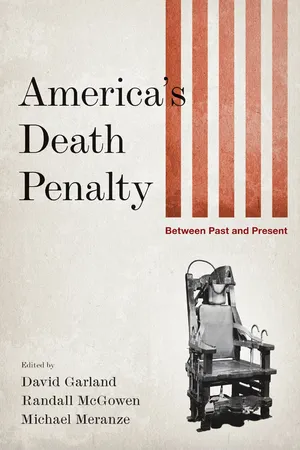
eBook - ePub
America's Death Penalty
Between Past and Present
- 241 pages
- English
- ePUB (mobile friendly)
- Available on iOS & Android
eBook - ePub
America's Death Penalty
Between Past and Present
About this book
Information
Topic
Scienze socialiSubtopic
Diritto penale1 Introduction
Getting the Question Right? Ways of Thinking about the Death Penalty
In recent years the death penalty has lost none of its power to arouse powerful emotions or to produce heated debates. Indeed, the question of capital punishment has secured greater prominence, as it has become one of the defining issues in the campaign to promote recognition of international human rights. The result has been the transformation of a debate largely taking place within national political contexts and arising mainly within Western culture into a cause that leaders of all nations feel compelled to address. Debates at the United Nations, discussions before various human rights conventions, as well as the attention of the world press have all brought a level of scrutiny of national practices that is difficult to avoid. Proponents of the abolition of the penalty assert that it violates universal human rights which transcend local traditions or circumstances. Their opponents tend to reject this claim, asserting, instead, the priority of separate and distinct national or religious identities.
Often the ethical and moral argument over capital punishment is posed as a timeless question whose fundamental shape has not, and cannot, change.1 Yet, paradoxically, much recent scholarly discussion has centered on a particular country and its peculiar history, namely, America’s retention of the death penalty. To many observers, the survival of capital punishment in this country appears both a puzzle and a provocation. The question seems simple, even if the answer has proved elusive: Why should a nation that casts itself as a leader in the battle for human rights resist so tenaciously the elimination of a practice so self-evidently a holdover from darker times? A great deal seems to be at stake in the answer to this question. The presence of capital punishment in America feels more threatening, at least to American and European scholars and activists, than its occurrence elsewhere in the world. Indeed, it often seems as if answering the riddle of the death penalty depends on solving a distinctively American enigma. Certainly this is the overwhelming impression one draws from a casual reading of the European and North American press or, indeed, from a survey of much of the recent scholarship on the topic.
This volume emerged out of a symposium convened by David Garland, Randall McGowen, and Michael Meranze (sponsored by New York University School of Law in May 2007) that sought to look at capital punishment in historical perspective, and to think again about how we might view its occurrence in our own time. The goal was to renew the debate by unsettling some of the certainties that have helped to shape its modern formulation. Our concern was that the seeming familiarity of the controversy has become an obstacle to reaching a new understanding of the issue. The strategy we followed was to examine not only the answers offered but also the questions posed in the debate. These questions often imported historical and theoretical assumptions which framed the answers that could be given. The conference drew together historians, sociologists, and legal scholars, as well as litigators engaged in the day-to-day struggles defending the condemned on death row. The conversations that went on during the meeting were wideranging, stretching from contemporary American death penalty litigation to the practices of capital punishment in other times and places. The longer the discussions went on, the more inadequate the insistent viewpoint of the present and the often repeated tales of the past came to seem.
Much of the initial discussion was devoted to the question of American exceptionalism, the fact that the United States seems on a different path from those countries with which its citizens usually compare themselves, especially in Europe. There was no shortage of candidates to explain this apparent disparity. Several people argued that it resulted from the country’s unique judicial arrangements, and others looked to the peculiar nature of its federal system of government. There was greater consensus that the nation’s tortured history of race relations was implicated in the development. Other scholars pointed to the frequency of violence in the American past and its prevalence in the country today. Finally, some participants traced the roots of the fierce retributive spirit at work in American justice to a powerful streak of religious fundamentalism that distinguishes the nation’s culture.2 It soon became clear, however, that too many candidates had the honor of explaining the American path. Every distinctive aspect of its culture and political life seemed to have a hand in producing the outcome. In sum, America retained the death penalty because it was America. This discussion of America’s distinctive relationship to capital punishment soon came to feel tired, even if it kept springing to life with each new formulation of the topic. The issues it raised seemed already obvious, the questions already answered. For all the heat generated, the debate seemed to repeat what was already assumed: that America was different.
During the conference, many participants expressed dissatisfaction with the way the question was being posed. Participants increasingly agreed that we needed to de-familiarize the issue in order to restore the strangeness, rawness, and urgency of the problem. One suggestion involved the argument that focusing on the United States was too parochial and, perhaps, a shade self-indulgent. Scattered references to the situation elsewhere in the world hinted at the value of wider comparisons that did not privilege any particular region. These comments often appeared as provocations rather than settled theories. Nonetheless, even in this form, they exposed some of the unarticulated premises that marked the usual debate. The widespread use and varied forms of capital punishment today challenge many of our theories about the meaning and occurrence of the penalty. Viewed from this unconventional direction, the American experience looks less exceptional than is usually claimed. One implication of this realization is that what one can say about capital punishment in relation to modern politics and what we predict for its future may be different from that assumed in so much of the scholarly literature.
The Death Penalty Kaleidoscope
A superficial reading of American and European newspapers presents a steady stream of seemingly familiar stories of the death penalty that alternate in their tone between the scandalized, the despondent, and the triumphant. A more careful survey of press coverage, however, reveals a more complex picture. This complexity suggests a simple experiment: instead of studying the world through the lens of the American experience—as Americans are wont to do—suppose we reverse the equation and work to locate U.S. behavior in a global context. Such an exercise helps to expose the deeply held beliefs about the relationship between this extraordinary penalty and the cultural values that have helped to shape the modern debate over capital punishment. The variety of death penalty practices that prevails around the world today offers problems not so much for how one views the morality or justice of capital punishment as for how we explain the persistence of the institution, its occurrence in particular places, and the politics to which it gives rise. For different reasons, both proponents and opponents of the death penalty have presented portraits of the penalty that tend to isolate and simplify it. Both views are disturbed when we seek to explore the varied and dense elaborations of the penalty in particular situations.
Despite a tendency, when speaking of the death penalty in America, to treat the country as monolithic, even a casual observer cannot help but note the astounding variety of often contradictory experiences that characterize the nation. What really marks the country to an unusual degree is the profound interest and intense passions the controversy arouses. The American public is emotionally invested in capital punishment, and people feel a deep stake in the issue.3 Although the nation is deeply divided, this division produces no simple pattern of political response to the topic. The result, instead, is more ambiguous and volatile. State responsibility for criminal legislation and the local election of judges and prosecutors result in what can seem a crazy quilt of possible outcomes when it comes to capital justice. Popular opinion can fluctuate considerably depending on the kinds of stories that fill the media or how the polling questions are phrased. There are committed activists on each side of the issue, but a considerable portion of the population is genuinely conflicted. One point upon which people agree is that the question is a moral one and is tangled up with the identity of the nation or a particular region. Certainly, there are few other places in the world where the practice looms so large in the national consciousness. Nor has the entire process of capital justice been subjected anywhere else to such searching examination—from police practice and issues of evidence to the capital eligibility of selected populations such as the young. The American preoccupation with the death penalty continues to produce strange and unexpected developments.
For instance, one certainty of American politics over the past thirty years has been the conviction that advocating the abolition of capital punishment meant political suicide for the candidate who pressed it. Recently, however, even this certainty has been thrown into doubt. In December 2007 New Jersey became the first state since the restoration of capital punishment in 1976 to abolish the penalty by legislation. The state had been one of many to reestablish capital punishment in the aftermath of Gregg v. Georgia, doing so in 1982. It also followed the national trend in legislating lethal injection as the method of execution. New Jersey courts sentenced more than forty people to death, though no executions actually took place. The last offender executed in New Jersey was in 1963. In 2004 the state appeals court held that the state’s mode of managing the death penalty was unconstitutional. A state commission declared the penalty in conflict “with evolving standards of decency.” Although some legislators noted this argument in explaining their votes, more mentioned that the cost of capital justice weighed most heavily in their minds. In signing the bill, Governor Jon Corzine applauded the end of “state-endorsed killing.” The measure replaced execution with life in prison with no opportunity for parole. New Mexico joined New Jersey in abolishing capital punishment in 2009. Legislatures in several other states took up the question in recent years. Only a veto by the state’s governor prevented New Hampshire from overturning the death penalty, and a similar scenario played out in Connecticut. In New York the State Assembly refused to pass a measure that would have reinstated the penalty, after the state’s Supreme Court ruled the existing law invalid. Polling suggested that a majority of the state’s citizens would be content with life imprisonment without parole as an alternative to capital punishment.4
Other developments reinforced the impression that the tide in America has once more turned against capital punishment. Most significant has been the overturning of numbers of capital convictions as a result of DNA evidence. Since 1973 133 death row inmates have been exonerated, and 17 of these cases involved DNA evidence. The fear of executing an innocent person gives pause to all but the most dedicated supporters of the death penalty. News stories of innocence came to occupy as much space as tales of offenders executed for horrendous crimes. In a widely publicized instance, Illinois Governor George Ryan imposed a moratorium on capital punishment after the discovery of serious injustices in the cases of several men on death row. He also appointed a commission to investigate the operation of the penalty and, in the wake of its report, granted amnesty to everyone on the Illinois death row at that time.5
Even in Texas, the stronghold of the death penalty, public officials and the press expressed concerns about the conduct of capital justice. In 2001 Governor Rick Perry declared a legislative emergency after an egregious case of error resulted in an innocent man spending fifteen years in prison. The legislature passed a bill offering state funding for convicts to have DNA tests performed. Dallas district attorney Craig Watkins allowed the Innocence Project to examine 350 cases. As of April 2008 sixteen convicts have been exonerated. Such stories weakened support for death. The Dallas Morning Post, a longtime supporter of capital punishment, announced in an editorial that it doubted the state could guarantee “that every inmate it executes is truly guilty of murder.” In 2009 Texas saw nine people sentenced to death, a sharp drop from the forty-eight condemned in 1999.6 Still, it does not do to overstate the case for change. When the panel Governor Perry created to examine forensic evidence in capital cases heard evidence strongly suggesting that Perry had signed the death warrant for an innocent man, Cameron T. Willingham, the governor dismissed the chairman and two other members of the commission. He mocked the evidence of fire scientists who questioned the original arson finding by calling the witnesses “latter-day supposed experts.” Yet, the governor’s conduct did not earn him the public disapproval in Texas that one might have expected. Perry’s political opponent, Kay Bailey Hutchison, criticized Perry but only for “giving liberals an argument to discredit the death penalty,” clearly implying that she would do a better job of defending the practice.7
Texas was not the only state to experience troubling shortcomings in its legal proceedings in capital cases. The release of a death-row inmate in North Carolina, the third within six months, raised new questions about the adequacy of defense counsel in such cases.8 State courts were also active in circumscribing the practice of death. The Ohio Supreme Court said that a mentally retarded man could not be executed, and the Nebraska Supreme Court ruled that the electric chair was cruel and unusual punishment. The Georgia Supreme Court reached the same decision in Dawson v. State (2001).9 The U.S. Supreme Court displayed its concern for procedural propriety when, in March 2008, it overturned a conviction on the basis that jury selection had unfairly excluded a black man.10
The most surprising development of 2007–8 was a national moratorium on executions that arose from the Supreme Court’s decision to rule on whether the cocktail mix of chemicals involved in lethal injection violated the Eighth Amendment injunction against cruel and unusual punishment in the case of Baze v. Rees (2008). As a consequence, only forty-two people were executed in the United States in 2007, the lowest total since 1994. This episode further confirmed the status of the Court as the one institution capable of shaping national policy with respect to capital punishment. The hiatus gave hope to those calling for the abolition of the death penalty even as they acknowledged that the composition of the Court was unlikely to favor their cause. It also provided cover for several governors who were inclined to suspend capital punishment because of doubts about the integrity of the process. Yet the course of the arguments before the Court in January 2008 provided scant grounds for optimism. Conservative justices made clear through their questions that they were intent on producing a decision that would forestall future litigation on the subject.11 The subsequent vote in Baze, 7 to 2, to uphold the existing protocol justified the fears of liberals. Like so many Court outcomes with respect to this topic, the “splintered” decision both upheld the current mode of execution and left the door open to new challenges to specific aspects of the procedure. The division among the justices mirrored the deep and acrimonious split in the nation. Even as Justice Stevens implied he would vote to abolish capital punishment, Chief Justice Roberts suggested he would resist future appeals from the condemned unless they could prove that “the state’s lethal injection protocol creates a demonstrated risk of severe pain.” Justice Thomas set the bar even higher; a “method of execution violates the Eighth Amendment only if it is deliberately designed to inflict pain.” In an ironic twist, the five Catholic justices on the Court, after voting to uphold the death protocol, all attended a dinner in honor of the visiting Pope Benedict XVI, a leading opponent of capital punishment.12
Another Supreme Court decision during the same term—Kennedy v. Louisiana—demonstrated just how delicately balanced the debate over capital punishment is in America. The issue concerned a Louisiana law which made it a capital crime to rape a child. The Court decided on a 5 to 4 vote that the law was unconstitutional. The deciding vote, given by Justice Kennedy, was justified on the basis of the claim that “evolving standards of decency” forbade the use of death when life had not been taken. “When the law punishes by death,” he wrote, “it risks its own sudden descent into brutality, transgressing the constitutional commitment to decency and restraint.” The decision appeared to be in line with recent Court rulings that served to cir...
Table of contents
- Cover Page
- Title Page
- Copyright Page
- Dedication
- Contents
- Acknowledgments
- 1 Introduction: Getting the Question Right? Ways of Thinking about the Death Penalty
- 2 Modes of Capital Punishment: The Death Penalty in Historical Perspective
- 3 The Death Penalty: Between Law, Sovereignty, and Biopolitics
- 4 Through the Wrong End of the Telescope: History, the Death Penalty, and the American Experience
- 5 Hanging and the English Judges: The Judicial Politics of Retention and Abolition
- 6 Interposition: Segregation, Capital Punishment, and the Forging of the Post–New Deal Political Leader
- 7 The Convict’s Two Lives: Civil and Natural Death in the American Prison
- About the Contributors
- Index
Trusted by 375,005 students
Access to over 1.5 million titles for a fair monthly price.
Study more efficiently using our study tools.
Frequently asked questions
Yes, you can cancel anytime from the Subscription tab in your account settings on the Perlego website. Your subscription will stay active until the end of your current billing period. Learn how to cancel your subscription
No, books cannot be downloaded as external files, such as PDFs, for use outside of Perlego. However, you can download books within the Perlego app for offline reading on mobile or tablet. Learn how to download books offline
Perlego offers two plans: Essential and Complete
- Essential is ideal for learners and professionals who enjoy exploring a wide range of subjects. Access the Essential Library with 800,000+ trusted titles and best-sellers across business, personal growth, and the humanities. Includes unlimited reading time and Standard Read Aloud voice.
- Complete: Perfect for advanced learners and researchers needing full, unrestricted access. Unlock 1.5M+ books across hundreds of subjects, including academic and specialized titles. The Complete Plan also includes advanced features like Premium Read Aloud and Research Assistant.
We are an online textbook subscription service, where you can get access to an entire online library for less than the price of a single book per month. With over 1.5 million books across 990+ topics, we’ve got you covered! Learn about our mission
Look out for the read-aloud symbol on your next book to see if you can listen to it. The read-aloud tool reads text aloud for you, highlighting the text as it is being read. You can pause it, speed it up and slow it down. Learn more about Read Aloud
Yes! You can use the Perlego app on both iOS and Android devices to read anytime, anywhere — even offline. Perfect for commutes or when you’re on the go.
Please note we cannot support devices running on iOS 13 and Android 7 or earlier. Learn more about using the app
Please note we cannot support devices running on iOS 13 and Android 7 or earlier. Learn more about using the app
Yes, you can access America's Death Penalty by David Garland,Randall McGowen,Michael Meranze, David Garland, Randall McGowen, Michael Meranze in PDF and/or ePUB format, as well as other popular books in Scienze sociali & Diritto penale. We have over 1.5 million books available in our catalogue for you to explore.