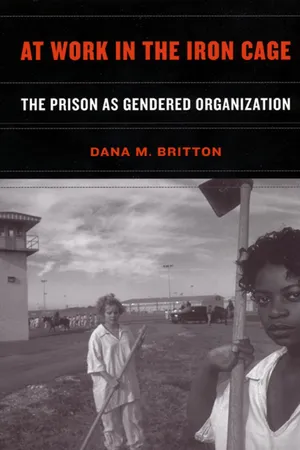
When most people think of prisons, they imagine chaos, violence, and fundamentally, an atmosphere of overwhelming brute masculinity. But real prisons rarely fit the “Big House” stereotype of popular film and literature. One fifth of all correctional officers are women, and the rate at which women are imprisoned is growing faster than that of men. Yet, despite increasing numbers of women prisoners and officers, ideas about prison life and prison work are sill dominated by an exaggerated image of men’s prisons where inmates supposedly struggle for physical dominance.
In a rare comparative analysis of men’s and women’s prisons, Dana Britton identifies the factors that influence the gendering of the American workplace, a process that often leaves women in lower-paying jobs with less prestige and responsibility.
In interviews with dozens of male and female officers in five prisons, Britton explains how gender shapes their day-to-day work experiences. Combining criminology, penology, and feminist theory, she offers a radical new argument for the persistence of gender inequality in prisons and other organizations. At Work in the Iron Cage demonstrates the importance of the prison as a site of gender relations as well as social control.
- 264 pages
- English
- ePUB (mobile friendly)
- Available on iOS & Android
eBook - ePub
About this book
Information
1
Engendering the Prison
Imagine a prison guard. Whom do you see? If you are like most people, the vision in your mind’s eye is probably that of a hulking man in uniform carrying a nightstick or even a gun. Perhaps you imagine him as brutal and sadistic; at the very least, you see someone who would be able to deal easily with unruly inmates, to meet violence with violence, to “bang heads” if necessary. Now imagine the place in which he does his work. Again, if like most of the population you have little experience of prison and prison life, you in all likelihood envision a Hobbesian nightmare of perpetual conflict, a war of all against all in which only the strong survive. If these are the images you saw, then you are not unusual. These notions have considerable currency. They are reflected in both commonsense mythology and popular culture. Films like Penitentiary (1938), Cool Hand Luke (1967), Brubaker (1980), and ConAir (1997) have framed prison work and prison life in these terms for generations of moviegoers. As this book demonstrates, however, these images have two things in common: they are largely inaccurate, and they are deeply gendered.
The figures obviously missing from this conceptual landscape are women, yet they are a growing proportion of those working and being held in prisons. As of 1995, 19 percent of all correctional officers (the term now preferred over the more colloquial “prison guard”) in federal and state prisons were women: 16 percent of officers in men’s prisons and 56 percent of those working in women’s facilities.1 Women account for 6.6 percent of all inmates in state and federal prisons, and their population has recently been increasing much faster than men’s. Regardless of the population they hold, most American prisons bear little resemblance to their anarchic fictional representations. Most inmates are non-violent offenders, and all have at least some stake in the maintenance of prison order, if for no other reason than the preservation of their own lives. It is because of this that mass outbreaks of prison violence are actually relatively rare. And contrary to popular mythology, correctional officers who work in inmate living areas are always unarmed. Given that they are commonly outnumbered by one hundred to one or more, a weapon of any kind is a potential liability.
These images also reflect ideas about gender. In this culture, the use of violence has always been connected with masculinity, whether the violence is illegitimate, as in the case of the “bad guy,” who becomes a prisoner, or legitimate, such as the sanctioned use of force by the police or corrections officer. Violence is so closely tied to hegemonic forms of masculinity that to be a “real man” is, by definition, to know how to use violence and to be willing to do so under appropriate circumstances. Given this, it only makes sense that men are the “natural” guardians of other men. The invisibility of women in our images of the prison and prison life also reveals the function of the masculine as an unmarked category. Prisons, in a generic sense, are men’s prisons; so, too, are prisoners and prison guards men. Women’s violence stands in stark contradiction to prevailing norms around (white) femininity, so much so that nineteenth-century criminologists believed the brains and bodies of women criminals to have been somehow masculinized. The requisites of femininity have the paradoxical effect of making women inmates appear even more aberrant than men, and seemingly disqualify women for the job of controlling prisoners, be they men or women.
While the evidence presented in this book contradicts some of these images, I also explore in more detail how notions like this shape our ideas about prisons and prison life. I propose that the ways that we think about the prison are deeply gendered and reflect an exaggerated version of life in men’s institutions, one in which “real men” constantly contend for the prize of masculine physical dominance. Women’s institutions are seen, when at all, as exceptions, or anomalies, though our ideas about them are also gendered and sexualized. In addition, in a comparative analysis of work in men’s and women’s prisons, I examine the ways that the prison, through its structure, practices, and policies, presumes and reproduces gender. Specifically, I show that work in the prison reflects the gendering of the institution at a number of levels, from the preconceptions and experiences that officer recruits bring with them, to training that focuses on violence and men’s institutions, to assignments based on ideas about what real officers (and thus real men) are like, to officers’ ideas about working with male and female inmates, and their conceptions of themselves as masculine or feminine.
This work draws on an emerging theoretical perspective in the sociology of work and organizations, the “theory of gendered organizations” (Acker 1990, 1992). In simple terms, the theory argues that we should see organizations not as neutral organisms infected by the germs of workers’ gender (and sexuality and race and class) identities but as sites in which these attributes are present in preexisting assumptions and constructed through ongoing practice. Thus far, this approach has figured in studies of a number of organizations and occupations, such as law and paralegal work (Pierce 1995), as well as nursing, teaching, librarianship, and social work (Williams 1995). Prisons are, without much question, both atypical organizations and unconventional work environments. In the jargon of the organizational literature, prisons belong to the small class of organizations known as “total institutions” (Goffman 1961), that is, these are settings in which people, at least for a time, live the whole of their lives. Residential schools, nursing homes, and the military are other examples of this type. This fact gives prison work some unique characteristics. Officers deal with a client population that is, by definition, involuntary, and thus understandably hostile and uncooperative at times. At the very minimum, prison inmates have a vested interest in subverting at least some elements of institutional control. Unlike most workers, prison officers are involved with the totality of inmates’ lives, supervising and surveilling their meals, showers, communications, and a multitude of normally private aspects of personal and sexual behavior.
Even given this, prisons are in some ways ideal settings for exploring processes of organizational and occupational gendering. Ideas about gender have shaped prisons, literally and figuratively, from their very first appearance as institutions of social control. Nineteenth-century reformers made women’s presumed inherent difference from men the primary basis of their case for separate institutions for women, run exclusively by female staff. In a similar way, ideas about masculinity played a role in the architecture and styles of discipline advocated in early men’s prisons. In a more general sense, the role of the total institution as a societal microcosm (Goffman 1961), as a small society in itself, means that gendering processes that may be diffuse or hidden in more open organizations may be easier to identify in this closed institutional context (Hearn and Parkin 1987).
Studying work in prisons also presents a virtually unique opportunity to perform a controlled comparison, one that may tell us much about the ways that gender inequality is maintained in more typical occupational settings. There is a considerable body of research on gender and work that relies on the comparative case study method, counterposing, for example, the experiences of fast-food workers and insurance sales agents (Leidner 1991, 1993), nurses and marines (Williams 1989), flight attendants and bill collectors (Hochschild 1983), and lawyers and paralegals (Pierce 1995). In some ways, however, this research is limited by the constraints of the occupational structure itself. The kinds of jobs that men and women do are very different, and it is difficult to directly compare the experiences of men integrating nursing, for example, to those of women lawyers. More light might be shed on the forces that shape workers’ experiences in male- and female-dominated occupations if one could compare a parallel case, a pair of institutions, similar in form and function, but in which one is dominated by women and one by men. These cases are rare, and none have yet been examined in a comparative study. The prison presents just such an opportunity. Men’s and women’s prisons are (at least nominally) parallel institutions, created for the same purposes and oriented toward the same goals. In general, the job of the correctional officer is the same in both settings; officers are responsible for enforcing institutional rules, dealing with inmate problems and complaints, supervising routine daily activities of inmates, and maintaining security. The similarity of the male- and female-dominated forms of the same institution thus allows for a somewhat controlled comparison, one in which, by holding the context constant (or as nearly so as possible), we may be able to identify some of the factors that produce inequalities of results and rewards for male and female workers, regardless of the organizational or occupational setting.
The analysis presented in this book draws on a number of sources. The primary material involves interviews I conducted from 1993 to 1998 with seventy-two corrections officers working in two men’s and three women’s prisons. Three are located in the South, two in the Midwest. Officers at state and federal facilities each constitute one-half of those in my study. There are twenty-seven women and forty-five men in the sample, and there are fifty-one white officers, fourteen African-Americans, and seven Hispanics. I conducted interviews with each officer that lasted between thirty minutes and three hours, asking them about their paths to the occupation, their training, and a wide variety of questions about work experiences and future plans (see the Methodological Appendix for a complete description of the sample and methodology). These data are supplemented by visits I made to prisons in two additional states. Though I was unable to undertake anything approaching complete ethnographies of these institutions, I was able to do some observation and informal interviewing at each.
The Theory of Gendered Organizations
The approach guiding the work presented here is relatively new, but it grows out of a long-established tradition of scholarship in gender, organizations, and occupations. Almost all this research begins from the same empirical problem: the large and persistent wage gap between men and women workers. Though women now make up 47 percent of those working in the paid labor force, those who work full-time, year-round, make only 73 percent of the salaries of their male peers.2 Much of this difference is due to occupational segregation, that is, men and women are in different jobs, and the jobs women hold pay less, on average, than those that men occupy. In 2001, about 20 percent of women workers were concentrated in just seven job categories.3 Male workers are less occupationally concentrated, and the average wages of the job categories in which they are most heavily represented are higher, on average, than those dominated by women.
The overall wage gap has persisted, however, even as women have begun to integrate some formerly male-dominated jobs. The reason for this is that even when men and women are in the same occupation, women still make less. In 2001, for example, women attorneys earned only 69 percent of the salaries of their male counterparts. This difference is largely due to internal stratification; women tend to occupy the lowest rungs of the occupational ladder. Women attorneys are more likely to be found in specialties like family law, public defense, and government law, all of which pay lower wages than those to be had in corporate law, a male-dominated specialty (Pierce 1995). Women correctional officers, on the other hand, make 83 percent of the wages of their male counterparts,4 and they are more likely to be found in state rather than federal prisons (where salaries are higher).5 As of 1995, women were 19 percent of officers in state prisons, but only 12 percent of those in federal facilities. Women are also less likely than men to occupy top administrative posts. Fewer than 10 percent of wardens in adult facilities, including women’s prisons, are women (Martin and Jurik 1996).
But these well-established findings take us only so far toward solving the puzzle of women’s lower wages. Nor do they explain the persistent empirical documentation of women’s lower levels of organizational power, status, autonomy, and mobility, a finding that holds regardless of the occupation or organizational setting. Taken as a whole, this research raises at least three further questions. First, why is occupational segregation so persistent, even in the wake of three decades of legal changes that have removed the formal barriers to women’s (and men’s) entry into occupations formerly dominated by members of the other sex? Second, why is it that the jobs in which women are concentrated pay less? Why are “people” or nurturing skills (disproportionately required by female-dominated jobs) systematically devalued? Finally, what factors keep women at the bottom of the ladder within occupations? Once they make the leap into the pool of lawyers, doctors, construction workers, or correctional officers, why do women sink to the bottom?
Drawing on the theory of gendered organizations (Acker 1990, 1992; Williams 1995), I suggest that the answer to all these questions can be found in the interaction between three factors: the structures of work organizations, the cultural and ideological assumptions upon which they draw and which in turn shape them, and the agency of workers themselves.6 This approach is grounded in two key assumptions. First, organizations must be viewed from within the context of an unequal society, one in which gender domination exists and is reproduced on an ongoing basis. Gender is not something imported into organizations with workers; it is an inseparable part of organizational structure (Acker 1990, 1992; Williams 1995; see also Smith 1979). Second, in line with the interactionist tradition in the sociology of gender (Kessler and McKenna 1978; West and Zimmerman 1987; West and Fenstermaker 1995), I conceptualize gender as a process, the product of a social construction that can be carried out both at the micro level (by the individual actor) and at the macro level (by social institutions, policies, and practices) (Acker 1990, 1992; Britton 1997a, 2000; Pierce 1995; Williams 1995). From this perspective, gender structures the organization and is reproduced by organizational policies and actors. In a similar way, notions about class, race, and sexuality are also intertwined with the framework of modern organizations. Though my focus will be on gender, this should not be taken to mean that I view gender as somehow more fundamental than these other characteristics. I hope to provide some insight as well into how these other axes of inequality shape organizational life.
Levels of Gendering in Organizations
One can conceptualize the process of gendering at a number of levels. Organizational structures, in the form of policies and practices, assume and build on the gender division of labor and more general notions about men and women. Workers in organizations exercise their own agency by “doing gender,” that is, men and women workers reproduce themselves (and others) as organizational actors with “appropriately” gendered characteristics. Culture plays a role as well—as the example of the prison suggests, we think about and represent organizations and occupations in deeply gendered ways. At the outset, however, it is important to note that while these levels will be separated for the purposes of analysis, in reality, they are always connected in dialectical processes of interaction; structure, agency, and culture are all interlinked in ongoing processes of organizational gendering. Gendered policies, for example, may be challenged by organized groups of workers who find themselves disadvantaged as a result. Organizational structures provide the bounded contexts in which workers define and contest occupational masculinities and femininities. Gendered cultural representations and ideologies affect our job choices, employers’ preferences for particular kinds of workers, and the practices that take place within organizations themselves. The great power of the gendered organizations approach lies in its potential to help us to understand not only the gendering process at each of these levels but also the interconnections between them.
Gendering through Organizational Structure
Fundamentally, organizations are gendered at the level of structure. In a very basic sense, organizations build on and reproduce a division of labor between the public and private spheres, between production and reproduction (Acker 1992). Most modern work organizations presume that the labor involved in the day-to-day reproduction of their workers may be relegated to the private realm, thus enacting a rigid separation between the work lives of their employees and such activities as childbirth, child care, sexuality, eating, and sleeping (Acker 1992). This division between public and private is on the order of an ideal type, of course. Some employers now provide benefits such as child care and paid maternity leave, though this is a rarity, and those who do so are still widely regarded as having done something extra, beyond the minimum necessary compensation due all workers. Such a division also makes much more sense from the perspective of men, rather than women, workers. Because women are primarily responsible for domestic tasks and child care, they often experience, and deal with the consequences of, the spillover of their duties in the private realm into their working days. Particular employers may be more or less tolerant of this, but again, workers see the former as unusually benevolent exceptions. Male workers typically enjoy much greater freedom from the distractions of the private sphere. Underlying the concept of the “job,” then, is the assumption that its holder will be able to honor the separation between public and private presumed by the organization. This means that jobs, the most basic units of organizational structure, are based on notions about gender and sustain its reproduction. As Acker writes: “The closest the disembodied worker doing the abstract job comes to a real worker is the male worker whose life centers on his full-time, lifelong job, while his wife or another woman takes care of his personal needs and children” (1990: 149).
The presumptions built into most jobs shape women’s paths to sex-segregated occupations. Research fairly consistently shows that, in the abstract, men and women value the same kinds of job characteristics, with salary, autonomy, prestige, and location topping the list (Bose and Rossi 1983; England 1982; Jencks, Perman, and Rainwater 1988; Kaufman and Fetters 1980; O’Farrell and Harlan 1982; Rowe and Snizek 1995; Walker, Tausky, and Oliver 1982). However, women, more than men, are forced to make trade-offs between work and family. This often restricts their options in terms of working hours, schedules, location, transfers, and travel and in practice can make female-dominated jobs appear more attractive. Many of these jobs offer regular hours and at least somewhat flexible schedules, allow for some “crossover,” however limited, between home and work life, and impose few penalties for women’s movement between locales and in and out of the labor force. Women pay a premium for this flexibility, obviously. The presumption of a rigid separation between public and private domains and its effect on women’s (and men’s) work affects the division of labor within organizations. This fact alone goes quite a long way toward explaining why women predominate in clerical positions, and men in administrative ones.
But it can also explain stratification within occupations. Workers who are free to put in long hours are generally perceived by employers as more committed and as better candidates for raises and promotions. Data indicate that men work more overtime than women, on average, and men predominate in the kinds of careers that require extraordinary numbers of hours per week. Domestic responsibilities may make women less likely to pursue avenues for upward mobility. This correctional officer, a white woman I interviewed in a men’s prison, had repeatedly eschewed promotion for precisely this reason:
[In my previous job], I went up [for promotion] and then I asked to be put back down. I just didn’t want the responsibility. It was just too much all the time. It was like I never had any time for me and my family. I don’t want that. Do you think women are more likely to think that way? I think so. Because being a mom and … a woman is, how do you put it? She’s got to be like a Jill of all trades, and that just goes along with being a female. So maybe it’s easier for men to move up the chain for that reason? I think so. That’s the way I see it. It would take a really special person to have the rank and those responsibilities plus a household.
The distinction between public and private spheres is even more strongly reinforced in jobs that require higher levels of responsibility and commitment, such as supervisory positions. In the current context, it does indeed take a “really special” woman to combine this kind of work with primary family responsibilities. The ex...
Table of contents
- Cover Page
- Title Page
- Copyright Page
- Contents
- Acknowledgments
- 1 Engendering the Prison
- 2 Penology in America: Men’s and Women’s Prisons as Gendered Projects
- 3 From Turnkey to Officer: Prison Work in Historical Perspective
- 4 Paths to Prison
- 5 Work with Inmates
- 6 The Rest of the Job: Coworkers, Supervisors, and Satisfaction
- 7 Conclusion
- Methodological Appendix
- Notes
- References
- Index
- About the Author
Trusted by 375,005 students
Access to over 1.5 million titles for a fair monthly price.
Study more efficiently using our study tools.
Frequently asked questions
Yes, you can cancel anytime from the Subscription tab in your account settings on the Perlego website. Your subscription will stay active until the end of your current billing period. Learn how to cancel your subscription
No, books cannot be downloaded as external files, such as PDFs, for use outside of Perlego. However, you can download books within the Perlego app for offline reading on mobile or tablet. Learn how to download books offline
Perlego offers two plans: Essential and Complete
- Essential is ideal for learners and professionals who enjoy exploring a wide range of subjects. Access the Essential Library with 800,000+ trusted titles and best-sellers across business, personal growth, and the humanities. Includes unlimited reading time and Standard Read Aloud voice.
- Complete: Perfect for advanced learners and researchers needing full, unrestricted access. Unlock 1.5M+ books across hundreds of subjects, including academic and specialized titles. The Complete Plan also includes advanced features like Premium Read Aloud and Research Assistant.
We are an online textbook subscription service, where you can get access to an entire online library for less than the price of a single book per month. With over 1.5 million books across 990+ topics, we’ve got you covered! Learn about our mission
Look out for the read-aloud symbol on your next book to see if you can listen to it. The read-aloud tool reads text aloud for you, highlighting the text as it is being read. You can pause it, speed it up and slow it down. Learn more about Read Aloud
Yes! You can use the Perlego app on both iOS and Android devices to read anytime, anywhere — even offline. Perfect for commutes or when you’re on the go.
Please note we cannot support devices running on iOS 13 and Android 7 or earlier. Learn more about using the app
Please note we cannot support devices running on iOS 13 and Android 7 or earlier. Learn more about using the app
Yes, you can access At Work in the Iron Cage by Dana M. Britton in PDF and/or ePUB format, as well as other popular books in Social Sciences & Criminology. We have over 1.5 million books available in our catalogue for you to explore.