Honorable Mention for the 2008 Robert Park Outstanding Book Award given by the ASA’s Community and Urban Sociology Section
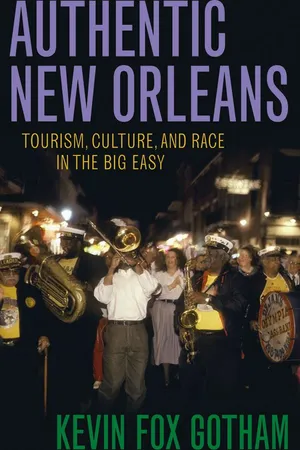
Mardi Gras, jazz, voodoo, gumbo, Bourbon Street, the French Quarter—all evoke that place that is unlike any other: New Orleans. In Authentic New Orleans, Kevin Fox Gotham explains how New Orleans became a tourist town, a spectacular locale known as much for its excesses as for its quirky Southern charm.
Gotham begins in the aftermath of Hurricane Katrina amid the whirlwind of speculation about the rebuilding of the city and the dread of outsiders wiping New Orleans clean of the grit that made it great. He continues with the origins of Carnival and the Mardi Gras celebration in the nineteenth century, showing how, through careful planning and promotion, the city constructed itself as a major tourist attraction. By examining various image-building campaigns and promotional strategies to disseminate a palatable image of New Orleans on a national scale Gotham ultimately establishes New Orleans as one of the originators of the mass tourism industry—which linked leisure to travel, promoted international expositions, and developed the concept of pleasure travel.
Gotham shows how New Orleans was able to become one of the most popular tourist attractions in the United States, especially through the transformation of Mardi Gras into a national, even international, event. All the while Gotham is concerned with showing the difference between tourism from above and tourism from below—that is, how New Orleans’ distinctiveness is both maximized, some might say exploited, to serve the global economy of tourism as well as how local groups and individuals use tourism to preserve and anchor longstanding communal traditions.
- 288 pages
- English
- ePUB (mobile friendly)
- Available on iOS & Android
eBook - ePub
About this book
Information
1
Introduction
Authentic New Orleans
In the days following the devastation unleashed by Hurricane Katrina, media outlets from around the world broadcasted riveting images of stranded residents, widespread physical damage, and flooded neighborhoods. News coverage of the aftermath revealed that the vast majority of people left behind in New Orleans were poor, African American, and elderly. Subsequent analysis confirmed the unequal effect of the hurricane’s damage, showing that almost one-half of the people living in damaged areas were African American and over 45 percent of homes were occupied by renters.1 Since the hurricane, residents have been returning to the city, even though physical destruction is widespread. The process of rebuilding the economic base, public school systems, legal and government infrastructures, and transportation systems is likely to take years.
The demographic and population consequences of the evacuation of tens of thousands of people remain unclear. The physical damage was extensive and uneven. Some of New Orleans’s famous tourist attractions like the French Quarter and the Audubon Zoo suffered little negative impact from the hurricane, whereas others such as City Park and the city’s famous cemeteries experienced major damage. Moreover, while the Uptown area and Garden District neighborhood escaped severe flooding, other neighborhoods such as the Ninth Ward, Treme, Marigny, and Broadmoor remained largely unoccupied months after the storm. Katrina’s forced displacement of residents and destruction has not only exposed the fault lines of race and class but also inspired debate over whether New Orleans’s rich culture and distinctive authenticity have been lost forever. No one knows what will come of the dispersal of New Orleans’s music and artistic life, or whether the thousands of artists and musical transients will become transplants.
Since the havoc, journalists, scholars, and others have presented the world with at least three contrasting scenarios for New Orleans’s future, scenarios that reflect different interpretations of the city’s past development as a tourist destination. One interpretation views the city as a twenty-first-century Pompeii, where the ravages of Katrina have wiped clean the enriching and vibrant culture that used to undergird and support a flourishing tourism sector. According to popular writer Anne Rice, Hurricane Katrina “has done what racism couldn’t do, and what segregation couldn’t do either. Nature has laid the city waste—with a scope that brings to mind the end of Pompeii.”2 Displaced musicians, preservationists, and others assert that what made New Orleans unique was the unbroken traditions of jazz music, creole architecture, and delicious cuisine. “The flavor and physical setting of the city’s culture is locked up in the vernacular wooden houses of the nineteenth century,” according to historian S. Frederick Starr, “and I fear from them now. [Are city officials] going to seize on this as an opportunity for mass demolition, in order to build something akin to Houston?”3 “It’s Armageddon for the culture,” according to one New Orleans pianist; “it’s the ephemeral folk expression in New Orleans that is gone,” echoes one archeologist.4 In an op-ed piece titled “Requiem for the Crescent City,” Washington Post journalist Eugene Robinson eulogized that the “old New Orleans is dead” because “the people who made it special are gone and so is the path for them to come back.”5 “In 2025, I can practically write the tourist-guide spiel,” according to local architect Allen Eskew; “the dark history will be buried, along with the black bodies. And that means a lot of black culture will be buried along with it.”6 These views suggest that the scattering of residents throughout the nation has eroded the tight-knit communities that used to be the seedbeds of cultural invention in the city. In this scenario, the rebuilding of New Orleans will be akin to the banalization of the city and its transformation into a culturally empty place divested of authenticity and communal value.
A second interpretation is that a reconstructed New Orleans will emerge, one displaying the features of a Disney theme park or Las Vegas–style entertainment destination. In this vision of the future, the resurrected city will be sanitized of its past charm and turned into a culturally and ethnically homogenous city that is an artificial and contrived version of its old urban self. “Will this quirky and endlessly fascinating place become an X-rated theme park, a Disneyland for adults?” Tulane University history professor Larry Powell asked in a speech. “Is it fated to be the place where Orlando embraces Las Vegas? That’s the American Pompeii I apprehend rising from the toxic sludge deposited by Lake Ponchartrain: an ersatz city, veritable site of schlock and awe.”7 According to filmmaker Ken Burns, the “spectacular vernacular architecture is all but destroyed… . I’m worried the money will come pouring in and what we’ll wind up with is a bigger, gaudier New Orleans, like Las Vegas.”8
In this interpretation, people worry about the taming of New Orleans’s improvisational impulse and the loss of creative culture embodied in the characters and eccentrics that once populated the city’s neighborhoods. “New Orleans is the most African of American cities, and those who have been displaced and potentially have the fewer resources to return are a core of this culture,” according to Danille Taylor, dean of humanities at Dillard University. “It’ll be a Disneyland if those people aren’t there.”9 This sense of unease is fueled by the slow progress of rebuilding and eerie rumors that city leaders are courting global entertainment chains and casinos to locate to New Orleans to supply the capital to rebuild the city. Mayor C. Ray Nagin’s initial proposal to create a casino district to stimulate rebuilding was quickly retracted in the face of intense opposition by local groups and the state governor’s office. “They’re trying to mold this city into a pseudo-Disneyland, gambling center, party center, a facade,” remarked one local artist. “I … fear the Disneyfication of the French Quarter with all this money: people coming and buying up bars, music clubs, old restaurants—and naming drinks ‘Katrina,’” complained another resident.10 These lamentations reflect a feeling that the 20 percent of the city that did not flood, including the Uptown area and French Quarter, will retain their tourist appeal and anchor the broader transformation of the city into a Disney-like theme park to entertain visitors. In this scenario, the cultural richness of pre-Katrina New Orleans will become a fossilized relic to amuse visitors.
A third interpretation views post-Katrina rebuilding as helping to foster a new appreciation and rebirth of local culture that will enliven and mobilize people to create new bases of urban authenticity. While some residents are deeply cynical and pessimistic about the future, others are hopeful that the distinctive way of life that residents nurtured for generations will act to stimulate and support a phoenix-like recovery that will animate and reinvent local heritage. “The New Orleans Area is steeped in tradition, but it is also a place that re-invents itself when need be,” according to the New Orleans Times-Picayune newspaper.11 Long-term residents and people who love the city have long championed New Orleans as one of the last authentic places in the nation. These people maintain that New Orleans’s unique sense of culture and place has been the bulwark against the homogenizing tendencies that have overtaken metropolitan America. While the spread of suburban-style strip malls, theme parks, chain stores, and other standardized and generic experiences have come to define many places, New Orleans has been a cultural “other” that has managed to retain an individuality and authenticity of its own. New Orleans is “a citadel against the McNuggeting of America. It seemed to resist the homogenization seen in many cities,” according to Denver Post journalist William Porter. “For me, New Orleans is one of the few authentic places left in our landscape, and that compounds the tragedy,” remarks filmmaker Ken Burns. “No other city is so equipped to deal with [Hurricane Katrina],” according to Louis Edwards, novelist and associate producer of the Jazz and Heritage Festival. “Think of the jazz funeral… . In New Orleans we respond to the concept of following tragedy with joy. That’s a powerful philosophy to have as the underpinning of your culture.”12
In the months since Katrina roared ashore, a plethora of books and articles have appeared proclaiming New Orleans to be one of America’s most beloved cities. Titles such as My New Orleans: Ballads to the Big Easy by Her Sons, Daughters, and Lovers; Why New Orleans Matters; and Very New Orleans: A Celebration of History, Culture, and Cajun Country Charm serve as timely and timeless tributes to the powerful spirit that defines the city. On the local level, a quiet but urgent conversation about New Orleans’s cultural survival and its sense of authenticity radiates through city streets and major institutions. Prognostications about loss and decline juxtapose with tales of resilience and strength in the face of adversity. While to some the future looks bleak and the city will never be the same, others look to the Katrina tragedy as an opportunity to face the quintessential challenge of rebuilding and reinventing the cultural heart of America.
Questions about New Orleans’s future are intertwined with symbols of solidarity and division that seek to make explicit, and more comprehensible, a city’s conflicting conceptions of itself and its past. In writing this book, I try to illuminate the interlocking nature of conflicts over race, culture, and authenticity in New Orleans and trace historically how tourism practices have displayed and articulated these conflicts. For more than a century, New Orleans has been a complex and constantly mutating city in which meanings of place and community have been inexorably intertwined with tourism practices. This book examines the historical growth and expansion of the tourism industry in New Orleans, the role of tourism in transmitting symbols of local culture and authenticity, and the influence of race and racial inequalities on tourism practices. For decades, scholars have derided tourism as a global process of standardization and cultural homogenization that annihilates the unique features and genuineness of places and creates what sociologist Dean MacCannell calls “staged” authenticity.13 Others have viewed tourism as a set of discrete economic activities, a mode of consumption, or a spatially bounded locality or “destination” that is subject to external forces producing impacts. In contrast, I view tourism as a highly complex set of institutions and social relations that involve capitalist markets; state policy; and flows of commodities, cultural forms, and people. In this conception, tourism is not exogenous to localities but is embedded within broader patterns of metropolitan development and sociospatial inequality. My goal is to investigate the processes of authentication through which different groups and interests make claims for local authenticity and attempt to legitimate their constructions of race and culture. I examine the historical development of racial meanings of local authenticity, analyze how conflicts over tourism have changed over time, and address wider issues concerning the relationship between tourism and the construction of place identity.
The connections between race, culture, and tourism are important for understanding the historical development of New Orleans and its future in the aftermath of Katrina. Terms such as “whiteness,” “blackness,” “creole,” “diversity,” and “multiculturalism” have long been major signifers of local identity, as a well as sources of division and conflict. Today, these categories are fueling local and national debates over who owns New Orleans, which groups should be allowed to return, and how the city should be rebuilt. Likewise, discussions about the role of tourism in the rebuilding process are sparking conflict over which cultural symbols and images reflect the “authentic” New Orleans and who should define what is local authenticity. Popular discussions frequently employ reified and stereotyped designations that obscure the historically changing nature of race, culture, and place. Scholars have pointed out that race and culture are socially constructed categories that have an emergent and variable quality rather than being fixed or immutable group characteristics.14 In New Orleans, racial and ethnic group distinctions, as well as cultural designations, have always been politically contested and subject to intense debate and protest. Moreover, the constructed and contingent nature of race and culture have been reinforced by the inherently fluid, situational, and fabricated nature of authenticity.15 Authenticity is a notoriously labyrinthine concept that can refer to a variety of idealized representations of culture, identity, place. While authenticity may be a socially constructed representation of reality, it has always been real in its consequences as different groups and organized interests have struggled to create and legitimate meanings of an authentic New Orleans. Broadly, in this book I seek to provide deep understanding into the changing role of tourism discourses and practices in the creation and transformation of New Orleans’s urban iconography.16
Historians such as Catherine Cocks, Jane C. Desmond, Harvey Newman, Hal Rothman, John F. Sears, and Marguerite S. Shaffer, among others, have unearthed a wealth of data that describe the role tourism has played in the development of national and local identities and in places of cultural significance.17 Yet many of these historical accounts lack empirical specificity and have made little progress in theorizing the development of tourism and its attendant spatial manifestations. Moreover, many accounts of tourism present it as either primarily negative (a destroyer of cultures and local traditions) or primarily positive (bringing a wealth of new products, ideas, and economic opportunities to people). Thus, the historical trajectories and path dependencies of tourism development remain underresearched, both empirically and theoretically. Another problem is the lack of serious examination of the connections between race and tourism. Many studies merely assert the importance of race and racial discrimination without an appreciation of their socially constructed and changing meanings. In this book, I analyze the changing linkages between tourism and race to show how specific racial meanings and manifestations of discrimination were institutionalized within the tourism industry during the twentieth century. At the same time, I examine the role of social movements and protest groups in using tourism discourses and practices to challenge social inequalities and contest marginalization.
Tourism from Above and Below
A major goal in this book is to develop a theoretically driven explanation of the historical development of tourism and its articulation with local actions and broader socioeconomic processes. For years, scholars have assailed tourism as a force of globalization that hollows out the rich texture and distinctiveness of local relations and their creations, and thereby corrupts authentic cultural spaces.18 According to critics, tourism transforms local culture into abstract, manufactured, and simulated social forms that are estranged from communal life and devoid of authenticity. Other more celebratory accounts have viewed tourism as a force of diversification that promotes cultural invention and innovation.19 Rather than embracing either/or explanations of tourism, I develop a both/and conceptualization that views tourism as an amalgam of both homogenizing forces of sameness and uniformity, and diversifying forces of difference and hybridity. I advance this conceptualization by distinguishing between tourism from above and tourism from below, a distinction that can help us get a better sense of how tourism can promote as well as destabilize and undermine local traditions and cultures.
Tables 1.1 and 1.2 present a schematic overview of the major processes, structures and networks, and key actors and organizations in New Orleans associated with tourism above and below. Broadly, tourism from above and tourism from below are not independently given sets of phenomena (a dualism) but a duality; they are an interplay that presupposes each other. Thus, tourism from above processes do not exist “apart” from localities but are embedded in networks and organizations that facilitate some forms of action and decision making in particular locales while discouraging others. To be specific, tourism from above and below and their related pro...
Table of contents
- Cover Page
- Title Page
- Copyright
- Contents
- Preface: In Defense of Tort Law
- 1 Introduction: Authentic New Orleans
- 2 Processions and Parades: Carnival Krewes and the Development of Modern Mardi Gras
- 3 “Of Incomprehensible Magnitude and Bewildering Variety”: The 1884 World’s Industrial and Cotton Centennial Exposition
- 4 Authenticity in Black and White: The Rise of Tourism in the Twentieth Century
- 5 Boosting the Big Easy: New Orleans Goes Global
- 6 From a Culture of Tourism to a Touristic Culture: The 1984 Louisiana World Exposition and the Holy Trinity of New Orleans Tourism
- 7 A Repertoire of Authenticity: Contested Space and Transformation of the French Quarter
- 8 “The Greatest Free Show on Earth”: Intimations and Antinomies of Commodification and Carnival
- 9 Conclusion: The Future of New Orleans
- Notes
- Selected Bibliography
- Index
- About the Author
Trusted by 375,005 students
Access to over 1.5 million titles for a fair monthly price.
Study more efficiently using our study tools.
Frequently asked questions
Yes, you can cancel anytime from the Subscription tab in your account settings on the Perlego website. Your subscription will stay active until the end of your current billing period. Learn how to cancel your subscription
No, books cannot be downloaded as external files, such as PDFs, for use outside of Perlego. However, you can download books within the Perlego app for offline reading on mobile or tablet. Learn how to download books offline
Perlego offers two plans: Essential and Complete
- Essential is ideal for learners and professionals who enjoy exploring a wide range of subjects. Access the Essential Library with 800,000+ trusted titles and best-sellers across business, personal growth, and the humanities. Includes unlimited reading time and Standard Read Aloud voice.
- Complete: Perfect for advanced learners and researchers needing full, unrestricted access. Unlock 1.5M+ books across hundreds of subjects, including academic and specialized titles. The Complete Plan also includes advanced features like Premium Read Aloud and Research Assistant.
We are an online textbook subscription service, where you can get access to an entire online library for less than the price of a single book per month. With over 1.5 million books across 990+ topics, we’ve got you covered! Learn about our mission
Look out for the read-aloud symbol on your next book to see if you can listen to it. The read-aloud tool reads text aloud for you, highlighting the text as it is being read. You can pause it, speed it up and slow it down. Learn more about Read Aloud
Yes! You can use the Perlego app on both iOS and Android devices to read anytime, anywhere — even offline. Perfect for commutes or when you’re on the go.
Please note we cannot support devices running on iOS 13 and Android 7 or earlier. Learn more about using the app
Please note we cannot support devices running on iOS 13 and Android 7 or earlier. Learn more about using the app
Yes, you can access Authentic New Orleans by Kevin Fox Gotham in PDF and/or ePUB format, as well as other popular books in Social Sciences & Ethnic Studies. We have over 1.5 million books available in our catalogue for you to explore.