Uncovers the mindset and motives that drive far-right extremists
More than half a century after the defeat of Nazism and fascism, the far right is again challenging the liberal order of Western democracies. Radical movements are feeding on anxiety about immigration, globalization and the refugee crisis, giving rise to new waves of nationalism and surges of white supremacism. A curious mixture of Aristocratic paganism, anti-Semitic demonology, Eastern philosophies and the occult is influencing populist antigovernment sentiment and helping to exploit the widespread fear that invisible elites are shaping world events.
Black Sun examines this neofascist ideology, showing how hate groups, militias and conspiracy cults gain influence. Based on interviews and extensive research into underground groups, the book documents new Nazi and fascist sects that have sprung up since the 1970s and examines the mentality and motivation of these far-right extremists. The result is a detailed, grounded portrait of the mythical and devotional aspects of Hitler cults among Aryan mystics, racist skinheads and Nazi satanists, and disciples of heavy metal music and occult literature.
Nicholas Goodrick-Clarke offers a unique perspective on far right neo-Nazism viewing it as a new form of Western religious heresy. He paints a frightening picture of a religion with its own relics, rituals, prophecies and an international sectarian following that could, under the proper conditions, gain political power and attempt to realize its dangerous millenarian fantasies.
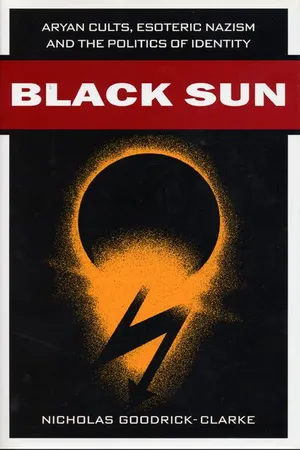
eBook - ePub
Black Sun
Aryan Cults, Esoteric Nazism, and the Politics of Identity
- 371 pages
- English
- ePUB (mobile friendly)
- Available on iOS & Android
eBook - ePub
About this book
Information
1
American Neo-Nazism
AN EXOTIC IMPORT from Europe, American neo-Nazism has always transcended American nationalism. American neo-Nazis regard themselves as the brothers of all white men in a global movement of racial nationalism. While they remain fixated on the figure of Adolf Hitler as the lost savior of the Western world, his German nationalist horizons are superseded by their wider vision of a pan-Aryan movement led by the United States as the leading white power of the postwar world. American neo-Nazism traces its roots to the early 1950s, when the anti-communist ideology of the Cold War could find a nostalgic model in Hitler’s attempted destruction of the Soviet Union. Neo-Nazism quickly stigmatized liberalism and the American Jews as the aides and abettors of communism in a violent anti-Semitism based on Nazi models. However, it was desegregation and the black civil rights movement of the early 1960s which have provided the enduring political motivation for American racial nationalism. The social enfranchisement of black Americans, forced integration, busing affirmative action and equal opportunities led the American neo-Nazis to cast themselves in a white supremacist role. When large-scale Hispanic and other Third World immigration began in the 1980s, American neo-Nazism regarded itself as the front-line defense of America’s survival as a white nation. The changing ethnic composition of the United States is a profound issue, as is the political cohesion of an increasingly diverse multicultural society. The progression of American neo-Nazism from George Lincoln Rockwell in the 1960s to William Pierce in the 2000s illustrates how the religious myths of German National Socialism are brought to bear on dramatic cultural changes in American demography and identity.
The self-styled Führer of the 1960s, George Lincoln Rockwell will always be identified as the founder of the overtly pro-Hitler, postwar Nazi movement in the United States. Rockwell’s extravagant praise for Hitler, his violent racism against the Jews and blacks, allied with excess and exhibitionist tactics, have ensured him a lasting place in the folklore of American political extremism. Despairing of his earlier political efforts with old-style far-right groups, Rockwell founded his American Nazi Party in 1959, adopting a brazen Nazi image complete with swastika flags, stormtroopers and open declarations of his intentions to gas the Jews. He fantasized that he would become president of the United States by 1973 and that he would enjoy the support of a Senate and House of Representatives made up of members of his party. His political program was firmly grounded in a policy of “white survival” which aimed at the wholesale repatriation of all American Negroes to Africa and at the extermination of the Jews, whom he regarded as the architects of racial desegregation, national decline and cultural degeneracy.
A mixture of clowning and provocation characterized all of Rockwell’s public appearances. Soon after founding the party, Rockwell and his men regularly picketed the White House with signs that read “Save Ike from the kikes,” “The only communist party in the Middle East is in Israel,” “Gas red Jewish spies” and “Communism is Jewish.” In 1961 Rockwell drove a “Hate Bus” through the South until his party was apprehended at New Orleans. The sides of the vehicle were hung with notices such as “We do hate race-mixing” and “We hate Jew-Communism.” Back in Washington, his stormtroopers used to drive a bus around the city bearing the slogan: “Rockwell is right! Who needs niggers?” In Boston and Philadelphia, the party picketed cinemas showing the popular film Exodus, which told the story of Jewish immigrants to Israel after World War II, with banners demanding “America for Whites and Gas Chamber for Traitors.”Throughout the mid-1960s, Rockwell and his American Nazi Party were involved in numerous protests and disruptions. Charges against stormtroopers ranged from fighting, loitering, vagrancy and assault to desertion, criminal defamation and unlawful possession of firearms.
What makes an American Nazi? Examining Rockwell’s life, one finds a mixture of religious conviction and idealism driving a noisy program of anti-Semitism and anti-communism, white supremacy and eugenics. His exhibitionist tactics were very likely influenced by his parental background. George Lincoln Rockwell was born on 9 March 1918 in Bloomington, Illinois, the eldest son of theatrical performers. His father, George Lovejoy “Doc” Rockwell, was a vaudeville comedian of English and Scottish ancestry with a top act on Broadway and well known on radio and in the leading theaters of the country. His mother, born Claire Schade, was a young German-French toe dancer, part of a family dance team. Following his parents’ divorce, he spent his childhood staying with his mother in rural Illinois and his father on the Maine coast, where regular house guests included Fred Allen, Benny Goodman and Groucho Marx.1
After completing prep school at Hebron Academy, Rockwell attended Brown University in 1938 to study philosophy and sociology. He quickly became politicized against the liberal, egalitarian tenor of social science and his teachers. Later, he became convinced that liberalism was the “pimping little sister” of communism. His grades were poor but he was art editor of the campus magazine, Sir Brown. His cartoons ranged from the humorous to comicbook horror with images of violence, destruction and bombings.2 The prospect of war offered a welcome relief from his studies. Eager for action, high-strung and edgy, Rockwell was swayed by the contemporary buildup of anti-German opinion. By March 1941, he had enlisted in the Naval Air Corps and quickly won his wings. He served as a naval aviator flying anti-submarine missions in the South Atlantic and South Pacific throughout World War II, commanded the naval air support at the battle for Guadalcanal and during the invasion of Guam in August 1944 and was demobbed with the rank of lieutenant commander and several decorations in October 1945.3
Meanwhile, he had married a girl he had known as a student at Brown. Rockwell spent the first five years after leaving the navy studying art and then taking a variety of jobs as a commercial photographer, a painter, an advertising executive and a publisher in Maine and New York. He showed some promise as a commercial artist, enrolling at the Pratt Institute in New York. In 1948 he won a $1,000 prize in a national art contest sponsored by the National Society of Illustrators. But war again intervened in his career. In 1950, with the outbreak of the Korean War, Rockwell returned to active duty, training fighter pilots in southern California. His involvement with the Korean conflict bred in him an enduring hatred of communism and a paranoid fear that it would undermine the United States.4
It was here that Rockwell first became politically engaged in the campaign to have the military hero General Douglas MacArthur elected president. The anti-communist revelations of Joseph McCarthy also dominated this period, and Rockwell was deeply suspicious of the motives of those who sought to discredit him. An old lady in San Diego involved in the MacArthur campaign showed him some newspapers that she claimed were controlled by Jews and out to smear both men. She introduced him to McCarthy’s speeches and Conde McGinley’s anti-Semitic newspaper, Common Sense, which contained startling revelations of a secret Jewish-communist plot behind the scenes of twentieth-century history. She also encouraged him to attend a speech of the veteran anti-Semite and rabble-rouser Gerald L. K. Smith in Los Angeles. Rockwell was overwhelmed by Smith’s emotive exposure of the Jewish conspiracy and bid for world power.5 Through further reading in the San Diego public library, he became convinced of the existence of a Jewish-communist world conspiracy. Rockwell was staggered by both the seeming magnitude of the conspiracy as well as the official and media silence concerning its existence. Down in the dark book stacks of the San Diego library one autumn day in 1950, Rockwell experienced illumination and political awakening. He had always felt that the world was out of joint, that mischief was afoot, but now he felt he held the key to the past and the present. But how could he fight against this monstrous and universal plot? Given the apparent enormity of the Jewish world conspiracy, Rockwell now wondered why America had gone to war on the side of the communist Soviet Union and opposed “Christian Germany, which never had a single highly placed spy in [America], and no plans for conquering the world.” The example of Adolf Hitler and his crusade against world Jewry and communism quickly came to mind. Rockwell believed Hitler had understood the Jewish menace from the outset of his career and that the Jews had involved Britain and America in the conflict for their own interests. Early in 1951, Rockwell found a copy of Mein Kampf in a local bookshop, read it and saw the world anew:
[Here] I found abundant “mental sunshine,” which bathed all the gray world suddenly in the clear light of reason and understanding. Word after word, sentence after sentence stabbed into the darkness like thunderclaps and light-ningbolts of revelation, tearing and ripping away the cobwebs of more than thirty years of darkness, brilliantly illuminating the mysteries of the heretofore impenetrable murk in a world gone mad. I was transfixed, hypnotized.…I wondered at the utter, indescribable genius of it… I realized that National Socialism, the iconoclastic world view of Adolf Hitler, was the doctrine of scientific racial idealism—actually a new religion.6
Thus was George Lincoln Rockwell converted to the religion of National Socialism. In later years he would write that “future generations will look upon Adolf Hitler as the White Savior of the twentieth century, and the Fuehrerbunker in Berlin as the Alamo of the White race.”7
Some eight years were yet to elapse before he became an outspoken Hitlerite at the head of the American Nazi Party. Meanwhile, in November 1952, the navy had assigned him to a base at Keflavik in Iceland, where he spent two years as a F8F Bearcat pilot and achieved the rank of commander. Here he met his second wife, Thora Hallgrimsson, a member of a prominent local family and the niece of Iceland’s ambassador to the United States. Rockwell was still engrossed in Mein Kampf and took his bride to Berchtesgaden, Germany, for their honeymoon. They made a pilgrimage to Hitler’s Eagle’s Nest in a mood of reverence and fascination.8 On returning to civilian life, he decided to enter magazine publishing, hoping to find both a livelihood and a forum for his political ideas. He was also active among right-wing groups, attempted to launch an American Federation of Conservative Organizations and tried to advance by concealing his Nazi hard-core ideology behind a respectable front. But eventually he despaired of this strategy as it failed to attract dedicated racists and anti-Semites.9
Prompted by a series of recurrent dreams in the winter of 1957–58 that always ended with his meeting Hitler, he decided to go public against what he perceived as Jewish power in America, with the financial patronage of Harold N. Arrowsmith, a wealthy anti-Semite. At Arlington, Virginia, they formed the National Committee to Free America from Jewish Domination. After a maverick campaign for the governorship of Georgia, Rockwell’s first opportunity for confrontation was provided by the U.S. government’s military aid in May 1958 for the Chamoun regime in Lebanon, which was unpopular with Lebanese Arabs but enjoyed the support of the Israelis. On 29 July 1958 Rockwell led a picket of the White House, protesting against Jewish influence on the government, and organized simultaneous demonstrations in Atlanta, Georgia and Louisville, Kentucky. Earlier in the year, Rockwell had been involved in the founding of the National States Rights Party, a new anti-Semitic and racist party in Georgia.10 When a synagogue was blown up in Atlanta on 12 October, the police seized Rockwell’s supporters there, and newspapers around the world carried stories implicating Rockwell. Now he and his family were harassed and his home was attacked; Arrowsmith retreated from the glare of the publicity and withdrew his support.11
His wife and children soon found the strain too great and returned to Iceland. Deserted by his family and former supporters, Rockwell faced a bleak and solitary future in the early months of 1959. One cold March morning in his house at Arlington, he found himself alone communing with a huge swastika banner and a plaque of Hitler. Following another “religious experience” involving a brief state of universal awareness, he became convinced he had to fulfill Hitler’s mission in a total, global victory over the forces of tyranny and oppression. He would henceforth become an overt National Socialist and self-proclaimed devotee of Hitler, abandoning all thought of liaison with conservative groups and respectability. He proudly displayed his Nazi banner, recruited a handful of stormtroopers to whom he issued grayshirt uniforms and swastika armbands, mounted a large illuminated swastika on the roof of his house and founded the American Party, later called the American Nazi Party. Besides the party headquarters at his house at 2507 North Franklin Road in Arlington, Rockwell also maintained a barracks in a run-down farmhouse nearby for his growing detachment of stormtroopers.12
Once Rockwell had decided on a flagrant, open avowal of Nazism, his activity was wholly directed toward the provocation of the Jewish enemy and society at large, which he regarded as its passive victim. Besides flaunting their Nazi uniforms and insignia, he and his stormtroopers missed no opportunity to shock and outrage domestic opinion. From 1960 onward, his brash and sensational exploits were designed to achieve maximum press coverage for an otherwise crackpot fringe group that numbered no more than two hundred members at its peak.13 Surrounded by fluttering Stars and Stripes and swastika flags, Rockwell held speeches before curious crowds and eager reporters advocating a national and then global program of eugenics to purify the Aryan race. He ceaselessly denounced the Jews as representatives of Marxism, unbridled capitalism, racial degeneration and cultural bolshevism and demanded their trial and execution by gassing. Rockwell effectively forced the media to give him publicity by concentrating on the distribution of imflammatory leaflets, creating public incidents and haranguing crowds to provoke violent opposition.14 The American Nazi Party also pursued a racist policy toward blacks. Rejecting all race mixing and desegregation as Jewish wiles to mongrelize the American racial stock, Rockwell proposed to resettle all American Negroes in a new African state, to be funded by the U.S. government. He even appeared as a guest speaker at a major convention of Black Muslims in Chicago on 25 February 1962, where he told an audience of more than twelve thousand that he considered Elijah Muhammad the Adolf Hitler of the black man. Privately, Rockwell imagined that such a deportation program would be preceded by an imminent race war and the mass slaughter of blacks.15
Rockwell’s success in achieving notoriety owed much to the growing strength of the contemporary civil rights movement among American blacks, led by Martin Luther King Jr. During the early 1960s, Negroes were becoming more politically aware: protests, marches and the Watts and Harlem riots signaled Negroes’ impatience for genuine equality in American society. This was the period of liberal concern for the blacks’ predicament, measures for desegregation were undertaken and the busing of white and black children to mixed schools became widespread. All this was anathema to Rockwell, who regarded blacks as a primitive, lethargic race who desired only simple pleasures and a life of irresponsibility. Formerly content as slaves, their problems had begun after their closer involvement with the social and economic life of whites. Rockwell was convinced that Jews had promoted blacks into a hopeless position of alleged equality with whites. Deeply frustrated by their inability to compete in education and for jobs, blacks had become violent and thereby fulfilled Jewish plans for fomenting the breakdown of the traditional order and the advent of communism.16 By harping on the threat of escalating Negro riots in conjunction with his rabid anti-Semitism and anti-communism, Rockwell attempted to exploit profound American anxieties about the apparent disorderliness of the 1960s.
The American Nazi Party engaged in a constant barrage of protests and disruptions at this time.17 Jewish youths were beaten up, a synagogue was bombed in Bridgeport, Connecticut, and the word “Jew” was painted on front doors. In early 1962 Rockwell began planning a massive rally to celebrate Hitler’s birthday in April. During the summer he attended an international Nazi camp-congress organized by the British neo-Nazi leader Colin Jordan in Gloucestershire in defiance of a Home Office ban on his entry to Britain. Here agreement was reached on the founding of a World Union of National Socialists.18 Following his deportation back to the States, Rockwell picketed the White House in protest. In September 1962 he awarded one of his captains, Roy James, a medal for punching Martin Luther King Jr. in the face in Birmingham, Alabama. There were also several disruptive incidents in the House of Representatives, including that of Robert A. Lloyd, who ran into the proceedings in blackface and a stovepipe hat, shouting “Long live ...
Table of contents
- Cover Page
- Title Page
- Copyright Page
- Contents
- Introduction
- 1 American Neo-Nazism
- 2 The British Nazi Underground
- 3 Julius Evola and the Kali Yuga
- 4 Imperium and the New Atlantis
- 5 Savitri Devi and the Hitler Avatar
- 6 The Nazi Mysteries
- 7 Wilhelm Landig and the Esoteric SS
- 8 Nazi UFOs,Antarctica and Aldebaran
- 9 Miguel Serrano and Esoteric Hitlerism
- 10 White Noise and Black Metal
- 11 Nazi Satanism and the New Aeon
- 12 Christian Identity and Creativity
- 13 Nordic Racial Paganism
- 14 Conspiracy Beliefs and the New World Order
- Conclusion
- Notes
- Acknowledgments
- Index
- About the Author
Trusted by 375,005 students
Access to over 1.5 million titles for a fair monthly price.
Study more efficiently using our study tools.
Frequently asked questions
Yes, you can cancel anytime from the Subscription tab in your account settings on the Perlego website. Your subscription will stay active until the end of your current billing period. Learn how to cancel your subscription
No, books cannot be downloaded as external files, such as PDFs, for use outside of Perlego. However, you can download books within the Perlego app for offline reading on mobile or tablet. Learn how to download books offline
Perlego offers two plans: Essential and Complete
- Essential is ideal for learners and professionals who enjoy exploring a wide range of subjects. Access the Essential Library with 800,000+ trusted titles and best-sellers across business, personal growth, and the humanities. Includes unlimited reading time and Standard Read Aloud voice.
- Complete: Perfect for advanced learners and researchers needing full, unrestricted access. Unlock 1.5M+ books across hundreds of subjects, including academic and specialized titles. The Complete Plan also includes advanced features like Premium Read Aloud and Research Assistant.
We are an online textbook subscription service, where you can get access to an entire online library for less than the price of a single book per month. With over 1.5 million books across 990+ topics, we’ve got you covered! Learn about our mission
Look out for the read-aloud symbol on your next book to see if you can listen to it. The read-aloud tool reads text aloud for you, highlighting the text as it is being read. You can pause it, speed it up and slow it down. Learn more about Read Aloud
Yes! You can use the Perlego app on both iOS and Android devices to read anytime, anywhere — even offline. Perfect for commutes or when you’re on the go.
Please note we cannot support devices running on iOS 13 and Android 7 or earlier. Learn more about using the app
Please note we cannot support devices running on iOS 13 and Android 7 or earlier. Learn more about using the app
Yes, you can access Black Sun by Nicholas Goodrick-Clarke in PDF and/or ePUB format, as well as other popular books in Politics & International Relations & Anarchism. We have over 1.5 million books available in our catalogue for you to explore.