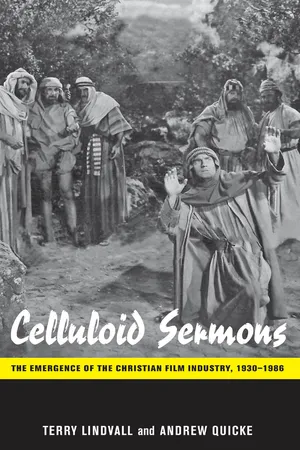
Christian filmmaking, done outside of the corporate Hollywood industry and produced for Christian churches, affected a significant audience of church people. Protestant denominations and individuals believed that they could preach and teach more effectively through the mass medium of film. Although suspicion toward the film industry marked many conservatives during the early 1930s, many Christian leaders came to believe in the power of technology to convert or to morally instruct people. Thus the growth of a Christian film industry was an extension of the Protestant tradition of preaching, with the films becoming celluloid sermons.
Celluloid Sermons is the first historical study of this phenomenon. Terry Lindvall and Andrew Quicke highlight key characters, studios, and influential films of the movement from 1930 to 1986—such as the Billy Graham Association, with its major WorldWide Pictures productions of films like The Hiding Place, Ken Curtis’ Gateway Films, the apocalyptic “end-time” films by Mark IV (e.g. Thief in the Night), and the instructional video-films of Dobson’s Focus on the Family--assessing the extent to which the church’s commitment to filmmaking accelerated its missions and demonstrating that its filmic endeavors had the unintended consequence of contributing to the secularization of liberal denominations.
eBook - ePub
Celluloid Sermons
The Emergence of the Christian Film Industry, 1930-1986
- 287 pages
- English
- ePUB (mobile friendly)
- Available on iOS & Android
eBook - ePub
Celluloid Sermons
The Emergence of the Christian Film Industry, 1930-1986
About this book
Information
Topic
Theology & ReligionSubtopic
North American History1
God Talks
One late spring day in May 1934, the Roman Catholic cardinal of Philadelphia, Dennis Dougherty, ordered his diocesan flock to “stay away from all [movie theaters].” He framed this exhortation not as pastoral counsel, but as a “positive command, binding all in conscience under pain of sin.”1 The same year, a forceful Roman Catholic layman, Joseph Breen, commandeered the reins of the Production Code Administration board, believing, like many frustrated church people, that the movie morality czar Will Hays had compromised the mission of guarding the public from Hollywood excess.2
When Hollywood looked at religious concerns, they were likewise frequently nonplussed. On one hot July morning in 1934, as Hollywood moguls grabbed bagels on their way to work, they glanced at their own trade paper bible, the Hollywood Reporter, and may have been startled to read the headline “Taking It on the Jaw.” The surprised executives read that it “seemed that every living soul (if you are going to believe the newsprints) was lined up against the industry, and the Churches of all denominations have created a new sin—THE SIN OF GOING TO THE MOVIES.”3
Christian fundamentalists and Roman Catholics, and even many mainline churches, believed that lax enforcement of movie morals had allowed film content to degenerate. Such accusations were extended into a general condemnation of all movies as sinful. Frustrated grumbling from clergy and laity toward Hollywood during the early 1930s percolated into a vocal, even vociferous protest. The campaign for decency in the moving pictures pitted religious people of all stripes against the devil’s minions who shot out filth and violence at twenty-four frames a second. It was, in a strange, unforeseen way, a truly ecumenical movement, uniting Protestants and Roman Catholics in a joint crusade.4
The religious boycott of movie theaters in Philadelphia spurred Hollywood to recognize that it knew little about this giant block of ticket buyers.5 Acknowledging the powerful lobby of the Roman Catholic Church, with its Legion of Decency driving a protest against Italian gangsters in Scarface, the suggestive naughty bits of Mae West and Betty Boop, and film exports that exemplified the “morals of the barnyard,” Hollywood moguls conceded that they needed the support of religious audiences to insure the industry’s profitability, especially during the Depression.6 Deals were made and the Roman Catholic influence substantially shaped the golden age of Hollywood film-making. Acquiescing to religious pressures, Hollywood essentially decided to avoid religious topics in its films throughout the 1930s, and only tiptoed back in the mid-1940s with inspirational priests played by the likes of Patrick O’Brien and Bing Crosby. As film the historian Francis Couvares adroitly pointed out, a grassroots Kulturkampf took place on Main Street America.7
Just before the Production Code secured its teeth to guard against “immorality” in Hollywood, numerous testimonies were broadcast against the kinds of films being exhibited, suggesting the kind of public struggle over cultural authority. One Methodist layman, A. H. Beardsley, attended the movies in the early thirties and found himself confused by what he viewed as Hollywood’s religious worldviews. On the one hand, he found much to laud about the 1929 feature film Evangeline, with its portrait of a kindly, courageous priest. He judged an accompanying short comedy less favorably. Its amusing plot centered on an urban rescue mission, where samplers like “Remember, Jack, your mother is praying for you tonight” decorated the walls. Beardsley interpreted the scene as mocking religion, as when a “bad boy” passed around a large bottle of “lemonade” laced with glue to all the parishioners, so that everyone in the whole mission got their lips stuck together as they attempted to sing a hymn. In the accompanying newsreel, a Catholic priest was called to bless hunters and hounds before a fox hunt (at which the writer wondered, “Who blessed the fox?”). The Methodist who visited the moving picture that day found that religion had been positively portrayed in a heartfelt drama, satirized by the ridiculous scene of a puckered-lip congregation, and finally thrown to the dogs. He left the theater feeling fully betrayed.8
The critical discourse of conservative religious spectators during this era marks a cultural divide on the nature and purpose of movies. With such a chasm opening between Hollywood and Christian traditions, it is not surprising to see the emergence of an alternative film movement, an independent cottage industry of religious filmmakers making movies for their own constituencies. For some Protestant and Roman Catholic leaders, policing a commercial industry was not as promising as growing one’s own media products for teaching, worship, and missions. The British journalist G. K. Chesterton had once recommended such a self-reliant strategy when he visited the United States in the 1920s. The problem with movies, he wryly observed, is not that they go to places like Middle America, but that they don’t come from places like Middle America.9
Moving pictures became an evangelistic complement for many churches, supplementing traditional forms of communication. Among the various denominations, films became extensions of their sermons. For Protestant fundamentalists and conservatives, the films preached repentance and conversion. For the more liberal groups, films sought to promote social justice and to bring a global consciousness to American congregations. As institutions whose primary missions were not to make movies, however, denominations would be supplanted by individuals and studios that sought only to produce movies. The emergence of a marginal troupe of film artists, outside the realm of traditional film history, suggests a subterranean industry and culture that reflected what the evangelist Jerry Falwell once labeled the “silent majority.” Ironically, this separatist movement by Christians paralleled the Yiddish film movement of the silent era, with many involved in the making of those films assimilating into the larger film culture. Christian involvement in the industry would culminate in creative artists, directors, and producers like Scott Derrickson, Tom Schatz, Ken Wales, and Ralph Winter contributing their talents directly to Hollywood. However, early experimentation of religious filmmaking would open the church up to new forms of communication, particularly in modes of reception. Religious moving images would function in conjunction with the preaching of the Word, as congregations might find parables not only in stone and glass, but also in digitized images. Churches adapted to a visual culture and found ways to show the Gospel instead of just telling about it.
The Silent Backdrop
In his earlier Sanctuary Cinema, Terry Lindvall ferreted out the origins of the Protestant film during the era of silent American cinema. That work culled forth unexpected details regarding the church’s involvement in exhibiting, making, and distributing films. Yet it all seemed to come to naught, with barely an image enduring into the Depression era. The advent of expensive mainstream “talkies” and the popularity of radio supplanted religiously oriented filmmaking in the 1930s, as churches did not possess the discretionary funds with which to make films. But that earlier blossoming of religious filmmaking was but the preface to the various future film enterprises to be addressed here.
To put the 1930s and beyond in context, it is worth looking back over the first quarter century of nontheatrical religious films, those films exhibited outside the normal channels of theaters in church basements, schoolrooms, and religious halls. The historian Arthur Edwin Krows divided the development of sponsored nontheatrical films into seven stages that corresponded with national American progress in an ongoing series published in Educational Screen.10 His first division covered the preliminary stages of World War I, when many educators and clergy differentiated between entertainment films and sponsored, nontheatrical moving pictures. During this era, the producer George Klein had tried, albeit unsuccessfully, to pioneer efforts in organizing the nontheatrical field for churches and schools. He tried to salvage old theatrical films, particularly travelogues and Passion plays, and offer them to churches for educational and mission use. During the second phase, wartime, films were intentionally produced for cantonments and for military companies overseas in order to inculcate moral and religious values in the soldiers. Third, immediately after the war, overseas projection equipment used by the military was returned, with much of it put on public sale and bought up by nonprofit institutions, especially schools and churches. The distributor Warren Foster tried valiantly to adapt noncommercial films into the civilian economy through his Community Motion Picture Bureau, but he fell far short of his goals. One organization that did stake out a modest foothold, the YMCA, inaugurated a Motion Picture Bureau under its tireless leader, George J. Zehrung. It slowly began to flourish, and in time it provided the vigorous impetus that would give rise to a viable nontheatrical movement. While many churches and schools supported the vision, they committed only trivial amounts of funding to sustain it. Nevertheless, a prominent trend began with small independent producers such as James Shields contributing significant product for distribution and exhibition (such as The Stream of Life, 1919).
Krows’s fourth era traced the momentous development of a visual educational movement, principally with the 1919 founding of the Society for Visual Education in Chicago, underwritten in large part by the public utilities magnate Harley Clarke. Through its official trade journal, Educational Screen, the organization was able to propagate an infectious vision to attract progressive educators and clergy to incorporate film into their work. Simultaneously, Eastman Kodak, the primary supplier of film and cameras, offered the Presbyterian Church two thousand projectors so that they might learn to exhibit their own films. In 1919, the Methodists held their centenary in Columbus, Ohio, and converted hundreds of ministers into “visual exhibitionists,” placing an emphasis on each of them becoming missionaries for using film in their own communities. For Krows, the fifth stage occurred when specialized users decided they were more competent and knowledgeable about their own needs than outsiders and could thus produce their own visual materials. Within this development were included the debut of the Christian Herald Film Bureau, the University Film Foundation of Harvard, Eastman Teaching Films, and, under the auspices of the Harmon Foundation, Yale University’s pedestrian Chronicles of America book and film series. The sixth and penultimate step for Krows involved the discovery of the need for specialized exhibition sites and a national system of distribution, particularly among churches of different denominations. Simultaneously, many intriguing and independent undertakings of groups that sought to capitalize and exploit a nontheatrical market proved quite speculative and quixotic (e.g., Pictorial Clubs and the American Motion Pictures Corporation headed by Paul Smith, now reposed in the “pathetic graveyard of worthy but premature endeavors” of those who risked capital and came up bankrupt). Finally, when talking pictures became commercially practical, Krows celebrated a revolution of cooperation in the production of educational talking pictures for schools and churches. Krows’s chronological account suggests a trajectory in which the church slowly came to the realization that it could make its own movies to instruct, evangelize, and even entertain its congregants. The optimistic prophecies of the historian writing in the mid-1930s would form the backdrop for the filmmakers emerging in the 1940s.11
Along with Krows, Mary Beattie Brady, director of the Harmon Foundation, envisioned the 1930s as a new era for the church to invest in sound moving pictures. The Harmon Foundation had been set up by a wealthy real estate tycoon in the late 1920s to investigate how religious groups could use the burgeoning film medium. Since denominations had largely retreated from motion picture production on grounds of the cost of sound, the Harmon Foundation was the one organization that championed the use of film in Protestant circles. For Brady, the usefulness of film to the religious field had become axiomatic, although from its early entry as a novelty to its strategic use by Protestants to get people to Sunday evening services, it had proved a dismal and disheartening failure due to inadequate equipment and lack of suitable products. Yet, as a by-product of the Legion of Decency movement of the early 1930s in which the Breen Code policed film content, Brady saw more visionary and creative approaches in the religious appropriation of film. Denominational visual education boards, the use of the moving picture in missions, academic courses, journal columns, and a focus on religious education through visual means evinced a persuasive case for optimism.12
The New Era of Religious Emotion
Various attempts at religious film production, distribution, and exhibition by churches in the silent era had been erratic and serendipitous. Filmmakers from the Protestant tradition usually exhibited an overt emphasis on the Word, demanding that images and music serve the verbal narrative in clear, definite, and propositional ways, by emphasizing doctrinal instruction over entertainment. Religious filmmakers often favored direct and moralizing address rather than such indirect communication as parables. Didacticism underlay and defined most Protestant silent films. Dogma prevailed over drama.
Back in 1927, the Christian Statesman reported that the Harmon Foundation had conducted an interesting experiment in the making of religious motion pictures and distributing them to churches. It pointed out that while the commercial side of the film industry had experienced an astounding growth, there existed a notorious neglect in creating worshipful pictures that could become part of the regular, formal service. Thus this attempt was commendable, in that the Harmon “pictures have been designed, through their direct and simple treatment of biblical themes, to enhance for the church the richness and dramatic qualities of worship. That they may not conflict with the continuity of the service, they are short and nontheatrical, appealing to the emotions much in the manner of the beautiful anthem or stirring hymn.”13 The key here was the cinematic appeal to the emotions.
Despite dogmatic concerns among conservatives, the evolving influence of the liberal ideas of the 19th-century German theologian Friedrich Schleiermacher began to inform what many saw as the emotional bases of religious education.14 For Schleiermacher and his German ...
Table of contents
- Cover Page
- Title Page
- Copyright Page
- Dedication
- Contents
- Preface
- Abbreviations
- 1 God Talks
- 2 Evangelical Film Auteurs
- 3 Methodist and Ecumenical Films
- 4 Reformed and Dissenting Images
- 5 The Studio Era of Christian Films
- 6 The Master Filmmakers
- 7 Mark IV and Apocalyptic Film
- 8 Global Film Evangelism
- 9 Conclusion: A Modest Renaissance before the End
- Appendix: Chronology of Christian Film History
- Notes
- Selected Bibliography
- Index
- About the Authors
Trusted by 375,005 students
Access to over 1.5 million titles for a fair monthly price.
Study more efficiently using our study tools.
Frequently asked questions
Yes, you can cancel anytime from the Subscription tab in your account settings on the Perlego website. Your subscription will stay active until the end of your current billing period. Learn how to cancel your subscription
No, books cannot be downloaded as external files, such as PDFs, for use outside of Perlego. However, you can download books within the Perlego app for offline reading on mobile or tablet. Learn how to download books offline
Perlego offers two plans: Essential and Complete
- Essential is ideal for learners and professionals who enjoy exploring a wide range of subjects. Access the Essential Library with 800,000+ trusted titles and best-sellers across business, personal growth, and the humanities. Includes unlimited reading time and Standard Read Aloud voice.
- Complete: Perfect for advanced learners and researchers needing full, unrestricted access. Unlock 1.5M+ books across hundreds of subjects, including academic and specialized titles. The Complete Plan also includes advanced features like Premium Read Aloud and Research Assistant.
We are an online textbook subscription service, where you can get access to an entire online library for less than the price of a single book per month. With over 1.5 million books across 990+ topics, we’ve got you covered! Learn about our mission
Look out for the read-aloud symbol on your next book to see if you can listen to it. The read-aloud tool reads text aloud for you, highlighting the text as it is being read. You can pause it, speed it up and slow it down. Learn more about Read Aloud
Yes! You can use the Perlego app on both iOS and Android devices to read anytime, anywhere — even offline. Perfect for commutes or when you’re on the go.
Please note we cannot support devices running on iOS 13 and Android 7 or earlier. Learn more about using the app
Please note we cannot support devices running on iOS 13 and Android 7 or earlier. Learn more about using the app
Yes, you can access Celluloid Sermons by Terry Lindvall,Andrew Quicke in PDF and/or ePUB format, as well as other popular books in Theology & Religion & North American History. We have over 1.5 million books available in our catalogue for you to explore.