An introduction to the dynamic complexity of American ethnic life and Latino identity
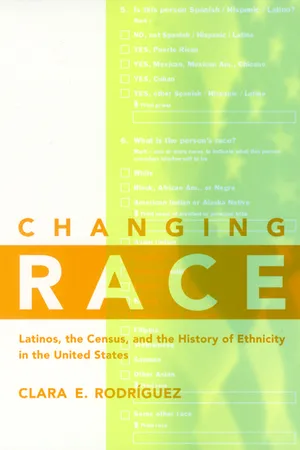
Latinos are the fastest growing population group in the United States.Through their language and popular music Latinos are making their mark on American culture as never before. As the United States becomes Latinized, how will Latinos fit into America's divided racial landscape and how will they define their own racial and ethnic identity?
Through strikingly original historical analysis, extensive personal interviews and a careful examination of census data, Clara E. Rodriguez shows that Latino identity is surprisingly fluid, situation-dependent, and constantly changing. She illustrates how the way Latinos are defining themselves, and refusing to define themselves, represents a powerful challenge to America's system of racial classification and American racism.
- 283 pages
- English
- ePUB (mobile friendly)
- Available on iOS & Android
eBook - ePub
About this book
Information
Index
Ability, skin color as determinant, 30
Abolitionist movement, 99
Aboriginal origin, 36
Accents, 3–4, 36, 62
Acuña, Rodolfo, 103
Adams, John Quincy, 188–89
Adoption, 60–62
Aethiops (Africans), 32–33, 34, 203n. 6
Affirmation, of race, 25, 82
Affirmative action, 157
Afghans, 87, 156
Africa/Africans, 28, 30, 35, 55, 112
ancient societies in, 32–33
African Americans, x, xii, 22, 23, 179, 201n. 17, 212–13nn. 1, 2
census categories for, 91–92, 129, 189, 193, 197, 206–7nn. 2–5
citizenship issues, 92, 95–99
proportion of free persons (1790–1860), 194 Fig. D.1
racial constructs, 4, 16, 40, 109–10, 202n. 1
self-classification, 55, 56, 134. See also “Blacks” (racial group); “Negro” (racial group)
African American studies, 53
African descent, 40, 45, 74, 85, 91, 208n. 19
“Free People of Color” census category, 191, 195, 196, 227n. 4
in Latin America, 113, 122, 213n. 8
Afrocentrism, 19, 123
Afro-Latino, 6, 19
Age, 7, 226n. 4
Akaka, Daniel, 158, 201n. 15
Alabama, 84, 99
Alaska, 210n. 2
Aleuts, 88
Aliens, 70–71, 78–80, 92, 99–101
Allocation rates, 167–69, 223nn. 21, 22
Almaguer, Tomás, 87, 211n. 14
Almey, Marcia, 37, 121–22, 204n. 15
Alvar, Manuel, 109, 116
American Arab Anti-Discrimination Committee, 156
“American Indian,” 6, 35, 88
American Indian movement, 25
American Revolution, 95
American Samoa, 81
Americas, comparison of census modalities in, 37–38, 111–25
Amerindian, 213n. 3
Ancestry: in early census data, 191–92
and identity, 25, 137, 139, 150
Latinos in U.S. racial structure, 7, 9, 10, 19, 25
and race, 17, 44, 81–82, 1...
Table of contents
- Cover page
- Title Page
- Copyright Page
- Contents
- Introduction
- Acknowledgments
- I The Fluidity of Race
- II Historical Constructions
- III Race and the Census
- Appendix A: Data Limitations and the Undercount
- Appendix B: The Biological Concept of Race in the United States
- Appendix C: A Technical Oversight or Racial Flux?
- Appendix D: Free People of Color
- Notes
- References
- Index
- About the Author
Trusted by 375,005 students
Access to over 1.5 million titles for a fair monthly price.
Study more efficiently using our study tools.
Frequently asked questions
Yes, you can cancel anytime from the Subscription tab in your account settings on the Perlego website. Your subscription will stay active until the end of your current billing period. Learn how to cancel your subscription
No, books cannot be downloaded as external files, such as PDFs, for use outside of Perlego. However, you can download books within the Perlego app for offline reading on mobile or tablet. Learn how to download books offline
Perlego offers two plans: Essential and Complete
- Essential is ideal for learners and professionals who enjoy exploring a wide range of subjects. Access the Essential Library with 800,000+ trusted titles and best-sellers across business, personal growth, and the humanities. Includes unlimited reading time and Standard Read Aloud voice.
- Complete: Perfect for advanced learners and researchers needing full, unrestricted access. Unlock 1.5M+ books across hundreds of subjects, including academic and specialized titles. The Complete Plan also includes advanced features like Premium Read Aloud and Research Assistant.
We are an online textbook subscription service, where you can get access to an entire online library for less than the price of a single book per month. With over 1.5 million books across 990+ topics, we’ve got you covered! Learn about our mission
Look out for the read-aloud symbol on your next book to see if you can listen to it. The read-aloud tool reads text aloud for you, highlighting the text as it is being read. You can pause it, speed it up and slow it down. Learn more about Read Aloud
Yes! You can use the Perlego app on both iOS and Android devices to read anytime, anywhere — even offline. Perfect for commutes or when you’re on the go.
Please note we cannot support devices running on iOS 13 and Android 7 or earlier. Learn more about using the app
Please note we cannot support devices running on iOS 13 and Android 7 or earlier. Learn more about using the app
Yes, you can access Changing Race by Clara E. Rodríguez in PDF and/or ePUB format, as well as other popular books in Social Sciences & Hispanic American Studies. We have over 1.5 million books available in our catalogue for you to explore.