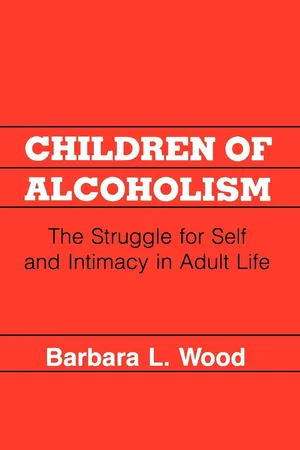
In this sensitive and richly rewarding book Barbara L. Wood, a clinician with many years' experience working with adult children of the chemically dependent, gives clinicians informed and practical advice on how to treat the damaged self of these individuals. She offers strategies for intervention, along with step-by-step principles that tell the therapist how best to create an environment to help patients.
- 182 pages
- English
- ePUB (mobile friendly)
- Available on iOS & Android
eBook - ePub
About this book
Information
1
ALCOHOLISM AND CO-DEPENDENCE
THE PREVALENCE of addictive disorders in the United States today challenges mental health professionals in complex and frustrating ways. Current research and theory in this field are concerned principally with unlocking the riddle of psychic and physical compulsion, but the solution remains elusive. We are confronted with the likely, and intimidating, prospect that there are many addictions—just as there are many cancers—and that treatment must be creatively tailored to individual need and circumstance.
As professional interest in the addictions increases, while the literature that forms our foundation of knowledge about this problem expands, practitioners of clinical psychiatry and psychology are recognizing what the “Anonymous” organizations have understood for years: The debilitating effects of alcoholism and other chemical dependencies are not confined to the addicted individual alone. Spouses, parents, children, even friends and colleagues of addicts, may suffer a progressive psychological, emotional, and spiritual deterioration that mirrors that of their chemically dependent loved one. The phenomenon of “co-dependence” is now accorded an attitude of respect and concern in the literature and in the consulting room, and this is as it should be.
It should come as no real surprise that entire families fall illwhen one member develops a chronic dependence on psychoactive chemicals. After all, any severe, long-term illness tends to preoccupy a family and create an atmosphere of tension, anxiety, and conflict. Chemical dependency is especially problematic in this regard, since it is so little understood in general, and so badly misunderstood by the lay community and so many members of the medical and mental health professions as well. Families experience intense shame about addictive problems, since they mistakenly believe that compulsion is a moral failing. This shame causes them to isolate themselves from potential sources of support, comfort, and assistance. Furthermore, when spouses, parents, or children from chemically dependent families do reach out for help, they often receive advice that is bad or confusing in that it conflicts drastically with the judgments proffered by some other authority. Or they may receive no advice at all. For these reasons, addicted families turn in on themselves, and struggle all alone to contain and subdue an affliction that they do not understand. In most cases they sink more and more deeply into the problems created by the illness, and are consumed by them.
The dependent individual usually suffers the most obvious deterioration, since chronic heavy use of most psychoactive drugs exacts a substantial physical toll. This is especially true when the drug of choice is alcohol, a substance that is so profoundly devastating to all the major organ systems of the body. The psychic devastation of addiction is equally profound, however, as the addict’s available mental energy becomes increasingly organized around the pursuit and use of chemicals, and the need to preserve his or her failing self-esteem by denying and compensating for the progressive loss of control.
The pain of a spouse, or parent, may be less immediately visible, but it is no less severe. Though these unhappy people are spared the direct physical consequences of addiction, they likely suffer from one or more psychosomatic conditions that are caused or aggravated by chronic stress. They may also be physically abused by the addict, who is intermittently and progressively stripped of normal inhibitions against violent behavior. They almost always suffer great emotional abuse from the addict, who unconsciously defends against the humiliation and terror of loss of control by blaming it on the people closest at hand. Saddest of all, the lives of spouses and parents are often diminished, year after year, by a vain, preoccupying effort to control and hide what can never be truly “controlled” and what is rarely capable of being concealed from any sensitive, relatively objective observer.
In the end, however, it is the children of alcoholism and other drug dependencies who are the most tragic victims of this disease. Since their parents are, in most cases, devoted to concealing what they consider to be a shameful problem, and since the medical and mental health professions have only just begun to discover the problem of co-dependence, children are usually silent victims as well. The varied and severe forms of disability that are common to this group often go unrecognized and untreated, or are, in many cases, misdiagnosed and inefficiently treated. Yet, the portion of their suffering that is directly attributable to their parents’ problems is very great.
Children, like other co-dependents, are emotionally abused, frequently neglected, and often physically victimized by addicted parents. The nonaddicted parents are frequently too psychologically debilitated to serve as a barrier to the destructiveness of the alcoholic or drug-dependent parent. Children are keenly aware that the drinking and drugging of their parents are threatening not only to their parents’ lives but to the integrity of the family as well; and their terror of losing their parents is made nearly unbearable by their recognition that they are relatively helpless without competent adult support. The unpredictability of the physical and psychological environment is enormously disturbing to children since they usually have no chance to escape from the family. Moreover, as children, they do not have the mental and emotional maturity which would help them to reject responsibility for their parents’ problems. For all of these reasons, a child’s distress over a parent’s chemical compulsion will be even greater than that of other co-dependents.
This book is about the torment that children experience in alcoholic homes, and how it affects their psychological development and their adjustment to adult life. The curious silence surrounding this subject has been broken in recent years by the publication of books by Sharon Wegscheider (1981), Claudia Black (1981) and Janet Woititz (1983). These authors poignantly describe the suffering of children who grow up with an alcoholic parent and find themselves so encumbered by parental needs that they cannot proceed normally toward the development of satisfying adult commitments to love and work. These three women have provided us with an invaluable topographic model of the problems faced by children of alcoholics. Yet their pioneering effort should not be viewed as an end in itself. Rather, it should be regarded as the leading edge of a new movement in the study of the phenomenon of co-dependence. It is my hope that this book will constitute a credible beginning for the second phase of this new movement. It attempts to do so by initiating a deeper probing of the problems experienced by adult children of alcoholics; one that ties observations made in the field to an existing body of literature concerning the normal and pathological development of the self and its relationship to others.
I must emphasize that this book can be only a beginning. Since my clinical practice is limited to adult patients, it is “adult children” of alcoholics who are the subject of this work. I do describe the environmental and psychic events that proved most critical in my patients’ early lives, but I address neither the crucial issue of early intervention in the lives of co-dependent children nor the possibility that there may be differences between adult children of alcoholic parents and adults who grew up in homes where there was compulsive use of other psychoactive chemicals. Most of my own patients were reared in alcoholic homes, and I have not noticed substantial differences in the problems experienced by the small numbers of people I have treated whose parents abused, or were addicted to, other drugs.
Al-Anon, the twelve-step, self-help group that is the family arm of Alcoholics Anonymous, can play a crucial role in the recovery programs of adult children of alcoholics. I always recommend that my patients attend these meetings regularly. Life in the alcoholic home can destroy one’s belief in the constructive, healthful potential of human relationships, and Al-Anon, like a good psychotherapy, restores this faith. Since my purpose in this book is to describe the formal psychotherapeutic process with adult children, I do not describe in detail my patients’ experiences in Al-Anon. However, I believe that attendance and intensive participation in this group always significantly improves an adult child’s chances of escaping the vicious cycle of an alcoholic lifestyle. I do find that many, hurt and frightened by the destructive intimacy of the alcoholic family group, are loathe to take a chance on any new group, and that psychotherapy must lay down a foundation of trust that will permit eventual participation in Al-Anon.
Other forms of group support and group psychotherapy have often been instrumental to my patients’ recovery. Bethesda Psychological Center now offers several short- and long-term groups that focus on the special problems and needs of adult children. I have chosen not to describe this type of intervention here. Once again, most of the adult children I have treated were unwilling, and, I think, unable to participate in group psychotherapy prior to a period of structure-building and trust-inspiring individual treatment.
This book is intended primarily for psychotherapists who treat adult children of alcoholics in their practices. It does not describe a program of self-help for adult children, though it may help them to understand the roots of many problems they face. The reader interested in developing a program of self-help may wish to consult recent texts by Gravitz and Bowden (1985) and Whitfield (1987).
A final caveat: The suffering of many adult children seems to be made greater by their sense that the professional mental health community, now that it acknowledges their problems, recognizes only their debilitation and never their considerable strengths as people. Certainly, in this book, I am mainly concerned with the curtailment of psychological and emotional development that can be traced to parental alcoholism. Though my focus is on the “pathology” of the adult child, I firmly believe, however, that even the most disturbing symptoms seen in these patients—panicky, schizoid flights from objects, for example, or aggressive assaults upon them—reflect only an indomitable and courageous will to survive the unnatural, unhealthy, and terrifying experience of parental neglect and brutality. This is an idea of Heinz Kohut’s that is essential to an understanding of adult children: Symptoms are but the effort of the embattled, intact core self to protect itself from threatened destruction. They are adaptive in that they have enabled the individual to emerge, scathed but capable of recovery and regrowth, from childhood. My intention was to write of the pain that is necessarily a part of this sort of desperate struggle for psychic survival, but I hoped to describe, as well, the qualities of determination and courage in adult children that enable them to bear this pain and even more, to bring it to a constructive resolution. If I have failed at the latter, the fault is mine, and not theirs.
2
CO-DEPENDENT CHILDREN: CAUGHT IN AN INFINITE LOOP
THE CONCEPT of the infinite loop comes from the field of computer science and refers to a programming error that leads to the perpetual and unsuccessful recapitulation of an algorithm, or problem-solving procedure. This is an apt metaphor for the lives of adult children of alcoholics, who seem to possess, as the unwanted legacy of their childhood experience, an irresistible attraction to an alcoholic lifestyle. This lifestyle may include compulsive drinking and drugging, ongoing destructive involvements with drinking, drugging, or enabling parents, and the acquisition of new life partners who reprise the important psychic themes of the childhood home, including instability, exploitation, dishonesty, and betrayal.
Wegscheider (1981) and Black (1981) examined the way in which children of alcoholics often seem to be trapped in self-destructive patterns that are either prescribed or modeled by their dysfunctional parents. They noted that children from alcoholic families defend against the instability and aggression that characterize these households by adopting certain “roles.” These roles serve to bring some semblance of predictability to the family and to one’s emotions, which, if openly expressed, might shatter the child’s self-esteem, as well as the fragile family structure. Wegscheider suggested that the most common roles include the family hero, the scapegoat, the lost child and the mascot.
Many authors have tried to convey the flavor of these four basic character structures. The hero is usually described as a highly conforming, high-achieving, “good child” who seeks to redeem the failing family, and to justify his or her own existence through great accomplishments and noble deeds. Family therapists might also call this individual the “parental” child; the child who assumes, or is forced to assume, an inordinate amount of responsibility for the siblings and the household in general. The unconscious goal of the family hero is to be so good that the drinking parent will be filled with pride and good feelings, and be thereby empowered, or persuaded, to stop drinking and become a fully functioning member of the family once again. Since this end is actually beyond the hero’s ability to effect, it is usually doomed to failure, and so is the hero. Whatever victories this child may win in the larger world outside the home, the early, crushing loss in the battle with a parent’s alcoholism seems to leave an indelible mark on the hero’s character. The hero is haunted by a sense that nothing that has been accomplished is truly satisfying, or really enough. He or she may be driven to heap one worldly success upon another, in a vain effort to quiet this nagging sense of inadequacy and irresolution.
The hero is usually the first-born child. The second child, who finds that the family has already expended its limited capacity to nurture a child on the hero, may cope with disappointment and feelings of loss by rebelling, taking frightening physical risks, and, in many cases, by engaging in outright delinquent behavior. In some cases, it seems that only acts of destructiveness are capable of answering the emptiness of these “scapegoats,” by helping them to reclaim a portion of the limelight that the hero has usurped.
The lost child retreats from the world of interpersonal relationships into an inner world of fantasy and self-preoccupation. The mascot is the “class clown,” who, like the hero, seeks positive attention and tries to reduce the feeling of active strain in the family by creating an atmosphere of warmth and well-being. Wegscheider referred to this child as “a Pagliacci hiding his own pain behind a permanently painted grin” (1981, 140).
While it is usual for a particular role to dominate the character of a particular child, aspects of all four roles may be seen in an individual child, and certain conditions may trigger a wholesale exchange of roles. For example, many a scapegoat has taken up the standard of heroic sibling whose early accomplishments have led to a school or professional career far from home. Further, many heroes display aperiodic bursts of aggression and recklessness of the sort that are so prominently and chronically featured in the personality of the scapegoat.
For a long time, our understanding of children of alcoholics rested upon our conception of these four childhood roles. More recently, the literature has reflected a concern with what happens when, as so often is true, the child in an alcoholic family remains untreated into adulthood. Black (1981) suggested that adult children cling tenaciously to the coping strategies that enabled them to survive the traumatic fears and disappointments of their growing years. She pointed out, however, that these deeply ingrained defenses against emotional experience cannot be sustained indefinitely, and that most adult children do experience breakthroughs of intense anxiety. Black noted that adult children frequently attempt to evade this anxiety in the same way that their parents did—with compulsive drinking or drugging. Of course, a variety of other compulsions are available to help an adult child effect a psychic withdrawal. Some adult children become workaholic. Others gamble, or are driven into deep debt by other forms of uncontrolled spending. Some find temporary relief from disturbing inner tension in compulsive sexual behavior, while still others develop eating disorders.
Janet Woititz (1983) compiled a list of behavioral and emotional characteristics that she believes appear with great regularity among adult children of alcoholic parents. The problems she outlined suggest a general and severe curtailment of the capacity for love and work in this population. She found an overall lowering of self-esteem, a fundamental ignorance of the requirements and workings of “normal” human relationships, a tendency to engage in harsh and uncompromising self-criticism, difficulty in relaxing and having fun, a constant need for approval and affirmation, and an excessive preoccupation with acquiring and maintaining control of relationships and events.
Woititz’s list reveals a number of apparent contradictions in the behavior of adult children. She said, for example, that these individuals tend to be “super responsible or super irresponsible”, and that while they dislike change, they often exhibit a self-destructive impulsivity (1983, 4–5). Further, while Woititz found that adult children maintain an unflagging loyalty and commitment to people and causes, even in the face of incontrovertible evidence that their devotion is undeserved, she also discovered that many find themselves consistently unable to complete projects they have undertaken, or to maintain close relationships over long periods of time (1983, 4–5). I, too, have observed that adult children regularly enter into, and become lost in, the most difficult and punishing of situations and relationships. They often persist in their efforts to raise a phoenix from the ashes for agonizingly long periods of time. However, they may also precipitously and whimsically abandon these “projects” and these abandonments often have destructive consequences for them, and for others.
The conflictual, erratic pattern of relationships that is characteristic of many adult children seems to be modeled on the relationship to the alcoholic and enabling parents. That is, deep, fundamentally masochistic involvements with alcoholic and enabling parents are often punctuated by sudden, surprising outbursts of aggression on the part of the adult child. It is as if the adult child shifts, without warning, from a mode that is dominated by the dutifulness and compassion of the hero, to one in which the rage of the scapegoat is ascendant. For example one patient regularly worked six, and sometimes seven days a week in an office where she was supervised by her alcoholic mother. Her workaholic behavior was clearly designed to forestall administrative awareness of her mother’s illness, and the chronic mismanagement of the office that resulted from it. This preoccupation caused the patient to neglect her own family responsibilities, as well as therapy appointments and obligations to friends. However, this long-suffering woman would also take sudden, unannounced extended vacations from the office. These “great escapes” often coincided with important deadlines to be met at work, and were usually provoked by some act of alcohol-induced betrayal by the mother.
What may we expect from an adult child who enters psychotherapy, then? This patient is likely to present a poorly defined self, whose most deeply held fears, feelings, beliefs, and memories are hidden beneath a rigidly conceived and maintained role that is based on a conforming or rebellious response to parental need. This concealment of self, which includes the repression of intensely felt personal needs, may well be complemented by an array of self-destructive relationships with depriving, sadistic (probably addicted) partners who require a masochistic sacrifice of self-interest by the patient. The adult child who requests psychotherapy may be troubled by a tendency toward contradictory extremes of behavior, including a compulsion to withdraw from, or aggress against, intimate partners upon whom she ordinarily depends deeply. This erratic behavior precludes real emotional connectedness with loved ones, and the patient may be extremely socially isolated and unable to function with colleagues at work as well. This isolation may produce acute states of intense anxiety, psychic agitation and depression, and, perhaps, chronic feelings of emptiness, unreality, and futility. Adult children are frequently hopeless about the possibility of substantial change, and this hopelessness, (and perhaps some little-understood genetic endowment) may have lead the patient to turn to some form of psychic compulsion in a desperate effort to assuage inner torment. In short, the patient is reliving the emotional havoc of the alcoholic home and is imprisoned within the infinite loop.
If the infinite loop of the adult child is, finally, to be breached by psychotherapy, the psychotherapist must understand, at a very deep level, the psychical impact of growing up with an alcoholic parent. In my own effort to arrive at such an understanding, I turned to Heinz Kohut’s Self Psychology, and to Object Relations theory, especially the work of the members of the so-called “British School”: D. W. Winnicott, W. R. D. Fair-bairn and Harry Guntrip. All of these men worked with patients who, like my adult-child patients, had been subjected to substantial emotional (and sometimes physical) abuse and neglect during childhood. Their patients, like mine, had lost hope, self-respect, individuality, and much of their capacity for self-determination in the struggle with a parent’s severe emotional illness. The British theorists, and Kohut, found that these kinds of patients are not greatly helped by classical analysis, or an analytically informed psychotherapy that emphasizes the freeing and rechanneling of repressed libido. They discovered, however, that these individuals do respond well to a psychotherapy that addresses the overall condition of the self, and the relationships between the self and its principal objects. They found that childhood deprivation and abuse leads to a self that is pervasively split, divided against itself, withdrawn and fearful of sustaining further damage, and ultima...
Table of contents
- Cover Page
- Title Page
- Copyright Page
- Dedication
- Contents
- Preface
- Acknowledgments
- CHAPTER 1 Alcoholism and Co-Dependence
- CHAPTER 2 Co-Dependent Children: Caught in an Infinite Loop
- CHAPTER 3 A Structural Approach to Understanding Psychopathology
- CHAPTER 4 Using Structural Theories to Understand Adult Children
- CHAPTER 5 The Restoration of Psychic Structure in Psychotherapy
- CHAPTER 6 Clinical Strategies for Use With Adult Children
- CHAPTER 7 When the Family Hero Turns Pro: The Adult Child in the Helping Professions
- References
- Index
Trusted by 375,005 students
Access to over 1.5 million titles for a fair monthly price.
Study more efficiently using our study tools.
Frequently asked questions
Yes, you can cancel anytime from the Subscription tab in your account settings on the Perlego website. Your subscription will stay active until the end of your current billing period. Learn how to cancel your subscription
No, books cannot be downloaded as external files, such as PDFs, for use outside of Perlego. However, you can download books within the Perlego app for offline reading on mobile or tablet. Learn how to download books offline
Perlego offers two plans: Essential and Complete
- Essential is ideal for learners and professionals who enjoy exploring a wide range of subjects. Access the Essential Library with 800,000+ trusted titles and best-sellers across business, personal growth, and the humanities. Includes unlimited reading time and Standard Read Aloud voice.
- Complete: Perfect for advanced learners and researchers needing full, unrestricted access. Unlock 1.5M+ books across hundreds of subjects, including academic and specialized titles. The Complete Plan also includes advanced features like Premium Read Aloud and Research Assistant.
We are an online textbook subscription service, where you can get access to an entire online library for less than the price of a single book per month. With over 1.5 million books across 990+ topics, we’ve got you covered! Learn about our mission
Look out for the read-aloud symbol on your next book to see if you can listen to it. The read-aloud tool reads text aloud for you, highlighting the text as it is being read. You can pause it, speed it up and slow it down. Learn more about Read Aloud
Yes! You can use the Perlego app on both iOS and Android devices to read anytime, anywhere — even offline. Perfect for commutes or when you’re on the go.
Please note we cannot support devices running on iOS 13 and Android 7 or earlier. Learn more about using the app
Please note we cannot support devices running on iOS 13 and Android 7 or earlier. Learn more about using the app
Yes, you can access Children of Alcoholism by Barbara L. Wood in PDF and/or ePUB format, as well as other popular books in Psychology & Psychotherapy. We have over 1.5 million books available in our catalogue for you to explore.