At its core, the Civil War was a conflict over the meaning of citizenship. Most famously, it became a struggle over whether or not to grant rights to a group that stood outside the pale of civil-society: African Americans. But other groups--namely Jews, Germans, the Irish, and Native Americans--also became part of this struggle to exercise rights stripped from them by legislation, court rulings, and the prejudices that defined the age.
Grounded in extensive research by experts in their respective fields, Civil War Citizens is the first volume to collectively analyze the wartime experiences of those who lived outside the dominant white, Anglo-Saxon Protestant citizenry of nineteenth-century America. The essays examine the momentous decisions made by these communities in the face of war, their desire for full citizenship, the complex loyalties that shaped their actions, and the inspiring and heartbreaking results of their choices-- choices that still echo through the United States today.
Contributors: Stephen D. Engle, William McKee Evans, David T. Gleeson, Andrea Mehrländer, Joseph P. Reidy, Robert N. Rosen, and Susannah J. Ural.
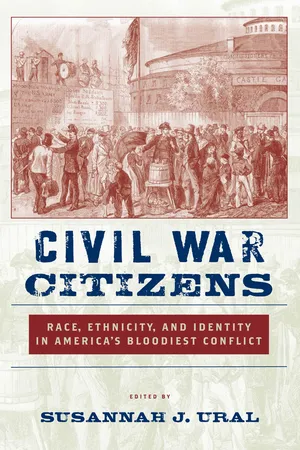
eBook - ePub
Civil War Citizens
Race, Ethnicity, and Identity in America’s Bloodiest Conflict
- 252 pages
- English
- ePUB (mobile friendly)
- Available on iOS & Android
eBook - ePub
About this book
Information
1
YANKEE DUTCHMEN
Germans, the Union, and the Construction of a Wartime Identity
For all the debate about states’ rights and slavery being the cause of the American Civil War, the actual conflict was fought between military communities, no matter how large or small, no matter what their ethnic complexion. “This is essentially a People’s contest,” explained Abraham Lincoln in his July 1861 message to Congress. As such, immigrants, along with their fellow Americans, needed to embrace the notion that they were preserving a Union that was favorable to their plight, and perhaps in some way make inroads into establishing themselves as more acceptable to Americans. As Phillip Shaw Paludan so wonderfully argues in his work “A People’s Contest”: The Union and Civil War, 1861–1865, Northerners came to understand the meaning of the Union more substantively. Never before had Americans participated in such a cause that forced them to travel more miles, over more landscapes, endure more hardships, and meet more people of ethnically diverse backgrounds than in the years of the Civil War. By joining the military, Northerners came to appreciate more fully the ethnically diverse nature of their Union. In some cases, such exposure to other groups during the war affected the way native-born Americans saw themselves.1
Because the war created small military communities at the regimental level that reflected the Northern population, it was no surprise that Americans were more likely to come into contact with Germans because of their presence in the military. While most Germans in the United States would agree that they were as uniquely different as were Americans (or any other ethnic group) and had yet to develop any singular “German identity,” Americans nonetheless typically perceived them as the same ethnically because the sole characteristic binding Germans to one another was language. Whether the war forced Anglo-Americans to accept or reject the ethnically diverse society they discovered in the ranks, those soldiers serving to preserve the Union at least came to recognize, because of the presence of their German comrades, that they were living in an ethnically diverse society, even if their views about the Germans did not change the kind of Union they wanted to preserve.2
Of all the ethnic groups that dotted the American landscape before the Civil War, none were more “generally distributed over the United States as were the Germans,” noted Ella Lonn in her seminal work Foreigners in the Union Army and Navy.3 Whether Germans settled into urban communities or the rural confines of states, by 1861 they had made a distinct impression on certain regions of the Northern landscape, adding significantly to the color and character of American culture. Wherever they resided, their customs, language, and cultural traditions stood out distinctly and, in many respects, provided Americans with their first exposure to ethnic difference, largely because it was the first time many Americans heard a language other than English. James Bergquist notes, for example, that the nineteenth-century Germans “were one of the most successful ethnic groups in establishing a tangible presence in American cities that went beyond a mere collection of institutions to advance ethnicity and became instead a community in the fullest sense.” Few Americans recognized the diversity within German communities that included Catholics, Lutherans, Reformed, Jewish, Freethinkers, old settlers, newcomers, farmers, artisans, businessmen, or simple laborers. Most Americans saw them as ethnically different first and foremost because of language.4
By 1861, Germans who had felt the need to belong to a German community had established German neighborhoods in many American cities. Whether in New York, Philadelphia, Cincinnati, St. Louis, or Milwaukee, Kleindeutschlands (Little Germanies) had become a significant and influential feature of the North, particularly in the urban areas. New York’s Kleindeutschland was the third-largest German-speaking community in the world behind Berlin and Vienna and was the first of the large ethnic urban settlements that came to distinguish American cities in the antebellum period. In Cincinnati, St. Louis, and Milwaukee, Germans constituted roughly one-third of the population. Other Northern cities such as Baltimore, Chicago, Indianapolis, and Buffalo absorbed sizable portions of America’s German population; these Germans typically segregated themselves into ethnic neighborhoods, which more often than not were “more uniform in their origins than they were in the blocks they inhabited.”5 This urban concentration of Germans quite often gave them a “disproportionate weight in many important centers of population and industry.” Fredrika Bremer, for example, described Milwaukee, or “German Town,” before the war as a place where “one sees German houses, German inscriptions over the doors or signs, German physiognomies.” “Here are published German newspapers,” she added, “and many Germans live here who never learn English, and seldom go beyond the German town.”6 Noted British reporter Edward Dicey, on assignment in America while walking the streets of New York City’s Kleindeutschland, observed the same characteristics of the German population, concluding that the Germans in that city “evidently [retain] the strongest individuality of any foreign class.”7
Other than New York, Milwaukee, and St. Louis, Cincinnati was perhaps the most German of all cities in the Civil War era. Strolling the streets of Cincinnati in the spring of 1862, Dicey remarked that what struck him most about the “Queen City of the West,” or “Over the Rhine” (as the Germans called it), was “the German air of the place and people.” It was hard to believe, he observed, “that you were not in some city of the old German vaterland.” Indeed, at least one-third of Cincinnati’s roughly 70,000 residents were German. “Almost everybody that you meet is speaking in the harsh, guttural, German accents,” remarked Dicey. “The women, with their squat, stout figures, their dull blue eyes, and fair flaxen hair, sit knitting at their doors, dressed in the stuffed woollen petticoats of the German fashion,” he noted, and “the men have still the woollen jackets, the blue worsted pantaloons, and the low-crowned hats one knows so well in Bavaria and Tyrol.” Here the old country prevailed. “There are ‘Bier Gartens,’ ‘Restaurations,’ and ‘Tanz Saale,’ on every side,” noted Dicey. “There are German operas, German concerts, and half a dozen German theaters,” and it was “here, in the free West, the Germans have asserted their right to spend Sunday as they like; and so ‘across the Rhine,’ the dancing gardens are open, and the Turner Feasts take place, and the first representations of the opera are given on Sunday as in their native land.”8 Still, Dicey noticed perceptively that despite this strong German identity in Cincinnati, “the German element was being merged in the American.”9
One of the distinguishing features of this assimilation or “merging,” as Dicey called it, was the presence in these German neighborhoods of the German American Turnvereine. In the tradition of Friedrich Ludwig Jahn’s work in Germany, these organizations were not only geared toward gymnastics and physical education but also served as “vehicles for German immigrants to continue their cultural endeavors” in America. They provided Germans outside of Germany with a local channel for maintaining their cultural heritage while embracing American culture and customs. The leaders of the Turnerbund (National Coordinating Organization) encouraged political activism and, by the time of the Civil War, had been responsible for encouraging Germans to engage in the political culture, join the Republican Party, and vote for Abraham Lincoln. Living abroad, Germans could espouse their disdain for politics in Germany without fear of persecution, while the Civil War provided them a chance to express their patriotism for the Union.10
When the war broke out, the approximately 150 Turnvereine were instrumental in marshaling and organizing Germans for the Union army. Inspired to serve by the Turnerbund, Turners were among the first Germans to volunteer. Within days of President Lincoln’s call for 75,000 volunteers, German Turners from Philadelphia, Louisville, Baltimore, Boston, Cincinnati, Indianapolis, Kansas City, St. Louis, and other cities enlisted to support the Union army. In Cincinnati alone, some 300 Turners from across the state came together in a few days and formed the Ohio Turner Regiment, officially known as the 9th Ohio Volunteer Infantry. In his work on the German Turners, Eugene Miller argues that the day after Lincoln’s call for volunteers, some 2,000 Kentucky Germans crossed the Ohio River into Cincinnati and volunteered for the army. In Chicago, more than 100 Turners organized the Turner Union Cadets shortly after President Lincoln’s call for volunteers, and in New York, Turners immediately came together and formed the 20th New York (Turnerschuetzen-regiment, or Turner Rifles) led by Max Weber. Members of the Turnvereine in St. Louis followed suit and formed the Westliches Turnerregiment, officially known as the 17th Missouri Volunteers. Although Carl Wittke argued that in 1861 some 10,000 Germans were members of Turnvereine in America and that between 5,000 and 6,000 men enlisted in the military, Annette Hofmann contends that the number was considerably lower. Yet, the significance of their presence in the Union army was more important to the German community than the numbers of Turners who enlisted, as expressed by one German Turner who acknowledged “the spirit of 1848 has once more awakened.”11
Although Bruce Levine suggests that in 1860 “the average German immigrant was almost three and a half times as likely as the average U.S. Citizen to live in one of the country’s major cities,” many Germans tended to settle on rural lands and earned their livelihood from tilling the soil, as Kathleen Neils Conzen has observed in her work on nineteenth-century Germans. Traveling through rural villages of Indiana before the war, an Austrian tourist recalled that he journeyed sixty to eighty miles through an area he recalled was “inhabited . . . exclusively by Germans.”12 The small Hoosier village of Ferdinand, he remarked, was “a completely Catholic German village protected and governed by the church that crowns the hilltop.”13 Rural Germans, noted Conzen, typically settled on lands that gave them not only economic and social independence but also easy access to markets, as well as access to nearby German settlements.14
More recently, Christian Keller has contributed to our understanding of the rural German populace in Pennsylvania. Keller argues that Germans who had migrated to that region in the eighteenth century had established farming communities and distinct identities as the “Pennsylvania Dutch” apart from those Germans who arrived in the decades before the Civil War. “The urban world of ‘Gemütlichkeit,’ of beer gardens, voluntary societies, and the Turnverein,” notes Keller, “held no appeal for the rural-dwelling Dutch, who felt no bond with the immigrant Germans.”15
Like their American counterparts, the bulk of the Germans who joined the rank and file of Union soldiers came from the farming and laboring classes. Pulled to the United States by the hope of economic opportunity, thousands of Germans had departed the fatherland years before the war and had managed to establish a cultural identity in their newfound communities. As William Burton insightfully observes in his classic work Melting Pot Soldiers: The Union’s Ethnic Regiments, it was not the radical, the intellectual, or the political leader but Germans like Nikolas Greusel of Aurora, Illinois, who made up the bulk of German Americans who came into the Union ranks. Greusel had migrated to America with his parents in 1834 and at the time of the Civil War was working for the Chicago, Burlington, and Quincy Railroad.16
From these German urban enclaves and farm communities came enthusiastic volunteers eager to join the Union army and become part of the cause. Many of the Germans who arrived in the North prior to the conflict were of military age and without jobs; they believed that life in America meant freedom, and life in the army meant full citizenship, which was attractive since it was financially worthwhile to enlist. Karl Wesslau of New York, for example, boasted to his family during the war that “these are very good times for people in Germany who want to come over here, it’s easy enough to find well-paid employment.”17 Obviously, the reasons for enlistment in the Union army were as varied for Germans as for any group, but many Germans desired some degree of assimilation and considered the military an opportunity to provide a bridge toward that goal. Hoosier commander August Willich, for example, wrote to the Freie Presse von Indiana shortly after the War Department had authorized Governor Oliver P. Morton to form an all-German regiment from Indiana. Willich argued that military service would provide Germans the opportunity to “really prove that they are not foreigners, and that they know how to protect their new republican homeland against the aristocracy of the South.”18
German enlistees typically felt a strong sense of comradeship among themselves, despite religious, economic, and political differences. The opportunity to participate in a great contest stirred the interest and excitement of Germans, particularly those who had been cast aside, rejected, or defeated during the German revolutions of 1848–49. The war inspired Germans to express a loyalty to their adopted country and, by their military participation, provide a manifestation of their strong allegiance to the kind of republic many had hoped to establish in Germany. In their wonderfully rich collection of edited and translated German letters entitled Germans in the Civil War: The Letters They Wrote Home, Walter D. Kamphoefner and Wolfgang Helbich observed that the “immigrants’ opinions on Americans issues were closely tied to their democratic aspirations for Germany and the rest of Europe.”19 Fritz Anneke of Wisconsin represented the typical attitude of the German Forty-Eighter volunteer in urging his fellow German Badgers to join the Union army and take part in a “second fight for freedom.”20 Albert Krause, who left Germany in the summer of 1861, concurred, writing to his family in July that, “as far as I am concerned, I am off to the fire filled with courage and enthusiasm.” “The United States have taken me in,” he confided, “I have earned a living here, and why shouldn’t I defend them, since they are in danger, with my flesh and blood?!” “I don’t want to go back to Germany,” he continued, “I have tasted freedom, and it tastes too good ...
Table of contents
- Cover Page
- Title Page
- Copyright Page
- Dedication
- Contents
- Introduction
- 1 Yankee Dutchmen: Germans, the Union, and the Construction of Wartime Identity
- 2 “With More Freedom and Independence Than the Yankees”: The Germans of Richmond, Charleston, and New Orleans during the American Civil War
- 3 “Ye Sons of Green Erin Assemble”: Northern Irish American Catholics and the Union War Effort, 1861–1865
- 4 Irish Rebels, Southern Rebels: The Irish Confederates
- 5 The Jewish Confederates
- 6 Native Americans in the Civil War: Three Experiences
- 7 The African American Struggle for Citizenship Rights in the Northern United States during the Civil War
- About the Contributors
- Index
Trusted by 375,005 students
Access to over 1.5 million titles for a fair monthly price.
Study more efficiently using our study tools.
Frequently asked questions
Yes, you can cancel anytime from the Subscription tab in your account settings on the Perlego website. Your subscription will stay active until the end of your current billing period. Learn how to cancel your subscription
No, books cannot be downloaded as external files, such as PDFs, for use outside of Perlego. However, you can download books within the Perlego app for offline reading on mobile or tablet. Learn how to download books offline
Perlego offers two plans: Essential and Complete
- Essential is ideal for learners and professionals who enjoy exploring a wide range of subjects. Access the Essential Library with 800,000+ trusted titles and best-sellers across business, personal growth, and the humanities. Includes unlimited reading time and Standard Read Aloud voice.
- Complete: Perfect for advanced learners and researchers needing full, unrestricted access. Unlock 1.5M+ books across hundreds of subjects, including academic and specialized titles. The Complete Plan also includes advanced features like Premium Read Aloud and Research Assistant.
We are an online textbook subscription service, where you can get access to an entire online library for less than the price of a single book per month. With over 1.5 million books across 990+ topics, we’ve got you covered! Learn about our mission
Look out for the read-aloud symbol on your next book to see if you can listen to it. The read-aloud tool reads text aloud for you, highlighting the text as it is being read. You can pause it, speed it up and slow it down. Learn more about Read Aloud
Yes! You can use the Perlego app on both iOS and Android devices to read anytime, anywhere — even offline. Perfect for commutes or when you’re on the go.
Please note we cannot support devices running on iOS 13 and Android 7 or earlier. Learn more about using the app
Please note we cannot support devices running on iOS 13 and Android 7 or earlier. Learn more about using the app
Yes, you can access Civil War Citizens by Susannah J. Ural in PDF and/or ePUB format, as well as other popular books in History & American Civil War History. We have over 1.5 million books available in our catalogue for you to explore.