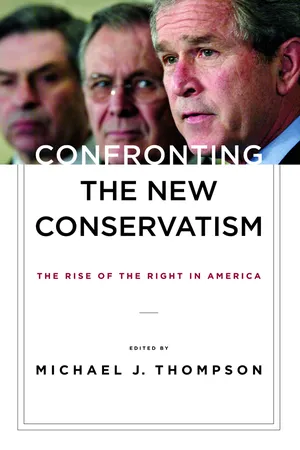
William Kristol, Paul Wolfowitz, Donald Rumsfeld, Condoleeza Rice, George F. Will, and Dick Cheney. These are today’s neoconservatives“confident, clear-cut, and a political force to be reckoned with. But how should we define this new conservatism? What is new about it? In this volume, some of today's top political scholars take on the charge of explaining, defining, and confronting the new conservatism of the last twenty-five years. The authors examine the ideas, policies and roots of this ideological movement showing that contemporary neoconservatism has been able to blend many of the aspects of social conservatism—such as religious populism and nationalism—with economic liberalism and the rhetoric of equality of opportunity and individualism. With their emphasis on dismantling the welfare state and a rhetorical return to economic laissez faire and individual rights, neoconservatives have been able to harness populist sentiment in terms of both economics and cultural issues. And with their belief in moral and cultural “simplicity,” their turn away from science, their conviction in American superiority on the global stage, and their embrace of “anti-government” rhetoric, they have effectively changed the nature of the American political landscape.
The contributors to Confronting the New Conservatism offer a trenchant analysis and substantive critique of the neoconservative ethos, arguing that it is an ideology that needs to be better understood if change is to be had.
Contributors: Stanley Aronowitz, Chip Berlet, Stephen Eric Bronner, Lawrence Davidson, Greg Grandin, Philip Green, Diana M. Judd, Thomas M. Keck, Charles Noble, R. Claire Snyder, Michael J. Thompson, and Nicholas Xenos.
- 304 pages
- English
- ePUB (mobile friendly)
- Available on iOS & Android
eBook - ePub
About this book
Information
Part I
What Is the New Conservatism?
Chapter 1
America’s Conservative Landscape
The New Conservatism and the Reorientation of American Democracy
The history of America’s political culture has been one of flux, of convulsion. It has seen seismic changes in its understanding of democracy, its concept of citizenship, and its view of the nature of politics, the state, and the economy; it has recast its ideas about race, gender, and the concepts of political participation and human liberty. It is against these aspects of newness in American democratic political life and culture that American conservatism has always fought. Older versions of conservatism were unabashedly racist and elitist. Adherents to this credo argued for the privilege of the few over the many. Whether it was the ideas about slavery by thinkers such as John C. Calhoun or George Fitzhugh or the “scientific” defense of class inequality by William Graham Sumner or the antimodernist pessimism of Henry Adams, all were critical of the progressive impulses of liberalism, universalism, and equality, the doctrines that were in fact the driving forces behind American democratic culture.
This conservative disposition in American politics and culture differs in some important respects from the brand of conservatism that has emerged over the past three decades and with more intense force over the past decade in particular. Hostility to the welfare state, a renewed sense of localism and provincialism, a growing apathy to economic inequality and its political consequences, and a new acceptance of economic and social hierarchies all point to what I call a “new conservative” landscape: a political and cultural moment where American politics has taken a turn toward embracing some of the more antidemocratic elements in culture, politics, and economics. The “new conservatism” espouses a hatred for economic equality, a renewed respect for institutional authority in politics as well as for the authority of tradition (i.e., religion) in culture and personal life, and a crude brand of nationalism. But it is more than ideology that informs social movements and elites. It is also a disposition created by certain shifts in economic and political life that have made many Americans more prone to accept many conservative ideas. Indeed, what seems to puzzle many liberal social and political thinkers is the extent to which conservative ideas and policies are embraced by the same people that tend to be most harmed by their effects.
But what, specifically, is “new” about the new conservatism? Writers like Thomas Frank have argued that it should be seen as a “Great Backlash,” or a political and cultural response to the new leftism of the 1960s. “While earlier forms of conservatism emphasized fiscal sobriety, the backlash mobilizes voters with explosive social issues—summoning public outrage over everything from busing to un-Christian art—which it then marries to pro-business economic policies.”1 Frank’s contention is not unique; in fact, it is how we generally conceive of the conservative reaction in contemporary politics.2 But I think it is much more than this. There is a real sense in which the rise of conservative thought is actually a much deeper, more profound shift in American politics and culture. It is a reaction against a deeper transformation that occurred in American society beginning in the late nineteenth century and that carried over into the early twentieth century, a reaction that effected a reordering of political and economic institutions but also, more fundamentally, reshaped the prevailing ideas about democracy and equality in America. What is broadly known as the Progressive movement sought to redefine American democracy in thought and in practice. It was a reaction against the laissez-faire liberalism of the eighteenth and nineteenth centuries and its narrow understanding of liberalism and individualism. The Progressive movement sought a reconstruction of democracy through a reinterpretation of the state, economy, the individual, society, and the relation of all these spheres to one another. What Progressives were able to conjure was a vision of democratic life that emphasized association, cooperation, the centrality of the state for achieving broader public ends, and the need to fuse the economy to standards of the public good, while still maintaining individual liberty in thought and speech. They fostered a move from communal and local ideas about political life toward a national concept of the public good and national goals. But most important, people associated with this movement sought to deepen American democracy by limiting economic power and eroding elite authority. They sought to forge a “new democracy” that would be appropriate for a modern world. The new conservatism should be seen as a countermovement to this reordering of American life; and the result, I argue, has become nothing less than the wholesale reorientation of the American democratic project.3
Part of my argument is that the contours of what can be called the “new conservatism” are not simply rooted in antiliberal ideas but in fact are grounded in many of the broader notions and assumptions of American liberalism itself: the sanctity of private property, individualism and autonomy, economic entrepreneurialism, a privileging of the private sphere over the public sphere, and a hostility to the state. American liberalism is something that can be, and has been, used for progressive ends. It has been able to challenge the pre-liberal political formations and social relations that plagued American political development especially in economic relations and, over time, in race and gender relations as well.4 But as Louis Hartz has pointed out, American liberalism could also lead to its dialectical opposite, the very thing that it opposed.5 I want to argue something similar here: that the peculiar brand of American liberalism has given rise to and also maintains certain aspects of the new conservative impulse in American politics, that the new conservatism is “new” precisely because it has been able to attach itself—even if only rhetorically—to so many of the core notions of political liberalism that define American political culture.
The new conservative disposition in American politics is primarily the result of the increasing social atomization and individualism of modern American life, which has eroded secular forms of association such as unions and social and political organizations and created an environment where both economic elites and old-style conservatives—such as members of the religious right—can push their respective agendas. Both groups are, to be sure, minorities of the population as a whole, but through the erosion of secular associational life, they have been able to gain significant traction in pushing their issues onto the public scene and the policy arena. The very source of conservative ideas is a curious mixture of liberal and traditionalist ideologies, and this makes conservatism a fairly pliable political and cultural doctrine. The popular—or perhaps populist—support for different dimensions of new conservative ideas come from different sectors: Some segments of the American electorate support fiscal conservatism, an emphasis on free markets, the dismantling of the welfare state, and so on. Others are drawn to the emphasis on traditional values, to religion, to the ideas of strong leadership and authority, and the like. But these different emphases are symptoms of a larger phenomenon. The rise of conservatism in American politics and the acceptance, or at least the broad toleration, of many conservative ideas—although by no means all conservative ideas—need to be linked to a more general erosion of democratic culture in the United States. Whereas the liberalism of the 1950s and 1960s was a dominant intellectual paradigm or, borrowing a phrase from Eldon Eisenach, “regime in thought” for much of the postwar era, it has waned as a political ideology capable of confronting the changing trends in modern economic and social life.6
The new conservative landscape I am describing can be defined through three different but interlocking dimensions of modern American social life and political culture: first, a redefinition and reappropriation of liberalism with a more radical emphasis on individualism; second, a resurgent capitalism that has brought back a new and resilient form of economic hierarchy and that has rearranged previous forms of economic life; and third, the narrowing and “provincialization” of everyday life—structured partially by the suburbanization of American culture—which feeds the other two dimensions and narrows the sphere of social interaction largely to the realm of work and family at the expense of broader forms of civil society. These three dimensions of the new conservative landscape are part and parcel of the reworking of America’s democratic institutions and the relation between state, society, the individual, and the economy that were the product of what Robert Wiebe has called the “revolution in values” that occurred during the late nineteenth and early twentieth centuries. It is this combination of factors that largely defines and drives contemporary American conservatism.7
From New to Old Liberalism
Central to the thinking of the new conservatism in America is the emphasis on individualism as a means toward enhanced personal and political liberty. In economic life, emphasis on the interests of the individual in the marketplace, on competition, commerce, and so on, all point to a renewal of what was once known as the “old liberalism”: a brand of liberalism that emphasized the notion of the individual as fundamentally asocial and ahistorical. Even outside the sphere of economics, the prevailing notion in American political culture has been the primacy of the negative liberty of the individual. The laissez-faire liberalism of the nineteenth century saw society as a collection of atomized individuals freely pursuing their self-interest. In John Dewey’s words, “the individual of earlier liberalism was a Newtonian atom having only external time and space relations to other individuals, save that each social atom was equipped with inherent freedom.”8 This led, in the view of many Progressive and reform thinkers of the time, to an atomized society of self-interested individuals where the very idea of public purpose was lost and the rootlessness of modern life would erode any meaningful notions of democratic life. These thinkers did not want to eradicate the ideas of individualism or even the liberal notion of private property, but they did see that the effects of liberal capitalism were leading American democracy toward crisis. Their solution was to create a new concept of democracy that emphasized the role of the state and sought to protect the public from wanton private interests.
Nineteenth-century American social thought was characterized by a laissez-faire liberalism and an individualism without any kind of institutional restraints on economic activity. This led not to the ethical and moral ends that the formulators of classical liberalism—namely, thinkers such as Locke—had envisioned but to a highly unequal society that was fragmenting at the very core. The laissez-faire doctrine had pervasive influence on economic policy, ideas about economic life, and the making and interpretation of law. Central to this thinking was the notion that there existed “laws” of economic activity, derived from thinkers such as Adam Smith and David Ricardo. Profit seeking, speculating, competition—all were considered “natural” in that they were products of truly free people maximizing their respective self-interests. The Social Darwinists of the late nineteenth and early twentieth centuries sought to ground this concept of individualism in ethical terms, constructing a rationalization of industrial society and economic inequality and social atomization.9
But the central premise of the ideas of writers such as Herbert Croly, Walter Weyl, John Dewey, and others who sought a reformulation of modern American democracy was the culmination of a broader trend in American social thought that began in the 1870s and the realization—influenced to a large extent by the effect of German social and moral thought on young American social theorists—that laissez-faire liberalism was in fact corrupting American political life.10 Influential thinkers, such as George Herbert Mead in his Mind, Self, and Society, put forth a conception of individuality that is essentially constituted by one’s relations to society and to others.11 The insight of these efforts in social theory was that individuals were to be seen as embedded in more complex social systems and were not to be seen as isolated, atomized selves. This meant that the older epistemological ideas that grounded classical liberalism could no longer hold: individuals were individuals, to be sure, but they were constituted by their social environment just as much as they helped to constitute that environment; they were not radical subjects but were intersubjectively related to the public around them. Mead, who also marched with striking laborers in Chicago, was conscious of the political implications of his work within the context of laissez-faire individualism: the very ideas of the individual and of society were being fundamentally reshaped and re-thought, and this meant a wholesale reconstruction of what American liberalism and democracy actually meant, both formally and substantively.12
This constituted a reconstruction of liberalism and of the very idea of democracy itself. The “new liberalism” saw individuals as embedded in a broader social, cultural, and economic context. It refused to see the individual as absolute and instead saw the individual as dependent on the complex networks and social ...
Table of contents
- Cover Page
- Title Page
- Copyright Page
- Contents
- Acknowledgments
- Introduction: Confronting the New Conservatism
- Part I What Is the New Conservatism?
- Part II The New Conservatism at Home
- Part III The Global Reach of the New Conservative Ideology
- Contributors
- Index
Trusted by 375,005 students
Access to over 1.5 million titles for a fair monthly price.
Study more efficiently using our study tools.
Frequently asked questions
Yes, you can cancel anytime from the Subscription tab in your account settings on the Perlego website. Your subscription will stay active until the end of your current billing period. Learn how to cancel your subscription
No, books cannot be downloaded as external files, such as PDFs, for use outside of Perlego. However, you can download books within the Perlego app for offline reading on mobile or tablet. Learn how to download books offline
Perlego offers two plans: Essential and Complete
- Essential is ideal for learners and professionals who enjoy exploring a wide range of subjects. Access the Essential Library with 800,000+ trusted titles and best-sellers across business, personal growth, and the humanities. Includes unlimited reading time and Standard Read Aloud voice.
- Complete: Perfect for advanced learners and researchers needing full, unrestricted access. Unlock 1.5M+ books across hundreds of subjects, including academic and specialized titles. The Complete Plan also includes advanced features like Premium Read Aloud and Research Assistant.
We are an online textbook subscription service, where you can get access to an entire online library for less than the price of a single book per month. With over 1.5 million books across 990+ topics, we’ve got you covered! Learn about our mission
Look out for the read-aloud symbol on your next book to see if you can listen to it. The read-aloud tool reads text aloud for you, highlighting the text as it is being read. You can pause it, speed it up and slow it down. Learn more about Read Aloud
Yes! You can use the Perlego app on both iOS and Android devices to read anytime, anywhere — even offline. Perfect for commutes or when you’re on the go.
Please note we cannot support devices running on iOS 13 and Android 7 or earlier. Learn more about using the app
Please note we cannot support devices running on iOS 13 and Android 7 or earlier. Learn more about using the app
Yes, you can access Confronting the New Conservatism by Michael Thompson in PDF and/or ePUB format, as well as other popular books in Politics & International Relations & Conservatism & Liberalism. We have over 1.5 million books available in our catalogue for you to explore.