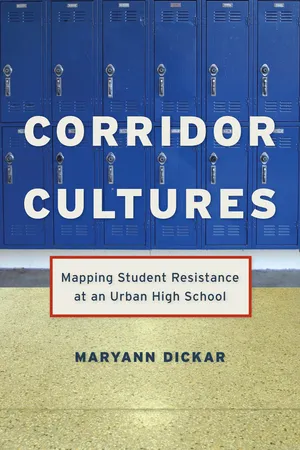
For many students, the classroom is not the central focus of school. The school's corridors and doorways are areas largely given over to student control, and it is here that they negotiate their cultural identities and status among their peer groups. The flavor of this “corridor culture” tends to reflect the values and culture of the surrounding community.
Based on participant observation in a racially segregated high school in New York City, Corridor Cultures examines the ways in which school spaces are culturally produced, offering insight into how urban students engage their schooling. Focusing on the tension between the student-dominated halls and the teacher-dominated classrooms and drawing on insights from critical geographers and anthropology, it provides new perspectives on the complex relationships between Black students and schools to better explain the persistence of urban school failure and to imagine ways of resolving the contradictions that undermine the educational prospects of too many of the nations' children.
Dickar explores competing discourses about who students are, what the purpose of schooling should be, and what knowledge is valuable as they become spatialized in daily school life. This spatial analysis calls attention to the contradictions inherent in official school discourses and those generated by students and teachers more locally.
By examining the form and substance of student/school engagement, Corridor Cultures argues for a more nuanced and broader framework that reads multiple forms of resistance and recognizes the ways students themselves are conflicted about schooling.
- 240 pages
- English
- ePUB (mobile friendly)
- Available on iOS & Android
eBook - ePub
About this book
Information
1

“The Covenant Made Visible”
The Hidden Curriculum of Space
It is no coincidence that this study of Renaissance focuses on spatial formation, because the significance of space is so overwhelming at the site itself. When I interviewed for a teaching position at Old School in 1989, I was awed by its impressive architecture as I approached from the bustling main street. When I walked through the front door I was greeted by a WPA mural and a grand marble staircase that took visitors to administrative offices on the mezzanine above. A security officer saw me and directed me to walk across the campus, the shortest way to get to where I was going. He pointed to a door that opened onto the school’s courtyard, and as I stepped out of the dark foyer into the sun, I felt as if I had stepped into another place and time.
The school’s limestone and brick building formed a peaceful quadrangle carpeted with a lush green lawn and lined with trees and flowers in full bloom that May afternoon. In the center sat a large wood-frame schoolhouse, the original academy. The gothic arches and terra cotta gargoyles and friezes of the main building visually transported me from the ghetto neighborhood that Old School served to an elite college campus. As I walked to the interview for my first teaching position, the campus filled me with a sense of awe at the work I hoped to undertake. On that spring afternoon, the architecture had done what it was designed to do—recall great institutions of learning and celebrate the grandness of the Western tradition.
Once I was teaching at the school, the physical plant took on different meanings. Old School was built with stationary cast-iron frame desks, the back of one seat the front of the next desk. In every classroom many of these seats were missing, leaving gaping holes like missing teeth. Plaster crumbled from ceilings that leaked in the rain, windowpanes were broken, and blackboards were cracked. The wooden desks were covered with graffiti etched in over the years. Mice and roaches were common classroom visitors. Bathrooms for students and teachers did not work; water fountains were always dry. The conditions in the building were harsh and resonated with the school’s reputation, not its architecture. The physical experience of the school presented an incredible contrast—this elegant building encoded with lofty academic ideals and high expectations in a terrible state of decay. The import of these conditions framed day-to-day life at the school and no one missed this obvious irony.
On my first day of school as a teacher, a senior colleague presented me with a petition that she was circulating, demanding that the bathrooms be fixed. Seeing this as a modest request, I went to sign when another colleague, acting as a mentor, moved me away. “These people focus on the building instead of on teaching,” she cautioned, encouraging me to ignore the physical conditions and focus on teaching and learning in my classroom. I quickly learned that the physical conditions in which we worked framed heated debates about what students could do and what was possible given these circumstances. They also informed discourses on race, pedagogical practice, and the curriculum. The narratives told daily in staff rooms, department and faculty meetings, and in the teachers’ cafeteria, equated the school’s physical and academic decline with the overwhelmingly Black population who attended at the time, while a vocal minority responded that institutional racism at all levels—the state, the city, the superintendent’s office, and within the school itself—had conspired to diminish the opportunities offered to Black students. Central to understanding the meaning of space at Old School, now Renaissance, is the recognition of the role race has played in shaping educational and public policies. The spatial reorganization of Old School over its long history offers a case study of the role of race in reshaping urban geography in the postwar and post-civil rights era.
The physical plant itself informs much of the discourse on Old School prior to its restructuring and calls attention to the hidden curriculum of space. Though not carrying out any explicit policy, the physical appearance, condition, and utilization of the school’s space convey powerful messages to students about the meaning of education and their place in American society. Here I offer a critical reading of the hidden curriculum of space to contextualize the issues facing reformers and students at Renaissance.
The Covenant Made Visible
Old School was one of the oldest secondary schools in the nation. Built in 1787 on land donated by the church located across the street and with funds donated by prominent New Yorkers, its original federalist-style school building is on the National Registry of Historic places. The newer structures, built between 1904 and 1939, gained landmark status in 2003. Though originally founded as an elite academy for boys, the school rapidly expanded. In 1801, girls were admitted, and in 1803, the local community funded the school, making it the first public secondary school in the nation (Landmark Preservation Commission 2003).
In 1896, Old School had 150 students, but by 1901, it had about 2000 (Board of Education 1987). This ballooning growth in population attests to a number of changes taking place at the turn of the earlier century, when New York City experienced a monumental explosion in immigration, and demands on its schools grew as well. Between 1900 and 1904, the school registers increased by 132,000 students (Landmark Preservation Commission 2003). In addition to the demand for public schooling, the demand for post-primary education increased and was not available in many parts of the city. In 1898, Old School was turned over to the City of New York on the condition that the city expand it.1
In the early twentieth century, G. B. Snyder, the chief architect of New York Schools, sought to establish a high school in each borough, making available to the masses a quality education beyond primary school. Each of these signature schools was designed to physically embody the vision of the high school as the “everyman’s college.” Snyder designed four wings for Old School, to be built as they were needed, and that, when complete, would form an enclosed quadrangle. The first wing, the front, was completed in 1904, the fourth and final wing in 1939. Though the last wing, built during the Depression, lacked the architectural flourishes of the wings designed by Snyder, all were built in brick and limestone and in the same style and scale.
The link between the physical design of the school and its educational mission is central to understanding Old School’s identity. The decision to design it to look like an elite college was informed by debates on education at the turn of the century when the school’s campus was planned. Surrounding both universities and public school systems expanding at this time were fierce debates between traditionalists (who supported a liberal arts and classical education) and modernists (who endorsed vocational education). Clearly, the traditionalists prevailed in the design of Old School, as Snyder encoded this commitment to the classical/liberal arts in its very walls, modeling it after the residential colleges of Oxford. From its architectural inception, Old School was aligned with conservative traditions in education representing the pursuit of knowledge as a noble pursuit in and of itself and grounded in a rejection of the demands of industrialization via vocationalism and “a nostalgia for gentlemanly elitism” (Turner 1990).
At this time, too, American institutions of higher learning embraced Medieval and Renaissance architectural styles to create a sense of scholarly tradition. Undergoing rapid development and expansion, these institutions reproduced the architectural forms of the great European universities in an effort to place themselves within that scholarly tradition. Where historical connections did not exist, American schools used exacting architectural artifice to create a visual and psychic connection to the highest intellectual traditions of the Western world (Turner 1990). This same concept informed the design of the “new” wings at Old School, which employ the Tudor style of architecture (also known as English Gothic) and reproduce elements of the English residential college such as a chapel (as the auditorium was called). The intention of the designers was to create a sense of tradition and inspire students to lofty goals (Krinsky 1987).
The decision to use such clear Anglo-Saxon forms also served other purposes, particularly the defining of an American identity for the largely first- and second-generation immigrants who would attend the school. Designers may have had one eye on the great universities but the other suspiciously considered the students enrolling in the city’s schools. According to Brumberg (1986), an estimated 277,000 Jewish students attended New York City’s elementary schools in the early 20th century, and in 1918 they comprised 53 percent of the city’s high school population of 85,000. By the 1920s, the community surrounding Old School was a working- and middle-class Jewish community. According to the census of 1920, almost 70 percent of New York’s population was either foreign born or the children of the foreign born. In the public schools, Jews comprised the largest single ethnic block followed by Italians (Brumberg 1986). By the 1920s, Old School echoed these patterns, and by the 1930s its students were predominantly Jewish.
At this time, the central role of the public schools of New York became the Americanization of this great foreign mass. Tyack (1974) suggests that one of the impulses driving turn-of the-century “schoolmen”2 to standardize the institution of schooling was the drive to protect patterns of Protestant socialization. In New York, this system included the teaching of the English language, punctuality, efficiency, and self-discipline, as well as manners, personal hygiene, American norms on how to set a table, clean a house, cook American food and, eventually, the Pledge of Allegiance. Brumberg argues,
Whether the messages transmitted by New York City’s public schools to its immigrant charges were accepted or rejected, they were unambiguously communicated and clearly defined. They presented an idealized America and strongly encouraged all its students to embrace that world and become active participants within it. (15)
As the identity of Old School developed, the Protestant and Anglo-Saxon forms used on the building also informed the curriculum and school rituals that reinforced strong connections between American and Anglo-Saxon culture. Thus, even at its inception, the building sent clear messages about student identity. On the one hand, it inspired and celebrated its students’ upward mobility, while on the other hand, it imposed a culturally specific ideal of the scholarly tradition and American identity.
The physical campus was pivotal in defining both an explicit and a hidden curriculum and in defining what it meant to be a student at Old School. The power of the architecture to frame the way students felt about their experience was well documented in the most recent installment of the school’s history, produced in celebration of its bicentennial. This volume, referred to as The Chronicles, focused on the years 1937 to 1987 and was the most ambitious of the school’s official histories. In addition to retelling the story of the school’s founding, as earlier volumes had, this edition offered a rich social history of the school over the fifty years it covered. A team comprised of alumni and teachers sent out questionnaires to alums, culled through the school’s archives, its newspapers, yearbooks, and literary magazines, and interviewed former and current school leaders. This edition offers a well-documented representation of the dominant narrative of the school’s history.
The text used the campus to frame a tradition of academic excellence that carried the legacy of the greatest traditions of the Western world to New York. In each genesis of The Chronicles, the history of the campus is the first story retold, and this history frames the interpretation of the lived experience of the school in the 1987 volume. The first page opens with “The Memory” as an introduction to the school’s history:
The campus touched everyone who passed through it, striking chords deep in each heart. How does a place, a mass of stone and swath of green, come to mean so much? Perhaps the rich heritage of architecture and garden are the outward symbols of the inner longing for achievement. Perhaps it calls forth the veneration of the past, which enhances the present and makes it meaningful. Perhaps it is the evidence, here in stone on stone, of the continuity of human knowledge and its extension across time. Surely, for each one in each generation, it has been the heritage and the covenant of [Old School] made visible. (3)
Positing this recollection of the experience as “The Memory” and not “a” memory suggests that these are the collective memories of generations of Old Schoolers and clarifies the ways the campus informs consciousness. The powerful architecture links the rich heritage of the past with the present. Students at Old School were carrying on a grand tradition, not creating new ones. Nor were they carrying on their own cultural traditions, but rather Anglo-Protestant traditions that were more central to American identity. “The Memory” also links the architecture to academic excellence, making the school’s outstanding reputation prior seem inevitable. As the campus decayed and its academic reputation plummeted, the connection between the physical space and academic performance was only strengthened. Through their appreciation of the architecture, their participation in this academic community, and their internalization of these values, the largely Jewish students who attended Old School in its hey-day (from the 1930s through the 1950s) were given access to this great tradition, to American identity, and upward mobility. The “covenant” (ironically, an Old Testament metaphor that describes God’s promise to the Jews) Old School makes with its students of inclusion in elite academic and cultural traditions was not kept when students did not readily identify with the architecture.
Many alumni quoted in The Chronicles echo these links between academic excellence, Western civilization, and the architecture. They also document the hidden curriculum of space. For example, one alumna wrote,
I felt privileged attending [Old School]. The buildings themselves with their Gothic architecture, arches, the lawns and pathways, the statue of [namesake of school], and the Old Building, made me feel as though I was attending a college of lasting renown. (52)
Students made the connections that architect Snyder and his colleagues had intended and linked the campus to elite, Western, academic traditions. This alumna felt elevated by the architecture, her detailed recollection of the campus indicating the centrality of the space itself in her identification with these traditions. Another alumna responded, “Every time we passed by the statue of [the school’s namesake] and gazed up, we felt as if we were a part of history” (Board of Education, 52). Without the visual link to the tradition and culture encoded in the walls and statuary, she would not have perceived herself to be part of it. Such perceptions of the students’ own background as outside of real history suggests the narrowness of the traditions Old School represented—traditions that were otherwise unavailable to immigrants and the children of immigrants. In inviting its students into these traditions, the school also constructs their ethnic and cultural identities as outside or marginal to them. Through the mediation of the school, students are brought into the American mainstream.
The cultural specificity of the tradition framed by the architecture was not lost on many alums. Many of the voices in The Chronicles noted the contradictions between their cultural identity and the culture and history celebrated by the school. One of the biggest events at the school was its Christmas concert. The Chronicles describes the procession:
The Choral Club entered from the rear of the Chapel singing Adeste Fidelis. They filled the stage with their red and cream robes while the Glee Clubs and the Cantata sang from the balconies with the orchestra down below. It was an emotional experience, the music rising and swelling and pouring out over the audience. With the traditional finale of Handel’s Hallelujah Chorus, there was many a surreptitious handkerchief to wipe away an emotional tear. (151)
These Christmas concerts were overtly Christian from the musical selections to the robes of the choir, and in the setting itself (beneath a stained glass window), not the secularized fare more common in schools today. The students did not sing carols like “Deck the Halls” and “Jingle Bells.” Rather, this predominantly Jewish student body awed their audiences (no doubt also predominantly Jewish) with highbrow selections that celebrated Christ as the Messiah and Christian domination.
Though these concerts, no doubt, were artistically magnificent, they were, nonetheless, problematic for many of the students:
Now that I mention Christmas, I must add that for a predominantly Jewish school, we certainly partook of the spirit of the season, including its specific religious symbols, with a whole heartedness (more innocence) that was positively glowing. … The caroling and partying that took place in just about every class made the day before the holiday one long festivity—though the official Christmas concert was clearly its highlight, not only for the superior beauty of the vocal and orchestral performances, but because it gave me a chance to gaze for rapt minutes at some current “crush” in the Glee Club. Alumna, 1948 (152)
I can still see her… [names music teacher], throwing herself into teaching us “There was a balm in Gilead—to heal the sin-sick soul.” And I still sing it! For a naïve Jewish girl, she represented passionate, generous Christianity—and I still remember she wrote something mysterious from Isaiah in my yearbook. Alumna, 1958 (152)
These quotes suggest that these Christmas celebrations gave students a sense of inclusion in an American culture that was also a Christian culture. At the same time, the emphasis the speakers place on their naïve enthusiasm suggest that at some point, though perhaps not as students, the speakers recognized the problematic irony presented by their Jewishness and the overtly Christian festivities. The second speaker notes her fondness for a teacher who represented “passionate, generous Christianity,” suggesting she had limited access to such notions of Christianity.
Another alum recalled “the thrill of singing Christmas carols on the radio with the girls especially as I came from an orthodox Jewish background” (alumna, 1948, 152). She suggests that much about these celebrations was social and at least as much about staring at boys in the glee club or singing on the radio with friends as about the Christian content. However, this alumna’s sense of “thrill” was perhaps also informed by her orthodox Jewish background and suggests that these festivities at school provided access to aspects of American culture many Jewish students did not have otherwise. The speakers forgive their youthful selves for their naïveté while speaking from a distance and a mature awareness of the school’s incorporation of Christian forms and their own identities as upwardly mobile Jewish students. Despite the celebratory nature of their reflections, they still suggest that their identities were in conflict with the institution. These students chose to ignore or overlook these conflicts and to embrace the school and its traditions in order to reap the benefits of such participation.
It is difficult to tell how students understood these conflicts at the time, what their families thought, and if, in fact, some students refused to participate in these activities. Certainly some students resented it, as I will discuss shortly. Within The Chronicles, the dominant interpretation of the Old School experience, however, was that everyone enjoyed the events.
Jewish students at Old School strategically navigated through its Christian architecture and culture. As Brumberg has pointed out, the messages sent to Jewish students by efforts to Americanize them were clear and unambiguous. American culture, as represented at Old School was clearly linked to Western European and Christian traditions. However, as Brumberg also points out, though the message was clear, it did not mean that students accepted it in its entirety. It appears, at least in The Chronicles, that Jewish students welcomed the opportunity to use the school to gain access to American culture. What also emerges from these ...
Table of contents
- Cover Page
- Title Page
- Copyright Page
- Contents
- Acknowledgments
- Introduction
- 1 “The Covenant Made Visible”
- 2 “In a way it protects us and in a way … it keeps us back”
- 3 “It’s just all about being popular”
- 4 “If I can’t be myself, what’s the point of being here?”
- 5 “You have to change your whole attitude toward everything”
- 6 “You know the real deal, but this is just saying you got their deal”
- 7 A Eulogy for Renaissance
- Notes
- Bibliography
- Index
- About the Author
Trusted by 375,005 students
Access to over 1.5 million titles for a fair monthly price.
Study more efficiently using our study tools.
Frequently asked questions
Yes, you can cancel anytime from the Subscription tab in your account settings on the Perlego website. Your subscription will stay active until the end of your current billing period. Learn how to cancel your subscription
No, books cannot be downloaded as external files, such as PDFs, for use outside of Perlego. However, you can download books within the Perlego app for offline reading on mobile or tablet. Learn how to download books offline
Perlego offers two plans: Essential and Complete
- Essential is ideal for learners and professionals who enjoy exploring a wide range of subjects. Access the Essential Library with 800,000+ trusted titles and best-sellers across business, personal growth, and the humanities. Includes unlimited reading time and Standard Read Aloud voice.
- Complete: Perfect for advanced learners and researchers needing full, unrestricted access. Unlock 1.5M+ books across hundreds of subjects, including academic and specialized titles. The Complete Plan also includes advanced features like Premium Read Aloud and Research Assistant.
We are an online textbook subscription service, where you can get access to an entire online library for less than the price of a single book per month. With over 1.5 million books across 990+ topics, we’ve got you covered! Learn about our mission
Look out for the read-aloud symbol on your next book to see if you can listen to it. The read-aloud tool reads text aloud for you, highlighting the text as it is being read. You can pause it, speed it up and slow it down. Learn more about Read Aloud
Yes! You can use the Perlego app on both iOS and Android devices to read anytime, anywhere — even offline. Perfect for commutes or when you’re on the go.
Please note we cannot support devices running on iOS 13 and Android 7 or earlier. Learn more about using the app
Please note we cannot support devices running on iOS 13 and Android 7 or earlier. Learn more about using the app
Yes, you can access Corridor Cultures by Maryann Dickar in PDF and/or ePUB format, as well as other popular books in Psychology & Developmental Psychology. We have over 1.5 million books available in our catalogue for you to explore.