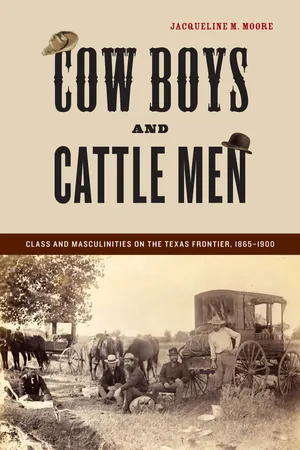
Cowboys are an American legend, but despite ubiquity in history and popular culture, misperceptions abound. Technically, a cowboy worked with cattle, as a ranch hand, while his boss, the cattleman, owned the ranch. Jacqueline M. Moore casts aside romantic and one-dimensional images of cowboys by analyzing the class, gender, and labor histories of ranching in Texas during the second half of the nineteenth century.
As working-class men, cowboys showed their masculinity through their skills at work as well as public displays in town. But what cowboys thought was manly behavior did not always match those ideas of the business-minded cattlemen, who largely absorbed middle-class masculine ideals of restraint. Real men, by these standards, had self-mastery over their impulses and didn’t fight, drink, gamble or consort with "unsavory" women. Moore explores how, in contrast to the mythic image, from the late 1870s on, as the Texas frontier became more settled and the open range disappeared, the real cowboys faced increasing demands from the people around them to rein in the very traits that Americans considered the most masculine.
Published in Cooperation with the William P. Clements Center for Southwest Studies, Southern Methodist University.
eBook - ePub
Cow Boys and Cattle Men
Class and Masculinities on the Texas Frontier, 1865-1900
- 281 pages
- English
- ePUB (mobile friendly)
- Available on iOS & Android
eBook - ePub
About this book
Information
PART I
Doing the Job
1
Of Men and Cattle
In order to understand ideals of masculinity among Texas cowboys and cattlemen in the late nineteenth century and the ways in which these ideals evolved and conflicted, it is first necessary to examine the intersections of the history of the cattle industry and the history of masculinity during this period. Between 1865 and 1900, the years this book covers, there were tremendous changes in American society, primarily as a result of industrialization, the rise of corporate monopolies, and the development of the industrial working class. The cattle business was no exception. Large private and corporate ranchers fenced in their lands in the 1870s and 1880s, ending the era of the open range and driving smaller ranches out of business. The large ranchers then modernized their practices to incorporate both corporate management techniques and scientific breeding measures. These latter developments ultimately both led to some de-skilling of ranch work and changed the nature of the relationship between ranchers and employees. There were regional differences in the timing of these changes, but general trends were consistent across the board.
In the nineteenth-century United States, a dramatic redefinition of manhood also occurred as a result of the rise of industrialization. In many ways, this hit the working class first, as they came into the new factory system and had fewer opportunities to control their own work or the products of it. Since the American definition of masculinity had always included some measure of independence and ability to control one’s own life, working-class men struggled to redefine their masculine identities.1 Many labor organizers tried to counteract the prevailing competitive model of manhood by emphasizing manhood through solidarity against the factory owners and managers in the form of labor unions.2 This rhetoric achieved only limited success, however, and most working-class men simply chose to express their masculinity in a world of all-male unrestrained social bonding and ritual. Meanwhile, by the late nineteenth century, middle-class men were facing challenges to their own ideals of manhood. They had traditionally based their identities in part on their economic success as well as their commitment to a patriarchal, but moral, social order. When this order began to collapse, and their ability to succeed financially became subject to a highly competitive market, they needed to rethink masculinity. With women entering the public spheres of work and politics, unscrupulous entrepreneurs becoming millionaires, and working-class men—including a huge influx of poor immigrants—uniting in opposition to their control, these men felt under attack.3
Social scientists and commentators began to worry that elite men had become “over civilized,” in a society in which culture was feminized and white Anglo-Saxon Protestant men seemed outnumbered by “swarthy” immigrants. Men were in danger of falling prey to “neurasthenia”: a nervous condition that produced effeminacy and sapped men of their virility. A loss of masculinity could put the whole nation at risk. Teddy Roosevelt argued that if George Washington or Abraham Lincoln had shown “the least touch of flabbiness, of unhealthy softness... [it] would have meant ruin for this nation.”4 The solution to these problems seemed to be what Roosevelt termed the Strenuous Life. Boys should be encouraged to break away from overprotective mothers and to cultivate aggression. This aggression was essential to preparing them for the competition they would face in the business world and they could avoid the curse of feminized culture. However, there was a thin line between aggressive behavior and savagery. Thus, as boys grew older, they also needed to learn to restrain their passions and channel them into productive behavior. The new ideal man was physically fit but could control his aggression. He could channel his passion into righteous causes, but unbridled emotion was a sign of weakness.5
The latter ideal of restraint was key to middle-class manhood, both in the sense of differentiating from boyhood, and in the sense of masculinity in comparison with other men. Working-class men were physically fit and far from feminine, and thus on the surface might fit this new ideal if it was not for the concept of restraint. Middle-class men could still claim superiority over their working-class counterparts by showing a superior form of masculinity. They classified working-class men, who defined their own masculinity in part through unrestrained social activities, as both childlike and savage. Gradually, middle-class men began to see regulation of working-class masculinity as essential to achieving proper social order, and to creating a new employee who would identify his interests with those of his employer.6 In some ways they did so by linking the concept of success with masculinity, arguing that any man could achieve success through willpower and manly self-assertion that was “forged in the battle of life.”7 By implication, workers who did not improve their situation were not real men, and were “best viewed as children.”8 Clearly, there were competing ideals of masculinity in the late nineteenth century.
Cowboys and cattlemen modeled their respective class ideals. Cowboys saw their masculinity in terms of their skills on the job, their control over their working conditions, and their ability to make independent decisions. They spent their leisure time in boisterous behavior designed to show masculinity through public drinking and sexual prowess. Cow towns like Dodge City at the railhead in Kansas and smaller towns like Tascosa in the Texas Panhandle gained sordid reputations as the playgrounds of drunken cowboys who gambled, consorted with prostitutes, and rode through town on their horses shooting their guns wildly in the air. While historians such as Robert R. Dykstra and Robert C. Haywood have shown that some of these descriptions were exaggerated or that they overlooked the more respectable permanent cow town residents, it is clear from cowboy narratives, criminal records, and newspaper accounts that the cowboys played as hard as they worked and that drinking, gambling, and fighting were key parts of cowboy identity.9
Cattlemen, however, typically enjoyed a different lifestyle. They saw their masculinity in terms of their ability to provide for their families while building civilization on the frontier. They prided themselves on supposedly superior morals to those of common men such as the cowboys, and they saw drunken violence and gambling as signs of a lack of restraint. Cattleman George W. Littlefield, for example, never drank or gambled, and Mifflin Kenedy built a church on his ranch for his cowhands, encouraging them to maintain moral behavior. Most cattlemen viewed themselves as father figures to their employees and felt they had every right to control them. Richard King, the patriarch of the King Ranch in South Texas, took on the role of a patrón with complete control and authority over his employees and the families that lived on his encomienda-style ranch. Charles Goodnight of the JA Ranch in the Panhandle assumed the right to set whatever rules he liked for his employees on the ranch, including regulation of his cowhands’ personal behavior. Colonel Joe C. Miller, founder of the 101 Ranch in Oklahoma, played patriarch to all who came to the ranch. He welcomed all visitors and employees with the phrase “Come in, children.”10 Cowboys and cattlemen were clearly considered two different classes of men. Cattlemen owned the ranch, cowboys were just employees. While shipping cattle on the Northern Pacific Railroad, the cattlemen and bosses got free passes to travel with the regular passengers, but the cowboys had to stay in a special car attached to the end of the train.11
The development of the Texas cattle industry before the Civil War was a result of the efforts of both Mexican and Anglo ranchers and workers as well as black slaves. In the seventeenth and eighteenth centuries, the Spanish brought cattle and horses to the New World to supply both the military and the Catholic missions. When the missions began to secularize in the 1790s, lands and cattle were dispersed to private individuals. In the system that evolved, workers lived on the self-sufficient ranches and were bound to a patrón for protection and employment. Vaqueros developed methods of roping from horseback, branded cattle to designate ownership, and helped drive the cattle to market. By 1800, there were several million cattle grazing on Spanish lands in California and Texas.12 But by 1830, while most Texas cattle were descended from Spanish stock, about 20 percent of the cattle were “American native” stock that had come with Anglo settlers in the Austin region.13 The blending of this stock with the Mexican cattle, as well as with cattle from Western Louisiana and elsewhere, led to the creation of the Texas Longhorn, the tough and somewhat wild cattle that could handle the heat of Texas and were equally at home in coastal prairies in Gulf Coast Texas and the brush country along the Rio Grande.14 Additional human migrants also came to Texas, many from the Southern United States, and brought with them livestock herding practices that had developed there. Historians have debated whether these practices originated from Scots-Irish herding techniques that immigrants brought to the United States, and indeed many Texas settlers were of Scots-Irish descent. Livestock raisers in Scotland and Ireland used many of the techniques associated with Texas ranching, including open range grazing, seasonal roundups, branding, and professional drovers. It is most likely, however, that the style of ranching that developed was less a result of ethnicity than that it was best suited to the geography of Texas.15
Much of the cowboy’s rough reputation in town came from Anglo cowboys who worked in the frontier period, when part of the job description was defending ranch property from Indian and Mexican attacks and “confiscating” cattle from neighboring herds.16 Anglo ranching in Texas often developed at the expense of Mexican ranchers. During the Texas Revolution, Texas soldiers began stealing cattle from the Mexicans to feed the troops and driving them north. Following the war, soldiers continued this practice. Indeed, until the 1870s, raiding on both sides of the border was common, and border hostilities often revolved around cattle thefts.17 Many Mexicans who owned land grants were intimidated into leaving or selling their land to the Anglo ranchers in the region after the Texas revolution. Others were forced out later when Anglo ranchers such as Richard King and Mifflin Kenedy fenced in their land and blocked access to water sources, some of which did not actually belong to them.18 On the Gulf Coast, intimidation also displaced a number of black landowners. Aaron Ashworth owned over 3,000 head of cattle in Jefferson County in 1850 but was driven off by envious Anglos.19 There were a few black cattlemen, such as Silas Jackson, who owned a large ranch near Goliad, or D. W. “80 John” Wallace, who eventually amassed over 10,000 acres in Mitchell County in north central Texas. Black owners were rare, however, as it was difficult for African Americans to purchase land in the years after the Civil War due to racial prejudices.20
Throughout the period leading up to the Civil War, Mexican vaqueros passed their skills on to Anglo settlers, who adapted their clothing and equipment to meet the needs of the job. In addition, some of the Anglo ranchers hired vaqueros to work for them, especially in South Texas, where they often hired the Mexican ranchers they had displaced.21 In the most direct transfer of customs and skills, in the 1850s, Richard King, a former riverboat captain, secured a large parcel of land in Southern Texas and persuaded an entire Mexican village to relocate to his ranch and take him as a patrón. King’s vaqueros or kineños, as they were called, lived on the ranch for generations with their families, and the job became an inheritance they passed down from father to son.22
By the 1850s, Texas ranchers had established markets for their cattle, which they drove up the Shawnee Trail to Kansas City and Sedalia, Missouri as well as New Orleans and Shreveport, Louisiana. A few even drove cattle to California to feed the Gold Rush migrants. However, most still shipped their cattle via steamship from Brownsville and Galveston to the Caribbean. During the Civil War, the Union blockade stopped both shipping and drives, and with many men off fighting, the herds went largely untended for five years. At the end of the war, there were an estimated five to six million wild cattle in Texas. In the next few years, ranchers began to round up all unbranded cattle, known colloquially as mavericks, to rebuild their herds. With the Southern economy in shambles, however, there was no demand for beef in the old markets. In 1866, Chicago opened its stockyards and the ranchers realized that if they could get their cattle to a railhead they could potentially sell to a national market. In 1867, the Kansas Pacific Railroad established such a railhead at Abilene, Kansas, and a few ranchers began the long trail drive north.23 Meanwhile, other ranchers had discovered during the Civil War that they could make money with government contracts to supply beef for the military, and later, for Indian reservations, so they drove cattle west to New Mexico and California, and north to Nebraska and the Dakotas.
The first cattle drives to the north after the Civil War started in 1866, with ranchers employing a few men to accompany them and their herds to the Mississippi to ship up the river. Faced with unfamiliar territory, and problems with outlaws, Indians, and settlers who objected to thousands of cattle driving across their land, the ranchers got very few cattle to market that year. In the following years, tick fever from Texas cattle caused the farmers in Illinois to block passage to the herds, and both Kansas and Missouri passed quarantine laws requiring cattlemen to leave their cattle in stock pens until it was determined they did not carry the fever.24 These early drives up the Chisholm Trail were not without difficulty but could be very profitable. Jonathan Hamilton Baker, a rancher from near Graham, Texas, took a herd up the trail in 1870, a banner year for cattle, earning enough profit to buy his wife a sewing machine, washing ma...
Table of contents
- Cover Page
- Title Page
- Copyright Page
- Dedication Page
- Contents
- Acknowledgments
- Introduction The West, the Man, and the Myth
- Part I Doing the Job
- Part II Having Fun
- Epilogue The Cowboy Becomes Myth
- Notes
- Index
- About the Author
Trusted by 375,005 students
Access to over 1.5 million titles for a fair monthly price.
Study more efficiently using our study tools.
Frequently asked questions
Yes, you can cancel anytime from the Subscription tab in your account settings on the Perlego website. Your subscription will stay active until the end of your current billing period. Learn how to cancel your subscription
No, books cannot be downloaded as external files, such as PDFs, for use outside of Perlego. However, you can download books within the Perlego app for offline reading on mobile or tablet. Learn how to download books offline
Perlego offers two plans: Essential and Complete
- Essential is ideal for learners and professionals who enjoy exploring a wide range of subjects. Access the Essential Library with 800,000+ trusted titles and best-sellers across business, personal growth, and the humanities. Includes unlimited reading time and Standard Read Aloud voice.
- Complete: Perfect for advanced learners and researchers needing full, unrestricted access. Unlock 1.5M+ books across hundreds of subjects, including academic and specialized titles. The Complete Plan also includes advanced features like Premium Read Aloud and Research Assistant.
We are an online textbook subscription service, where you can get access to an entire online library for less than the price of a single book per month. With over 1.5 million books across 990+ topics, we’ve got you covered! Learn about our mission
Look out for the read-aloud symbol on your next book to see if you can listen to it. The read-aloud tool reads text aloud for you, highlighting the text as it is being read. You can pause it, speed it up and slow it down. Learn more about Read Aloud
Yes! You can use the Perlego app on both iOS and Android devices to read anytime, anywhere — even offline. Perfect for commutes or when you’re on the go.
Please note we cannot support devices running on iOS 13 and Android 7 or earlier. Learn more about using the app
Please note we cannot support devices running on iOS 13 and Android 7 or earlier. Learn more about using the app
Yes, you can access Cow Boys and Cattle Men by Jacqueline M. Moore in PDF and/or ePUB format, as well as other popular books in History & North American History. We have over 1.5 million books available in our catalogue for you to explore.