This, the twenty-seventh volume in the annual series of publications by the American Society for Political and Legal Philosophy, features a number of distinguised contributors addressing the topic of criminal justice. Part I considers "The Moral and Metaphysical Sources of the Criminal Law," with contributions by Michael S. Moore, Lawrence Rosen, and Martin Shapiro.
The four chapters in Part II all relate, more or less directly, to the issue of retribution, with papers by Hugo Adam Bedau, Michael Davis, Jeffrie G. Murphy, and R. B. Brandt. In the following part, Dennis F. Thompson, Christopher D. Stone, and Susan Wolf deal with the special problem of criminal responsibility in government—one of great importance in modern society. The fourth and final part, echoing the topic of NOMOS XXIV, Ethics, Economics, and the Law, addresses the economic theory of crime. The section includes contributions by Alvin K. Klevorick, Richard A. Posner, Jules L. Coleman, and Stephen J. Schulhofer.
A valuable bibiography on criminal justice by Andrew C. Blanar concludes this volume of NOMOS.
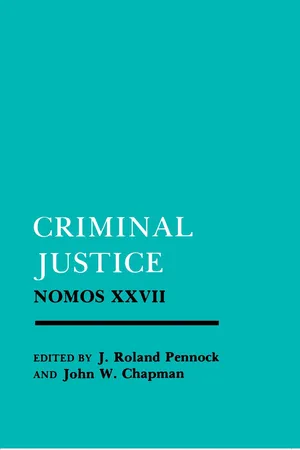
eBook - ePub
Criminal Justice
Nomos XXVII
- 386 pages
- English
- ePUB (mobile friendly)
- Available on iOS & Android
eBook - ePub
About this book
Information
THE MORAL AND METAPHYSICAL SOURCES OF THE CRIMINAL LAW
1
THE MORAL AND METAPHYSICAL SOURCES OF THE CRIMINAL LAW
INTRODUCTION
My topic calls for clarification: what is meant by “criminal law” and by “source?” The criminal law that is the subject of this paper is, first of all, substantive criminal law, not criminal procedure. Secondly, within substantive criminal law, I will discuss only what for decades now has been known as the “general part,”1 that set of legal doctrines and principles that have relevance to all crimes and which do not concern themselves with the elements of particular crimes. The requirements of actus reus, mens rea, and the principle of legality are examples of the doctrines and principles of the general part, as are most of the rest of the standard fare of a first-year law course in substantive criminal law.
Whether a (truly) general part of the substantive criminal law exists is a matter of some controversy. George Fletcher, for example, urges that we operate with three different “patterns of criminality,” each with its own characteristics.2 Mark Kelman’s more recent attempt at “deconstruction” is even more extreme in its denial that a coherent, general part to the criminal law exists.3 Without arguing the point, I think it is demonstrable that neither of these kinds of criticism can show that the traditional view of the matter is mistaken. The case for there being a set of doctrines cutting across all crimes is much stronger than is the corresponding case for there being, say, a general part to property law that cuts across all kinds of property, real as well as personal. Assuming, then, the existence of a general part to the substantive criminal law, my interest is to inquire into its sources.
By “source,” I do not mean to designate the legitimating origin of criminal doctrines—the sense in which jurisprudes speak of the “sources of law.” Whether criminal law is statutory, common law, customary, etc., is not my question. Neither is this an historical inquiry. By “source” I mean to designate those non-legal ideas that in some sense can be said to underlie our criminal law. The relation between these ideas and the criminal law is a logical one, such that the criminal law can be said to presuppose these other, more general ideas.4
I believe the criminal law has two such sources, one moral and one metaphysical. Since the metaphysical basis of the criminal law is the principal topic of this paper, I shall utilize this introduction to say something about the relation of the criminal law to its underlying moral basis. The moral basis of the criminal law is to be found in those moral principles under which fault is properly ascribed to persons for their behavior. These are the moral principles that tell us: (1) when a being is sufficiently accountable for his actions that he may be counted a moral agent; (2) on what occasions moral or legal norms may fairly obligate such agents; (3) when an act is done, a harm is caused, and with which mental states culpability is to be found; and (4) what circumstances amount either to a justification or an excuse for having caused a harm. These four principles are so closely embodied in criminal law that criminal lawyers are apt to forget that they are also moral principles defining culpability and telling us when a person may fairly be blamed for his actions.
These four principles together form a system that I shall here minimally sketch. First, the principles of accountability define the range of beings who are moral agents and thus the proper addressees of our substantive moral norms. As usually construed, these principles exclude animals, corporations, infants, and the insane from being the kinds of agent that are capable of being morally responsible. So construed, moral agency becomes coextensive with personhood, so that all and only persons are moral agents; aggregates of persons (corporations), and members of the human species that lack certain distinctive features of personhood (as the insane and the very young lack rationality) are not moral agents, on this view.
Second, the principles of fairly imposed obligation limit blameworthiness to those moral agents who have had a fair chance to acquaint themselves with the norms of any society. The aliens who come among us, children, and (more controversially) what used to be called psychopaths, who have not had such chance at moral education, are not fairly blameable for the harms they cause.
Third, in our fault ascriptions we apply what might be called a principle of answerability, which requires the simultaneous concurrence of three things: (1) that the individual acted; (2) that he did so intentionally, recklessly, or negligently; and (3) that he either caused some morally bad result, or, if he did not cause it, such result was the object of some further intention of his with which he acted. Excluded by the first of these, the act requirement, are involuntary movements, such as reflex movements, as well as another’s use of one’s body as an instrumentality. The mental state requirement excludes people who are non-negligently ignorant or mistaken about what it is they are doing by their actions. The causation requirement excludes persons who neither tried to cause some bad result nor in fact did so. If, on the other hand, someone’s behavior satisfies all three requirements (and assuming he is a moral agent with a fair chance to become morally educated), then he is prima facie answerable for that behavior.
Such a person is only prima facie answerable, however, and not actually culpable, because of the fourth set of principles relevant here. These are the principles of justification and excuse. If one can show that in the particular circumstances in which one acted, the harm caused or intended was less than the harm prevented, one may be justified in so acting; alternatively, we may be justified in acting if the party who suffers the harm is himself at fault in placing us in a position of peril. The principles of excuse, by way of contrast, don’t tell us when it is legitimate to act in ways otherwise prohibited; rather, they tell us when it was sufficiently difficult for an agent to resist causing some harm that he may not fairly be blamed for bringing it about. People who act under the coercion of others, who are placed by nonhuman circumstances in positions requiring very hard choices, and people who act under extreme emotional disturbance, are the kinds of people typically excused under these principles.
These four sets of principles form a system in the sense that they together determine when a being is morally culpable and thus, morally blameworthy. They may themselves be justified by yet more general principles, such as H.L.A. Hart’s principle of responsibility or even yet more general principles of liberty.5 More pertinently here, the four principles by-and-large justify the doctrines that make up the general part of the substantive criminal law.6 These principles are the source of criminal law doctrines in the sense that they form part of the most coherent justification that can be given of these doctrines.
I do not regard the thesis that our criminal law has such a moral basis to be very problematic. It can only be made to seem problematic if one confuses it with much stronger theses about the relationship of criminal law to morality. The thesis I have sketched is not, to begin with, a natural law theory—or at least it needn’t be. The connection between law and morals asserted here is only a contingent one: the doctrines of our criminal law turn out to be based on particular moral theory about when a being is morally responsible. Such a connection to morality is not necessary for our criminal laws to be laws, as a natural law theory would assert. We could have laws that assign liabilities in ways that have little resemblance to this or any other moral theory, and they would still be laws. As it happens, however, our criminal law does reflect this underlying moral theory about when it is fair to ascribe responsibility to a person.
Secondly, no necessary or contingent connection between what it is the criminal law prohibits and what it is that morality prohibits need be asserted. The general part of the criminal law, as we have seen, is “topic-neutral” in the sense that it is not concerned with what is defined as criminal; the general part deals with the conditions under which liability can attach, no matter what acts or harms may be prohibited by the special part of the criminal law. The relevant morality, accordingly, is not that which concerns itself with what are good or bad acts or states of affairs or right or wrong actions, but rather, “topic-neutral” morality, those moral principles that define the conditions under which it is fair to attribute moral responsibility for acts or harms, no matter what the moral status of the latter.7 It is this topic-neutral morality, the moral principles of fault ascription, with which the general part of the criminal laws is to be linked. One can imagine a system with wildly immoral criminal law prohibitions that nonetheless parceled out liability only under those moral conditions of fair fault ascription; for such a system my thesis about the criminal law having a moral basis would be satisfied.
The second set of ideas underlying our criminal law—what I shall call its metaphysical basis—consists of those presuppositions of what persons must be like if the moral system that I have just described can fairly be applied to them. The moral principles that determine when fault is fairly ascribed, I contend, themselves utilize concepts that link morality (and thus the criminal law) to a particular metaphysical view about persons. This is the view that persons are rational and autonomous agents. The concepts that reveal such a view of man are the concepts of action, intention, negligence, causation, compulsion, accountability, and the like—the key concepts in the moral principles of fair fault ascription. These concepts are not only concepts in terms of which moral responsibility is ascribed but are also the concepts in terms of which we understand ourselves as persons. Such concepts, in other words, are not just moral concepts; they are more generally the concepts in terms of which we describe and explain human doings in everyday life and throughout most of the social sciences. Thus, the morality in which the criminal law is embedded is itself built upon a more general metaphysical view of what persons are like.
Since I do not regard the moral thesis, as I have described it, as very problematic, I shall not argue for it here beyond what has already been said. Nor will I seek to give the metaphysical thesis the defense it requires in terms of a detailed consideration of how the principles of fault ascriptions presuppose that persons are rational and autonomous agents, for this I have done elsewhere.8 Rather, in the body of this paper I seek to do three things: first, to sharpen the metaphysical thesis by defining rationality and autonomy; second, to show why any view of persons in terms of such attributes is properly characterized as “metaphysical;” and third, to give a partial defense of the metaphysical thesis, not by making the positive case for it, but by rebutting several common skepticisms about the metaphysics of minds and persons prevalent in legal circles. I shall close with some remarks about why we should care about the metaphysics of personhood presupposed by both the criminal law and the morality that underlies it.
THE METAPHYSICS OF PERSONS AS RATIONAL AND AUTONOMOUS AGENTS
Rationality and Autonomy
The attributes of rationality and autonomy are best analyzed in terms of the idea of an agent acting for reasons. This idea is actually a conjunction of two ideas: that of action, and that of reasons for acting. These two ideas correspond, respectively, to the ideas of autonomy and rationality, and will be considered separately.
Rationality and Reasons. Reason-giving explanations of human behavior have two parts and serve two explanatory functions.9 With regard to the two parts: a full explanation in terms of reasons for action requires, first, a statement specifying the agent’s desires (goals, objectives, moral beliefs, purposes, aims, wants, etc.), and second, a statement specifying the agent’s factual beliefs about the situation he is in and his ability to achieve, through some particular action, the object of his desires. For example, if someone (X) opens the window in order to chill the room, we will have explained his action by citing explicitly or implicitly:
1. His desire that the room be chilled, and
2. His belief that opening the window will chill the room.
Knowing this desire and belief set of X, we can understand his action in the fundamental way in which we understand all human actions, in terms of the agent’s reasons or motives for acting.
This mode of explanation serves two quite distinct functions: reasons for an action both rationalize the action and causally explain it. A belief/desire set rationalizes an action in the sense that it portrays the action as the rational thing to do, given the agent’s beliefs and given his desires. We understand the action in this sense because we can understand that a rational agent would so act, and that had we a similar belief/desire set, we too would so act. We can see the action as a means to something the agent wants. As long as the object of the agent’s desire is intelligible to us as something a person in our culture could conceivably want, and so long as the factual beliefs are not themselves irrational, we can empathize with the action, even if we disagree with it morally or esthetically. We empathize because, knowing the belief/desire set, we perceive the activity to be the rational thing for an agent with such beliefs and desires to do.
This aspect of reasons for acting is sometimes confusingly expressed by saying that there is a logical connection between the sentences describing the belief/desire set and the sentence describing the action. Yet without supplementation with further premises, there is no logical connection between sentences describing a desire and a belief of an agent and a sentence describing his action. Still, some connection exists between the content of the beliefs and of the desires, on the one hand, and the action they explain on the other. The content of X’s belief about means will necessarily include the same description of the action to be explained (opening the window) as is given in the conclusion, and the content of this belief will also necessarily include the same description of the end (chilling the room) as is ...
Table of contents
- Cover
- Nomos
- Title Page
- Copyright Page
- Contents
- Contributors
- Preface
- Introduction
- Part I: The Moral and Metaphysical Sources of the Criminal Law
- Part II: Concerning Retributive Theory
- Part III: Criminal Responsibility in Government
- Part IV: The Economic Theory of Criminal Law
- Bibliography
- Index
Trusted by 375,005 students
Access to over 1.5 million titles for a fair monthly price.
Study more efficiently using our study tools.
Frequently asked questions
Yes, you can cancel anytime from the Subscription tab in your account settings on the Perlego website. Your subscription will stay active until the end of your current billing period. Learn how to cancel your subscription
No, books cannot be downloaded as external files, such as PDFs, for use outside of Perlego. However, you can download books within the Perlego app for offline reading on mobile or tablet. Learn how to download books offline
Perlego offers two plans: Essential and Complete
- Essential is ideal for learners and professionals who enjoy exploring a wide range of subjects. Access the Essential Library with 800,000+ trusted titles and best-sellers across business, personal growth, and the humanities. Includes unlimited reading time and Standard Read Aloud voice.
- Complete: Perfect for advanced learners and researchers needing full, unrestricted access. Unlock 1.5M+ books across hundreds of subjects, including academic and specialized titles. The Complete Plan also includes advanced features like Premium Read Aloud and Research Assistant.
We are an online textbook subscription service, where you can get access to an entire online library for less than the price of a single book per month. With over 1.5 million books across 990+ topics, we’ve got you covered! Learn about our mission
Look out for the read-aloud symbol on your next book to see if you can listen to it. The read-aloud tool reads text aloud for you, highlighting the text as it is being read. You can pause it, speed it up and slow it down. Learn more about Read Aloud
Yes! You can use the Perlego app on both iOS and Android devices to read anytime, anywhere — even offline. Perfect for commutes or when you’re on the go.
Please note we cannot support devices running on iOS 13 and Android 7 or earlier. Learn more about using the app
Please note we cannot support devices running on iOS 13 and Android 7 or earlier. Learn more about using the app
Yes, you can access Criminal Justice by Ronald Pennock,John W. Chapman, Ronald Pennock, John W. Chapman in PDF and/or ePUB format, as well as other popular books in Social Sciences & Criminology. We have over 1.5 million books available in our catalogue for you to explore.