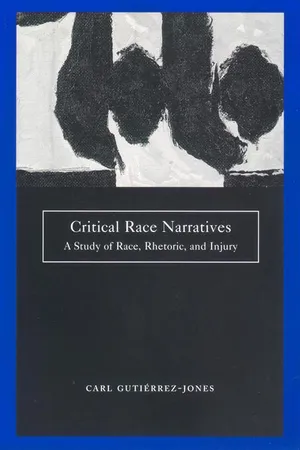
The beating of Rodney King, the killing of Amadou Diallo, and the LAPD Rampart Scandal: these events have been interpreted by the courts, the media and the public in dramatically conflicting ways. Critical Race Narratives examines what is at stake in these conflicts and, in so doing, rethinks racial strife in the United States as a highly-charged struggle over different methods of reading and writing.
Focusing in particular on the practice and theorization of narrative strategies, Gutiérrez-Jones engages many of the most influential texts in the recent race debatesincluding The Bell Curve, America in Black and White, The Alchemy of Race and Rights, and The Mismeasure of Man. In the process, Critical Race Narratives pursues key questions posed by the texts as they work within, or against, disciplinary expectations: can critical engagements with narrative enable a more democratic dialogue regarding race? what promise does such experimentation hold for working through the traumatic legacy of racism in the United States? Throughout, Critical Race Narratives initiates a timely dialogue between race-focused narrative experiment in scholarly writing and similar work in literary texts and popular culture.
- 248 pages
- English
- ePUB (mobile friendly)
- Available on iOS & Android
eBook - ePub
About this book
Information
WORKING THROUGH RACIAL INJURY
CHAPTER ONE
THE CONTOURS OF THE CONTEMPORARY RACE DEBATE
The historic argument for inclusion has always been set within the overarching sign of “America”: equal rights equals the achievement of America’s democratic ideals. In the contemporary era, we are witnessing how this idea of rights can be turned into a means for garnering protection for the historically privileged, so that whites, men and heterosexuals can claim—and have been winning their claims in court—their right to exclude and discriminate.
—Robyn Wiegman, American Anatomies, 133
If recent decades in American studies will be recalled for a pervasive concern regarding the inclusion of previously disenfranchised communities, it may well be that the movement of American studies into the twenty-first century will be remembered for a pronounced skepticism toward the promise of inclusion. This is not to say that the inclusion-oriented debates—over curriculum, hiring policies, conference participation, and structure—that have animated the pages of the various professional journals and bulletins devoted to American studies are likely to evaporate. Instead, I mean to register a probable transformation in the political possibilities tied to inclusion as a form of remedy (for racism, for sexism, etc.). Though the skepticism explored here is not unique to American studies, it does speak in very pointed ways to the implicit and explicit ethical concerns that have exercised considerable influence over the shape and direction of American studies. Much of the skepticism I refer to focuses on the exaggerated nature of the remedy attributed to processes of inclusion in themselves. As posed by Robyn Wiegman in American Anatomies: Theorizing Race and Gender, the recent politics of visual representation in popular culture, a politics which might be read as a sign of America’s movement toward integration, in fact reveals extremely troubling reinscriptions of social and cultural hierarchies, an indicator that white supremacy has deflected earlier criticisms by simply finding more sophisticated ways of disseminating its messages. Although Wiegman’s argument is one of the most systematic critiques in this vein, scholars working within a variety of disciplines within American studies have begun voicing, more and more forcefully, their dissatisfactions with inclusion- and exclusion-oriented political claims.1 For most, the result has been a desire not to discount the importance of inclusion, but rather to rethink the nature of the injury supposedly ameliorated by inclusion. The frequently implicit assumption, then, is that by refining notions of the injury previously equated in a blanket form with “exclusion,” scholars might avoid some of the pitfalls that ensue when rights discourse in particular too quickly yields to a mythology of American consensus, when inclusion too quickly glosses the nature of injury.
Although the point is rarely made in debates about race and racism, most, if not all, of the key terms at issue—including merit, fairness, equality—draw directly on a highly complex discourse of injury which has notable contours that mark it as a product of U.S. cultures, and “Western” culture generally. Patricia Limerick’s Legacy of Conquest: The Unbroken Past of the American West and the New Western History enterprise as a whole is but one example of how American studies has tried to reshape itself around a project which would complicate notions of injury. In the New Western History approach, the imaginative centrality of the frontier yields to a focus on the consequences of conquest itself. In this regard, Limerick and her cohorts are in fact elaborating a concern with the contours of injury which stretches back through lodestar texts like Richard Slotkin’s Regeneration through Violence, and Henry Nash Smith’s Virgin Land. This interest in injury has of course served varied political purposes. One might even argue that Frederick Jackson Turner’s frontier thesis, a cornerstone of American history, is itself built upon a notion of injury wrought by the closing of the West itself, an injury that helped transform the colonization of the West into a larger imperial project of global dimensions by securing a basic ideological nostalgia for America’s own subdued natives.
Whether our focus is the United States or abroad, ample evidence suggests that current debates regarding injury, including debates over discrimination and reverse discrimination, are far from exceptional. Contemporary argument about the “efficacy” of official apologies for racial injuries, including the Tuskegee experiments and slavery itself, tended to produce struggles regarding claims of injury that are very similar to those found in the wake of civil and international wars.2 A recent measure in the California State Assembly offers an example of the difficult rhetorical terrain; here lawmakers asked Japan to apologize to U.S. veterans who were forced into slave labor, to sex slaves from Korea, and to the victims of the “rape of Nanking.” Debate about the measure, in turn, focused on the injuries caused to Japanese civilians by U.S. atom bombs, on the internment of Japanese Americans during the war, and on the injuries that may be received by Asian Americans if the bill enhances lingering racial resentments. Not surprisingly, divisions over the measure extended to the Asian American members of the Assembly, prompting U.S. Senator Daniel Inouye (Hawaii) to quell tensions by sharing his own wartime experiences in Europe and emphasizing that “in war, no party is blameless.”3
As newspapers across the country have taken up U.S. race debates, readers have been drawn through repeated examples of our tremendous differences, particularly in terms of our basic understandings of what defines race and racism. Very rarely have these defining differences been laid out in an analytical fashion, and most often the functional definitions in arguments are left implicit, if not simply vague. A good part of the popular skepticism that filters through such articles and op-ed pieces is bound up with the notion—sometimes explicitly stated—that the “discussion” on race has run its course, or at least stalled, and that there might not be anything gained in further efforts that have no shared understandings.4 As if to reenact this very impasse, media of all sorts have profiled a gambit of politically balkanized, academically credentialed pundits, virtually none of whom were asked to critically engage questions about what constitutes race, or what the defining dynamics of racism might be. Given the difficulties in both the popular and academic venues that I have been describing, American studies—at least to the extent that it has been invested in questions of race, class, and gender—appears to be at a crossroads of sorts. However we understand the vexed choices this crossroads represents, I would argue there is a significant value in rethinking the ways we are articulating the notions of injury which ground presumed engagements with politics.
A RHETORIC OF INJURY
Like most concepts that end up at the center of debate, “injury” seems to call forth a definition based in common sense. But as is the case with most such terms, closer inspection reveals a lot of baggage to unpack. In one sense, the term is resoundingly rhetorical in nature, a creature animated by the arts of persuasion. Like the verb form “to injure,” injury marks an act against “jur,” against the law, rights, and accepted privilege. There is also, woven into the term’s history, an aspect of oral responsibility. The predominant definition of injury emphasizes its association with a verbal act, with calumny and the like. As suggested by terms like juror, jurat, jury, the law violated by injury is sustained with verbal practices and allegiances, by oaths of filiation to established authority. Injury is also a bit fickle as regards questions of agency. While one definition for the term emphasizes a willful action of hurt, and therefore a resulting blame, another definition treats injury as an effect without focus on the agent.5 In this sense, injury marks a dichotomy in legal thought that establishes distinct poles as adjudication works through either the perpetrator’s or the victim’s perspectives. Extending the implications of this dichotomy, one might well argue that the competing basis for arguments about both reverse discrimination and institutional racism are bound up in this slippage. While the former claim assumes that group remedies have insufficiently identified racist agents and therefore enact racist remedies (affirmative action policies and the like), the latter assumes that injuries identified by effects are sufficient to merit judicial action. In sum, injury is continually rearticulated and jostled as it is employed in a rhetorical battle that is legally oriented from the start.
In recent scholarship, injury has also been rethought in terms of the psychoanalytic notion of “trauma,” a term that has been particularly important in Holocaust studies and historical inquiries regarding the difficulty, if not impossibility, of representing extreme injury, or “limit events.”6 As I am using the term, injury is distinguished from trauma for a variety of reasons, but among them trauma as a notion is often more singularly oriented toward addressing the victim’s experience of loss or hurt. By contrast, injury helps contextualize a larger rhetorical economy based on perpetrator/victim interplay. Obviously great caution is required as we move between study of the Holocaust and study of race dynamics in the United States. At the same time, there is much to be gained by comparing these critical projects as they wrestle with ethical dynamics that tend in these different contexts to be both impoverished and naturalized (or somehow trapped in a field of “common sense”). It is exactly this common-sense field of assumptions about injury which enables such distinct positions—reverse racism versus institutional racism—to be described in what seems to be a relatively consistent set of rhetorical gestures. Exploring these gestures can clarify their limits, and how they in fact contribute to the sense of impasse that national discussions on race continue to face.
When certain authors argue that affirmative action-oriented definitions of racism are “overextended,” compromising essentially autonomous realms—threatening, that is, our embrace of merit, or fairness—they do so not only by limiting what counts as injuries to minorities, but also by reframing how the concept of injury may be legitimately used. In other words, what is at issue is not simply a dynamics of exclusion—critics of affirmative action claiming that minority injuries do not count—but rather a fight over the proper ways to read injury. In what follows, I argue that the best readers of racism do not simply respond by demanding inclusion per se; their interventions are directed toward complicating the rhetorical uses of racial injury. This self-consciousness about injury in turn reframes current calls to color-blindness, showing them to be an extension of a certain political consensus that dates back at least to the 1960s when mainstream politicians aligned right-wing white supremacists (including the KKK) with the black power movement, calling both “racist.” Ultimately, the collapse of these groups into the same “racist” project enabled mainstream politicians to avoid questions regarding these groups’ location relative to dynamics of social power; in turn, whatever might have been distinguished as social critique in the discourse of the black power movement or other minority nationalisms was vilified and thoroughly discounted.7
By turning to an analysis of injury in its shifting uses, my hope is to create a critical space for complicating the interpretive and ethical dimensions of racial injury. Like Dominick LaCapra’s efforts regarding Holocaust representations, this labor will involve diversifying our attentions and probing the roles played by, and the responsibilities attached to, bystanders, collaborators, and resistors, which, for instance, is happening as Swiss banks are being held accountable for their part in hiding the resources due Holocaust survivors and their families. At issue in terms of racism in the United States are questions about the privileges and benefits afforded nonminority bystanders and collaborators in racism, participants who stand outside the law’s definition of intentional actors guilty of discrimination. The undertaking I describe also requires us to consider specifically why these diverse positions (bystanders, collaborators, etc.) have not received treatment, a problem which brings us with some force to questions of moral equivalences in American and Western culture, and the shaping by these equivalences of perpetrator/victim paradigms.
Elaborating a version of the skepticism Robyn Wiegman advocates, I turn now to a set of examples that offers a limited map of current rhetorical gestures regarding racial injury. In one sense, this inquiry elaborates upon the supposition of political appropriation argued by Wiegman in my epigraph: It demonstrates the ways in which addressing racism has become a vehicle for furthering white privilege. Beyond this, however, the inquiry questions what might lie beyond the current limits of injury rhetoric and its particular economies. One way to think of this goal is to ask, are there alternative means of treating claims of injury? are there in fact alternative forms of injury “literacy” that challenge existing practice? It is with these questions in mind that we now take up arguments offered by four prominent voices in current debates about race. Although the citations are not exhaustive, nor are they necessarily fully representative of the range of the debates taking place, they do offer explicit engagements with the rhetoric of injury and therefore a means to explore what I argue is a crucial discursive moment in these debates.
My process of selection has been guided by the following interests: Each of these four authors is markedly explicit in defining racism, something that unfortunately cannot be taken for granted in treatises on the topic; each articulates a reasonably clear notion of injury; each situates his/her claims within a historically deep context (they are attuned to the rhetorical qualities of these debates); and finally, each tends, in varying degrees, to replicate a tendency in U.S. race discourse to pose black/white dynamics as the defining characteristic, a problem that we will consider as it speaks to certain “normalizing” tendencies articulated by and through the rhetoric of injury generally.
Although the persistence—and unfortunate success—of books on race and racism that refuse to define or even index these concepts is startling, I would not suggest that some blazing solution awaits the chosen one who supposedly surmounts once and for all these fundamental, though undervalued, efforts at definition.8 The processes of defining race and racism must themselves be ongoing and incomplete because these terms have complex rhetorical lives. At the same time, this understanding of the complicated, socially constructed nature of the terms does not free us from recognizing that at any particular time and place, competing definitions may exercise tremendous influence, and not just in explicitly political or rhetorical spheres of activity. In an attempt to address the responsibilities that ensue, and with an eye toward the apparent impasse of current race “dialogues,” I read the four selections offered here as windows into a consistent set of rhetorical gestures regarding racial injury. In keeping with my emphasis on the dynamic process of race and racism definition, I will also suggest ways in which two of the authors attempt to rethink the articulation of injury by incorporating techniques that may be aligned with the psychoanalytic notion of transference.
RETHINKING INCLUSION AND EXCLUSION
Racism is an ideology of intellectual or moral superiority based upon the biological characteristics of race.... Racism began in the West as a biological explanation for a large gap of civilizational development separating blacks from whites. Today racism is reinforced and made plausible by the reemergence of that gap within the United States. For many whites the criminal and irresponsible black underclass represents a revival of barbarism in the midst of western civilization. If this is true, the best way to eradicate beliefs in black inferiority is to remove their empirical basis.
—Dinesh D’Souza, The End of Racism, 27, 527
Why is it so difficult for many white folks to understand that racism is oppressive not because white folks have prejudicial feelings about blacks (they could have such feelings and leave us alone) but because it is a system that promotes domination and subjugation? The prejudicial feelings some blacks may express about whites are in no way linked to a system of domination that affords us any power to coercively control the lives and well being of white folks. That needs to be understood.
—bell hooks, Black Looks, 15
Racial hostilities are engendered by racial unfairness. The reason is this: race is a category having absolutely nothing to do with merit, or with genuine entitlement; its use in the distribution of goods is therefore odious and by a good society repudiated. Racial favoritism first breeds resentment; resentment breeds distrust.... In those special circumstances in which we can ascertain that race was the ground of an earlier injury, and it is known by whom and to whom that racial injury was done, racial classifications can serve in the design of a fitting remedy. Such cases are very few.... With rare exceptions therefore, race-based measures cannot do justice.
—Carl Cohen, Naked Racial Preference, 213
The continuing struggle for racial justice is tied up with the degree to which segregation and the outright denial of black humanity have been naturalized in our civilization.... We must get beyond the halting conversations filled with the superficialities of hurt feelings and those “my maid says blacks are happy” or “whites are devils” moments. If we could press on to a conversation that takes into account the devastating legacy of slavery that lives on as a social crisis that needs generations more of us working to repair—if we could just get to the enormity of that unhappy acknowledgment, then that alone might be the source of a genuinely revivifying, rather than a false, optimism.
—Patricia Williams, The Rooster’s Egg, 20, 24
Dinesh D’Souza traces the spread of racial categorization and the advent of Western racism to European expansion during the Enlightenment. In the course of his book, The End of Racism, D’Souza suggests that the same sort of racist dynamics operant at the height of European global expansion are controlling our current responses to blacks in the United States. At the core of this argument one finds an assumption that, at quite different historical and cultural moments, there exists a continuous (and essentially unquestioned) need for societies to rationalize perceived differences among people in terms of “civilizational” achievement. Race and racism—all but collapsed in this account—therefore constitute an ideological injury that may be remedied neither by reshaping or dismantling the apparent “needs” of a given society, nor by assuming a stance of cultural relativism. Instead, according to D’Souza, the answer lies in removing the “empirical” basis upon which the larger society projects its “rough justice.”
D’Souza’s text is more interesting than many of those produced by his conservative peers precisely because his arguments do try to engage an historical depth; unlike many proponent...
Table of contents
- Cover Page
- Title Page
- Copyright Page
- Contents
- Acknowledgments
- Introduction
- Part One: Working through Racial Injury
- Part Two: Narrative Interventions
- Conclusion
- Notes
- Works Cited
- Index
- About the Author
Trusted by 375,005 students
Access to over 1.5 million titles for a fair monthly price.
Study more efficiently using our study tools.
Frequently asked questions
Yes, you can cancel anytime from the Subscription tab in your account settings on the Perlego website. Your subscription will stay active until the end of your current billing period. Learn how to cancel your subscription
No, books cannot be downloaded as external files, such as PDFs, for use outside of Perlego. However, you can download books within the Perlego app for offline reading on mobile or tablet. Learn how to download books offline
Perlego offers two plans: Essential and Complete
- Essential is ideal for learners and professionals who enjoy exploring a wide range of subjects. Access the Essential Library with 800,000+ trusted titles and best-sellers across business, personal growth, and the humanities. Includes unlimited reading time and Standard Read Aloud voice.
- Complete: Perfect for advanced learners and researchers needing full, unrestricted access. Unlock 1.5M+ books across hundreds of subjects, including academic and specialized titles. The Complete Plan also includes advanced features like Premium Read Aloud and Research Assistant.
We are an online textbook subscription service, where you can get access to an entire online library for less than the price of a single book per month. With over 1.5 million books across 990+ topics, we’ve got you covered! Learn about our mission
Look out for the read-aloud symbol on your next book to see if you can listen to it. The read-aloud tool reads text aloud for you, highlighting the text as it is being read. You can pause it, speed it up and slow it down. Learn more about Read Aloud
Yes! You can use the Perlego app on both iOS and Android devices to read anytime, anywhere — even offline. Perfect for commutes or when you’re on the go.
Please note we cannot support devices running on iOS 13 and Android 7 or earlier. Learn more about using the app
Please note we cannot support devices running on iOS 13 and Android 7 or earlier. Learn more about using the app
Yes, you can access Critical Race Narratives by Carl Gutierrez-Jones in PDF and/or ePUB format, as well as other popular books in Social Sciences & Discrimination & Race Relations. We have over 1.5 million books available in our catalogue for you to explore.