A persuasive and compassionate analysis of the appropriation of Native American culture in sports
Sports fans love to don paint and feathers to cheer on the Washington Redskins and the Cleveland Indians, the Atlanta Braves, the Florida State Seminoles, and the Warriors and Chiefs of their hometown high schools. But outside the stadiums, American Indians aren't cheering—they're yelling racism.
School boards and colleges are bombarded with emotional demands from both sides, while professional teams find themselves in court defending the right to trademark their Indian names and logos. In the face of opposition by a national anti-mascot movement, why are fans so determined to retain the fictional chiefs who plant flaming spears and dance on the fifty-yard line?
To answer this question, Dancing at Halftime takes the reader on a journey through the American imagination where our thinking about American Indians has been, and is still being, shaped. Dancing at Halftime is the story of Carol Spindel's determination to understand why her adopted town is so passionately attached to Chief Illiniwek, the American Indian mascot of the University of Illinois. She rummages through our national attic, holding dusty souvenirs from world's fairs and wild west shows, Edward Curtis photographs, Boy Scout handbooks, and faded football programs up to the light. Outside stadiums, while American Indian Movement protestors burn effigies, she listens to both activists and the fans who resent their attacks. Inside hearing rooms and high schools, she poses questions to linguists, lawyers, and university alumni.
A work of both persuasion and compassion, Dancing at Halftime reminds us that in America, where Pontiac is a car and Tecumseh a summer camp, Indians are often our symbolic servants, functioning as mascots and metaphors that express our longings to become "native" Americans, and to feel at home in our own land.
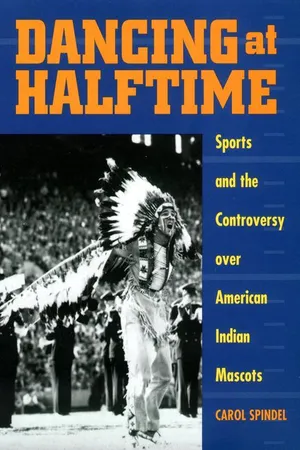
eBook - ePub
Dancing at Halftime
Sports and the Controversy over American Indian Mascots
- 308 pages
- English
- ePUB (mobile friendly)
- Available on iOS & Android
eBook - ePub
About this book
Information
Chills to the Spine, Tears to the Eyes
The thirties were not great years for Illinois football. Attendance went down. Zuppke thought the rules needed an “appendectomy”—the removal of the extra point, for which he blamed his team’s losses. Zup loved the challenge of teaching a runner to play football or molding an ordinary player into a good one, but he refused to go out of his way to recruit high school stars. In the years after Grange left Illinois, he hadn’t needed to. Every young player wanted to run on the field where the Ghost had scored. But by the late thirties Zuppke’s refusal to recruit was forcing Illinois football into decline. Zuppke, who always said, “Only a dead man leaves the field,” resigned in 1941. In his retirement Zuppke continued what had always been a serious hobby—oil painting. To those who saw no connection between art and athletics, Zuppke gave an eloquent little dissertation on rhythm and movement—essential in both—and pointed out that good painters, just like good football players, needed to demonstrate vigor and endurance.
Ed Kalb had been a clarinet player, but when he was recruited by the concert orchestra he switched to oboe for the chance to come to the university and play for Harding. It was 1933 and tuition was thirty-five dollars a semester, but Ed paid seventy since he used musical instruments. Music ran in the family. His father played trombone and his mother was a pianist who played sheet music in the “dimery”—the old Kresge variety store.
When football season began his freshman year, the first game was Boy Scout Day and Scouts got in free. Ed put on his Scout uniform and attended. When he saw Bill Newton dancing with the band as Chief Illiniwek, he decided then and there that he would perform as the chief himself someday.

Ed Kalb as Chief Illiniwek IV, 1935-1938. Courtesy of the University of Illinois Archives, Urbana-Champaign.
That spring, Newton was leaving, and the band held a tryout. “Newton’s kid brother wanted to be chief.” Ed chuckles, a deep throaty chuckle, at the memory. But at the end of the tryout, the assistant band director announced that Ed had the job. There was no interview. He was an Eagle Scout, a requirement in those days, although he doesn’t remember anyone asking. He became the fourth Chief Illiniwek and served from 1935 to 1938.
“I learned my Indian dancing from the Indians in Scouting. This was during the Depression. Roosevelt tried to buy us out of the Depression. He would send the Indians. There would be three, government wards, they were called. Roosevelt would send the Indians around to Boy Scout camps—two old men who were craftsmen and one young man—a dancer. I learned weaving and stonecutting and silvercraft, all that in Scout camp.”
Ed has a strong, deep voice. It’s a little gruff. At first he talks about the old days with a kind of distance, but as we keep on talking, it seems as if he moves closer to those times, and his voice fills with enthusiasm. “Indians dancing told a story. These two old characters that taught crafts by day, they would interpret the dancer around the campfire. The two old characters would tell the story of the dance.” Ed pauses to laugh. “Thinking about the Boy Scout camp and those old Indians—it really takes me back. At night, the old guys would tell the story of the dancer and the young guy would dance. And I guess we had three or four summers of that. It wasn’t the same Indians every time. The Hopi, the Zuni, the Navajo. There was a fourth tribe I forget. They taught us the Ghost Dance, the Sun Dance.” He turns to me with enthusiasm. “I remember the Hoop Dance—the Hopi Hoop Dance. The Hopi had a hoop measured just so it would fit over the shoulders. They would dance and flick that hoop over their head!” Ed gestures with his arms to show what he means, but gives up at bending over to demonstrate how they slipped the hoops over their legs. “For years I tried to do that. I couldn’t do it now.”
“I started when I was twelve. All summer we lived in cabins with screens on the upper half and bunk beds. I spent at least four summers doing that.”
After Ed was picked as chief, he and the football captain made a tour of the state. The physical plant built a tepee on a pickup truck and they drove it to every large town, Chicago included, handing out the poster with the game schedule. As far as Ed knows, that was the first time anyone had ever done that. It was his only duty as Chief Illiniwek other than dancing at halftime.
I ask Ed how it felt to be Chief Illiniwek in the 1930s. “Were you the honored symbol of the University? Did people hold you in awe and reverence?” Ed laughs. “No! I remember at Ohio State some drunk wanted a feather out of my headdress. I took off the headdress and rolled it up. He was falling down drunk.” Ed’s deep voice turns emphatic. “I was part of the marching band. Period.”
Ed doesn’t care for the way the chief’s dance has evolved. “He behaves like a ballet dancer and I don’t go to the football games because I don’t approve of the chief.” Ed won’t buy products with Chief Illiniwek on them, either. “The heck with Indian dancing, that’s their attitude now.”
What about students who feel they respect Indians? I ask.
“I would question their knowledge of the chief, of Indian culture, period,” Ed replies in his deep, serious voice. He worked at the State Museum in Springfield for many years. He drove the museummobile and taught schoolchildren about Indian culture in Illinois. “They didn’t know anything about Indians. I didn’t either when I started. I thought I did. But,” he said, laughing, “I soon learned. The dioramas taught me.”
Maybe students had other rituals then, I suggest. Maybe the University was smaller and more personal so the students didn’t need one symbol to unify them.
Ed shakes his head. “The university was big then, in the thirties. We all had our own groups.” As a musician, he hung out at Smith Music Hall and worked his way through school waxing pianos in the practice rooms. There were sixty pianos. “Heck of a lot of wax,” says Ed laconically. He also worked as a driver for the director of the music school. “And then I copied music for Harding at five cents a page. It took me about half an hour to do a page. Boy, I hadn’t thought of that in years!”
One difference in Ed’s day, before television, was the excitement generated by the live performance of the university band. “People used to come to the game to see the band. Harding would always direct one concert number. I think half of the people came just for that.”
Like all the other chiefs, Ed wrote his name on the back of the headdress in India ink. But he remembers that as he performed the intricate steps he had learned in the summers from the old Indians, the headgear was always in his way. Not surprising, according to Ed. “Indian chiefs don’t dance,” he told me in his gruff, matter-of-fact voice. “The underlings do.”
After Zuppke retired, his successor never had a chance to turn the football program around. New teams showed up as adversaries: the Great Lakes Naval Training Station, the Iowa Seahawks. By 1942 the Roll of Honor in the football program listed twenty-eight Illini killed in action. There were three navy training schools on campus. The women’s residence halls were turned over to the officers and the ballroom of the Illini Union became a mess hall. Fraternities and sororities declared a no-flower dance season and wore corsages and boutonnieres of war stamps pinned to their lapels instead.
Football games weren’t luxuries, however. MacArthur himself had said otherwise: “Men who engage in fighting games such as football develop a combative spirit, the kind of spirit needed by all of our men in the fighting forces.” A Chesterfield cigarette ad from a 1942 football program showed a football player in a brown leather helmet directly in front of an air force pilot in a nearly identical helmet. Below them, framed in a decorative border, was this quote from MacArthur: “On the fields of friendly strife are sown the seeds which, in other years on other fields, will bear the fruits of victory.” A Spalding ad showed a team of football players with the caption, “Next year they play Tokyo.”
The 1943 team was pieced together from seventeen-year-olds, 4-Fs, and the naval engineering students who were in training on campus. The band had “Princess Illiniwek,” played by Idelle Stith, a coed from Oklahoma who had spent much of her childhood on the Osage reservation where her father was an attorney. According to the football program, she was an “authentic honorary Osage princess.” Later chiefs were not impressed with her credentials: they removed her name from the list on the back of the war bonnet; nor did it appear in the list of former chiefs in the football program until feminism arrived in the seventies.
During the war, Indians disappeared altogether and patriotic imagery—eagles, flags, tanks, and soldiers—dominated the football programs. Every advertiser tried to show how its product helped the war effort. Kellogg proudly announced that its Kel-Bowl-Pac, the box of cereal you cut open and pour milk into, was used by the army in the field. In a long shot, Oscar Mayer, an Illinois trustee, pointed out that the continuous yellow band around his wieners looked a lot like a cartridge belt.
After the war, the university was full of veterans. Football flourished. Illinois went to the Rose Bowl as the underdog to play powerful UCLA on January 1, 1947, and won against all odds. Now that the war was over, the theme for the Tournament of Roses parade was an old favorite: “Our Golden West.” One of the flower-covered floats reproduced The End of the Trail in flower petals. This sculpture by James Earle Fraser, who also designed the buffalo–Indian head nickel, depicts a drooping Indian man seated on his equally drooping horse, dragging a lance. Originally made in the 1890s, a monumental reproduction of The End of the Trail was displayed at the Panama-Pacific Exposition of 1915 in San Francisco. Reproduced on calendars and as ashtrays, bookends, and even parade floats covered with flower petals, this image has been influential in creating and expressing the stereotype of the Indian who is doomed to extinction. Unable to hunt or make war any more, he has given up. He is the last of his tribe. Fraser hoped to install a monumental cast of the sculpture on a cliff overlooking the Pacific Ocean, a visual assertion that American Indians had been pushed right off the edge of the map into watery oblivion. But he could never raise the funding for the project.
Presented at every turn with this image of the defeated warrior, alone and dejected, many Americans had no idea that communities of Indians still existed and were wrestling with complex questions about education, assimilation, alcoholism, communal versus private land ownership, and corruption and paternalism in the Bureau of Indian Affairs.
When Illinois went to the Rose Bowl again in 1952, it was to battle the Stanford Indians. “I hope your football team is not as good as your band,” Governor Earl Warren said when he welcomed the marching band to California. A. A. Harding himself came out of retirement to go along. The band members practiced barefoot on cold muddy fields to keep their shoes clean and at halftime produced an elaborate show that began with an innovative moving train formation.
“Dreams of the Future” was the parade theme that year and the winning float, “Every Girl’s Dream of the Future,” featured a bride who poked out like a cake decoration from a sweeping floral hoop skirt. Illinois fans went to Chicago and rented hotel rooms with televisions so they could see their team play in the first college football game to be nationally televised. A family and a house with a television might be the dream of the future, but in 1952 many students still wanted to see the action live. Any student who could produce the stub of a Rose Bowl ticket was granted an extension of Christmas vacation. Illinois won 40-7.
On their return, the band stopped at the Grand Canyon. Photographs show them on the South Rim in the ILLINI formation. The Chief Illiniwek that year, Bill Hug, faces the canyon, his arms raised in a grand gesture. The Alumni News reports that “Hopi Chief Porter Temiche, himself a famed Indian ceremonial dancer, escorted Hug across the hotel’s courtyard to Hopi House where Hug was made a real Indian chief in a Hopi ceremony.” In photos they smoke a pipe and try on each other’s headdresses. “This meant that I was now a member of the Hopi tribe and he was a member of the Illini,” Hug explained at the time. The most striking photograph of all shows Hug, his legs split wide, seemingly suspended in midair. Temiche watches with his mouth open. It was Hug’s idea to add the acrobatics—two stag leaps and the split leap—to the routine. “I almost hate to admit it,” he says wryly when I call to ask him about it now. He’s aware that the dance has been criticized in recent years for its lack of authenticity. “I didn’t see it as a spiritual or religious dance. It was in a football stadium. As a performer, I was thinking of the people in the top bleachers.”
And the dancing itself? “It was a celebration,” Hug says. “It had nothing to do with American Indians. I had never, until recently, seen it as anything but a great honor. It never even occurred to me that anyone would object.”
A perusal of the football programs, with their ads and interviews and profiles, gives a reader a popular history of America in this century. Sincerely sober during wartime, sincerely hankering for glory in peacetime, and sincerely believing in fair play. The country portrayed by the boosters is a hopeful, upbeat place.
Indian imagery has been part of the programs ever since the students began to call themselves Illini. In 1926 tiny Indians decorated the bottoms of the pages of the football programs, saying things like “Ugh! Ketchum Hawks!” and “Heap Big Medicine.” In 1932 the referee’s hand signals were demonstrated by an assortment of horridly drawn Indians. The caption says, “The little Illiniweks pictured above are not doing a war dance, but merely presenting to you the most common hand signals used by the referees. Our apologies to the referee!” Obviously, there was no need to apologize to the Illiniwek. They were a vanished race. Chief Illiniwek was listed as a member of the marching band and sometimes the band page carried an inset photograph of him, but he was not the band’s bestknown feature in those years. At the 1948 homecoming, A. A. Harding was honored and at halftime the band spelled out AAH. The history of the band in the program did not mention Chief Illiniwek. In the fifties, long-nosed caricatures of Indians and photographs of the Chief became more prevalent in the programs. The band had new formations: UGH, Three Little Indians, HOW, and tepees. Opposing teams also used the Indian to represent Illinois, of course, and these depictions were often derogatory.


Indian-theme teams generate a wake of caricatured Indian images like these two examples of Indians as buffoons from football programs in 1932 (upper left) and 1957 (upper right) and the advertisement from 1956 (lower right). Courtesy of the University of Illinois Archives, Urbana-Champaign.

The Illinettes, dressed in “mod Indian” attire in 1970. Indian-theme bands and flag squads accompany most college and professional football teams with Indian names. Courtesy of the University of Illinois Archives, Urbana-Champaign.
After an up and down decade in the sixties (a Rose Bowl win and severe penalties from the NCAA over a slush fund), the seventies began with a fresh start for football and halftime—a new coach for the team and women for the first time ever in the marching band. According to one reporter, the “female invasion had no visible effect” because “so many male members of the band have shoulder-length hair that it was next to impossible to pick out the girls.” A flag corps and herald trumpet corps, both all-female, also made their debut. Their costumes were described as “mod Indian.” This meant head feathers, fringed shirts and boots, and bright orange hot pants. They were greeted with “loud cheers from the appreciative crowd.” Those of us old enough to remember know that this probably meant catcalls and wolf whistles.
In 1972 faculty achievements were showcased in the football program. These included the appearance on the best-seller list of Bury My Heart at Wounded Knee by a University of Illinois librarian, Dee Brown, a popular history that made many white Americans realize for the first time that some “battles” had actually been massacres perpetrated by the U.S. Army. Readers bought millions of copies of this compelling account of the last wars with the Plains Indians. They read about Crazy Horse and Red Cloud with sympathy and outrage, but once again, their interest remained focused on the past and did not carry over to modern Indian people.
The back-to-nature movement was an important part of the 1970s. Americans now routinely considered how their actions made an impact on the “environment,” as they called the natural world. Even that made it into the programs when the Marching Illini created a halftime act that featured flowers, a pollution factory, a bright sun, and the word YOU. Idealized Indians were favorite role models for students who wanted to live lightly on the earth. With the rise of the American Indian Movement, American Indian students and activists brought the issue of sports mascots to campuses. Clyde Bellecourt, one of the founders of AIM, spoke at Illinois in 1975. That year’s yearbook devotes two pages to his visit with the headline, “A Challenge to the Chief.” A former Chief Illiniwek replied, “Other university mascots are just caricatures but Illiniwek portrays the Indians as they would want to be portrayed.”
During this period, the Dartmouth Indians became the Dartmouth Big Green. There were protests at Cleveland against Chief Wahoo, Oklahoma retired its “Little Red” mascot, and Syracuse dropped its Saltine Warrior. The Stanford Indians became the Stanford Cardinal (singular) with no significant loss of alumni support.
Stanford’s change, from the Indians to the Cardinal and the retirement of their mascot, Prince Lightfoot, seems to have been accomplished smoothly in the seventies. John White, who now devotes his ...
Table of contents
- Cover Page
- Title Page
- Copyright Page
- Dedication
- Contents
- Prologue
- Home Game
- The Controversy
- Myth and Mascot
- Races of Living Things
- Starved Rock
- That Roughneck Indian Game
- Sons of Modern Illini
- Folded Leaves
- The Wild West
- Chills to the Spine, Tears to the Eyes
- The Speakers Have It All Wrong
- In Whose Honor?
- Signaling
- The Spoils of Victory
- Coloring Books
- What Do I Know about Indians?
- The Wistful Reservoir
- Dancing
- Scandalous and Disparaging
- The Tribe
- A Young Child Speaking
- A Racially Hostile Environment?
- Homecoming
- Video Letters
- Addendum from Grand Forks, North Dakota
- Afterword
- Acknowledgments
- Bibliographic Essay
- Selected Bibliography
- About the Author
Trusted by 375,005 students
Access to over 1.5 million titles for a fair monthly price.
Study more efficiently using our study tools.
Frequently asked questions
Yes, you can cancel anytime from the Subscription tab in your account settings on the Perlego website. Your subscription will stay active until the end of your current billing period. Learn how to cancel your subscription
No, books cannot be downloaded as external files, such as PDFs, for use outside of Perlego. However, you can download books within the Perlego app for offline reading on mobile or tablet. Learn how to download books offline
Perlego offers two plans: Essential and Complete
- Essential is ideal for learners and professionals who enjoy exploring a wide range of subjects. Access the Essential Library with 800,000+ trusted titles and best-sellers across business, personal growth, and the humanities. Includes unlimited reading time and Standard Read Aloud voice.
- Complete: Perfect for advanced learners and researchers needing full, unrestricted access. Unlock 1.5M+ books across hundreds of subjects, including academic and specialized titles. The Complete Plan also includes advanced features like Premium Read Aloud and Research Assistant.
We are an online textbook subscription service, where you can get access to an entire online library for less than the price of a single book per month. With over 1.5 million books across 990+ topics, we’ve got you covered! Learn about our mission
Look out for the read-aloud symbol on your next book to see if you can listen to it. The read-aloud tool reads text aloud for you, highlighting the text as it is being read. You can pause it, speed it up and slow it down. Learn more about Read Aloud
Yes! You can use the Perlego app on both iOS and Android devices to read anytime, anywhere — even offline. Perfect for commutes or when you’re on the go.
Please note we cannot support devices running on iOS 13 and Android 7 or earlier. Learn more about using the app
Please note we cannot support devices running on iOS 13 and Android 7 or earlier. Learn more about using the app
Yes, you can access Dancing at Halftime by Carol Spindel in PDF and/or ePUB format, as well as other popular books in Social Sciences & Discrimination & Race Relations. We have over 1.5 million books available in our catalogue for you to explore.