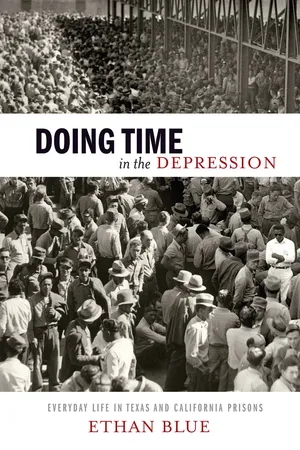
As banks crashed, belts tightened, and cupboards emptied across the country, American prisons grew fat. Doing Time in the Depression tells the story of the 1930s as seen from the cell blocks and cotton fields of Texas and California prisons, state institutions that held growing numbers of working people from around the country and the world—overwhelmingly poor, disproportionately non-white, and displaced by economic crisis.
Ethan Blue paints a vivid portrait of everyday life inside Texas and California’s penal systems. Each element of prison life—from numbing boredom to hard labor, from meager pleasure in popular culture to crushing pain from illness or violence—demonstrated a contest between keepers and the kept. From the moment they arrived to the day they would leave, inmates struggled over the meanings of race and manhood, power and poverty, and of the state itself. In this richly layered account, Blue compellingly argues that punishment in California and Texas played a critical role in producing a distinctive set of class, race, and gender identities in the 1930s, some of which reinforced the social hierarchies and ideologies of New Deal America, and others of which undercut and troubled the established social order. He reveals the underside of the modern state in two very different prison systems, and the making of grim institutions whose power would only grow across the century.
- 335 pages
- English
- ePUB (mobile friendly)
- Available on iOS & Android
eBook - ePub
About this book
Information
1
Of Bodies and Borders
The Demography of Incarceration
In Robert Joyce Tasker’s 1928 memoir, Grimhaven, the narrator describes his entry into California’s San Quentin State Penitentiary:
The official jerked his thumb towards a door. The very motion gave me the key to my position. I was merchandise, duly received and acknowledged. Henceforth I was to be an animated piece of baggage. And for that I was grateful, for it fitted with the least effort into my mood.
The room into which I now passed was small—a mere recording office for the registry of new-comers. A convict rose from behind a desk and came to the counter that separated us. He asked my name, nativity, and age; later, my crime, and the county from which I was sent.1
After a bath, strip search, and shoddy haircut and shave, Tasker was disoriented and had lost his sense of place. “Somewhere in the bowels of the building behind me I had become confused in my bearings, and never again could I think of east other than as south. The whole institution had manoeuvred [sic] a quarter turn.”2 In We Who Are About to Die, his 1935 prison memoirs, David Lamson outlined similar feelings of detachment and disembodiment. As he described physically entering San Quentin and being discursively entered into its record-keeping apparatus, Lamson switched from the first person to the third. Wittingly or no, he effectively saw himself through the eyes of the other prisoners watching him (as he would soon be watching others) and the eyes of the authority surrounding him.
The convict clerk produces a pen and a bottle of India ink and prints a number on the [clothing]—54761. He sprawls the same number on the undershirt; the drawers; each sock; inside the shoes. That number is the man’s laundry mark. It is his own mark. It is himself. For as long as he is in this prison, he is 54761. . . . So far as San Quentin is concerned he will be Fifty-four seven sixty-one until he dies.
The convict next enters a room full of typewriters. A young man in grey shirt and trousers
runs a printed form into a typewriter and starts asking the man questions, typing the answers on the printed form. There are a great many questions—the familiar where and when born, home address, mother’s name, address, age, birthplace, father’s name, address, birthplace; and on down the line to education, religion, crime charged, plea, previous arrests or convictions. . . . He lights a cigarette, and tilts his head and squints his eyes against the smoke. These things give him an air of incurious detachment. It is as if he said, “I’m not asking these very personal questions out of curiosity, you know. I don’t give a damn, really; I just work here.” . . .
Later, the new man will be brought back again to the fingerprint room in the rear of the offices, where he will be printed and have his Bertillion measurements taken. Later, he will be photographed again, this time in prison garb and with his hair clipped short. Later, he will be taken to the hospital for a medical examination.
But for the present, his initiation . . . is completed. He has become a convict, following the road that all men follow in becoming convicts.3
Texas prisoner Benton Layman described a similar dislocation when he first arrived in Huntsville: “Made me kind of numb. It seemed like a dream—a bad dream.”4 Harry W. Jamison explained the feeling to prison investigators at San Quentin: “[W]hen I walked through these gates here it was like an empty feeling in your stomach.”5 Terrence Bramlett described the feeling in equally corporeal terms: “It took all the heart out of me. . . . Kind of stunned me, I guess. . . . I didn’t come to my senses until I’d been in prison a while.”6 According to Texas prisoner Andrew George, his penal initiation was “burned into my mind as with a red-hot iron, never to be erased,” part of a process that sociologist Erving Goffman aptly described as “mortification.”7
Black prisoners were equally troubled by the transition to prison, redolent as it was with the histories of slavery—especially in the South. Blues and work songs immortalized Texas transfer agent Bud Russell and Black Annie, his 28-seat truck, which delivered 115,000 prisoners from county jails to the Huntsville Walls Unit over Russell’s 39-year career. Armed with two six-shooters, two gas guns, brass knuckles, and a blackjack, Russell drove the truck with a submachine gun tucked between his knees.8 Bud Russell took J. B. Smith in a coffle of prisoners from the Dallas County Jail to the Huntsville Walls Unit in 1938. Smith always thought that Russell was just a legend—there was a world of bawdy and blues songs about him—and was surprised to learn that the man was real. “He used to put a chain around your neck, and a lock, a Yale lock. Turn your collar up, and he says, ‘All right boys get ready to put on this necktie,’” as he threaded the long throat chain through the whole line of prisoners. “Don’t know what the ‘Bud’ meant,” Smith recalled, signifying on the man’s name, “but he was a rustler.”9 Another black Texan recalled a time before he was imprisoned:
Everybody knew when they were going to pick up the chains. . . . The news was spread that Bud Russell was pickin’ up the chains, because it was something to see. . . . He would have the guards lined up with machine guns. The convicts would come out chained by the ankles and by the necks and by the hands. Come out in what we call a “Chinese shuffle.” . . . I never knew I’d be a victim of the same circumstances.10
Though seeing prisoners chained together was a spectacle for its residents—machine guns a show of force as much for the audience as for prisoners—as a young man, this prisoner had little reason to identify with the convicts themselves, whom he rendered as almost racially different, doing a “Chinese” shuffle. Russell’s combination of the antebellum coffle with modern firepower made him into an effective contemporary Charon, ferrying prisoners across the divide from the land of the living to the grim prison world, where they were legally dead. He reportedly only lost one prisoner in all of his years.11
Once in the institutions, prisoners were subject to a battery of measurements and examinations—more explicitly modern in California than in Texas but still designed to humiliate as well as to impose finely tuned physical and even psychological surveillance. San Quentin chief surgeon Leo Stanley described the procedure. “Every man who comes to the prison is given a thorough examination. . . . The man’s physical status is then thoroughly known and should he have any remedial defects he is slated for an operation or treatment as the case may require.” A psychiatrist on staff also examined the incoming prisoner. “With these mental and physical examinations the prisoner obviously understands that his condition is known. . . . The prisoners realize that they would be unable to put anything over on the medical department and therefore they do not try. Malingering just does not exist in this institution.”12 If this biomedical knowledge of prisoners might prevent their playing sick and shirking hard labor, its ritual humiliations also helped break their spirits. “I have seldom seen one whose ego does not diminish under the preliminary medical examination.” He continued that “[t]he dog-like shaving, bathing, medical testings [sic], robs the most defiant lawbreaker of bravado as it strips him of his clothes. It is not a grueling ordeal. But it makes the dullest criminal realize how firmly he is trapped, and, perhaps for the first time in his life, he quails.”13
Prison officials needed ways to categorize their wards upon intake into their institutions. After the ritual degradation of arrest, trial, and sentencing, inmates entered the discursive and material spaces of prison systems when their bodies and histories were transcribed in record books. There should be little surprise that this dehumanizing process took place in rooms with names like the “fish tank” at San Quentin and the “bull pen” at Huntsville. Prisoners’ bodies were categorized in different institutional forms, including convict ledgers, indices, and identification cards, all of which described inmates to better control them, and marked prisoners for the creation of institutional memories. Each of these processes created paper bodies to parallel the prisoners’ physical ones. Moreover, they fixed complex, multiple, and contextual identities into a single, legally recognized person, recorded in text and mandated by the rule of law.14 Sociologists have called this a kind of symbolic violence, a cultural practice that comes so naturally as to go unnoticed. It “tends to be taken for granted by virtue of the quasi-perfect and immediate agreement which obtains between, on the one hand, social structures . . . and, on the other, cognitive structures inscribed in bodies and minds.” Symbolic violence operates “beyond—or beneath—the controls of consciousness and will.”15
There were many versions of the prison and of the people who lived behind its walls: prisoners’ own understandings of themselves, their views of each other, and the views of prison officials and the prisoners who served as their proxy. But the official version was especially powerful. It had the institutional and coercive ability to make its representations of prisoners’ bodies into a material reality.16 The visions of inmates’ bodies described in institutional records operated precisely to this effect. Prisoners certainly saw themselves in specific and opposing ways to those of the state (though at times they overlapped), but the state had the ability to make its version of prisoners’ bodies “real.” When prisoners described feelings of disembodiment and disorientation on entering the institutions, of seeing and being seen, they articulated a phenomenon similar to what W. E. B. Du Bois called double consciousness: the dissonance between their own senses of self and the descriptions and controls that prison authorities and the state imposed.17
Yet who were the people arriving in Texas and California prisons? Where did they come from, and what had they done to be sent to prison? How did those populations change over the course of the Depression? Officials kept many records and tabulated much data, to better control their populations. Yet sociologists, statisticians, and demographers have had lengthy debates about changing prison populations: do increasing numbers of prisoners reflect more intakes, or longer sentences meted out for similar crimes? New policy priorities, at county or state levels? Growing fears of crime and thus increased arrests? Or do they reflect actual growing numbers of crimes committed and sentences handed out? Complicating factors appear in release decisions, not just entry: who gets to decide which prisoners are released, why, and when, questions of parole rates and decisions, the indeterminate sentence, and the uses of probation: all of these affect the size of a prison population, reflecting complex political priorities as much as if not more than the occurrence of criminal acts.
What is indisputable is that prison populations increased substantially in the Depression, even given the rapid growth that took place in the 1920s under the Volstead Act’s criminalization of alcohol. San Quentin cells built for two people now held three, four, or five. Storerooms were converted into makeshift dormitories. Bodies packed Texas’s tanks more and more tightly. Newspapers decried crime waves and criminals run amok, but prisons, increasingly overcrowded, were both a solution and a source of the problem.18 Despite the ongoing contradiction, the trend was the same across the country. Despite some variations as to when their populations peaked—1934 in California, and 1938 in Texas—prisons grew across the Depression decade. They dropped sharply as war industries increased in 1940, and would continue to decline through the war years.19 (See tables 1.1, 1.2, 1.3, and 1.4.)20
By the time the Depression hit, Texas and California had long been points of travel and arrival in overlapping migratory circuits. In the early nineteenth century, diverse streams of European Americans hailing from the Southeast traveled into Texas, frequently bringing enslaved African Americans with them. They met settled Tejanos along Mexico’s northern frontier and Native Americans displaced from the central plains. These migrants, like those in the later nineteenth century, were harbingers of the expanding capitalist world system. California’s Gold Rush and, later, its even more lucrative Central Valley agricultural industries drew immigrants from around the world. Multiple streams of Asian travelers sojourned east to arrive in these borderlands, displaced from homes by European expansion, capitalist development, and domestic political violence, drawn toward the colonial metropoles and centers of capital emergent in the western United States. Between 1850 and 1930, Chinese, Japanese, Filipino, Korean, South Asian Indian, Mexican, Italian, Portuguese, and Greek populations—and this is a partial list—streamed east, west, north, and south into the American West to work its booming (and busting) mines, fields, railroads, and factories. By the Depression years, “Okies” and “Arkies,” as well as black southerners from the Southeast and European Americans from the Northeast, traveled into California.21 Meanwhile, ethnic Mexican migrants displaced by revolution and enclosure movements and still permitted entry for agricultural labor under the Immigration Act of 1924, and black and white migrants from the American Southeast looking for new opportunities, had settled in Texas. At the same time, thousands upon thousands of black and white Texans moved from their rural homes into urban centers like Houston and Dallas. Mobility in and across these borderland states in the first decades of the twentieth century brought new and disparate peoples into contact with one another, making for new cultural opportunities and antagonisms. Many of the poorest of these people, and some of the most unruly, would find themselves behind bars.22
TABLE 1.1
Texas and California Prison Population, 1929–1941
Texas and California Prison Population, 1929–1941

TABLE 1.2
Combined State and Federal Prisoners
Combined State and Federal Prisoners

TABLE 1.3
California Prison Population
California Prison Population

TABLE 1.4
Texas Prison Population
Texas Prison Population

Traditional labor and immigration histories have demonstrated convincingly...
Table of contents
- Cover Page
- Title Page
- Copyright Page
- Contents
- Acknowledgments
- Introduction
- 1 Of Bodies and Borders: The Demography of Incarceration
- 2 Work in the Walled City: Labor and Discipline in California’s Prisons
- 3 From Can See to Can’t: Agricultural Labor and Industrial Reform on Texas Penal Plantations
- 4 Shifting Markets of Power: Building Tenders, Con Bosses, Queens, and Guards
- 5 Thirty Minutes behind the Walls: Prison Radio and the Popular Culture of Punishment
- 6 Sport and Celebration in the Popular Culture of Punishment
- 7 A Dark Cloud Would Go Over: Death and Dying
- 8 Going Home
- Epilogue
- Notes
- Index
- About the Author
Trusted by 375,005 students
Access to over 1.5 million titles for a fair monthly price.
Study more efficiently using our study tools.
Frequently asked questions
Yes, you can cancel anytime from the Subscription tab in your account settings on the Perlego website. Your subscription will stay active until the end of your current billing period. Learn how to cancel your subscription
No, books cannot be downloaded as external files, such as PDFs, for use outside of Perlego. However, you can download books within the Perlego app for offline reading on mobile or tablet. Learn how to download books offline
Perlego offers two plans: Essential and Complete
- Essential is ideal for learners and professionals who enjoy exploring a wide range of subjects. Access the Essential Library with 800,000+ trusted titles and best-sellers across business, personal growth, and the humanities. Includes unlimited reading time and Standard Read Aloud voice.
- Complete: Perfect for advanced learners and researchers needing full, unrestricted access. Unlock 1.5M+ books across hundreds of subjects, including academic and specialized titles. The Complete Plan also includes advanced features like Premium Read Aloud and Research Assistant.
We are an online textbook subscription service, where you can get access to an entire online library for less than the price of a single book per month. With over 1.5 million books across 990+ topics, we’ve got you covered! Learn about our mission
Look out for the read-aloud symbol on your next book to see if you can listen to it. The read-aloud tool reads text aloud for you, highlighting the text as it is being read. You can pause it, speed it up and slow it down. Learn more about Read Aloud
Yes! You can use the Perlego app on both iOS and Android devices to read anytime, anywhere — even offline. Perfect for commutes or when you’re on the go.
Please note we cannot support devices running on iOS 13 and Android 7 or earlier. Learn more about using the app
Please note we cannot support devices running on iOS 13 and Android 7 or earlier. Learn more about using the app
Yes, you can access Doing Time in the Depression by Ethan Blue in PDF and/or ePUB format, as well as other popular books in History & North American History. We have over 1.5 million books available in our catalogue for you to explore.