An inside look at how patients living with terminal illness created one of the country's first medical marijuana collectives
Marijuana as medicine has been a politically charged topic in this country for more than three decades. Despite overwhelming public support and growing scientific evidence of its therapeutic effects (relief of the nausea caused by chemotherapy for cancer and AIDS, control over seizures or spasticity caused by epilepsy or MS, and relief from chronic and acute pain, to name a few), the drug remains illegal under federal law.
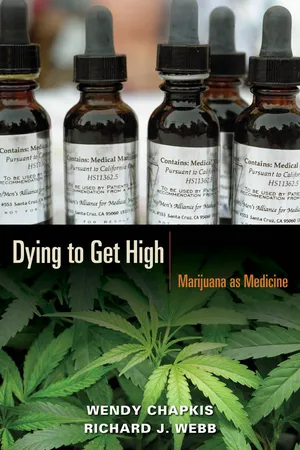
In Dying to Get High, noted sociologist Wendy Chapkis and Richard J. Webb investigate one community of seriously-ill patients fighting the federal government for the right to use physician-recommended marijuana. Based in Santa Cruz, California, the Wo/Men's Alliance for Medical Marijuana (WAMM) is a unique patient-caregiver cooperative providing marijuana free of charge to mostly terminally ill members. For a brief period in 2004, it even operated the only legal non-governmental medical marijuana garden in the country, protected by the federal courts against the DEA.
Using as their stage this fascinating profile of one remarkable organization, Chapkis and Webb tackle the broader, complex history of medical marijuana in America. Through compelling interviews with patients, public officials, law enforcement officers and physicians, Chapkis and Webb ask what distinguishes a legitimate patient from an illegitimate pothead, good drugs from bad, medicinal effects from just getting high. Dying to Get High combines abstract argument and the messier terrain of how people actually live, suffer and die, and offers a moving account of what is at stake in ongoing debates over the legalization of medical marijuana.
- 272 pages
- English
- ePUB (mobile friendly)
- Available on iOS & Android
eBook - ePub
About this book
Information
Topic
Medizin1
Shamans and Snake Oil Salesmen
Why Marijuana Isn’t a Medicine
For many modern critics, the concept of “medical marijuana” is a contradiction in terms. Medicine is standardized, synthetic, and pure; marijuana involves the unrefined and promiscuous coupling of more than four hundred components rooted in the dirt. Medicine—in its most powerful and privileged forms—rests in the hands of men,1 while the most potent form of marijuana is found in the female flowering plant. Medicine engages in heroic battles against death. Marijuana claims only to enhance the quality of life. Medicine presents itself as an objective science safeguarded by the ritual of the double-blind, randomized clinical trial.2 The therapeutic value of marijuana relies largely on the “soft science” of subjective experience and anecdotal evidence. From the perspective of its critics, then, cannabis is an effeminate interloper in the masculine world of real medicine, a dangerous drug pushed on a credulous public by illegitimate quacks.
But this story is too simple. The line separating regular doctors from snake oil salesmen, good drugs from bad, is as much the product of politics as it is of science.
The dominance of politics in determining the value of marijuana as a medicine was first demonstrated in the 1930s when the federal government began to restrict the medical use of marijuana, against the recommendations of the American Medical Association (AMA).3
The struggle between politics and science over the use of cannabis as a medicine continues. In the final decade of the twentieth century, the federal government threatened physicians with the loss of their license for recommending marijuana to patients, made criminals of patients who followed their doctor’s advice, and actively blocked scientific research into the therapeutic value of cannabis, while insisting that it was an established scientific fact that marijuana is not a medicine.
During the opening of a 2004 congressional hearing on medical marijuana, this ongoing battle over cannabis was described by committee chair Rep. Mark Souder (R-IN) as a critical front in the War on Drugs and consistent with the modernization of medicine:
This hearing will address a controversial topic, the use of marijuana for so-called medicinal purposes. In recent years, a large and well-funded pro-drug movement has succeeded in convincing many Americans that marijuana is a true medicine to be used in treating a wide variety of illnesses. . . . Marijuana was once used as a folk remedy in many primitive cultures, and even in the 19th century was frequently used by some American doctors, much as alcohol, cocaine, and heroin were once used by doctors. By the 20th century, however, its use by legitimate medical practitioners has dwindled, while its illegitimate use as a recreational drug has risen.4
Souder thus sets the stage for a morality tale populated by primitive practitioners and legitimate doctors, dangerous drug fiends and decent drug warriors.
Fox News personality Bill O’Reilly invoked a similar cast of characters in his 2004 discussion of medical marijuana with U.S. Deputy “Drug Czar” Dr. Andrea Barthwell.5 That year, voters in Oregon were to be presented with a ballot measure to amend their state’s already-existing medical marijuana law. The proposed amendment (which ultimately failed) was intended both to increase the amount of marijuana a patient could have over the course of a year and to redefine which health professionals could legally recommend marijuana for medical use.
O’Reilly scoffed at the idea that licensed health practitioners other than physicians might be authorized to recommend the use of cannabis to their patients: “Even a shaman could grant permission for you to toke in Oregon. I mean, this is, you know, any health practitioner. So you’re a shaman from the Amazon and you set up shop. Come on, I mean, everybody knows this is a ruse. Am I wrong?”6 Andrea Barthwell confirmed for viewers that O’Reilly’s concerns were quite legitimate: “No, you’re absolutely right, Bill. This is what we’ve been trying to make clear to people when they have these proposals presented to them. This is not about getting medicine to people who are sick and dying. This is about making marijuana legal.”
While both host and guest shared the belief that the Oregon proposal was no more than a thinly disguised attempt to legalize marijuana, O’Reilly asked whether cannabis itself might not be a legitimate medicine if prescribed by a legitimate physician to a patient with a legitimate need: “But there is a legitimate issue here, Doctor. We had Montel Williams [another popular TV talk show host] on a few weeks back. He has MS [multiple sclerosis]. And I believe Montel Williams when he says, ‘Look, medical marijuana helps me, helps me cope with this disease, cope with my suffering. There’s no reason why I should be denied it.’ And I agree with Montel Williams that if this is the case, if a doctor—a doctor—says that he needs it for his MS, he should have it. You don’t disagree with that, do you?” Barthwell’s response was uncompromising: “Well, I do, actually. There is nothing that tells us from the science now that smoked, crude botanical should be a medication. We have a process that has been in place for 100 years in this country that protects the sick and dying from snake oil salesmen. And just because something makes you feel better doesn’t make it medicine.”
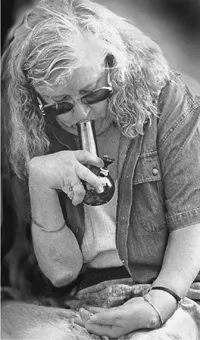
Kathy using a water pipe. Photo courtesy of Jean Hanamoto.
In this short exchange, the terms of the debate for dismissing cannabis therapeutics are neatly laid out: medical marijuana is a ruse; cannabis is the modern day equivalent of “snake oil”; “crude botanicals” are not real medicine; licensed alternative health practitioners are not legitimate healers; marijuana is reduced to and synonymous with smoking as a delivery system; and “feeling better” isn’t always therapeutic. Taken together, these claims create a neat division between marijuana and “real medicine,” with medicine narrowly defined as that which is practiced by physicians prescribing pharmaceuticals to patients who will not necessarily feel better as a result.
The Rise of “Regular” Medicine and the Battle against Botanicals
According to Dr. Raphael Mechoulam, an Israeli research chemist who performed much of the original work in the early 1960s isolating the active ingredients in marijuana:
From ancient times to the early 20th Century, cannabis was used for a wide variety of medical purposes including the treatment of pain and swelling, depression, arthritis, impotence, kidney stones, hemorrhaging in childbirth, irregular bowel movements, cold sores, distending stomach, dropsy, headaches, diseases of the respiratory organs, hysteria, neuralgia, sciatica, tetanus, dysentery, fatigue, disorders of the female reproductive system, convulsions, cholera, delirium tremens, vomiting, spasmodic asthma, and a host of other ailments. Most of these therapeutic claims were either based on folklore or were anecdotal, but the use of cannabis as a therapeutic agent in the past provides an insight for future drug development. More recently, some of the historical therapeutic properties of cannabis have been verified with pure natural or synthetic cannabinoids; however, in several fields no modern scientific work exists.7
In order to understand why marijuana, a promising medicinal botanical, should now be excluded not only from the modern pharmacopeia but also from much formal scientific study, it is necessary to ask why some drugs, but not all, get labeled “medicine”; why some healers, and not others, are “regular doctors”; why some effects, but only some, are understood as “therapeutic”; and why some risks are acceptable while others are prohibited under penalty of law. The answers cannot be found in a simple appeal to scientific standards. Instead, in order to understand what counts as “legitimate” medicine, it is useful to ask who, beyond the patient, might benefit from such distinctions.
In our exploration of the role of organized medicine, state regulatory agencies, the courts, and the pharmaceutical industry in the demonization of marijuana, the intent is not to perform the reverse process, demonizing modern medicine. Over the past century, during which organized medicine consolidated its authority and cannabis was first marginalized and then removed from the pharmacopeia, astonishing medical advances have been made. Unquestionably, the public would be ill served by a return to a time of unregulated medicine practiced by poorly trained doctors with recourse to few effective drugs.
Nonetheless, it is also the case that the healing arts remain an impure science.8 The most striking difference between marijuana and “real medicine” is not the physical but the social effects the plant has on users and healers alike. Association with marijuana marks those it touches as illegitimate—a distinction with deep historical roots. Prior to the professionalization of medicine, lay healers—often women—made extensive use of medicinal plants. But as modern medicine moved into the ranks of the professions, and into hands of men, botanicals were discredited along with the women who had used them. In their pathbreaking study of the rise of the male medical expert, For Her Own Good, Barbara Ehrenreich and Deirdre English note that, in the fifteenth and sixteenth centuries, anxiety over women’s knowledge of medicinal botanicals contributed to the European witch hunts: charges against the accused often included the provision of herbs.9
In Colonial America and the early republic, health and healing practices also rested largely in the hands of lay women practicing herbal medicine.10 Historian Carol Smith-Rosenberg observes that “women as midwives and as family nurses, women wise in the ancient herbal pharmacopoeia, had always cared for their own and neighboring families. A survey of cookbooks and women’s diaries for the eighteenth and early nineteenth centuries shows that women collected and exchanged recipes for medicines as routinely as they did for pies and cookies.”11
By the nineteenth century, however, as medicine entered the marketplace, male physicians with little formal training claimed for themselves the designation “Regular doctor” while moving all others to the margins of the healing arts. In North America, midwives, bonesetters, and “root and herb” doctors were thus gradually displaced by the self-proclaimed “Regulars,” not through the violence of witch burnings, as happened in Europe, but rather through professionalization. This challenge was, according to Ehrenreich and English, “at bottom, economic. Medicine in the 19th century . . . [became] a thing to be bought and sold.”12
Professionalization required that the Regulars distinguish themselves from midwives and herbalists; they did so through “heroic medicine,” a practice involving dramatic (though not necessarily beneficial) techniques such as bloodletting, blistering, purging, and the use of toxic mercury-based medicines. These interventions were intended to produce “the strongest possible effect on the patient.”13 Though such therapies were not only dangerous and often ineffective, Ehrenreich and English observe that they gave “regular doctors something activist, masculine, and imminently more salable than the herbal teas and sympathy served up by rural female healers.”14 In fact, despite the very serious risks of heroic medicine, Smith-Rosenberg notes that the Regulars insisted that it was they who were protecting “the lives of innocent citizens from ill-trained, irresponsible ‘irregulars,’ and hysterical midwives.”15
The Regulars prospered during the first two decades of the nineteenth century and succeeded in securing licensing laws in many states restricting the practice of medicine to those in their ranks and limiting membership to men. But growing dissatisfaction with the results of “heroic medicine,” and populist misgivings about monopolies and elites, led to the temporary repeal of such laws during the 1830s.16 The “Popular Health Movement” of the period challenged the position of Regulars by emphasizing “self-help” (through better hygiene and healthy living) and by embracing the therapeutic approaches of alternative medical sects, including those advocating botanical treatments.17
As sociologist Carol Weisman notes, under the banner of science, Sectarians or Irregulars “were attacked by mainstream physicians as ‘quacks,’ although the therapeutics of the regular physicians were not generally more effective than those of the irregulars.”18 The Regulars reinforced their claim that they, and they alone, were legitimate physicians by founding a national professional organization in 1847—the American Medical Association—explicitly excluding both women and sectarian practitioners.19
In the second half of the nineteenth century, economic competition intensified as both Regulars and their rivals—now known as the “Eclectics”—opened medical schools to train practitioners. The Eclectics, who advocated the use of botanical therapies, also represented a more populist and egalitarian politics—for example, they admitted women to their medical schools.20 During this same period, in 1854, cannabis joined other herbal remedies in the national pharmacopeias and was freely prescribed for a large number of medical conditions ranging from insomnia to neuropathic pain.21 In the late nineteenth and early twentieth centuries, dozens of research papers were published on the various medicinal uses of marijuana.22
This corresponds to a period in which Regulars began to consolidate the power of the newly organized medical profession, in part by absorbing Eclectics into their ranks. As Paul Starr observes in his landmark study, The Social Transformation of American Medicine, Eclectics “succumbed to quiet cooptation; they were only too glad to be welcomed into the fold.”23 By co-opting much of the opposition, physicians were able to secure new licensing laws restricting the practice of medicine. But Eclectics paid a significant price; with the consolidation of control by conventional medicine, botanical therapies were increasingly marginalized by mainstream medicine.
The allopathic approach24 of the Regulars was not only dominant but also institutionalized in the early twentieth century when organized medicine completed its process of professionalization by gaining control over medical education, access to hospitals, and the right to prescribe drugs.25 The dominance of this paradigm was r...
Table of contents
- Cover Page
- Title Page
- Copyright Page
- Contents
- Acknowledgments
- Introduction
- 1 Shamans and Snake Oil Salesmen
- 2 Set and Setting
- 3 The Greening of Modern Medicine
- 4 “Potheads Scamming the System”
- 5 Cannabis and Consciousness
- 6 Mother’s Milk and the muffin Man
- 7 Love Grows Here
- 8 Lessons in Endurance and Impermanence
- Notes
- Index
- About the Authors
Trusted by 375,005 students
Access to over 1.5 million titles for a fair monthly price.
Study more efficiently using our study tools.
Frequently asked questions
Yes, you can cancel anytime from the Subscription tab in your account settings on the Perlego website. Your subscription will stay active until the end of your current billing period. Learn how to cancel your subscription
No, books cannot be downloaded as external files, such as PDFs, for use outside of Perlego. However, you can download books within the Perlego app for offline reading on mobile or tablet. Learn how to download books offline
Perlego offers two plans: Essential and Complete
- Essential is ideal for learners and professionals who enjoy exploring a wide range of subjects. Access the Essential Library with 800,000+ trusted titles and best-sellers across business, personal growth, and the humanities. Includes unlimited reading time and Standard Read Aloud voice.
- Complete: Perfect for advanced learners and researchers needing full, unrestricted access. Unlock 1.5M+ books across hundreds of subjects, including academic and specialized titles. The Complete Plan also includes advanced features like Premium Read Aloud and Research Assistant.
We are an online textbook subscription service, where you can get access to an entire online library for less than the price of a single book per month. With over 1.5 million books across 990+ topics, we’ve got you covered! Learn about our mission
Look out for the read-aloud symbol on your next book to see if you can listen to it. The read-aloud tool reads text aloud for you, highlighting the text as it is being read. You can pause it, speed it up and slow it down. Learn more about Read Aloud
Yes! You can use the Perlego app on both iOS and Android devices to read anytime, anywhere — even offline. Perfect for commutes or when you’re on the go.
Please note we cannot support devices running on iOS 13 and Android 7 or earlier. Learn more about using the app
Please note we cannot support devices running on iOS 13 and Android 7 or earlier. Learn more about using the app
Yes, you can access Dying to Get High by Wendy Chapkis,Richard J. Webb in PDF and/or ePUB format, as well as other popular books in Medizin & Medizinische Theorie, Praxis & Referenz. We have over 1.5 million books available in our catalogue for you to explore.