An interdisciplinary anthology of the rich Asian American influence on U.S. popular culture
From henna tattoo kits available at your local mall to "faux Asian" fashions, housewares and fusion cuisine; from the new visibility of Asian film, music, video games and anime to the current popularity of martial arts motifs in hip hop, Asian influences have thoroughly saturated the U.S. cultural landscape and have now become an integral part of the vernacular of popular culture.
By tracing cross-cultural influences and global cultural trends, the essays in East Main Street bring Asian American studies, in all its interdisciplinary richness, to bear on a broad spectrum of cultural artifacts. Contributors consider topics ranging from early Asian American movie stars to the influences of South Asian iconography on rave culture, and from the marketing of Asian culture through food to the contemporary clamor for transnational Chinese women's historical fiction. East Main Street hits the shelves in the midst of a boom in Asian American population and cultural production. This book is essential not only for understanding Asian American popular culture but also contemporary U.S. popular culture writ large.
eBook - ePub
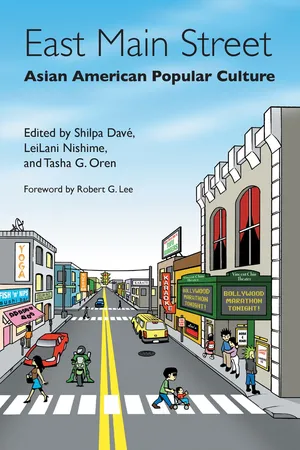
East Main Street
Asian American Popular Culture
- 382 pages
- English
- ePUB (mobile friendly)
- Available on iOS & Android
eBook - ePub
East Main Street
Asian American Popular Culture
About this book
Information
Topic
Ciencias socialesSubtopic
Estudios asiaticoamericanosGlobalization and Local Identities
Chapter 1
Trance-Formations
Orientalism and Cosmopolitanism in Youth Culture
Images and sounds of Asia emerged to mark the “cool” edge of U.S. popular culture in the 1990s in ways that express the contradictions of economic and cultural globalization, immigration, and racialization, contradictions that speak to the particular positioning of Asian Americans at this historical moment. In the late 1990s, for example, South Asian motifs and music became particularly visible in the latest manifestation of “Asian cool” at a time when South Asian immigration to the United States was growing rapidly, with an increasing number of South Asian labor migrants working in low-income jobs. South Asian American youth were justifiably ambivalent about this “appropriation” of South Asian cultural symbols, from henna “tattoos” and decorative “bindi jewels” to the images of Hindu deities on T-shirts and lunch boxes.
Yet the commodification of South Asia in mainstream youth culture is not just about contestation over cultural authenticity and ownership; it also brings to light deeper issues of race relations in the United States, the inequities of economic globalization, and rising anti-immigrant sentiment —all heightened after the events of September 11, 2001. I have focused elsewhere on the meanings of this cultural commodification of “Asian cool” for South Asian American youth (Maira 2000), yet not much work has been done to carefully examine what it means for white American youth to consume these symbols of “otherness.” Asian icons are often used by white (or other) American youth to signal their “alternative” approach to mainstream popular culture, as with neohippie subcultures that have reinvented the sixties’ fascination with India.
I want to focus here on what this manifestation of late capitalist Orientalism reveals about the national and global imaginaries re-created in U.S. youth cultures at the turn of the millennium and, in particular, reflect on the implications of the adoption of South Asian iconography by dance music subcultures. Are notions of Orientalism, cosmopolitanism, and globalization, much discussed in cultural studies and Asian American studies, relevant to these phenomena? If so, how can the “local” and “global” structures of feeling expressed in these youth subcultures help us rethink these paradigms and understand the contradictions of citizenship and consumption today?
Electronic Dance Music and Goa Trance
Electronic dance music is a large and continually expanding musical genre and dance subculture, having evolved from Detroit techno, Chicago house, and New York garage/disco parties as well as European electronic music experiments, notably in Germany (Collin 1997; Reynolds 1998; Shapiro 2000; Silcott 1999). In brief, the story of raves begins, most recently at least, in England where Chicago house music was transformed by clubbers in the 1980s into what was called acid-house, an Ecstasy-driven, all-night dance culture (Thornton 1996). Travel is a key motif in this subculture. It has always been at the heart of the evolution and narration of raves: it was British tourists in Ibiza, Spain—on routes that would later include India, Nepal, and Thailand—who helped import a casual and communal club ethos to England in the late 1980s and early 1990s.
Transnational travel and cultural globalization continues to thread itself into the story of rave culture’s entry into the United States. The first fullblown raves on the East Coast were hosted by deejay Frankie Bones in Brooklyn in 1989 after he attended house parties in Britain (Champion 1997; Reynolds 1999, p. 144). On the West Coast, a group of British expatriates drawing on rave’s “techno-pagan” dimension hosted parties on northern California beaches that offered a cyberhippie consciousness through a vision of dance as ritual and the deejay as “digital shaman” (Silcott 1999, pp. 58–59; Reynolds 1999, p. 156). In southern California, British expatriates jump-started a party culture that mutated into its local manifestation of outlandishly spectacular and highly fashion-conscious events, some held in the desert; in the early nineties, these parties were reportedly unusually racially mixed (Prince and Roberts 2001; Reynolds 1999, pp. 159–160).
Trance music has been called “the Esperanto of electronic dance music” by dance music critic Simon Reynolds, who claims that in the late 1990s it was the “most popular rave sound in the world” (1998, no page). Trance is growing in appeal in the United States and offers a “populist, accessible alternative to the experimental abstraction of hip rave styles such as techno and drum and bass” (Reynolds 1998). Trance has a more melodic sound within the spectrum of electronic music subgenres, characterized by what Reynolds calls “recognizably human emotions and a warmly devotional aura.” Goa trance is the faster, “fiercer” version of trance music (140 bpm and up), first popularized by raver-tourists re-creating the Ibiza paradise on the beaches of Goa, India—historically a sixties’ hippie haven—and later circulating as a “viral, ‘virtual’ presence across the Western world” (Reynolds 1999, pp. 175–176).
I was initially intrigued by “Goa trance” because it seemed to be the enactment of a late-twentieth-century Orientalist fantasy. But the meanings of Goa trance are more complex than I had thought. My own understandings of Orientalism in practice, particularly in the context of globalization, have changed in response to my research. To interrogate the nature of the Orientalist imaginary in Goa trance, one has to situate the music in the particular local contexts in which it is embedded and produced.
The Rave Subculture in the “Happy Valley”
In western Massachusetts, where my research is situated, the rave scene is minimal compared to urban centers in San Francisco, New York, Orlando, and the Washington, D.C.–Baltimore area. Yet there seems to be a community of “party kids” in the Northampton-Amherst area who travel to raves up and down the East Coast. This is not surprising given the large college population attending institutions such as the University of Massachusetts, Amherst, and Smith College and also the demographic makeup of the region, for electronic dance music is a largely white, middle-class youth subculture. The “Happy Valley” of Western Massachusetts, as the area is called with an equal measure of affection and derision, has a predominantly white population with a very visible neohippie culture. Apart from the small Cambodian American community in the Northampton-Amherst area and the Vietnamese immigrant community in Springfield, there is only a transient population of Asian American youth attending the area colleges. Trance fans find out about parties in the region by word of mouth or from fliers and websites. This subculture is inherently nomadic, and the large parties are generally held not in clubs but in visually and digitally enhanced auditory environments created in ice-skating rinks, amusement parks, barns, and fields. The notion of space, and thus of community, is mobile and fluid but at the same time focused and circumscribed by subcultural ideologies about authenticity and virtuosity.
Deejay Kalyx is one of the young owners of The Grow Room, an electronic music store in Amherst that sells vinyl as well as dancewear and that has become a meeting spot for (aspiring) deejays and party kids. Kalyx spins trance at parties in Cambridge and New York and observed that Goa trance itself has fragmented, with many local variations in sound and tempo across the various sites it has produced. Gavin, a producer of trance parties in Amherst and New York, describes Goa trance as the traditional label, now interchangeable with “psychedelic trance” (or psy-trance) for a sound that has an “arpeggiated synth-line” and is “very chaotic,” with “lots of sounds and noises moving in and out of each other,” which Reynolds calls “mandala-swirls of sound” (1999, p. 176). The mystical imagery is not coincidental: Goa parties have a “cyberdelic” aura, or what Kalyx calls a “supertribal” vibe, with images of Hindu gods and symbols forming the standard visual iconography of psy-trance fliers. The parties do not use strobe light or traditional shadowy club lighting but ultraviolet or “black” light that reflects off the dancers’ fluorescent clothing. Women often wear nose rings or bindis, the Indian forehead ornament, and according to the promoter of the well-known Tsunami trance parties in New York, “they look like goddesses, infused with the spiritual energy of India” (cited in Reynolds 1999, p. 208). Ravers and promoters alike suggest that a particular Orientalist, or at least spiritual, overtone was key to Goa trance’s emergence in the United States, connected to the return to house in dance music in recent years and the fringe status of psy-trance within rave culture. Hien, a young Vietnamese American man who grew up in Worcester and has been going to dance parties for several years, said insightfully: “I think, you know this is probably like Orientalism at its lowest common denominator. Basically, Goa trance has nothing to do with, trance itself has nothing to do with Southeast Asia or India…. It’s funny because when house became popular, a lot of people reinvented trance just to be this all mystical, and Oriental, and Southeast Asia like, to set themselves apart from house, to make it seem more like spiritual, or more psychedelic.”
Many observers as well as participants describe trance music as “a religion” and its fans as “tribally devoted to the scene.” This attitude was evident among the people I spoke to. Like fans of other music genres, they felt passionately about the music. The underground nature of the trance scene appeals to those tired of the commercialism of the mainstream parties and the influx of younger clubbers who they say are primarily drawn by the drugs rather than the music. Both deejays and dancers like what they perceive as the “underground” nature and spiritual vibe of the trance parties compared to the increasingly expensive, large-scale raves that are attracting high school students.
In fact, Hien points out that the name “rave” itself is no longer used by insiders, because of the mainstreaming of the subculture and the negative attention it has drawn in the mass media: “Raves are like the ideal. But nowadays, being called a raver kind of has a lot of bad connotations. Because when you’re a raver, you’re trying to be underground, you’re trying to do lots of drugs and stuff. That’s why a lot of people now call themselves party kids, not ravers.” For Hien and other “party kids,” there is a clear sense of belonging to a youth subculture that has to keep renaming and re-creating itself in order to remain true to its own vision and distinct from the mainstream, even if doing so is not sanctioned by the law. Issues of authenticity and subcultural capital are preeminent in the hierarchies that undergird belonging in this subculture, as I have elaborated elsewhere (see Maira 2003).
In this subculture there are two ways to gain subcultural capital and advance in the social hierarchy: skill as a dancer or connections as a drug dealer. The issue of drug use is highly contested. All the people I spoke to were ambivalent about its role in the party culture, expressing their concern that drugs had given their subculture a bad rap, so to speak, and had overshadowed what to them was most important and unique about parties: the music and the dancing.1 Dance is an extremely important element in this youth subculture. Apart from hip hop—from which it draws several stylistic and kinesthetic features—dancing is perhaps the most heavily prized, even fetishized, art form in raves. Hien was himself a member of a dance crew, a collective of young men from western Massachusetts who danced together at parties and who had joined the group by invitation.
There is an understanding among the youth I spoke to that the party subculture is particularly generational, that individuals spend a few years in the scene and then eventually move on, either burned out on the drugs or unable to maintain a lifestyle compatible with being in the workforce. For the mostly middle-class party kids the cover charges for these events are expensive, not to mention the drugs, and attending parties requires a schedule that allows for the travel to and from and “recovery” afterwards. But there are certainly those who struggle to find the time and economic resources to participate consistently in the subculture. So for many, the party scene can be viewed as fulfilling the role of a traditional youth subculture (Clarke et al. 1976), of providing a liminal space where youth can participate in shared rituals that create a sense of collectivity but that they ultimately leave when they enter adulthood and the larger social and class hierarchy.
However, the question I am interested in addressing here is not the traditional subcultural lynchpin of resistance or subversion, but the work of Asian iconography in raves. This preliminary research leads me to ask questions about the relation of youth, specifically U.S. party kids, to the postindustrial nation-state in an age of globalization and at a moment when the Asian and U.S. economies are ever more intertwined, as is apparent from the role of Asian (and Asian American) sweatshop labor and imported Asian commodities (Louie 2001; Skoggard 1998).2
I draw on the multilayered structure of Goa trance in offering a preliminary analysis, conceiving of my samples from the interview narratives as layered into two tracks: one, the theme of technology, modernity, and Orientalism; and two, tensions between cosmopolitanism, consumption, and citizenship.3 In fact, this multilayered structure models that of Goa trance itself.
Track I: Technology, Modernity, and Orientalism
Noah, an articulate and thoughtful young man who grew up in Northampton, has traveled to trance parties in New York and throughout New England. He believed that the very long, “low-frequency sound waves” of the heavy bass have a neurophysiological affect on dancers that is responsible for creating an altered state of being, in addition to or even apart from the influence of drugs. The idea of consciousness-altering rituals involving music and dance that simultaneously subvert and reinforce the social order is obviously an old one. What is new in these contemporary rites at raves is the notion that one can be simultaneously modern, or even postmodern, and premodern. Some have called this techno-shamanism, which for the so-called E-generation is not as paradoxical as it might appear. Gavin, who producers Spectra parties and is based in Amherst, explained why he used Mayan images on his fliers:
Trance is the fusion of the newest technology available with the oldest rhythms available. People who come to the parties are very computer-literate, they are using technology to awaken their senses. The Mayans were very advanced for their time, and they were also very spiritual. The vibe at parties is very tribal…. it’s very modern but also the oldest thing people have been doing.
Trance parties rely on digital technology and a postmodern aesthetic based on sampling, but they also distinguish themselves by their ritualistic performance and staging; live acts feature not only deejays but also drummers and fire artists who perform with fireballs and firesticks. Successful party producers such as Gavin pay special attention to the visual decorations, which include not just the digital displays found at other parties but also installations of fabric and banners that react to the UV light. “Om” symbols and images of Hindu deities are also common; in fact, Hindu iconography is so standard ...
Table of contents
- Cover Page
- Title Page
- Copyright Page
- Contents
- Acknowledgments
- Foreword
- Introduction
- Part I: Globalization and Local Identities
- Part II: Cultural Legacy and Memories
- Part III: Ethnicity and Identification
- About the Contributors
- Index
Trusted by 375,005 students
Access to over 1.5 million titles for a fair monthly price.
Study more efficiently using our study tools.
Frequently asked questions
Yes, you can cancel anytime from the Subscription tab in your account settings on the Perlego website. Your subscription will stay active until the end of your current billing period. Learn how to cancel your subscription
No, books cannot be downloaded as external files, such as PDFs, for use outside of Perlego. However, you can download books within the Perlego app for offline reading on mobile or tablet. Learn how to download books offline
Perlego offers two plans: Essential and Complete
- Essential is ideal for learners and professionals who enjoy exploring a wide range of subjects. Access the Essential Library with 800,000+ trusted titles and best-sellers across business, personal growth, and the humanities. Includes unlimited reading time and Standard Read Aloud voice.
- Complete: Perfect for advanced learners and researchers needing full, unrestricted access. Unlock 1.5M+ books across hundreds of subjects, including academic and specialized titles. The Complete Plan also includes advanced features like Premium Read Aloud and Research Assistant.
We are an online textbook subscription service, where you can get access to an entire online library for less than the price of a single book per month. With over 1.5 million books across 990+ topics, we’ve got you covered! Learn about our mission
Look out for the read-aloud symbol on your next book to see if you can listen to it. The read-aloud tool reads text aloud for you, highlighting the text as it is being read. You can pause it, speed it up and slow it down. Learn more about Read Aloud
Yes! You can use the Perlego app on both iOS and Android devices to read anytime, anywhere — even offline. Perfect for commutes or when you’re on the go.
Please note we cannot support devices running on iOS 13 and Android 7 or earlier. Learn more about using the app
Please note we cannot support devices running on iOS 13 and Android 7 or earlier. Learn more about using the app
Yes, you can access East Main Street by Shilpa Dave,LeiLani Nishime,Tasha Oren, Shilpa Dave, LeiLani Nishime, Tasha Oren in PDF and/or ePUB format, as well as other popular books in Ciencias sociales & Estudios asiaticoamericanos. We have over 1.5 million books available in our catalogue for you to explore.