All but buried for most of the twentieth century, the concept of altruism has re-emerged in this last quarter as a focus of intense scholarly inquiry and general public interest. In the wake of increased consciousness of the human potential for destructiveness, both scholars and the general public are seeking interventions which will not only inhibit the process, but may in fact chart a new creative path toward a global community. Largely initiated by a group of pioneering social psychologists, early questions on altruism centered on its motivation and development primarily in the context of contrived laboratory experiments. Although publications on the topic have been considerable over the last several years, and now represent the work of representatives from many disciplines of inquiry, this volume is distinguished from others in several ways.
Embracing the Other emerged primarily as a response to recent research on an extraordinary manifestation of real-life altruism, namely to recent studies of non-Jewish rescuers of Jews during World War II. It is the work of a multi-disciplinary and international group of scholars, including philosophers, social psychologists, historians, sociologists, and educators, challenging several prevailing conceptual definitions and motivational sources of altruism. The book combines both new empirical and historical research as well as theoretical and philosophical approaches and includes a lengthy section addressing the practical implications of current thinking on altruism for society at large. The result is a multi-textured work, addressing critical issues in varied disciplines, while centered on shared themes.
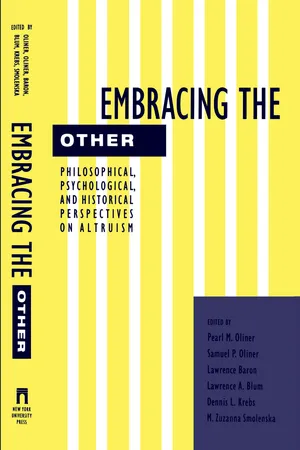
eBook - ePub
Embracing the Other
Philosophical, Psychological, and Historical Perspectives on Altruism
- 474 pages
- English
- ePUB (mobile friendly)
- Available on iOS & Android
eBook - ePub
Embracing the Other
Philosophical, Psychological, and Historical Perspectives on Altruism
About this book
Information
PART ONE
PREFACE AND INTRODUCTION
PREFACE
This book was initiated at the international conference titled “Theoretical and Social Implications of Rescuing People in Extreme Situations: Another Look at Altruism,” held in Radziejowice (Poland) in June 1989. The purpose of the conference was to discuss the implications of studies concerning the capability of human beings to perform brave, enduring altruistic actions. The inspiration for such an approach came from the Altruistic Personality Project—the large-scale study originated and directed by Professor Samuel Oliner. The project focuses on people who were willing, despite grave risk and consequence, to help others—to rescue Jews during the Holocaust—and it was supposed to shed new light on the psychological and concomitant social implications of such actions. It was based on a sample of approximately seven hundred rescuers, nonrescuers (controls), and rescued survivors in various countries under Nazi occupation, and provided a large database concerning the social and family background of the subjects, their childhood experience, their social relations before and after rescuing actions ensued, and many other related factors. The results of the project were presented in the book written by Samuel P. Oliner and Pearl S. Oliner titled The Altruistic Personality: Rescuers of Jews in Nazi Europe (Free Press, 1988).
It should be kept in mind that reflection about human nature is heavily influenced by the studies uncovering its various flaws and imperfections. One of the first great sources of disillusionment about human nature was Freud’s discovery of the unconscious, with its primitive sexual and aggressive urges. Subsequent studies on the authoritarian personality, prejudice, Machiavellianism, “crimes of obedience,” cognitive biases, etc., contributed to the reinforcement of a rather unflattering picture of the human being. There were, though, some attempts to look at human nature in different ways—the proponents of humanistic psychology claimed that an individual, freed from imposed constraints and undue pressures, will manifest a capacity for empathy and creative selfrealization. But the foundations of this claim were rather shaky. In fact, it was more an expression of the personal convictions of its authors than a proposition supported by some kind of scientific evidence.
Nevertheless, over the last two decades there has been an increasing number of empirical studies focusing on the “positive” forms of human behavior—on the psychological mechanism of prosocial actions: helping, sharing, and caring for others. Many of these studies were conducted in laboratory settings. But their real significance could not be fully appreciated as long as there was not enough data linking laboratory situations with real life. The studies of real-life altruism provide this missing link. They show the phenomenon that in the laboratory may have a rather elusive and “ghostly” existence, but that under certain conditions can become very robust; prosocial forces can sustain themselves under the most adverse conditions.
The studies of altruism indicate that the idea that empathy and altruism as a natural propensity of a human being must inevitably appear, if the conditions that suppress it are eliminated, is rather simpleminded. The real mechanisms of prosocial action are apparently much more complex. As the understanding of these mechanisms grows, many of our old views about human beings may require major revisions.
This was, in fact, the basic assumption of the organizers of the conference. They believed that through the analysis of these mechanisms we could shed new light on a number of issues: on theories of personality, social attitudes, and culture; on family relationships, education, and public policy; on moral, philosophical, and religious considerations. Of course, one cannot in the framework of one conference exhaust all the possible considerations dealing with this topic. Its major goal was therefore more modest; it was to instigate thought about the implications of the studies on altruism for our approach to different spheres of social life. And this is also the aim of this book, which is the outcome of that conference.
The organizers of the conference would like to express their appreciation to the following institutions, which by offering their generous support made the whole undertaking possible: the Institute of Psychology of the Polish Academy of Science, the Altruistic Personality and Prosocial Behavior Institute, and the Institute of Noetic Sciences.
INTRODUCTION
In the summer of 1989, we met with a group of international scholars in Poland to exchange views on a particular type of altruism: the kind that some have called “heroic” altruism and that the conference organizers described as altruistic activity undertaken in extreme situations.
The topic of the conference emerged largely from recent studies of rescue activities undertaken by non-Jews on behalf of Jews during the Nazi occupation of Europe during World War II. Rescuers, as they are popularly called, risked their lives and frequently those of their families as well to help Jews survive the Nazi Holocaust. In a very real sense, rescue was an embrace: an act of enclosure and protective care in the midst of an ocean of unrelieved brutality. Moreover, the “other” whom rescuers embraced were neither family members nor coreligionists; in some cases, they were not even conationals. In many cases, rescuers helped Jews despite their “outsider” status, the consequence of national and ethnic definitions that excluded them. While their numbers were very small—even by the most generous estimates, no more than one half of 1 percent of the total population under Nazi occupation—the very existence of rescuers suggests something important about the human spirit and its potential. In light of it, it seems less naive to envision a future without genocides and war, and even possible to imagine a global society marked by care.
Just as the topic evoked images of extreme evil and hope, so did the site of our meeting and its timing. Poland suffered one of the most cruel Nazi occupations and was the center of most of their exterminating centers, yet it also mounted an impressive resistance. Testimonies about that period were everywhere: in the monuments on every few streets to those who had died, in the Warsaw ghetto remnants in the heart of the city, in Auschwitz where we visited, and in conversations with Poles. The scarcity of goods on store shelves, the long lines of people waiting patiently to enter the shops, and the unrepaired facades on buildings attested to the economic hardships Poles endured in the years following. But during that very summer of our conference, Communist and Solidarity representatives were meeting at the round table to see if they could forge unprecedented cooperative means to bring the country to a new political structure without violence. The symbolic significance of these multiple events—simultaneously grim and hopeful—was keenly felt by all of us.
The conference participants were a highly diverse group. Composed of scholars from multiple disciplines (historians, psychologists, social psychologists, sociologists, philosophers, educators, and social welfare representatives) and nations, their approaches to the topic ranged from highly theoretical to strongly pragmatic. Inherent in such diversity is both a threat and a promise: the threat of increasing fragmentation, polarization, and disconnectedness, and the promise of bringing mutual enrichment and cohesion out of isolating specializations and cultural specificities. The threat was quickly dissipated, for what eventually marked the lively exchanges and the resultant papers included herein was the sense of commonality of issues and shared problems, albeit expressed in the conceptual language particular to their respective disciplines.
The common underlying motif of the conference, expressed implicitly or explicitly, was the inadequacy of dominant theories to explain altruism—particularly heroic altruism, such as rescue. Such inadequacies focused on central issues.
One issue revolved around prevailing definitions of altruism and its relationship to moral theory. Behaviorist definitions try to avoid motivational issues, while concentrating on objective, measurable criteria. Other definitions have included motivational aspects, some insisting for example on specific internal states, such as empathy, lack of concern with restitution, specific values (such as love or compassion), personal norms, or principles of justice. Conference participants almost unanimously rejected behaviorist definitions as adequate. And while they also did not accept the motivations identified by others as quite sufficient to explain rescue, they largely agreed that the issue of motivation was essential to any adequate definition of altruism.
Another issue revolved around the relationship of altruism generally and rescue specifically to morality and moral theory. While none disputed the idea that altruism resonates with moral implications, rescue itself appeared to imply moral themes that extended beyond Western conceptions of morality and prevailing moral theories. Neither the Kantian notions of justice nor insistence on pure selflessness appeared satisfactory to address altruism generally or the particular moral virtues of rescue.
The continuing debate over the paradox of altruism in the context of evolutionary theory surfaced as yet another issue. While notions of kinship and reciprocity might help explain some cases of altruism, they appeared inadequate to explain rescue behavior that was directed toward outsiders who were often strangers, and who constituted poor prospects for future reciprocity claims. Yet to rely on cultural explanations alone appeared equally unacceptable in view of real human biological constraints. Could evolutionary theory be reconciled or modified to account for behaviors such as rescue?
Just as evolutionary theory appeared inadequate to explain rescue, so did social psychological theory. If altruism is a trait that some people have and others do not, as implied in the notion of “an altruistic personality,” then the world can presumably be divided into altruists and nonaltruists. But people often behave altruistically in one context and selfishly in another, and the quality of their altruistic responses also varies in the sense of their effectiveness and comprehensiveness. Given that many aspects of cognition and affect are subject to development, might it not be the case that altruism itself is an incremental developmental stage process, the potential for which all people have but not all develop fully?
Nor could social psychological theory adequately account for the influence of culture and the demands of specific situations. While apparently altruistic acts might share behavioral similarities, the meaning of such acts often differs depending on the culture in which they occurred. Thus, for example, rescue in the case of Denmark appeared to be largely an affirmation of national political traditions, whereas among Christian Reformed groups in Holland, it appeared to be largely an affirmation of religious culture in which Jews were perceived as God’s chosen people.
Finally, conferees unanimously agreed that the pragmatic implications of their work were of the utmost importance. The hope they shared in common was that their work would illuminate practice designed to create a better world society.
These issues, initially expressed at the conference, were subsequently refined in the written articles that followed thereafter. They serve as the organizational framework for this volume.
PART 2: PHILOSOPHICAL, DEFINITIONAL, AND CONCEPTUAL ISSUES
The authors of part 2 address three central questions: What is an adequate definition of “altruism”? How is altruism related to rescue particularly and morality generally? And how well do our traditions of moral thought illuminate the phenomenon of altruism?
Rejecting ordinary forms of prosocial behavior as manifestations of altruism, Krzysztof Konarzewski (chapter 1) begins by arguing that the rescue of Jews during the Holocaust was a prototypical form of moral altruism. Heroic altruism of this type, says Konarzewski, requires both empathy and protest, two quite different motivational orientations. Whereas the former depends on some degree of social dependency or conformism, the latter requires a principled independence based on recognition of and commitment to the axiological foundations of community life. Since these are rooted in quite different and apparently irreconcilable psychological orientations, Konarzewski asks how both can be cultivated simultaneously in the same individual.
While Lawrence Blum (chapter 2) agrees emphatically that rescue was a qualitatively different activity from that implied in more routine kindly acts, he finds the term “altruism” itself insufficient to capture the moral resonances of rescue. Although agreeing with Konarzewski that rescue was unquestionably an altruistic act and an act of protest, Blum nonetheless argues that rescue involved moral principles beyond altruism. While acknowledging that morality requires universality—that is, extending one’s concern to all human beings—he adds a distinctly innovative component by introducing the moral value of “affirming cultures.” Whereas universality denies differences and obscures them, preserving people as a distinct people affirms their valued specificity.
Victor Seidler (chapter 3) takes Blum’s argument further. Rather than liberating people and embracing them, the universalistic rational tradition, rooted in Enlightenment thought, is predicated on an abstract humanity from which cultural identity is to be trajected. In this tradition, feelings and self are regarded as manifestations of egoism; thus, the price of freedom and equality is self-denial. Seidler argues that Western moral theorists have embraced this notion with pernicious consequences. Inasmuch as the language of altruism is tied to Christian/Kantian thought, neither the concept of altruism nor conventional Western notions of morality or moral theory suffice to explain rescue. By way of contrast with this tradition, which emphasizes “ethical purity,” he offers the tradition of Judaism, which, he says, accepts emotions, self, and individuality as well as social context as part of the human condition and integral to moral behavior rather than in conflict with it.
PART 3: SOCIOBIOLOGY AND MORAL ALTRUISM
Given that altruism is maladaptive at the individual level, in the sense of being incompatible with reproductive success, how can altruism generally and rescue behavior particularly be explained in terms of evolutionary theory? Rejecting both exclusively biologically based and exclusively culturally based explanations for this paradox, Ian Vine (chapter 4) and Ronald Cohen (chapter 5) attribute altruism to an interaction between biologically based altruistic dispositions and cultural inputs. While kin selection, reciprocity, and manipulation help explain altruism in part, says Vine, they are inadequate to explain the self-sacrificial behavior toward “outsiders” as evidenced in rescue behavior. He proposes instead that an evolved subjective self-system enables humans to transcend biological constraints and develop sympathy and a sense of identity with a broad range of others. What genes do is provide a range of possible behaviors, but it is culture and learning that shape the selection of the range. Hence, he concludes, “our biology encourages us to be saints in some contexts and allows us to in others. … But it remains a matter of choice which human options we cultivate.”
Although he conceptualizes it somewhat differently, Cohen also proposes an interactionist model between biology and culture, in which choice features. Altruism, including rescue, says Cohen, is based on both genetic and sociocultural evolution. Its genetic basis lies in an innate capacity for restraint that modifies dominance striving and provides a basis for morality. Congruent with the “dual inheritance model” advanced by Boyd and Richerson, he argues that while biological and cultural evolution are logically and empirically separate domains, “they are nonetheless united phenomenologically into a single process of descent with modification.” Hence, while not divorced from reproductive inheritance, both biology and culture are modifiable, the latter most particularly through role recruitment, population migrations, and diffusion of traits. Current societal trends (e.g., a rising concern with public versus private concerns, the end of Cold War tensions, and an increase in the nuclearization of family life), coupled with the phenomenon of rescue itself, lead Cohen to a very optimistic view regarding the possibilities for the evolution of what he calls “civil society,” in which norms and behaviors toward other persons and groups will take their welfare into account.
PART 4: THE DEVELOPMENT AND ENACTMENT OF ALTRUISM
The chapters in this section address the growth of altruism over the life span and the internal and external factors that mediate altruistic behavior. Dennis Krebs and Frank Van Hesteren (chapter 6) begin by asking whether there really are altruists and egoists or whether we are all a little bit of both. Rather than a trait that some people have and others do not, altruism, they argue, is shared to a greater or lesser degree by all people, and the capacity for it grows with social and cognitive development. Claiming that past approaches have failed to adequately address the stages of altruistic development and its interactional aspect, Krebs and Van Hesteren propose a “developmental-interactional” model consisting of seven cognitively based stage structures, the apex of which is “integrated altruism.” What distinguishes individuals possessing advanced stages is their more direct focus on enhancing the welfare of others as an end in itself, and their capacity to perform a broader array of more altruistic acts, as well as ...
Table of contents
- Cover Page
- Title Page
- Copyright Page
- Dedication
- Contents
- Contributors
- Part One: Preface and Introduction
- Part Two: Philosophical, Definitional, and Conceptual Issues
- Part Three: Sociobiology and Moral Altruism
- Part Four: The Development and Enactment Of Altruism
- Part Five: Embracing the “Outsider”
- Part Six: Promoting Altruistic Bonds
- Index
Trusted by 375,005 students
Access to over 1.5 million titles for a fair monthly price.
Study more efficiently using our study tools.
Frequently asked questions
Yes, you can cancel anytime from the Subscription tab in your account settings on the Perlego website. Your subscription will stay active until the end of your current billing period. Learn how to cancel your subscription
No, books cannot be downloaded as external files, such as PDFs, for use outside of Perlego. However, you can download books within the Perlego app for offline reading on mobile or tablet. Learn how to download books offline
Perlego offers two plans: Essential and Complete
- Essential is ideal for learners and professionals who enjoy exploring a wide range of subjects. Access the Essential Library with 800,000+ trusted titles and best-sellers across business, personal growth, and the humanities. Includes unlimited reading time and Standard Read Aloud voice.
- Complete: Perfect for advanced learners and researchers needing full, unrestricted access. Unlock 1.5M+ books across hundreds of subjects, including academic and specialized titles. The Complete Plan also includes advanced features like Premium Read Aloud and Research Assistant.
We are an online textbook subscription service, where you can get access to an entire online library for less than the price of a single book per month. With over 1.5 million books across 990+ topics, we’ve got you covered! Learn about our mission
Look out for the read-aloud symbol on your next book to see if you can listen to it. The read-aloud tool reads text aloud for you, highlighting the text as it is being read. You can pause it, speed it up and slow it down. Learn more about Read Aloud
Yes! You can use the Perlego app on both iOS and Android devices to read anytime, anywhere — even offline. Perfect for commutes or when you’re on the go.
Please note we cannot support devices running on iOS 13 and Android 7 or earlier. Learn more about using the app
Please note we cannot support devices running on iOS 13 and Android 7 or earlier. Learn more about using the app
Yes, you can access Embracing the Other by Pearl Oliner,Samuel P. Oliner,Lawrence Baron,Lawrence Blum, Pearl Oliner, Samuel P. Oliner, Lawrence Baron, Lawrence Blum in PDF and/or ePUB format, as well as other popular books in Social Sciences & Sociology. We have over 1.5 million books available in our catalogue for you to explore.