Dreams and visions, prophetic words from God about "dusty souls," speaking in tongues while "in the spirit"—narratives of these and similar events comprise the heart of Every Time I Feel the Spirit. This in-depth study of a Black congregation in Charleston, South Carolina provides a window into the tremendously important yet still largely overlooked world of African American religion as the faith is lived by ordinary believers.
For decades, scholars have been preoccupied with the relation between Black Christianity, civil rights, and social activism. Every Time I Feel the Spirit is about black religion as religion. It focuses on the everyday experience of religion in the church, congregants' relationships with God, and the role that God and Satan play in congregants' lives—not only as objects of belief but as actual agents. It explores the concepts of religious experience and religious ritual, while emphasizing the attributions that people make to the operation of spiritual forces and beings in their lives.
Through interviews and field work, Nelson uncovers what religious people themselves see as important about their faith while extending and refining sociological understandings of religious ritual and religious experience.
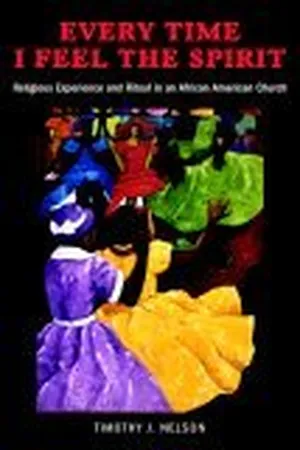
eBook - ePub
Every Time I Feel the Spirit
Religious Experience and Ritual in an African American Church
- 222 pages
- English
- ePUB (mobile friendly)
- Available on iOS & Android
eBook - ePub
Every Time I Feel the Spirit
Religious Experience and Ritual in an African American Church
About this book
Information
Topic
Theology & ReligionSubtopic
Religion1
God’s House in the Holy City
The past, someone once observed, is another country. Perhaps this is why Charleston seemed so foreign and exotic to me the first time I drove down South Carolina’s Route 61, past the Ashley River plantations with their quaint formal gardens and ghostly rice fields and onto the streets of the narrow peninsula. For in this city, history is a constant and talkative companion who continually interrupts the routines of daily life with reminders of its 300-odd years of existence. Every trip through the compact grid of downtown streets and alleys, whether to the grocery store or post office, is like a journey through Southern history, and one must pass the house of this Confederate general or that signer of the Declaration of Independence just to mail a letter or buy some milk and eggs. The description of a visit to Charleston as “walking through the pages of a history book” (Stevens 1939) are as applicable now as they were when they were written during the Great Depression, and I soon found that the greatest challenge of driving here was avoiding the horse-drawn carriages that constantly plied the lower half of the peninsula, filled with sun-burned tourists marveling at the nation’s largest collection of pre-Revolutionary structures.
As one who had spent most of my thirty-something years in southern California, where any building older than the Second World War seemed like an ancient relic, I found this history-on-display quite remarkable, sometimes astonishing and frequently disturbing. For mixed in the urban landscape with these venerated and meticulously preserved buildings, there are reminders of another past that is not so glorious. The physical remains of this legacy are sprinkled throughout the city’s historic district in such sites as the Old Jail, a crumbling concrete fortress in the middle of an African American housing project and built on the very site of the work house once used to punish slaves. There is the Old Slave Mart on Chalmers Street, site of the largest slave auction house in the South and a museum for a brief time, but now shuttered after Hurricane Hugo tore the roof off in 1989. There is Market Hall on Meeting and Market Streets, standing at the epicenter of Charleston tourism and recently renovated, with a museum devoted to the Daughters of the Confederacy. And of course, there are the remains of Fort Sumter, a constant brooding presence in the harbor and a silent testament to the war waged to defend that “peculiar institution” of slavery.
Here in the Lowcountry, the boundary between past and present was more permeable than any place I had ever been, and it seemed particularly true of this twisted and tangled relationship between blacks and whites. Unlike the North, which didn’t accommodate significant numbers of African Americans until after 1910, the races have over three hundred years of continuous history together in the South, and the physical legacies of this complex past are all but unavoidable. Even the drive from our apartment building on Colonial Lake to Eastside Chapel was like a guided tour of the brutal, tragic, and often ironic history of southern race relations: past the statue of John C. Calhoun the ardent “fire-eating” separatist whose passionate rhetoric helped spur South Carolina to become the first state to withdraw from the Union; past the Old Citadel, an institution with its origins in the establishment of a city militia following the aborted slave uprising in 1822 led by Denmark Vesey (and serving, in the 1980s and 1990s, as the county welfare office before its current incarnation as an Embassy Suites hotel); past Emanuel AME Church, one of the first and most important independent black churches in the South, and the base of Vesey’s recruitment for that slave insurrection that never happened.
Although Eastside Chapel itself is hardly historic—it was founded and built in the 1940s—the surrounding community has a unique place in African American history as one of the oldest urban black settlements in the country. The Eastside neighborhood actually comprises several historic suburbs—Mazyckborough, Wraggsborough, and Hampstead—which were annexed to the city in 1849. Although furthest away from the old section of city, the Village of Hampstead was the first of the three to be developed, laid out in the 1760s by Henry Laurens, a slave trader and millionaire several times over and perhaps one of the wealthiest men in the American colonies at that time (Fraser 1989). Laurens modeled his ninetynine acres after an English suburb, complete with a central grassy square that still remains. Mazyckborough was developed next, in 1786, and subdivided into exceptionally wide streets to help control the fires that plagued the narrow cramped quarters of old Charleston. Finally, Wraggsborough was laid out in the 1790s with an open mall off Meeting Street for public use (Grimes et al. 1987).
Because contemporary American cities tend to be so segregated by race and class, it is sometimes difficult to imagine how diverse the population of the Eastside was for most of its history. In the early 1800s wealthy white planters Joseph Manigault and William Aiken built mansions (both of which still stand) in the Mazyck-Wraggsborough districts, and Hampstead was the summer home of several successful planters and merchants. Interspersed among these wealthier families were many middle and workingclass whites who moved into the neighborhood in the 1830s and 1840s, some displaced by the fire of 1838 in nearby Ansonborough. When white immigrants from Ireland, Bavaria, and France poured into the already crowded area in the 1850s, they lived with sometimes as many as 16 under one roof (Grimes et al. 1987). The homes that were built during this period, from 1830-1860, were patterned after the “single house” which predominated in the lower part of the city, so called because they are one room wide and two rooms deep on each floor, with porches (called “piazzas” by Charlestonians) on the sides to catch the summer breezes.
The “Neck” as this portion of the peninsula was then known, also attracted many African Americans. After the Ansonborough fire Charleston passed an ordinance requiring that all new structures were to be built with brick, with the result that the Neck (which was still outside the city limits) became, according to one observer, “rapidly filled with small cheap wooden houses.” Many slaves whose masters had permitted them to live on their own (a growing practice at this time in the urban South) sought housing in this lower-rent district (Wade 1964). Here they lived alongside free blacks, a group that made up almost a quarter of the Neck’s African American population in 1850 (Jenkins 1998). In addition to the attraction of cheap rents, the area was also further from police surveillance and thus appealed to “runaways, slaves ‘passing as free,’ and other people eager to expand their margin of liberty” (Grimes et al. 1987: 3). The growing numbers of slave and free blacks in the Neck was a constant worry to authorities, and the area was annexed to the city in 1849 partly to establish more control over this population (Powers 1994). In 1850, whites made up about 46 percent of the Neck’s population, slaves comprised another 45 percent, and free persons of color the additional 9 percent.
After the Civil War the city’s black population increased rapidly as freed slaves left the rural plantations and streamed into the urban centers of the South, and Charleston’s total African American population grew by 57 percent between 1860 and 1870. The black population of the Neck grew by 79 percent during the decade while losing only about 3 percent of its whites (Jenkins 1998). Throughout the first half of the twentieth century, Charleston remained one of America’s most residentially integrated cities, with African Americans spread throughout every district (Taeuber and Taeuber 1969). In 1900, the three wards that comprise the current Eastside were 31 percent, 36 percent, and 37 percent black, nearly perfectly coinciding with African Americans’ representation of 36 percent in Charleston overall. Residential integration was the norm here, to the extent that Cabbage Row, the black tenement renamed “Catfish Row” in Dubose Heyward’s 1925 novel, Porgy and Bess, was located below Broad Street in Charleston’s wealthiest enclave.
While Charleston became progressively more segregated in the early decades of the twentieth century, it still had the lowest segregation index of any American city until 1960 (Taeuber and Taeuber 1969). Several factors contributed to this slow but steady racial separation of the city. First, there was a steady attrition of blacks employed as domestic servants by wealthy white families. These servants, who generally lived in or near their places of employment, relocated to the upper wards of the city. The lower wards also began to restore their large historic houses, with the effect of raising property values and forcing out low-income blacks. Finally, the construction of the Wraggsborough public housing complex in the Eastside during the 1940s and 1950s drew a uniformly poor and black population to the area (Zierden 1990; Powers 1994).
At some point in the 1960s, probably coinciding with enforcement of desegregation in the Charleston School District, residential turnover reached a tipping point and there were dramatic changes in the racial complexion of the neighborhood. In 1960 the Eastside held almost 10,000 people, about 60 percent of them African American, and the median income of the nonwhite population was only slightly below that for the nonwhite population in the larger metropolitan area. By 1970 all but a handful of whites had left and there was a slight decrease in the black population as well. The result was that the Eastside lost over 40 percent of its overall population and became 98 percent black within a few short years. With a poverty rate of 65 percent, the remaining black residents were significantly poorer than those in the larger Charleston area, which had a rate of about 50 percent. These trends continued for the next two decades, so that by the time I began my research the neighborhood was down to about 3,400 residents—a 65 percent loss in population since 1960. While the fortunes of Charleston’s African Americans improved greatly after the Civil Rights era, the Eastside increasingly became the repository of the elderly and impoverished. The poverty rate for the neighborhood’s African Americans was 55 percent, down from its height in 1960, but still far above the cutoff of 40 percent that social scientists had established for identifying neighborhoods of “extreme poverty” (Jargowsky and Bane 1990), and a full 25 points higher than the rate for the region’s African Americans as a whole.
In short, when I first came to Eastside Chapel the neighborhood around the church had become Charleston’s most notorious and dangerous slum. Directly across the street from the church property there was an abandoned house, sagging and weary with neglect, almost every chip of paint weathered from the gray boards. Every block had at least two or three of these boarded-up and abandoned properties, rotting like bad teeth between the occupied dwellings, some of which didn’t look in much better shape. These crumbling houses, many between 90 and 150 years old, are the legacy of neighborhood’s white and black flight over the past forty years. In the late 1990s, the Eastside Neighborhood Council mapped 115 abandoned buildings in one part of the community (Maybank 2001). In addition to population loss and neglected housing stock, the Eastside has become increasingly plagued by the social problems that seem inevitably to accompany inner-city poverty—unemployment, fatherless families, crime, drug abuse, and social isolation. Nearly 12 percent of the Eastside’s adult men were unemployed when I began my study, compared to 7 percent of African American men in the greater Charleston area (and only 2 percent of white men). When they were able to find employment, close to 40 percent of Eastside adults worked in service occupations—almost twice the rate for other blacks in the region. This may reflect the lack of education among the population, as over 60 percent of the neighborhood adults over twenty-five years of age had not graduated from high school, a rate that was a third higher than the rate for African Americans throughout Charleston. Finally, almost a third of the families in the neighborhood were headed by single mothers, and close to a third of all the families had some income from public assistance (U.S. Bureau of the Census 1990).
In this impoverished environment dealing drugs is a tempting occupation for many of the Eastside’s male residents. Opportunities to do so are particularly plentiful in Charleston, as it is the seventh busiest seaport in the United States and serves as an entry point for the South American, Asian, and Mexican narcotics destined for distribution in the Southeast. A half a block to the south of the church there is a tiny corner store where boisterous young men tend to gather and carouse on weekend evenings, sometimes loudly enough to distract from Eastside Chapel’s Sunday evening services or the midnight prayer service on Saturday nights. In addition to the usual (and generally unheeded) signs that prohibit loitering in front of the store, a hand-lettered message on the front door warns: “There will be no drug dealing in and around this establishment. A hint to the wise should be sufficient. Leave your drugs at home or somewhere else.” Several of Eastside Chapel’s men—including several church leaders—were either former dealers or still struggled, sometimes unsuccessfully, with the temptation to go back to the trade.
Where there are drugs, there is crime. Shortly before I began studying the church, Lt. Ronald Hamilton, head of the Charleston Police Team One unit whose boundaries include the Eastside, told the Charleston Post-Courier, “Crime on the Eastside is out of control” (Dorothy Givens, “Policeman Gives Grim Report on East Side Crime,” Nov. 15, 1990). In the same article a local merchant reported that his store had been broken into over fifty times in a two-year span. Just five days later the paper ran an article with the headline “Eastside Heavy on Homicides,” with figures showing that the majority of the sixty homicides in Charleston from 1983 (the year that the popular but eccentric police chief Rueben Greenberg took office) to 1990 had occurred in the Eastside (Charles Francis, Nov. 20, 1990). Much of the crime was drug-related, and the worst drug infested corner in the county was right on the park that had once served as Hampstead’s village green 200 years earlier. The many abandoned houses in the area also attracted addicts who used them as “shooting galleries”—a problem so bad that the city started seizing properties identified by police and residents as the worst of the “drug havens” and boarding them up (Post-Courier April 9, 1992). In 1992 the Federal government chose the Eastside, now recognized as the drug and crime capital of the Lowcountry, as a demonstration site for its “weed and seed” program and began to initiate community policing and other neighborhood programs, with mixed results.
Although the Eastside continues to have more than its share of poverty and the many social problems that accompany it, the neighborhood is not wanting for religious resources. One of Charleston’s oldest nicknames is “the Holy City,” a moniker earned, so the guidebooks speculate, because of the many churches within its borders. If this interpretation is true (the label may be an ironic one, given the city’s historic reputation for drunkenness, debauchery, and general wickedness), then the Eastside can perhaps be considered its most sacred community. Within the small area defined by the neighborhood boundaries (about one mile long and a half mile wide), I counted no fewer than fifteen active black congregations when I first explored the community, in the fall of 1991. Although racially homogenous, these churches were quite diverse in denominational affiliation: one Catholic, two Baptist, two United Methodist, three African Methodist Episcopal, one Christian Methodist Episcopal, one Reformed Episcopal, one Church of God in Christ, and four independent Holiness or Pentecostal congregations. They ranged in size from the massive presence of Emanuel AME (the flagship church of the denomination in the South), to the small and struggling independent churches where sometimes fewer than a dozen of the faithful worshipped together on a Sunday morning. Still, the vitality and dedication of these congregations stood in stark contrast to the poverty, crime, and hopelessness that surrounded them.
Although such a concentration of black churches in poor urban communities is certainly not unique (McRoberts 2003), the African American congregations of the Eastside have spiritual roots that go deeper than those in virtually any other North American community. Charleston was the scene of three decisive events in the development of black Christianity: the historic encounter between John Wesley and a converted African that led to the first Christian outreach to the slaves; the discovery of the Denmark Vesey slave rebellion, which closed independent black churches throughout the South for decades; and the landmark meeting that launched the coordinated mission to the slaves in the contentious years before the Civil War. Though these events have mostly receded into obscurity—only the Vesey incident has remained an important touchstone for some of the region’s black population—their legacy has powerfully shaped the religious landscape of African Americans today, in Charleston and throughout the nation.
It was on the first Sunday in August in 1736 when John Wesley, who had been in the colonies for less than six months, delivered a sermon at St. Philip’s Church in Charleston. Wesley had been invited to preach by Anglican minister Alexander Garden, the Commissary of the Bishop of London and a long-time advocate of religious education for slaves. Following the service, Wesley—probably on his own initiative—approached one of the few Africans in attendance, an older woman who had been converted to Christianity by her mistress. Conversing with her for some time, Wesley became increasingly distressed at her inability to answer what he considered the most basic questions of Christian teaching. Reflecting later upon the conversation, he anguished, “When shall the Sun of Righteousness arise on these outcasts of men, with healing in His Wings?” This event had a deep impact on Wesley and tremendous significance for the future Christianization of African Americans, as this encounter in Charleston marks the beginning of the evangelical Protestant mission to the slaves (Frey and Wood 1998: 89).
When Wesley preached that sermon in 1736, Africans had been in the Lowcountry of South Carolina for over sixty years, arriving in Charlestown, as it was then known, with the first boatload of displaced Barbadians in 1670. In a very real sense, the history of African Americans in Charleston is the history of Africans as a people in North America, as scholars estimate that well over 40 percent of all the slaves reaching the British mainland colonies between 1700 and 1775 first touched the New World here. Historian Peter Wood provides the metaphor:
Here was a thin neck in the hourglass of the Afro-American past, a place where individual grains from all along the West African coast had been funneled together, only to be fanned out across the American landscape with the passage of time. Sullivan’s Island, the sandy spit on the northeast edge of Charlestown harbor where incoming slaves were briefly quarantined, might well be viewed as the Ellis Island of black Americans. (1974: xiv)
As a major port of entry for African slaves, the nonwhite population of South Carolina grew rapidly, particularly with the successful introduction of rice in the late seventeenth century and the rising demand for workers from West Africa who knew how to cultivate the profitable crop. Around 1708, within one generation of the colony’s founding, the black population outstripped the white through continued importation. By 1720, persons of African descent comprised 65 percent of South Carolina’s population, and the density of the black population in the colony was the highest of any in North America. Upon landing in Charlestown a year after Wesley’s visit, one Swiss immigrant remarked, “Carolina looks more like a Negro country than like a country settled by white people” (Wood 1974: 132).
There had been some attempt to convert the growing numbers of enslaved Africans to Christianity before the Wesleys—and George Whitefield after them—brought Methodism to the slaves. The Anglican Church had established the Society for the Propagation of the Gospel to Foreign Parts (SPG) in 1701 for the express purpose of evangelizing Native Americans and African slaves, but this effort failed for several reasons. First, the Anglican brand of Christianity was book-oriented, which not only clashed with the more experiential African religious style, but also meant that SPG missionaries placed an emphasis on teaching the slaves to read—a practice staunchly opposed by most slaveholders, particularly following the Stono Rebellion of 1740 (Creel 1988). As a result, many slave owners actively opposed slave conversion and refused to let missionaries onto their property or allow the slaves to meet for Sunday services. Because the SPG workers drew their salaries from these same planters, they were hardly in a position to force the issue. Second, American colonists were not an especially religious lot themselves and showed little outward concern for their own souls, let alone those of their bondspeople. This indifference to Christianity did not escape the notice, nor the condemnation, of the SPG missionaries who diverted their religious zeal toward saving the colony’s white population. Missionary Francis Le Jau wrote to his London supervisor in 1713 that he had been forced to spend much of his energies not on converting the “pagan” Africans but on combating the “visible progress of atheism, irreligion and immorality” among the English colonists (Bowes 1942: 17).
African Americans not only outnumbered whites in South Carolina for most of their almost 200 years of slavery, but they were also densely settled and relatively isolated on rice and cotton plantations. One observer of the Lowcountry region remarked that these segregated living arrangements, combined with the continued importation of Africans into the nineteenth century, had allowed slaves to “more easily preserv...
Table of contents
- Cover Page
- Title Page
- Copyright Page
- Dedication
- Contents
- Acknowledgments
- Introduction
- 1 God’s House in the Holy City
- 2 Religious Experience and Ritual
- 3 “Do You Really Know Who God Is?”
- 4 “On the Battlefield”
- 5 “In Spirit and in Truth”
- 6 Sacrifice of Praise
- 7 Race, Class, and Religion
- Conclusion: Belief, Experience, and Ritual
- Notes
- References
- Index
- About the Author
Trusted by 375,005 students
Access to over 1.5 million titles for a fair monthly price.
Study more efficiently using our study tools.
Frequently asked questions
Yes, you can cancel anytime from the Subscription tab in your account settings on the Perlego website. Your subscription will stay active until the end of your current billing period. Learn how to cancel your subscription
No, books cannot be downloaded as external files, such as PDFs, for use outside of Perlego. However, you can download books within the Perlego app for offline reading on mobile or tablet. Learn how to download books offline
Perlego offers two plans: Essential and Complete
- Essential is ideal for learners and professionals who enjoy exploring a wide range of subjects. Access the Essential Library with 800,000+ trusted titles and best-sellers across business, personal growth, and the humanities. Includes unlimited reading time and Standard Read Aloud voice.
- Complete: Perfect for advanced learners and researchers needing full, unrestricted access. Unlock 1.5M+ books across hundreds of subjects, including academic and specialized titles. The Complete Plan also includes advanced features like Premium Read Aloud and Research Assistant.
We are an online textbook subscription service, where you can get access to an entire online library for less than the price of a single book per month. With over 1.5 million books across 990+ topics, we’ve got you covered! Learn about our mission
Look out for the read-aloud symbol on your next book to see if you can listen to it. The read-aloud tool reads text aloud for you, highlighting the text as it is being read. You can pause it, speed it up and slow it down. Learn more about Read Aloud
Yes! You can use the Perlego app on both iOS and Android devices to read anytime, anywhere — even offline. Perfect for commutes or when you’re on the go.
Please note we cannot support devices running on iOS 13 and Android 7 or earlier. Learn more about using the app
Please note we cannot support devices running on iOS 13 and Android 7 or earlier. Learn more about using the app
Yes, you can access Every Time I Feel the Spirit by Timothy Nelson in PDF and/or ePUB format, as well as other popular books in Theology & Religion & Religion. We have over 1.5 million books available in our catalogue for you to explore.