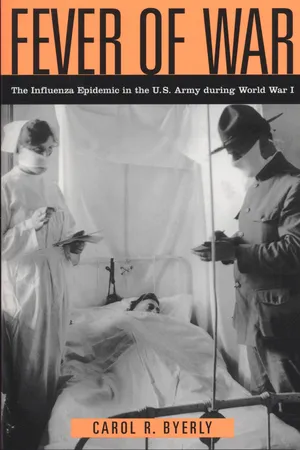
The influenza epidemic of 1918 killed more people in one year than the Great War killed in four, sickening at least one quarter of the world's population. In Fever of War, Carol R. Byerly uncovers the startling impact of the 1918 influenza epidemic on the American army, its medical officers, and their profession, a story which has long been silenced. Through medical officers' memoirs and diaries, official reports, scientific articles, and other original sources, Byerly tells a grave tale about the limits of modern medicine and warfare.
The tragedy begins with overly confident medical officers who, armed with new knowledge and technologies of modern medicine, had an inflated sense of their ability to control disease. The conditions of trench warfare on the Western Front soon outflanked medical knowledge by creating an environment where the influenza virus could mutate to a lethal strain. This new flu virus soon left medical officers’ confidence in tatters as thousands of soldiers and trainees died under their care. They also were unable to convince the War Department to reduce the crowding of troops aboard ships and in barracks which were providing ideal environments for the epidemic to thrive. After the war, and given their helplessness to control influenza, many medical officers and military leaders began to downplay the epidemic as a significant event for the U. S. army, in effect erasing this dramatic story from the American historical memory.
- 251 pages
- English
- ePUB (mobile friendly)
- Available on iOS & Android
eBook - ePub
About this book
Information
1
Medical Heroes
Medical Officers’ Confidence as They Prepare for War
The health of the Army both at home and overseas has been excellent and [sick rates] lower probably than in any similar body of troops in the history of warfare.—Surgeon General William C. Gorgas
“I Haven’t the Least Doubt”
In April 1918, Army Surgeon General William Crawford Gorgas received a letter from Major General Hugh Scott, commander of the Seventy-eighth Division at Camp Dix in New Jersey, who was worried about disease in his camp. “I feel perturbed over the pneumonia and scarlet fever situation. … No one here seems to be able to give me a cause sufficient for the effects I see—the camp is as clean as a hound’s tooth.” He described the sanitation measures he had ordered in the camp and asked Gorgas to “come over to give us the once over and I will feel that I have done the best possible.” He closed his letter saying, “Until the best has been done I will feel uneasy.”1 Gorgas responded quickly, acknowledging the problem of pneumonia and taking the opportunity to recall a recent victory against disease. “It is now just like yellow fever before we used mosquito precautions,” he wrote, “we know perfectly well that we can control pneumonia absolutely if we could avoid crowding the men, but it is not practicable in military life to avoid this crowding.” He assured Scott, however, “I haven’t the least doubt that if you, tomorrow, could give every man in Camp Dix his own individual hut, that pneumonia would ease at once.” This, he explained, is what they did to successfully fight pneumonia among workers during construction of the Panama Canal. The surgeon general promised that he would visit Scott’s camp soon and said that “we have a number of the best scientists in the United States studying this question of transmission of pneumonia and may be [sic] we will be as successful with pneumonia in this as we were with yellow fever and malaria in the Spanish-American War.”2
This exchange between a worried general and a confident medical officer shows how medicine’s past victories shaped the Army Medical Department’s response to infectious disease during World War I. Army medical officers were elites among elites: officers among men, physicians among laymen, whites in a polyglot world, men in a gendered hierarchy, and professionals who believed they could wield the tools of modern science and technology to save lives and defeat disease. Gorgas felt proud and optimistic about the power of scientific medicine to fight disease and save lives. Although military mobilization created fertile ground for epidemics in army camps, Gorgas had “not the least doubt” that they could “control pneumonia absolutely given the right circumstances.”3 His confidence in his profession’s ability to control pneumonia in an era before antibiotics stemmed from advances in medical science that had generated powerful new vaccines and laboratory diagnostic techniques. These tools facilitated the early detection of disease in individuals, more effective treatment for some illnesses, and the prevention of others. The surgeon general’s response to Scott also shows that like many generals, Gorgas looked to past wars to prepare for World War I. He drew upon his successes in vanquishing yellow fever and malaria in Cuba after the Spanish-American War and in the Isthmus of Panama during the American construction of the canal there. Gorgas received international acclaim for those achievements, and his profession enjoyed reflected glory as the United States gained influence in the hemisphere.
Gorgas’s optimism about the ability of scientific medicine to control disease also reflected medical officers’ sense of pride as members of a modern industrial nation that was stepping onto the world stage. With new scientific tools to fight disease, the medical profession took steps to consolidate its authority and power in society, and medical officers likewise sought to reinforce their status within medical and military professions.4 As war approached, they defined themselves in relation to other social groups by recruiting the elites among white, male physicians in the country and excluding women and African Americans from their ranks. They also assisted the War Department in screening American soldiers to ensure that only the strongest, healthiest men would become soldiers.
This process, however, would also set the stage for tragedy. Gorgas and his colleagues’ past medical and military experience and painstaking screenings did not adequately prepare them or any other army personnel for modern industrial warfare and a daunting array of infectious diseases. The tropical diseases Gorgas confronted in Cuba and Panama would not menace the armies of World War I. Americans served not in tropical jungles, but in hastily constructed training camps and in cold and muddy trenches on the Western Front. The diseases that preyed most upon these soldiers were not transmitted by visible vectors such as mosquitoes carrying yellow fever and malaria or water contaminated with typhoid and dysentery. Instead, respiratory diseases such as measles and influenza attacked the army stealthily, borne on the air people breathed. These germs had no respect for social class or hygienic behavior, and most sanitary measures were powerless to stop them. Airborne respiratory diseases—first the measles, and then, lethally, influenza—would confound General Gorgas and thousands of medical officers and become their worst nightmare.
General Gorgas
William C. Gorgas (fig. 1) was already a national hero when Woodrow Wilson appointed him army surgeon general on 6 April 1914. In 1903, Congress had recognized him with a special promotion for his work in Cuba, in 1907 President Theodore Roosevelt praised him publicly and appointed him to the Isthmian Canal Commission, and the following year the American Medical Association (AMA) elected him president. Several universities, including the University of Pennsylvania, Harvard, Brown, Johns Hopkins, and his alma mater, the University of the South in Sewanee, Tennessee, awarded Gorgas honorary degrees.5 The British government in South Africa called on Gorgas for advice on the control of pneumonia in the Rand mining district, and the Rockefeller Foundation consulted him on yellow fever in Latin America. He achieved further international recognition in 1914 when Oxford University awarded him an honorary degree of Doctor of Science. When Wilson named him surgeon general, he was at the top of his profession. Congress ratified his prestige with the unprecedented step of promoting him to major general in March 1915.6

Fig. 1. William C. Gorgas, Surgeon General of the Army, April 1914 to October 1918. (National Library of Medicine, B 13205)
While Gorgas’s reputation was due to his record as a physician and sanitarian, his first love was the army. In fact, he became a physician so he could be a soldier.7 A Southerner, William Crawford Gorgas was born in Mobile, Alabama, in 1854. His mother was the daughter of the former governor and his father was a West Point graduate who served the Confederacy as a general in the Civil War. During the war, young Gorgas and his family lived in the Confederate capital of Richmond, Virginia, and afterwards, Gorgas pursued his father’s career by applying to West Point. When West Point refused him admission, he enrolled instead in the University of the South and then continued to medical school, graduating from Bellevue Medical College in New York City in 1879.
In 1880 Gorgas joined the Army Medical Corps and finally succeeded in becoming an army officer. As a medical officer on frontier outposts throughout the West, he encountered the disease that would shape his life: yellow fever. Medical scientists did not know what caused yellow fever, but they did know that it killed 20 to 70 percent of its victims. This terrifying disease, however, was also the source of positive events in his life. Gorgas’s parents met when his mother fled to an army arsenal during a yellow fever epidemic in Mobile, Alabama.8 Gorgas too encountered his future wife during a yellow fever epidemic, in 1882 at Fort Brown on the Texas-Mexican border. Marie Gorgas opens her biography of her husband by describing how he cared for her when she was sick with fever. He soon fell ill too, and as they convalesced they fell in love—and, by surviving, together acquired permanent immunity to yellow fever.9 With this immunity, Gorgas and his wife began a lifelong association with the army and yellow fever, traveling the world to combat the disease.
Gorgas’s professional breakthrough came during the Spanish-American War when the army sent him to Cuba in 1898 to run a yellow fever camp at Siboney. His patients included medical officer Victor C. Vaughan, later dean of the University of Michigan School of Medicine and president of the American Medical Association (AMA), who credited Gorgas with saving his life.10 After the war, Gorgas joined the army medical team assigned to clean up Cuba for the American occupation of the island. Yellow fever, however, was such a serious problem that the War Department appointed a board headed by Major Walter Reed to investigate the cause of the disease. After a series of dramatic and well-known experiments, in which volunteers exposed themselves to the bites of mosquitoes carrying yellow fever and thereby contracted the disease, Reed and the yellow fever board determined that the mosquito Aedes aegypti was the vector for yellow fever, carrying the disease pathogen from person to person. With this knowledge, Gorgas, as chief sanitary officer of Havana, launched a vigorous, effective sanitary campaign to rid Havana of mosquitoes, and in the following years yellow fever cases fell from well over one thousand in 1900 to none in 1902.11 Reed and Gorgas’s success brought them fame and enhanced the Army Medical Department’s prestige.
The army surgeon general appointed Gorgas chief sanitary officer of the Panama Canal in 1904 with the mission to control the diseases that had driven the French from the project in the 1880s.12 Gorgas again enjoyed dramatic and indisputable success: in eighteen months, yellow fever disappeared from the Canal Zone. The last case was reported in May 1906.13 The site became so safe that Teddy Roosevelt traveled to Panama in November, returning home with high praise for Gorgas and other officials in Panama. In a special address to Congress, Roosevelt equated them with military heroes, “entitled to the same credit that we would give to the picked men of a victorious army.” The conquest of yellow fever would “stand as among the very greatest conquests, whether of peace or of war, which have ever been won by any of the peoples of mankind.”14 By eliminating mosquitoes from the environment, medical officers could banish or control the diseases they carried. Medical officer Reynold Webb Wilcox also lauded the Panama Canal achievement, telling the graduating class of the Army Medical School in 1915: “The sanitation of the Canal Zone, which made this feat possible, is an imperishable tribute to the Medical Corps of our Army.”15
Roosevelt, Gorgas, and their contemporaries believed that new scientific knowledge and technologies enabled American and European powers to extend their control and influence beyond their borders. Historians have shown how medicine facilitated imperialism and vice versa. Eric Hobsbawm, for example, argues that imperialism promoted the study of bacteriology and immunology because it provided incentives for white men to conquer the tropical diseases that they saw as inhibiting their occupation of colonial areas.16 Tropical medicine historian Warwick Anderson agrees, describing how physicians sought to resolve the problem of deadly fevers in colonies by controlling disease rather than requiring white colonists to adjust to their new environments.17 Gorgas’s victory over yellow fever therefore seemed to demonstrate that modern science could make the tropics the province of European civilization.
Gorgas explicitly linked scientific progress with racial superiority and imperialism in his book, Sanitation in Panama. Claiming to have saved 70,000 lives, preserved the health of three times as many people, and saved $80 million in hospital costs, he compared the achievement to the discovery of the Americas.18 And in his 1909 presidential address to the AMA, “The Conquest of the Tropics for the White Race,” he described the control of yellow fever and malaria in tropical regions in racial supremacist and imperialist terms. “Advances in tropical sanitation in the last fifteen years,” Gorgas explained, “have shown that the white man can live in the tropics and enjoy as good health as he would have if living in the temperate zone.” The consequences of disease control were vast: “I dare to predict that after the lapse of a period, let us say, equal to that which now separates the year 1909 from the Norman conquest of England, localities in the tropics will be the centers of as powerful and as cultured a white civilization as any that will then exist in the temperate zones.”19 It might take centuries, but scientific medicine would enable “white civilization” to dominate the earth.
Scientific Medicine and Professionalization
That William Gorgas’s career paralleled the emergence of modern medicine helps to explain the overweening confidence that he and other members of the medical profession had on the eve of the war. The medical profession and the Army Medical Department rode the crest of scientific and technological advances that reduced infant mortality and deaths from infectious diseases, and increased life expectancy. Sanitation measures such as municipal sewer systems and sand filtration of water drove cholera, dysentery and typhoid from the cities, and milk pasteurization reduced infant mortality and tuberculosis rates. Other diseases began to succumb to new medical practi...
Table of contents
- Cover Page
- Title Page
- Copyright Page
- Dedication
- Contents
- List of Figures
- List of Abbreviations
- Acknowledgments
- Prologue
- Introduction
- 1 Medical Heroes: Medical Officers’ Confidence as They Prepare for War
- 2 Building a Healthy Army: Government Control and Accountability
- 3 Worst-Case Scenario: The Influenza Epidemic of 1918 in the Camps
- 4 Fighting Germs and Germans: Influenza in the American Expeditionary Forces
- 5 Postmortem: The Trauma of Failure, 1918–1919
- 6 “Except for the Flu…”: Writing the History of the Epidemic
- Conclusion: Memory and the Politics of Disease and War
- Notes
- Select Bibliography
- Index
- About the Author
Trusted by 375,005 students
Access to over 1.5 million titles for a fair monthly price.
Study more efficiently using our study tools.
Frequently asked questions
Yes, you can cancel anytime from the Subscription tab in your account settings on the Perlego website. Your subscription will stay active until the end of your current billing period. Learn how to cancel your subscription
No, books cannot be downloaded as external files, such as PDFs, for use outside of Perlego. However, you can download books within the Perlego app for offline reading on mobile or tablet. Learn how to download books offline
Perlego offers two plans: Essential and Complete
- Essential is ideal for learners and professionals who enjoy exploring a wide range of subjects. Access the Essential Library with 800,000+ trusted titles and best-sellers across business, personal growth, and the humanities. Includes unlimited reading time and Standard Read Aloud voice.
- Complete: Perfect for advanced learners and researchers needing full, unrestricted access. Unlock 1.5M+ books across hundreds of subjects, including academic and specialized titles. The Complete Plan also includes advanced features like Premium Read Aloud and Research Assistant.
We are an online textbook subscription service, where you can get access to an entire online library for less than the price of a single book per month. With over 1.5 million books across 990+ topics, we’ve got you covered! Learn about our mission
Look out for the read-aloud symbol on your next book to see if you can listen to it. The read-aloud tool reads text aloud for you, highlighting the text as it is being read. You can pause it, speed it up and slow it down. Learn more about Read Aloud
Yes! You can use the Perlego app on both iOS and Android devices to read anytime, anywhere — even offline. Perfect for commutes or when you’re on the go.
Please note we cannot support devices running on iOS 13 and Android 7 or earlier. Learn more about using the app
Please note we cannot support devices running on iOS 13 and Android 7 or earlier. Learn more about using the app
Yes, you can access Fever of War by Carol R Byerly in PDF and/or ePUB format, as well as other popular books in History & North American History. We have over 1.5 million books available in our catalogue for you to explore.