A fascinating study of freedom and slavery, told through the life of an escaped slave who built a life in the Hudson Valley
In 1793 James F. Brown was born a slave, and in 1868 he died a free man. At age 34 he ran away from his native Maryland to pass the remainder of his life as a gardener to a wealthy family in the Hudson Valley. Two years after his escape and manumission, he began a diary which he kept until his death. In Freedom's Gardener, Myra B. Young Armstead uses the apparently small and domestic details of Brown's diaries to construct a bigger story about the transition from slavery to freedom.
In this first detailed historical study of Brown's diaries, Armstead utilizes Brown's life to illuminate the concept of freedom as it developed in the United States in the early national and antebellum years. That Brown, an African American and former slave, serves as such a case study underscores the potential of American citizenship during his lifetime.
eBook - ePub
Freedom’s Gardener
James F. Brown, Horticulture, and the Hudson Valley in Antebellum America
- 219 pages
- English
- ePUB (mobile friendly)
- Available on iOS & Android
eBook - ePub
Freedom’s Gardener
James F. Brown, Horticulture, and the Hudson Valley in Antebellum America
About this book
Information
PART I
Life as a Slave
Who was James F. Brown, the bondsman? And what precisely did freedom from slavery mean to him? It is a game of shadows, following the outlines of the life of James Brown during his years as a slave. He appears and disappears through the light of this or that written fragment from his time, but always in murky form. His figure is blurry, sometimes only chimerical before the viewer, and then vanishes from sight. This is not entirely surprising. After all, the details of the lives of most slaves as individuals are elusive. James and Julia Brown were the settled identities of a married couple, former slaves, whose passage to freedom included the use of family names, names bestowed by owners, names assumed as aliases in order to avoid detection, married names, and/or names selected to mark the attainment of freedom. There is a strong possibility that James F. Brown, Anthony Chase, and Anthony Fisher were one and the same man. It is also even more likely that Julia Williams, Julia Chase, and Julia Brown were the same woman. James picked up, shed, and changed names as part of his quest for full manhood in early-nineteenth-century terms, with Julia alongside as his chosen mate in life. Dotted in places, the line documenting the connection between James and his two aliases—one definite, the other likely, but tenuous—is not always continuous and it does not always appear in sharp relief. Consider the following events.
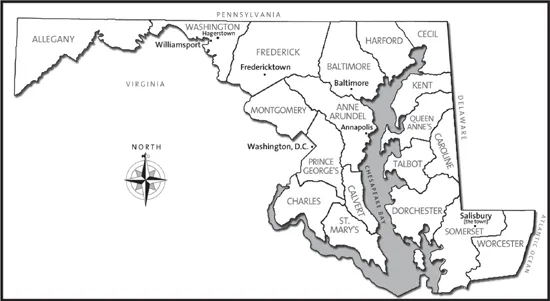
Map 1. Maryland
1
What Can a Man Do?
The life of James F. Brown, the slave, begins with questions about his birth date. A late-nineteenth-century newspaper profile of him put his year of birth at 1783, but James was probably born ten years later than that, as the Mount Gulian Historic Site’s Web site claims. The 1850 federal census lists him as being fifty years old, thus making 1800 his year of birth. And if he was sixty-seven in 1860 as indicated by the federal census in that year, then he was born in 1793. As for a birthday, the diary itself consistently fixes it on October 1. So the best, cumulative conclusion is that James F. Brown was born on October 1, 1793. 1
James was born in Maryland. The Mount Gulian Web site pinpoints Fredericktown (present-day Frederick) as the city of his birth, but there is no ironclad verification of this. Several diary entries indicate that he had correspondents there, but they are untraceable and/or mostly unnamed. In January 1829, he “received a letter from Louis Carroll of Frederick town, Md.” The fact that there is no federal census evidence of such a person living in Frederick County under any spelling of that name in either 1820 or 1830 is a good indication that Louis Carroll was black, because census notation of free blacks was notoriously iffy and not individualized for slaves. Early in the holiday season of 1832, James “wrote to Fredericktown.” At the start of 1833, James also “received a letter from Fredericktown Md”; early in 1846, he again recorded that he “received a letter from Frederick Town, Maryland” and this time that he “wrote a letter to Frederick Town, Maryland.”2 In addition, the diary mentions someone born there who may have been a close relative of Brown’s: In the family history section of his diary, Brown recorded that “John Robert Brown was born on the [illegible] day of June 1799 and was baptized on the 23rd day of June by the Rev Shaffer of Frederick town and died the 4th day of Feb. 1824 ages 5 years, 7 months and 10 days.” Indeed, a Reverend David Frederick Schaeffer simultaneously served Evangelical Lutheran Church in Fredericktown and a Bethel Church in Frederick County early in the nineteenth century. However, Reverend Schaeffer’s pastorate of the two congregations began in 1808—nine years too late for him to have baptized John Robert.3 Still, the careful record of John Robert Brown’s short life in the diary section where James safeguarded some of the most important events of his life—his marriage, his manumission of Julia—and the closeness of John’s year of birth to James’s own hint that John Robert was perhaps James’s younger brother. Yet James curiously reported an age-at-death for John Robert that suggests the latter may have been a son James fathered when he was twenty-six years old. If John Robert was James’s younger brother by nearly six years, then James would have been thirty years old when John Robert died in 1824, so that the “5 years” James assigned to John at death might have been a simple writing error.
In fact, James may have been the eldest of several siblings who lived to adulthood. He mentions a sister, Comfort Dennis, in several places in the diary; she was born about 1795. Then there was another probable sister, Esther, married to Levin Huston of Salisbury, Maryland. Esther was born in 1797. James also had a brother William Brown, whose age cannot be ascertained from existing sources. Another possible brother was Samuel Brown, who was born in 1803. 4
James was born of “negro parents,” according to a late-nineteenth-century newspaper biographical sketch of him. This would seem to be true. There is no description of his being light-skinned or being able to pass for white. He is described as “colored” in the 1840 federal census and as a “mulatto” in the 1850 federal census, as was his sister, Comfort, in the 1880 census. But in 1860 the enumeration listed James as “black.”5 Colored, mulatto, black—these were notoriously subjective categories used inconsistently by census takers with highly individualized understandings of the spectrum of African American skin tones throughout the nineteenth century. Materials are silent about James’s mother and who she was exactly. We know nothing about when she was born and died, where she lived, her owner(s), if any, and her racial or ethnic background. James’s father, however, was a man named Robert Chase who died in Maryland, possibly in Baltimore, on July 22, 1838. Robert Chase was a “free Negro” who leased a small three-acre plot of land in Somerset County, Maryland, called “Little Belane” for twenty-four years after securing the rental rights to farm it in 1814. Before his death, Robert had lived for a time in Salisbury, Maryland—probably with Esther and Levin Huston at Poplar Hill Mansion, because that is where James sent his father letters and money. Levin was his brother-in-law, but just how is unclear because Esther’s maiden name was Polk.6
As a slave, James would have received his last name from his owner. Throughout the English-speaking Atlantic world, once slavery was firmly established in a region, in most cases it was slavemasters and not the slaves themselves who came up with slave names.7 Even when slaves retained African names, owners or overseers often assigned them an additional familiar English name as well, and this generally consisted only of a forename, for example Mary, Dinah, Harry, or George. In this way, whites asserted their authority over their human property and a racialized distinction between “negroes”—a category of being requiring no more than one name—and themselves, people known by a first name, generally one or more middle names, and a last or family name. In those cases in which African Americans went by first and last names, they were free or else were situated as slaves within a relatively fluid regional slave system, one in which the hierarchy of power dividing whites and blacks was not so rigid.8 Certainly, this was the case in Frederick County during James’s childhood and youth.
Frederick County, Maryland, was founded in 1748, less than half a century before James Brown was born. It was located in northern Maryland, a region distinct from that of southern Maryland. There were in fact two separate Marylands that took shape between 1790 and 1850. For one thing, the northern part of Maryland, which included Fredericktown and Baltimore, had a more diverse population than did the southern part. There were more European immigrants in northern Maryland than in southern Maryland. The evidence for this in Fredericktown was the existence of four German congregations in the eighteenth century when James was born there—a German Reformed church, a Lutheran church, a Moravian church, and a Church of the Brethren. In fact, Fredericktown had been settled by a group of German immigrants some time after 1745. Many Germans (Pennsylvania Dutch) moved to Fredericktown as part of their migration southward and westward through the Great Valley that included the Shenandoah Valley into the western piedmont of North Carolina during the late eighteenth century when James was born. Southern Maryland did not experience a similar immigrant influx. There, the demographic divide was chiefly between British-descended whites and African-descended blacks.9
The relatively higher degree of ethnic, racial, and cultural heterogeneity in northern Maryland, and particularly in Frederick County, contributed to a somewhat more liberal culture than that in the southern half of the state. For instance, there was relatively little divisive sectarianism among Christians in Frederick County during the late eighteenth century. Until the 1750s when the Moravians built their own church, people of Anglican, Reformed, Lutheran, and Moravian persuasion all worshiped together. Then during the Revolutionary War era, Anglican Church growth was stunted mainly by animosity toward Loyalists and their flight; in fact, the county’s Episcopalians had no rector from 1776 to 1786. From 1785 to 1813, they met only monthly: every fourth Sunday in the neighboring county at a church in Hagerstown.10
The shaky standing of the Anglican church in Frederick County during James Brown’s formative years meant that if he was indeed living there then, he was likely to have been taught basic literacy skills through one of the German churches while a child or adolescent. While a 1760 Maryland statute blocked Christian baptism as a path to emancipation for slaves, the opportunity to learn to read and write remained at least as one way in which Christian religion offered a better life on earth for them.11 Lutheranism in the early republic was concerned with promoting Christian education, Protestant unity, and Christian benevolence in the service of national greatness. All of this conceivably had a positive impact on slaves within the geographical reach of Lutheran congregations. The afore-mentioned Reverend David Frederick Schaeffer, a father of the General Synod of the Lutheran Church in America, pastor in Fredericktown from 1808 to 1837, and also the minister who may have baptized one of James’s likely brothers, participated in the burgeoning Sunday School movement, which taught children to read and write through Bible instruction. Reverend Schaeffer also believed in cross-denominational fellowship and African American uplift through colonization; he was an officer in the Fredericktown auxiliary of the American Colonization Society, which equated black welfare with the resettlement of freed African Americans in Liberia. James and other interested slaves would have been readily accommodated in their desire for literacy by such a man.12
Although slavery was legally recognized and practiced throughout Maryland prior to the Civil War, the institution was more pervasive in the southern part of the state than in the northern counties. Moreover, even as Maryland emerged during this period as an exporter of slaves to points farther south, the trend in the state as a whole was toward the freedom of blacks held in bondage for economic reasons. Northern Maryland, and the Frederick-town area more specifically, boasted a more diversified economy in relation to southern Maryland. In the northern part of the state, farmers grew mainly cereal crops, and slaves were a smaller part of the society. So as a young man, James probably was not engaged in the tobacco–slave plantation economy normally associated with the Chesapeake region. Fredericktown was an important market town for its area, Frederick County, which was on its way by 1830 to becoming a mining center for such resources as coal, iron, limestone, copper, marble, and gold.13 In 1810, besides farms, Frederick County boasted 2 gun powder mills, 2 glass works, 3 carriage manufacturers, 4 paper mills, 5 flaxseed oil mills, 4 breweries, 7 tanneries, 102 shoe/boot/slipper manufacturers, 20 saddlers, 20 stills, 1 still manufacturer, 5 clock and watch makers, 2 furnaces, 3 forges, and 36 hatteries.14 In contrast, southern Maryland was devoted almost exclusively to agriculture and depended heavily on tobacco cultivation as the backbone of its economy, even though tobacco was a steadily unprofitable crop because of soil overuse and erosion. Some farmers in the area engaged in wheat production, but tobacco was the mainstay in southern Maryland in the late eighteenth and early nineteenth centuries.15
Figures on the proportion that slaves represented in the two sections of Maryland reflect the differences in their economies. In 1790, around the time James Brown may have been born, slaves were 14.9 percent of the population in northern Maryland (including the counties of Allegany, Baltimore, Carroll, Harford, Washington, and Frederick) and had decreased to 4.8 percent by 1850. On the other hand, in southern Maryland (including the counties called Anne Arundel, Calvert, Charles, Prince George’s, Montgomery, and St. Mary’s), 45.6 percent or just under half of the population total consisted of slaves. In 1850, slaves made up 43.7 percent of the population of this area.16
Statistics on free blacks also underscore the difference between northern and southern Maryland in the antebellum years. While in southern Maryland free blacks increased over time as a percentage of the total population from 2 percent in 1790 to 10.2 percent in 1850, their increase was slightly steeper in northern Maryland, where James may have spent his youth. There, the percentage of free blacks in the whole population increased from 1.9 percent of the population to 11.2 of the total. More strikingly, in Frederick County specifically, the proportion of free blacks crept up slowly from 12.5 percent of the population around the time of James’s birth to 18.7 percent by 1850. 17
The ratio between slaves and free blacks changed dramatically, but differently, over six decades in northern Maryland as opposed to southern Maryland. In the northern part of the state, in 1790 the ratio of slaves to free blacks was 7.9 to 1, but by 1850 it had dropped to 0.4 to 1. By 1850, free blacks were more than twice as numerous in northern Maryland as the slave population there. In southern Maryland, in 1790, the ratio of slaves to free blacks was 22.7 to 1 and dropped to only 4.3 to 1 by 1850. In other words, in 1850, slaves still outnumbered free blacks in southern Maryland by more than four times. James then presumably grew up in a region where he could observe the number of black bondsmen shrinking all around him as the number of free African Americans expanded absolutely and proportionately. Focusing more narrowly on Frederick County, the ratio of slaves to free blacks declined steadily during the decades of James’s youthful maturation. In 1790, it was 17.1 to 1; in 1800, 9.7 to 1; in 1810, 4.7 to 1; and by 1820, just 3.8 to 1. 18
Imagine the effect of such population shifts on everyday life: Race relations loosened, and slaves gained a sense of widening possibility for themselves in such an atmosphere. Given the sometimes historically inverse relationship between laws and reality, the consequences of these demographics may be reflected in the fact that Fredericktown imposed a new nighttime curfew of 10 o’clock on its slave population in 1817. The law was intended “to restrain the slaves from wandering around the town at night” by providing for the arrest and jailing of violators. In other words, the strictness of the statute ironically revealed both the lax hold many owners had on their slaves and the desire of some of them and other whites to hold the line on black–white/slave–free distinctions more tightly, as the free black population rose in number, proportion, visibility, and influence.19
So if James Brown lived as a child slave in Fredericktown or Frederick County, who was his master or mistress? There are no slaveowning Browns among the sixteen household heads with that last name listed for those places in 1790, just before his birth. In 1800, just after James’s birth, only one of the twenty-three household heads in all of Frederick County with the last name Brown was a slaveowner, and that was Stophel Brown, who had one slave. It is unlikely that this was James. Because he would have been only seven years old at the time, too young for serious farm work, at least his slave mother should have been present for him in Stophel’...
Table of contents
- Cover Page
- Title Page
- Copyright Page
- Dedication
- Contents
- Acknowledgments
- Introduction
- Part I. Life as a Slave
- Part II. Free Man and Free Laborer
- Part III. Free Man and Citizen
- Conclusion
- Notes
- Index
- About the Author
Trusted by 375,005 students
Access to over 1.5 million titles for a fair monthly price.
Study more efficiently using our study tools.
Frequently asked questions
Yes, you can cancel anytime from the Subscription tab in your account settings on the Perlego website. Your subscription will stay active until the end of your current billing period. Learn how to cancel your subscription
No, books cannot be downloaded as external files, such as PDFs, for use outside of Perlego. However, you can download books within the Perlego app for offline reading on mobile or tablet. Learn how to download books offline
Perlego offers two plans: Essential and Complete
- Essential is ideal for learners and professionals who enjoy exploring a wide range of subjects. Access the Essential Library with 800,000+ trusted titles and best-sellers across business, personal growth, and the humanities. Includes unlimited reading time and Standard Read Aloud voice.
- Complete: Perfect for advanced learners and researchers needing full, unrestricted access. Unlock 1.5M+ books across hundreds of subjects, including academic and specialized titles. The Complete Plan also includes advanced features like Premium Read Aloud and Research Assistant.
We are an online textbook subscription service, where you can get access to an entire online library for less than the price of a single book per month. With over 1.5 million books across 990+ topics, we’ve got you covered! Learn about our mission
Look out for the read-aloud symbol on your next book to see if you can listen to it. The read-aloud tool reads text aloud for you, highlighting the text as it is being read. You can pause it, speed it up and slow it down. Learn more about Read Aloud
Yes! You can use the Perlego app on both iOS and Android devices to read anytime, anywhere — even offline. Perfect for commutes or when you’re on the go.
Please note we cannot support devices running on iOS 13 and Android 7 or earlier. Learn more about using the app
Please note we cannot support devices running on iOS 13 and Android 7 or earlier. Learn more about using the app
Yes, you can access Freedom’s Gardener by Myra B. Young Armstead in PDF and/or ePUB format, as well as other popular books in History & North American History. We have over 1.5 million books available in our catalogue for you to explore.