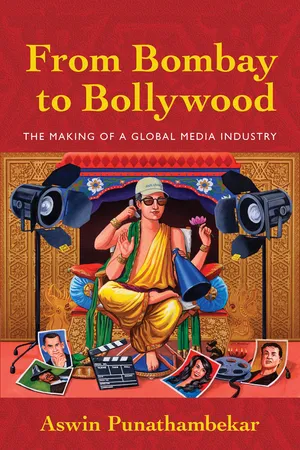
From Bombay to Bollywood analyzes the transformation of the national film industry in Bombay into a transnational and multi-media cultural enterprise, which has come to be known as Bollywood. Combining ethnographic, institutional, and textual analyses, Aswin Punathambekar explores how relations between state institutions, the Indian diaspora, circuits of capital, and new media technologies and industries have reconfigured the Bombay-based industry’s geographic reach. Providing in-depth accounts of the workings of media companies and media professionals, Punathambekar has produced a timely analysis of how a media industry in the postcolonial world has come to claim the global as its scale of operations.
Based on extensive field research in India and the U.S., this book offers empirically-rich and theoretically-informed analyses of how the imaginations and practices of industry professionals give shape to the media worlds we inhabit and engage with. Moving beyond a focus on a single medium, Punathambekar develops a comparative and integrated approach that examines four different but interrelated media industries--film, television, marketing, and digital media. Offering a path-breaking account of media convergence in a non-Western context, Punathambekar’s transnational approach to understanding the formation of Bollywood is an innovative intervention into current debates on media industries, production cultures, and cultural globalization.
- 272 pages
- English
- ePUB (mobile friendly)
- Available on iOS & Android
eBook - ePub
About this book
Information
1
Bollywood Is Useful
Media Industries and the State in an Era of Reform
Held in the “grand ballroom” of the five-star Renaissance Hotel in suburban Bombay, the inauguration of the FICCI-FRAMES 2009 convention was a lavish affair that opened with Amit Mitra, the Secretary-General of FICCI, inviting the Minister of State for Information & Broadcasting and External Affairs, Anand Sharma, on to the stage to light a lamp—a widely practiced ritual to begin an event on an auspicious note. As the ritual came to a close, Mitra invited five others to join the minister on the stage: Sushma Singh, Secretary, Ministry of Information & Broadcasting; Yash Chopra, legendary film producer and director, head of the powerful family-owned studio Yash Raj Films, and chairman of the FICCI Entertainment Committee; Kunal Dasgupta, CEO of Sony Entertainment Network and co-chairman of the FICCI Entertainment Committee; Amit Khanna, Chairman of Reliance Entertainment and chair of the FICCI Convergence Committee; and Donald White-side, Vice President and Director of Global Public Policy, Intel Corporation. And as I mentioned in the previous chapter, a few minutes into his address, Yash Chopra proceeded to invite Karan Johar, another influential producer-director in Bollywood, to join him on stage.
The prominence granted to Anand Sharma and Sushma Singh from the Ministry of Information & Broadcasting was not surprising given the remarkable shifts in state policy toward the media industries in general and the Bombay-based Hindi film industry in particular. Yash Chopra and Karan Johar’s presence seemed appropriate as well. After all, their films—Dilwale Dulhania Le Jayenge (The Big-Hearted Will Take the Bride, Aditya Chopra, 1995) and Kabhi Khushi Kabhie Gham (Happiness and Sorrow, Karan Johar, 2001)—had played such a crucial role in reimagining relations between India and the diaspora as well as establishing the overseas territory as a lucrative market for Bollywood. Further, the importance accorded to these two personalities also spoke to the influence that family businesses and kinship-based networks of media production and circulation wielded in Bollywood.
In sharp contrast to the exception that Chopra and Johar seemed to personify was Amit Khanna. A media entrepreneur with over two decades’ experience in the film and television industries in Bombay, Khanna is currently chairman of Reliance Entertainment, a media conglomerate that is shaping Bollywood’s transnational imprint in important ways. Khanna has also served as the chairman of the Convergence Committee within FICCI, a group that focuses on emerging media technologies and platforms. Seated beside Khanna was Donald Whiteside, an executive from Intel Corporation who was leading a U.S. delegation to the convention on behalf of the US India Business Council (USIBC). Finally, bringing these industry and government figures together was Amit Mitra from FICCI. Established in 1927, FICCI is a colonial-era institution that represents the interests of Indian businesses across a range of sectors. Since the mid-1990s FICCI has played a crucial role in mediating ties between the Indian government and the media industries and, most importantly, in assembling a Media and Entertainment sector with Bollywood at the center. Taken together, the people assembled on stage at the inauguration of the tenth anniversary of the FICCI-FRAMES convention represented the different sites and interests that had played pivotal roles in the production of Bollywood as a global media industry.
This chapter traces how these various relations between the state, the media industries, and institutions such as FICCI and the Confederation of Indian Industry (CII) were forged, and situates them within a broader set of sociocultural and political transformations that set the stage for the reconfiguration of the Bombay film industry as Bollywood. Building on George Yudice’s observation that “there is an expedient relation between globalization and culture in the sense that there is a fit or a suitability between them,” this chapter elaborates how the fit between globalization and the cultural industries was worked out in the Indian context and specifically, posed as a problem of cleaning up and corporatizing the Bombay film industry.1 I begin with an analysis of links between the nation-state and the diaspora, redefinitions of citizenship, and Bombay cinema’s mediation of these shifts to show that the state’s efforts to manage the cultural industries is part of a larger process of managing a wide-ranging set of spatial crises engendered by processes of economic liberalization and globalization. As Leela Fernandes and others have shown, economic reforms enacted by the Indian state during the early 1990s resulted in a profoundly uneven restructuring of urban space, a process that was oriented primarily toward the needs and desires of a new and highly visible middle class.2 Focusing on Bombay, Fernandes also argues that a politics of “spatial purification” and a range of movements to “cleanse spaces of the poor and working classes” accompanied new claims on urban space.3 Building on these insights, I show how changes in state policies toward the media and entertainment industries and indeed, the very idea of creating and defining Bollywood as a global media industry, was shaped by a broader political discourse of cleaning and cleansing (safai) that played out at urban, national, and diasporic scales throughout the 1990s and 2000s.
Reforming the National Family
In an essay titled “The Diaspora in Indian Culture,” Amitav Ghosh writes of an “epic relationship” between India and the diaspora to emphasize the “tremendously historical and imaginative nature of diasporic belonging.”4 To speak of the “Indian diaspora,” then, is to take into account indentured laborers who left India to work as coolies on sugar plantations in countries such as Fiji and Guyana during the colonial era, immigrants in oil-rich Gulf nations, the more recent wave of high-tech migrants to locales such as the Silicon Valley in the United States, and so on.5 However, despite what is a long history of travel and migration, it is only since the late 1980s that expatriate Indians have begun attracting attention. In fact, for nearly four decades after independence, the Non-Resident Indian (NRI) was inscribed in the Indian imagination as someone who had betrayed the nation to seek better fortunes elsewhere. Positioned squarely within a narrative of brain drain, the NRI was, until recently, “not really Indian.” As Sinha-Kerkhoff and Bal point out, unlike Gandhi, who had seen overseas Indians as integral to anticolonial struggles, Nehru believed that “expatriate Indians had forfeited their Indian citizenship and identity by moving abroad and did not need the support of their mother country.”6 In the Nehruvian imagination, the “national family” was territorially bound. This was reflected very directly in official policy as well, as the following quote makes clear:
It is the consistent policy of the government that persons of Indian origin who have taken foreign nationality should identify themselves with and integrate in the mainstream of social and political life of the country of their domicile. The government naturally remains alive to their interests and general welfare and encourages cultural contacts with them. As far as Indian citizens residing abroad are concerned, they are the responsibility of the government of India.7
It is important to note that there was considerable opposition to Nehru’s views. Right-wing groups such as the Vishwa Hindu Parishad (Global Hindu Council), which was formed during the 1960s with the goal of organizing Hindus on a global scale, characterized Nehru’s policies toward expatriate Indians as “confused, erratic and apathetic.”8 As early as 1977, when the Janata Party held power in New Delhi for a brief period of two years, Atal Bihari Vajpayee, who was the Minister of External Affairs at the time, declared: “India would never disown overseas Indians, or fail to appreciate their loyalty to the motherland.”9 The ruling Janata Party attempted to reframe India’s relationship with the diaspora through a number of formal and informal initiatives—sponsoring seminars on overseas Indians, exploring the viability of establishing a department that would deal exclusively with the affairs of overseas Indians, introducing new laws to allow overseas Indians to return to India even if they held citizenship elsewhere, and so on. None of this, however, made any significant impact until the late 1980s and early 1990s when India’s gradual integration into the global market economy was set in motion. Several scholars have shown that the program of structural adjustment and economic liberalization that successive Indian governments undertook during the 1990s was not just a matter of reframing economic policies. These structural changes also opened up, as Aditya Nigam observes, “immense imaginative possibilities for the new elite imagination of a deterritorialised global nation.”10 He writes:
In the vision of this “global nation,” those who went away were no longer to be seen as traitors. They were the resources that the nation, now preparing to move into the brave new world, could profitably utilize. They had state-of-the-art skills, knowledge and capital to invest in the new areas that needed to be rapidly developed. Enter, therefore, the ubiquitous figure of the NRI—the privileged citizen of this global nation.11
While this transition in the cultural and political elites’ imagination of a deterritorialized national family began during the 1980s with Prime Minister Rajiv Gandhi inviting diasporic entrepreneurs like Sam Pitroda to guide India’s march into the twenty-first century by capitalizing on the “microchip and communications revolution,” it was only during the late 1990s when the right-wing Bharatiya Janata Party (BJP) came to power that the state began forging ties with the diaspora in aggressive fashion.12 Refashioning India’s relationship with the diaspora, particularly with wealthy first-world expatriates in countries such as the United States and England, was a key element of the BJP’s agenda for governance. In a document titled “Foreign Policy Agenda for the Future,” this objective was clearly articulated: “The people of Indian origin living abroad are an asset, which the BJP would try to utilize to the fullest extent to foster relations of friendship and cooperation between the countries of their residence and India. The BJP will seriously examine the question of dual citizenship to NRIs.”13 In September 2000, the BJP government appointed a High Level Committee under the chairmanship of L. M. Singhvi, an MP who had served as High Commissioner to the U.K. and was regarded as someone familiar with issues relating to the Indian diaspora. The committee had a clear mandate: to conduct a “comprehensive study of the global Indian diaspora” and to “recommend measures for a constructive relationship with them.”14 Redefining the NRI as a Person of Indian Origin (PIO), the BJP government went on to declare a few years later:
We believe that the vast community of NRIs and PIOs also constitute a part of the Great Indian Family. We should endeavour to continually strengthen their social, cultural, economic and emotional ties with their mother country. They are a rich reservoir of intellectual, managerial and entrepreneurial resources. The government should devise innovative schemes to facilitate the investment of these resources for India’s all-round development (my emphasis).15
The BJP government also followed the Singhvi report’s recommendation to organize an annual event that would celebrate the nation’s relationship with its diaspora, and serve to strengthen cultural ties. In 2003, the Ministry of External Affairs and the Federation of Indian Chambers of Commerce and Industry (FICCI) jointly organized the first ever Pravasi Bharatiya Divas (The Day of the Diaspora). Held during the month of January, this event hoped “to bring the Indian family from all over the world together... and to acquaint the Indian people with the achievements of the Indian diaspora and to use them as a bridge to strengthen relationships between India and the host countries in this age of globalization.”16 Attracting individuals from over sixty different countries, the extravagant event was billed as “the largest ever gathering of the global Indian family (my emphasis).”17 It was, as Bakirathi Mani and Latha Varadarajan note, “a striking example of the new historical, political, and cultural relationship between the Indian state and diasporic populations in the early twenty-first century... and crucial to the reimagination of the postcolonial Indian state and constitutive of India’s place in a neoliberal global order.”18
How does this transition in state-diaspora ties and the reimagination of the figure of the NRI as pivotal to India’s fortunes in a global economy relate to what Ashish Rajadhyaksha terms the “Bollywoodization of Indian cinema”?19 There are two interrelated developments that need to be elaborated: first, Bombay cinema’s role in mediating changing relations between India and the diaspora; and second, the crisis in the Bombay film industry, particularly regarding financing, and the state’s decision to intervene. Let me turn, then, to NRI-centric Hindi-language films and the ways in which Bombay-based producers and directors imagined the NRI figure and represented the “global Indian family.”
“From Bihar to Manhattan”: Bombay Cinema and the Global Indian Family
In June 2003 I received an invitation to attend the publicity event for Rajshri Productions’s Main Prem Ki Diwani Hoon (I’m Crazy about Prem, dir. Sooraj Barjatya, 2003) in New York City. The email invitation, extended by a friend whose family lived next door to the Barjatyas in Bombay, explained that the event was part of Rajshri Productions’s marketing and promotions strategy and was designed to give journalists and film critics in the United States a glimpse of the film before its worldwide release. Given Rajshri Productions’ reputation as having reintroduced the “family film” in India with box-office hits such as Maine Pyar Kiya (I Fell in Love, 1989), Hum Aapke Hain Kaun..! (What Do I Mean to You? 1995), and Hum Saath Saath Hain (We Are Together, 1997), these films’ enduring popularity in India and among diasporic audiences, and Rajshri’s position as one of the first production companies to have developed innovative strategies to market their films, I was excited at the opportunity to attend the event and perhaps even ask the marketing manager, Rajat Barjatya, a few questions.20
The event, attended by well over thirty journalists, began with a screening of the trailer of Main Prem Ki Diwani Hoon and three song sequences from the film. This was followed by a twenty-minute session during which Rajat Barjatya fielded a range of questions about the film’s plot, the stars, and the music. Throughout this question and answer session, he reminded everyone about Rajshri Productions’ commitment to making “wholesome films with melodious music that the entire family could watch.” Toward the end, when it was clear that the journalists and other attendees had no other questions, Barjatya announced that there was one important idea he wished to convey. Speaking softly and affecting a solemn tone, he delivered his marketing pitch:
Everyone knows that Rajshri has made family films that appeal to viewers in every strata of society across India—north, south, east, and west. Today, we wish to appeal to families all the way from Bihar to Manhattan. From Bihar to Manhattan, Indian families everywhere (my emphasis).
About half an hour later, I had an opportunity to meet Rajat Barjatya and ask him to explain what he meant by saying Rajshri Productions wished to appeal to families “from Bihar to Manhattan.” “If you’ve seen films like Dilwale Dulhania Le Jayenge (DDLJ), Pardes, and Kabhi Khushi Kabhie Gham (K3G) you know exactly what I mean,” he began. “Indians in America exist in two worlds. They have spent many years here and they know what...
Table of contents
- Cover Page
- Title Page
- Copyright Page
- Dedication
- Contents
- Acknowledgments
- Introduction
- 1 Bollywood Is Useful: Media Industries and the State in an Era of Reform
- 2 Staging Bollywood: Industrial Identity in an Era of Reform
- 3 “It’s All about Knowing Your Audience”: Marketing and Promotions in Bollywood
- 4 “Multiplex with Unlimited Seats”: Dot-Coms and the Making of an Overseas Territory
- 5 “It’s Not Your Dad’s Bollywood”: Diasporic Entrepreneurs and the Allure of Digital Media
- Conclusion: Fandom and Other Transnational Futures
- Appendix 1: Profiles of Key Bollywood Companies
- Appendix 2: Top Box-Office Successes, 2000–2009
- Notes
- Bibliography
- Index
- About the Author
Trusted by 375,005 students
Access to over 1.5 million titles for a fair monthly price.
Study more efficiently using our study tools.
Frequently asked questions
Yes, you can cancel anytime from the Subscription tab in your account settings on the Perlego website. Your subscription will stay active until the end of your current billing period. Learn how to cancel your subscription
No, books cannot be downloaded as external files, such as PDFs, for use outside of Perlego. However, you can download books within the Perlego app for offline reading on mobile or tablet. Learn how to download books offline
Perlego offers two plans: Essential and Complete
- Essential is ideal for learners and professionals who enjoy exploring a wide range of subjects. Access the Essential Library with 800,000+ trusted titles and best-sellers across business, personal growth, and the humanities. Includes unlimited reading time and Standard Read Aloud voice.
- Complete: Perfect for advanced learners and researchers needing full, unrestricted access. Unlock 1.5M+ books across hundreds of subjects, including academic and specialized titles. The Complete Plan also includes advanced features like Premium Read Aloud and Research Assistant.
We are an online textbook subscription service, where you can get access to an entire online library for less than the price of a single book per month. With over 1.5 million books across 990+ topics, we’ve got you covered! Learn about our mission
Look out for the read-aloud symbol on your next book to see if you can listen to it. The read-aloud tool reads text aloud for you, highlighting the text as it is being read. You can pause it, speed it up and slow it down. Learn more about Read Aloud
Yes! You can use the Perlego app on both iOS and Android devices to read anytime, anywhere — even offline. Perfect for commutes or when you’re on the go.
Please note we cannot support devices running on iOS 13 and Android 7 or earlier. Learn more about using the app
Please note we cannot support devices running on iOS 13 and Android 7 or earlier. Learn more about using the app
Yes, you can access From Bombay to Bollywood by Aswin Punathambekar in PDF and/or ePUB format, as well as other popular books in Social Sciences & Discrimination & Race Relations. We have over 1.5 million books available in our catalogue for you to explore.