In 1835, Winston and Salem was a well-ordered, bucolic, and attractive North Carolina town. A visitor could walk up Main Street from the village square and get a sense of the quiet Moravian community that had settled here. Yet, over the next half-century, this idyllic village was to experience dramatic changes.
The Industrial Revolution calls forth images of great factories, mills, and machinery; yet, the character of the Industrial Revolution went beyond mere changes in modes of production. It meant the radical transformation of economic, social, and political institutions, and the emergence of a new mindset that brought about new ways of thinking and acting.
Here is the illuminating story of Winston-Salem, a community of artisans and small farmers united, as members of a religious congregation, by a single vision of life. Transformed in just a few decades from an agricultural region into the home of the smokestacks and office towers of the R.J. Reynolds Tobacco Company and the Wachovia Bank and Trust Company, the Moravian community at Salem offers an illuminating illustration of the changes that swept Southern society in the nineteenth century and the concomitant development in these communities of a new ethos. Providing a rich wealth of information about the Winston-Salem community specifically, From Congregation Town to Industrial City also significantly broadens our understanding of how wholesale changes in the nineteenth century South redefined the meaning and experience of community. For, by the end of the century, community had gained an entirely new meaning, namely as a forum in which competing individuals pursued private opportunities and interests.
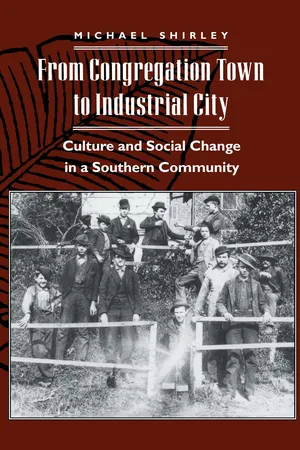
eBook - ePub
From Congregation Town to Industrial City
Culture and Social Change in a Southern Community
- 338 pages
- English
- ePUB (mobile friendly)
- Available on iOS & Android
eBook - ePub
From Congregation Town to Industrial City
Culture and Social Change in a Southern Community
About this book
Information
Index
Ackerman, John, 22
Africa, 5
African Americans, 4, 148, 168, 201–2, 212, 215, 236
benevolent associations, 212
and community, 164, 212–13, 221, 235
in crafts, 47–48
culture of, 212–13
and entrepreneurship, 163–64
and Knights of Labor, 213, 218, 221–23
and paternalism, 213–14
and politics, 217, 222–31
and race relations, 222–31
and religion, 212
as slaves, 47–52
and sports, 212
in textile manufacturing, 50, 52, 87–90, 153
in tobacco manufacturing, 193–98, 212–15, 227
agriculture, 4, 7–9, 18, 24–28, 31–32, 33, 35–36, 38–39, 70–71, 142, 144, 147–49, 151, 179, 186–87, 197–98, 212, 227
and artisans, 39, 179
cash value of farms, 34
and Civil War, 132–36
farm size, 34–35, 148
farmers, 102, 106–7, 109, 111–12, 115, 132, 139, 142, 146, 164–65, 186–87, 230
labor, 35
and market, 32–35, 36, 39, 147–48, 164, 254
prices of commodities, 32–33, 36, 90, 134–35, 179, 186
output, 32–33, 147–48, 254
slaves, 35
sharecropping and tenancy, 148, 165, 179, 186, 207, 212, 227. See also names of individual commodities
Alamance County, N.C., 92
Alamance Volunteers, 132
Alberson, Martha, 79
Alberson, Patience, 79
Allegheny True Blues, 132
Allen, S. E., 115, 164, 166–68
Alspaugh, John W., 125, 166, 168, 280n
Alspaugh, Samuel, 108
American Federation of Labor, 231–32
American party, 111, 123–24
Anglicans, 104
Arkansas, 128
artisans (and shopkeepers), 2–3, 7–11, 13, 18–24, 27–29, 31, 36...
Table of contents
- Cover Page
- Title Page
- Copyright Page
- Contents
- List of Illustrations
- Maps
- Acknowledgments
- Introduction
- ONE The Congregational Community of the Moravians
- TWO The Congregation and a Changing Economy
- THREE Manufacturing and Community in Salem
- FOUR Community Culture in Antebellum Salem
- FIVE The Community at War
- SIX Postbellum Winston and Salem: The Emergence of a Business Class
- SEVEN Workers in an Industrial Community
- EIGHT The Industrial Community: Drawing the Lines of Class and Race
- Conclusion
- APPENDIX A Rules and Regulations
- APPENDIX B Occupational Classifications for Population Sample from 1850 Census
- APPENDIX C Occupational Classifications for Population Sample from 1880 Census
- Notes
- Bibliography
- Index
Trusted by 375,005 students
Access to over 1.5 million titles for a fair monthly price.
Study more efficiently using our study tools.
Frequently asked questions
Yes, you can cancel anytime from the Subscription tab in your account settings on the Perlego website. Your subscription will stay active until the end of your current billing period. Learn how to cancel your subscription
No, books cannot be downloaded as external files, such as PDFs, for use outside of Perlego. However, you can download books within the Perlego app for offline reading on mobile or tablet. Learn how to download books offline
Perlego offers two plans: Essential and Complete
- Essential is ideal for learners and professionals who enjoy exploring a wide range of subjects. Access the Essential Library with 800,000+ trusted titles and best-sellers across business, personal growth, and the humanities. Includes unlimited reading time and Standard Read Aloud voice.
- Complete: Perfect for advanced learners and researchers needing full, unrestricted access. Unlock 1.5M+ books across hundreds of subjects, including academic and specialized titles. The Complete Plan also includes advanced features like Premium Read Aloud and Research Assistant.
We are an online textbook subscription service, where you can get access to an entire online library for less than the price of a single book per month. With over 1.5 million books across 990+ topics, we’ve got you covered! Learn about our mission
Look out for the read-aloud symbol on your next book to see if you can listen to it. The read-aloud tool reads text aloud for you, highlighting the text as it is being read. You can pause it, speed it up and slow it down. Learn more about Read Aloud
Yes! You can use the Perlego app on both iOS and Android devices to read anytime, anywhere — even offline. Perfect for commutes or when you’re on the go.
Please note we cannot support devices running on iOS 13 and Android 7 or earlier. Learn more about using the app
Please note we cannot support devices running on iOS 13 and Android 7 or earlier. Learn more about using the app
Yes, you can access From Congregation Town to Industrial City by Michael Shirley in PDF and/or ePUB format, as well as other popular books in History & North American History. We have over 1.5 million books available in our catalogue for you to explore.