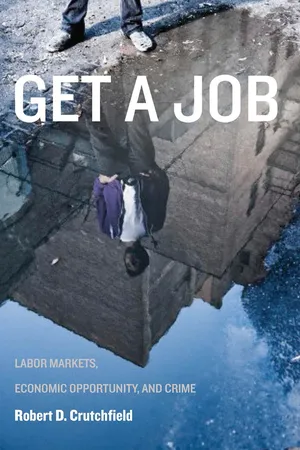
Are the unemployed more likely to commit crimes? Does having a job make one less likely to commit a crime? Criminologists have found that individuals who are marginalized from the labor market are more likely to commit crimes, and communities with more members who are marginal to the labor market have higher rates of crime. Yet, as Robert Crutchfield explains, contrary to popular expectations, unemployment has been found to be an inconsistent predictor of either individual criminality or collective crime rates. In Get a Job, Crutchfield offers a carefully nuanced understanding of the links among work, unemployment, and crime.
Crutchfield explains how people’s positioning in the labor market affects their participation in all kinds of crimes, from violent acts to profit-motivated offenses such as theft and drug trafficking. Crutchfield also draws on his first-hand knowledge of growing up in a poor, black neighborhood in Pittsburgh and later working on the streets as a parole officer, enabling him to develop a more complete understanding of how work and crime are related and both contribute to, and are a result of, social inequalities and disadvantage. Well-researched and informative, Get a Job tells a powerful story of one of the most troubling side effects of economic disparities in America.
- 303 pages
- English
- ePUB (mobile friendly)
- Available on iOS & Android
eBook - ePub
About this book
Information
1
Modern Misérables
Labor Market Influences on Crime
I heard the news first in a phone call from my mother. My youngest brother, Robby, and two of his friends had killed a man during a holdup. Robby was a fugitive, wanted for armed robbery and murder. The police were hunting him, and his crime had given the cops license to kill. The distance I’d put between my brother’s world and mine suddenly collapsed. The two thousand miles between Laramie, Wyoming, and Pittsburgh, Pennsylvania, my years of willed ignorance, of flight and hiding, had not changed a simple truth: I could never run fast enough or far enough. Robby was inside me. Wherever he was, running for his life, he carried part of me with him.1
John Edgar Wideman’s book Brothers and Keepers is the tale of two brothers; the younger Robby’s early life and incarceration in a Pennsylvania prison, convicted of felony murder and sentenced to life. The other, John himself, now a Brown University professor, was on the faculty of the University of Wyoming when he wrote the above passage. Brothers and Keepers is also a tale of their Homewoods; one of Pittsburgh’s black ghettos, where the Wideman brothers came of age. John’s Homewood of working-class neighborhoods was peopled by blue-collar families. Most of the parents and some of the children had immigrated from the South. But a dramatic change occurred by the time Robby came of age. Ten years after John, Robby’s Homewood was an edgier, faster place with a street life that was not always the most virtuous. The social fabric of the community had changed, as had its culture. By the time Robby became an adolescent, Homewood’s streets were a lure to the dark side for many black boys and young men, including the youngest of the Wideman brothers. And while Robby sat imprisoned in Pennsylvania’s Western State Penitentiary, Homewood changed yet again when the steel mills, which had employed thousands of her residents, closed.2 Most of those mills were later demolished, along with the dreams and the basis of a good economic life for working-class Pittsburgh families. Many of those families were immigrants from the South, to what Nicholas Leman and others called the Promised Land.3 As the twentieth century ended, the once Promised Land of Homewood would produce many more stories of crime and suffering.
The objective of this book is an exploration of how labor market experiences influence crime. Both the violent and property violations of individuals and variations in rates of these crimes are affected by the economy and people’s relationship to it. Work is central to who we are, the well-being of our families, and it determines where and how well we live. Whether they are black or white, Latino or Asian, Native American or immigrant, the chances of a person becoming involved in crime is related directly to the employment and opportunities available to them, or indirectly through the characteristics of the places where they live and spend time. As a sociologist for more than thirty years I have become convinced that the stratification of labor—how people become slotted into good jobs and not-so-good jobs—is a substantial contributor to where they live, the lifestyle they lead, and their criminality. And this understanding is consistent with the folk knowledge I learned from coworkers and in the streets when I worked first as a juvenile probation officer and later as a parole agent for the State of Pennsylvania. Here the effect of labor stratification on young men and women, children, and communities, including those like Homewood, will be the focus.
The notion that people become slotted into positions is certainly at odds with the conceptions of the United States that many Americans hold dear, but even though it is inconsistent with our national self-image, it is the reality for most. To be clear, I do not argue that we are positioned into specific occupations, but rather that tiers exist. Those born into a particular tier have a good chance of remaining there. Although systems of stratification that perpetuate such patterns are not the focus of this book, I will touch on how employment opportunities, resulting crime, and criminal justice system exposure help to maintain the status quo for many.
The Economy and Criminals?
The hero of Victor Hugo’s Les Misérables, Jean Valjean, was sent to prison for stealing bread to feed his sister’s starving children; a noble act of larceny because of his motive. This imagery lies at the root of popular expectations that when economic times are tough some will turn to crime in order satisfy needs. Of course some people likely do commit crimes because of need, but then others among us, who are less noble than Jean Valjean, turn to villainy simply for wants that will not be satisfied by work and saving. It is intuitively appealing to attribute criminal actions to material motives—and so many of us expect that unemployment will lead to crime, and that the economically less fortunate will do more of it. We extend this conception of the poor when we presume that the stresses of their lives, and the brutal conditions that some of them experience, lead them to engage in violence.
The general public easily, and with little question, accepts the idea that crime can be attributed to a poor economy. But recurring anomalies suggest that this may not, or at least not always, be true. For example, during the Great Depression of the 1930s the rates of some crimes declined, even though unemployment rates exceeded twenty-five percent for extended periods. Thirty years later, during the 1960s, along with sustained economic expansion the US experienced large increases in both property and violent crime rates. Considering the link between economy and crime more globally, it is no secret among criminologists that comparative poverty rates are not highly correlated with crime rates within western industrialized nations. And while some of the poorest nations of the word have high crime rates, many poor countries have relatively low rates. At the same time, even among industrialized nations, it is difficult to explain their relative rankings based on their economies. The US continues to have astoundingly high rates of homicide, even though it has one of the world’s most productive economies and its people enjoy a comparatively high per capita income.

Figure 1.1. US Homicide Rate, 1900–2002: Rate per 100,000 Population
*Includes 9/11 terrorism deaths
Source: National Center for Health Statistics, Vital Statistics
Consider the trends in homicide during the twentieth century (Figure 1.1). Murder is probably the best—but by no means perfectly—measured crime during this period. Logically we would not expect the decline that occurred in the 1930s or the increases of the 60s, but more deaths from homicide makes some sense during the economic displacement of the 80s and early 90s. And now that the US has experienced the deepest recession since the Great Depression, it is not clear that homicide has increased appreciably, at least not across the board.
While the image of a desperate yet heroic Jean Valjean may capture the romantic imaginations of readers of Hugo’s novel and the patrons of the Broadway musical, we should recognize that a more accurate stereotype may be the teenager who mugs a schoolmate to steal his expensive athletic shoes. Notice that here I include this image too as a stereotype. Both the hero of Les Misérables and the thief of a pair of Air Jordans present too limited pictures to convey how economic forces affect crime. There are, to be sure, those who come to crime in desperation because legitimate opportunities are closed off to them. Criminologists have long recognized this motivation. There are also delinquents who can reconcile or rationalize mugging a schoolmate because, “Why should he have those shoes if I can’t?” And of course, the neutralizing power of this self-posed question is even more compelling for someone with sufficient might to force his will. These images and their explanations, though, are also too limited to help us understand the link between the economy and employment and crime.
The last half of the twentieth century, the United States witnessed major economic shifts that included the deindustrialization of traditional manufacturing cities and regions, and a reversal of some demographic flows. Many migrants departed places that a generation earlier had attracted those looking for work. Jobs, and not surprisingly the people that follow them, moved out. Chicago and Detroit, Pittsburgh and Cleveland, Youngstown and Gary all experienced the loss of substantial portions of the industries that had given them their identities. Rather than rebuild, retool, and modernize in these industrial capitals, corporations elected to open new manufacturing plants elsewhere. First they moved operations to Sunbelt states with cheaper labor costs, and ultimately many producers moved some or all of their manufacturing operations out of the US in search of even lower-cost labor. We all now recognize the latter portion of this trend as the process of globalization that is perhaps the most significant force in the current world economy. Companies and workers everywhere are now linked together in ways that affect life everywhere.
Included among the products of globalization are changing crime rates. In some places the community changes that result from globalization might reduce the incidence of crime by bringing increased prosperity, but at times the opposite occurs. William Julius Wilson’s account of what happens in desperately poor American urban neighborhoods when jobs are lost as a result of deindustrialization includes increases in crime.4 Emil Durkheim and Frederick Tonnies wrote of the disruptions to social life that accompanied early European industrialization. It is not hard to imagine that the disrupting influences that accompanied the shift from agrarian to industrial economies in nineteenth-century France and Germany may now change societies and increase crime in those nations where multinational companies site facilities and jobs today. Industrialization and urbanization fractured cultural and normative systems of nineteenth-century agrarian societies. The reduction of social control that resulted from normative disruption allowed deviance in general, including crime, to increase. Conversely, there will be newfound prosperity in some formerly destitute communities when global economic forces cause companies to bring in new jobs. This may cause crime rates to drop. The addition of industrial jobs to formally nonindustrial areas will have both crime-producing and crime-reducing influences.
Two different processes are at work as a result of globalization. First, the loss of jobs from industrial economies has dire consequences in First World cities; second, the changes that accompany the arrival of modern industrial concerns profoundly affect social life in those places where jobs move to. Here I will focus on the former, but on occasion I will attempt to comment a bit on the latter as well.
“Buddy Can You Spare a Dime?” or “Give Me Your Wallet!”
The changes that happened in American cities in the last half of the twentieth century as a result of deindustrialization were different than those experienced by people during the Great Depression. While the latter saw some declines in crime, the former saw increases, especially of violent crime rates. In actuality during the Depression some crime rates fell—notably homicide, which not only did not increase (note Figure 1.1) but appears to have declined—but other rates increased (e.g., burglary).5 It is the case, however, that crime rates during the Depression were not what we would simply predict using the popular conceptions about the relationship between the economic well-being of the populace and crime. I suspect that crime did not increase more because there was pervasive, widespread unemployment, which affected many groups and segments of society. We should take care not to romanticize this period. Life was hard. Families struggled to function economically, and people suffered. But when so many were out of work it is possible that the relative deprivation felt by Depression-era families may have been mitigated. There was a sense of widespread struggle and people needing to pull together to support one another. One gets a sense of the approach to life of Depression-era families and workers when reading excerpts from the manuscripts of the Federal Writers’ Project, 19361940. This program enlisted writers to interview and describe “real people.” The quotes below are taken from that effort.
I’ve knowed people though that’s been willin’ to work and somehow couldn’t get along. I know a woman that had saved and bought her own house, and took care of her sick mother too. Her husband got out of a job and she was out down to one day’s work a week. Her mother died and she didn’t have money to bury her with. That was one Friday night back in the summer. Up to late Saturday they didn’t know whether they was goin’ to be able to bury her or not. Some of the neighbors went around and took up a collection to pay the grave diggers and buy the lot. Then this woman made arrangements with the undertaker and they got her mother buried Sunday mornin’. I heard the other day she was losin’ her place and I expect she has held it long as she can.
A collection come hard back then because so many people wasn’t gettin’ full time. I’ve been glad that Jim’s got to work so steady. Up to now we haven’t had to draw any rocking chair money. That’s what they call the unemployment money, you know. Of course nobody don’t know in these times when they’ll be laid off. Jim’ll work as long as he can get work though.6
Here, neighbors themselves on hard times come to the aid of a family in particular distress. Work is clearly a scarce and valued commodity.
The next morning I was at the mill gates an hour before bell time. There I found all of my fellow workers and I joined in their conversation. Each asked the other what they had been doing during the lay off and what were they going to do with their first pay? There were predictions, laughingly made that Fat’s saloon would do a rushing business on pay night. But under all this gay jesting everyone of us knew that when the order was finished in a few months, we would again be laid off, to a tramp the streets while we collected our unemployment compensation checks and then back on relief we would have to go until the mill started running full time again. We had gone through this routine many times in the past ten years and each one of us knew that he would go through it many times in the future. But that knowledge could not dim our spirits today because we knew that while the mill operated we would be able to eat what we wanted, we could dress our families and have a dollar left so that when meeting our fellow workers in Fat’s saloon on Saturday night each one of us could stand up to the bar and pay for a round of beers.7
The boom and bust cycle described here persisted for most workers from 1929 until the start of World War II. Others’ comments put the blame on everything from crooked politicians to automation to the bosses, but a fairly common theme running through these narratives is that of working people struggling together.
Clearly there were those during the Depression whose suffering was less and still others who thrived, but in general there was a collective notion that Americans, as well as the populations of many industrialized nations, were suffering together. There was a broadly felt collective despair. While this period did not produce especially high crime rates, there were political movements to unseat the leaders of government and industry. The Communist Party in America experienced its greatest period of popularity. There was conflict during the Depression, and working people expressed their displeasure with the way the country and the economy were going.
The 1960s economic boom time was very different. Though the economy was strong, crime increased, as did political activism and conflict. That crime “boomed” along with the economy has been characterized as a paradox. Our traditional theories and explanations would have made predictions to the contrary. It is likely that a number of social forces contributed to this seemingly anomalous pattern. Two are likely very important: the baby boom, and the substantial social changes that that took place in the US and in other western democracies after World War II.
In the 1960s large numbers of postwar baby boomers entered schools, hung out on street corners, and learned to drive. We overwhelmed institutions. New schools had to be built; radio stations and the entertainment industry more broadly came to cater to us, we changed popular music, and entered the crime-prone teenaged years. It should not be surprising that crime and delinquency increased. We were the largest group of people of the most crime-prone ages, fourteen to seventeen, that western nations had experienced.8 It was natural that crime would increase, but also the institutions that control adolescent behavior—schools, churches, community centers, and communities themselves—were overwhelmed by the onslaught. There were just so many of us. Other factors contributed to the 1960s crime boom that accompanied its economic boom, but more on that in a bit.
To explain post-World War II crime trends, sociologists Lawrence Cohen and Marcus Felson advanced their routine activities perspective, which explains how normal patterns of daily behavior that brings people who are motivated to commit crimes together with potential victims in the absence of guardians increases criminality.9 Cohen and Felson were explicitly concerned with the paradox of growing crime with increasing plenty. The conclusion they drew from their analyses was that changes in routine activities, in particular social changes that increasingly moved social life away from home and into the public sphere, brought motivated criminals and potential victims together in the absence of effective guardians. Other postwar lifestyle changes contributed to crime growth. The presence of more cars, which facilitate crime, are also themselves targets for crime. The growth in possession of portable electronic devices (easy to steal) and more dual career couples (no one at home to protect against burglary) contributed to increased postwar crime rates. Perhaps the most important lesson that we can learn from Cohen and Felson’s study is to beware of single-item or issue explanations (e.g., “the economy”) of crime that are popular with the media and are too often sought by too many politicians. The economy is but one, albeit important, factor that contributes to fluctuations in crime. Our focus here is with the linkage between the economy, specifically l...
Table of contents
- Cover Page
- Title Page
- Copyright Page
- Dedication
- Contents
- Acknowledgments
- 1 Modern Misérables: Labor Market Influences on Crime
- 2 “Get a Job”: The Connection between Work and Crime
- 3 Why Do They Do It? The Potential for Criminality
- 4 “I Don’t Want No Damn Slave Job!”: The Effects of Lack of Employment Opportunities
- 5 “Life in the Hood”: How Social Context Matters
- 6 Lessons from the Hole in the Wall Gang
- 7 Toward a More General Explanation of Employment and Crime
- 8 A Tale of My Two Cities
- Appendix: Data
- Notes
- Index
- About the Author
Trusted by 375,005 students
Access to over 1.5 million titles for a fair monthly price.
Study more efficiently using our study tools.
Frequently asked questions
Yes, you can cancel anytime from the Subscription tab in your account settings on the Perlego website. Your subscription will stay active until the end of your current billing period. Learn how to cancel your subscription
No, books cannot be downloaded as external files, such as PDFs, for use outside of Perlego. However, you can download books within the Perlego app for offline reading on mobile or tablet. Learn how to download books offline
Perlego offers two plans: Essential and Complete
- Essential is ideal for learners and professionals who enjoy exploring a wide range of subjects. Access the Essential Library with 800,000+ trusted titles and best-sellers across business, personal growth, and the humanities. Includes unlimited reading time and Standard Read Aloud voice.
- Complete: Perfect for advanced learners and researchers needing full, unrestricted access. Unlock 1.5M+ books across hundreds of subjects, including academic and specialized titles. The Complete Plan also includes advanced features like Premium Read Aloud and Research Assistant.
We are an online textbook subscription service, where you can get access to an entire online library for less than the price of a single book per month. With over 1.5 million books across 990+ topics, we’ve got you covered! Learn about our mission
Look out for the read-aloud symbol on your next book to see if you can listen to it. The read-aloud tool reads text aloud for you, highlighting the text as it is being read. You can pause it, speed it up and slow it down. Learn more about Read Aloud
Yes! You can use the Perlego app on both iOS and Android devices to read anytime, anywhere — even offline. Perfect for commutes or when you’re on the go.
Please note we cannot support devices running on iOS 13 and Android 7 or earlier. Learn more about using the app
Please note we cannot support devices running on iOS 13 and Android 7 or earlier. Learn more about using the app
Yes, you can access Get a Job by Robert D. Crutchfield in PDF and/or ePUB format, as well as other popular books in Social Sciences & Criminology. We have over 1.5 million books available in our catalogue for you to explore.