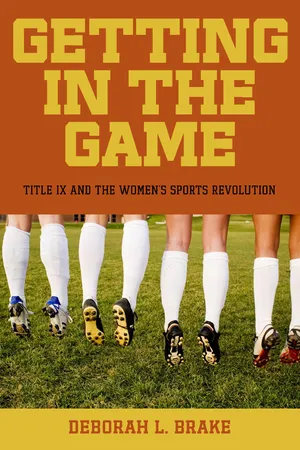
In this first legal analysis of Title IX, Deborah L. Brake assesses the statute’s successes and failures, using a feminist theory lens to understand, defend, and critique the law. While the statute has created tremendous gains for female athletes, not only raising the visibility and cultural acceptance of women in sports, but also creating social bonds for
women, positive body images, and leadership roles, the disparities in funding between men’s and women’s sports have
remained remarkably resilient. At the same time, female athletes
continue to receive less prestige and support than their male counterparts, which in turn filters into the arena of professional sports. Brake provides a richer understanding and appreciation of what Title IX has accomplished, while taking a critical look at the places where the law has fallen short.
A unique contribution to the literature on Title IX, Getting in the Game fully explores the theory, policy choices, and successes and limitations of this historic law.
- 320 pages
- English
- ePUB (mobile friendly)
- Available on iOS & Android
eBook - ePub
About this book
Information
1
Separate Is Equal?
The dominant principle in modern antidiscrimination law is that all persons should be treated as individuals, without reference to their status as members of a social group. In American law, this translates into a principle of color blindness when we’re speaking about racial equality and gender blindness when the focus is on discrimination against women. Civil rights laws on workplace equality, for example, require employers to use gender-neutral hiring criteria, with few exceptions. Once Title VII of the Civil Rights Act of 1964 went into effect, employers could no longer advertise positions for “women’s jobs” or “men’s jobs.” Instead, the law requires employers to consider men and women together for the same positions—unless the job fits into a narrow category of exceptions where sex is a “bona fide occupational qualification” for performing the job. Men have an equal right to be considered for secretarial positions, just as women can compete for jobs in law enforcement. Whether or not such gender-blind criteria actually produce a diverse mix of men and women throughout the workforce is not the law’s primary concern. Title VII is a quintessentially liberal feminist law, promising a gender-neutral process, not equal results.
Title IX’s approach is markedly different from this baseline. As any college or high school sports fan knows, gender blindness is not the rule in competitive sports. Men and women generally do not compete against each other for the same sports opportunities. Title IX left the sex-separate structure of sports largely intact and opted for more substantive measures of equal opportunity rather than a rule of gender blindness. Where Title IX has had the greatest impact, in high school and college varsity sports participation, separation by sex is the rule rather than the exception. Title IX’s allowance for sex separation has facilitated a legal approach that emphasizes results over process and actual opportunities for girls and women over a more formal gender neutrality. However, the law also leaves intact a structure in which women’s sports are too often marginalized as secondary to men’s games, a poor stepsister to the “real” varsity programs.
The question of how to structure sport so that it fully includes and values women raises what is known among feminist legal scholars as the dilemma of difference. If women as a group are not similarly situated to men with respect to sports as they are currently played, how can sex-discrimination law best secure equality? Should it ignore gender differences, promote a gender-blind structure, and call it equality if schools have open tryouts for each sport? In this model, the best athlete, male or female, would make the team with no special dispensation for an athlete’s sex. Alternatively, should Title IX take a gender-conscious approach that acknowledges gender difference and makes sure that women have enough opportunities to play sports compared to the number of men’s opportunities?
The Dilemma: Separation or Integration?
Neither model is costless. Shifting to a framework that offers coed opportunities for all athletes with no attention to gender could potentially wipe out the biggest gains Title IX has produced: the burgeoning numbers of girls and women who participate in competitive school sports. With gender-blind team selection and competition, the majority of female athletes could well be relegated to second-tier teams or club and intramural games with only token representation at the varsity level. For many girls and women, such a shift would offer fewer paths to the success and status that so many female athletes have achieved under Title IX. Sport as a path to empowerment would become much narrower for most women, if not closed off completely. Although some individual female athletes might be better off with coed teams because of their ability to excel in competition with male athletes, women as a group would likely face diminished opportunities to play sports at the most elite levels.
On the other hand, accommodating gender difference has its costs, too. It reinforces an ideology that has historically been used to justify the outright denial of sports opportunities to women and, more recently, to place a lower value on women’s sports. Having separate men’s and women’s teams risks sending the message that women are inherently lesser athletes. The existence of sex-segregated programs risks identifying female athletes as the second-class citizens of sport. It also sacrifices whatever benefits might be gained by having men and women, and boys and girls, compete with and against one another and the potential transformation in gender relations that might result. As the feminist sport historian Jennifer Hargreaves explains the dilemma, separatism can increase women’s control over sport, mobilize women to fight for equal resources, and enable them to participate in sports free from male domination, but it also re-creates social gender divisions and can exaggerate sexism, with the message that biological sex, rather than culture, defines athleticism.1
This is the classic dilemma of difference, leaving advocates for gender equality damned if they ignore gender and damned if they don’t. Title IX negotiates this terrain with a flexible and pragmatic approach. As a starting point, Title IX allows schools to offer separate competitive teams for men and women. But this baseline can be altered in narrow circumstances recognized by Title IX and, in some cases, the U.S. Constitution’s equal protection clause. The result is that individual athletes have a right to try out for an opposite-sex team, but only if they meet certain criteria—criteria that strongly favor tryout rights for women over those for men. In this legal regime, gender separation is the norm, integration the exception.
This chapter explores how Title IX navigates the tricky terrain of gender separation and assimilation in sports. It concludes that, although critiques of sex segregation in sport deserve our attention, Title IX has done a relatively good job of forging a pragmatic approach to structuring sports opportunities for girls and women. In forsaking gender blindness for a more gender-conscious, result-oriented model, Title IX has chosen substantive equality over formal equality. This choice has created the potential for expanding girls’ and women’s sports participation and inciting broad-based cultural transformation in society’s response to female athletes and to women’s roles more generally.
The Development of Title IX’s Approach to Sex Equality in Sports
Title IX emerged from a broader social movement seeking the recognition and vindication of women’s rights. After Congress passed Title VII of the Civil Rights Act of 1964, which banned workplace discrimination on the basis of race, color, religion, sex, or national origin, women’s rights advocates turned their attention to widespread practices of discrimination against girls and women in education. Early drafts of what would become Title IX proposed simply adding “sex” to Title VI of the 1964 Civil Rights Act, which bans race discrimination in all federally funded programs, including education programs. However, in response to extensive testimony in Congress specifically focused on sex discrimination in education, the proposal was redrafted and ultimately enacted as separate legislation.
Congressional hearings on the bill barely mentioned sports, focusing instead on the discrimination women faced in gaining admission to college and graduate school. At the time, many universities, if they allowed women in graduate programs at all, had quotas limiting the number of places they could fill. The theory was that women were likely to marry and stay home to raise children and should not take slots away from men, who would make better use of their degree.2 To the extent that the topic of sports came up at all in these hearings, it was raised by proponents of Title IX to allay fears that the law would go too far in radically altering male turf. Senator Birch Bayh of Indiana, a leading sponsor of the legislation, mentioned sports only twice during the hearings. The first time was to provide reassurance that the law would not mandate coed football. Senator Peter Dominick of Colorado retorted that he would have had much more fun playing football if it had been coed, prompting chuckles from the Senate gallery. The only other time the subject was mentioned was to reassure members of Congress that Title IX would not require coed locker rooms and would allow personal privacy to be preserved.3 Whatever ambivalence surrounding the law’s coverage of sports was present at the time was overshadowed by a general consensus on the need to expand women’s access to educational opportunities.
The final version of the law was enacted as part of an education funding law in 1972—the same year that Congress endorsed the Equal Rights Amendment, which would later die a protracted death in the state ratification process.4 The core provision of Title IX is a broad and general ban on sex discrimination. The heart of the law says simply: “No person in the United States shall, on the basis of sex, be excluded from participation in, be denied the benefits of, or be subjected to discrimination under any education program or activity receiving federal financial assistance. …”5 As with other similarly broad statutes, “discrimination” is a loaded and highly malleable term. It requires interpretation, and the consensus that the term generates masks what are often sharp conflicts about its meaning.
Today, almost everyone agrees that discrimination is wrong, but questions about what that means, the implications of remedying it, and who will bear the costs have historically been the subject of deep social conflict. Title IX is no exception. The rosy glow of consensus quickly gave way to bitter disputes over the law’s application to sports. Although Senator Bayh’s oblique remarks about football were intended to reassure skeptics that the law would not be too far-reaching, they implicitly reflected an expectation that the law would apply to athletics. The sports establishment soon rallied to try to cabin the law’s implications for intercollegiate sports. The National Collegiate Athletic Association (NCAA) was a leader in this effort. With the group’s support, Senator John Tower of Texas attempted to amend Title IX in the early 1970s. Senator Tower first introduced a bill that would have exempted intercollegiate sports entirely. When that effort ran into opposition, he sponsored an alternative proposal to exempt “intercollegiate athletic activity to the extent that such activity does or may provide gross receipts or donations to the institution necessary to support that activity.”6
The Tower Amendment passed in the Senate, but when the Education Amendments of 1974 reached the joint House-Senate conference, the conference committee replaced it with a compromise provision that basically evaded the tough questions about how Title IX would apply to sports. Proposed by Senator Jacob Javits of New York and henceforth known as the Javits Amendment, the compromise delegated authority to the federal enforcing agency, then the Department of Health, Education, and Welfare (HEW), to issue regulations for implementing Title IX that included “with respect to intercollegiate athletics reasonable provisions considering the nature of particular sports.”7 The Javits Amendment recognized that Title IX should allow for differences among individual sports, with football and its mega-budgets and squad sizes being the elephant in the room, but it implicitly rejected the notion that a sport’s ability to raise revenue should categorically exempt it from Title IX. Still, the compromise left the details—large and small—to be worked out at another level of government. During the second half of the 1970s, the battle over Title IX shifted from Congress to federal regulators and eventually to the courts.
Even before the Javits Amendment turned over the job to HEW, the agency’s Office for Civil Rights had already begun struggling with the difficult question of how to craft antidiscrimination standards to fit intercollegiate athletics. Lawyers at HEW quickly realized that the desegregation model for enforcing Title VI, which covers race discrimination in federally funded schools, could not simply be replicated in Title IX.8 They recognized that competitive sport was a particularly thorny area for developing measures of gender equality.
In the vast majority of settings in which antidiscrimination laws apply, including employment and voting rights, assimilation and gender neutrality are the guiding norms and goals shared by the law’s supporters.9 For example, although American workplaces continue to have a significant degree of de facto sex gender segregation, both vertically and horizontally, employment discrimination laws aspire to dismantle this segregation and create a gender-blind opportunity structure.10 In the world of sports, however, it is much less clear that integration is or should be the primary goal of Title IX. As was true in 1972, sex segregation remains the norm for sports competition today, and there is no consensus, even among Title IX’s strongest proponents, that the law should aspire otherwise.
When HEW was developing its proposal for Title IX regulations, some stakeholders argued for sex integration as the measure of equality. Among them, some women’s rights advocates acknowledged that temporarily separate sports programs for women might be necessary as a type of affirmative action but pushed for the ultimate goal of having men and women compete for a spot on the same team. Other stakeholders who supported sex integration, however, did so as a way of preserving the status quo. For example, during early debates over the Title IX regulations, some male athletic directors argued that colleges should be able to satisfy Title IX simply by opening tryouts to men and women, even if the end result was all-male teams with no additional female participation.11 Supporters of separate women’s sports programs vigorously resisted such proposals, arguing for a more substantive measure of nondiscrimination that would ensure meaningful opportunities to participate. The debate drove a wedge between women’s rights advocates over how best to achieve sex equality in sports.
The feminist group most critical of sex segregation in sports, the National Organization for Women (NOW), argued that “separate but equal” was an inappropriate permanent baseline for sports, as for other areas of public life. But NOW acknowledged that sex-separate teams might be a necessary interim measure until the gap in training and experience closed and women could meaningfully compete with men.
Other advocates of women’s sports were more comfortable with sex separation as a lasting baseline and pushed for measures of equality within sex-separate programs. The Association for Intercollegiate Athletics for Women (AIAW), for example, argued for separate teams for all men’s and women’s sports, with proportionate funding.12 The organization made the case that giving women control over their own resources would allow them to develop their own model of sports rather than simply replicate what men had designed for themselves. Separation would allow women broader opportunities in sport instead of limiting them to the sports selected for men. More important, the group hoped that women’s programs might avoid the commercialism that was already taking hold in men’s programs, and emphasized broad participation, instead of spending vast sums on a few elite athletes.13 The AIAW represented female physical educators, the vast majority of whom would have been pleased with separate teams, as long as they had sufficient resources to succeed.
Sifting through the arguments in 1973, HEW’s Office for Civil Rights initially considered two very different approaches: (1) opening up team tryouts to all athletes, male and female; or (2) keeping sex-separate programs but developing measures of equality to ensure equal opportunities.14 By 1974, when it issued draft regulations, HEW had rejected the first option. Instead, the draft regulations issued for public “notice and comment” required educational institutions to annually gauge the athletic interests of their student bodies and to engage in affirmative action to increase women’s opportunities in sports.15 The “affirmative efforts” requirement included providing women with training and support and encouraging them to take advantage of existing athletic opportunities.
The agency received nearly ten thousand sets of written comments on the draft regulations, prompting Secretary Casper Weinberger to observe, with a tinge of sarcasm, that “the most important issue in the United States today is intercollegiate athletics.”16 Various interest groups opposed the...
Table of contents
- Cover Page
- Title Page
- Copyright Page
- Dedication
- Contents
- Acknowledgments
- Introduction: The Feminism of Title IX
- 1 Separate Is Equal?
- 2 Integration Rights: Girls Playing with Boys and Boys Playing with Girls
- 3 The Three-Part Test and the Opportunity to Play
- 4 Complicating Equal Participation: What Counts as a Sport, Which Sports Should Women Play, and Which Women Should Play Them?
- 5 Cutting Men’s Opportunities to Help Women? Title IX and Leveling Down
- 6 Treatment as an Equal
- 7 The Dilemma of Difference and the “Problem” of Pregnancy
- 8 Beyond Equal Access: Retaliation, Coaching, and Sexual Harassment
- Conclusion
- Notes
- Selected Bibliography
- Index
- About the Author
Trusted by 375,005 students
Access to over 1.5 million titles for a fair monthly price.
Study more efficiently using our study tools.
Frequently asked questions
Yes, you can cancel anytime from the Subscription tab in your account settings on the Perlego website. Your subscription will stay active until the end of your current billing period. Learn how to cancel your subscription
No, books cannot be downloaded as external files, such as PDFs, for use outside of Perlego. However, you can download books within the Perlego app for offline reading on mobile or tablet. Learn how to download books offline
Perlego offers two plans: Essential and Complete
- Essential is ideal for learners and professionals who enjoy exploring a wide range of subjects. Access the Essential Library with 800,000+ trusted titles and best-sellers across business, personal growth, and the humanities. Includes unlimited reading time and Standard Read Aloud voice.
- Complete: Perfect for advanced learners and researchers needing full, unrestricted access. Unlock 1.5M+ books across hundreds of subjects, including academic and specialized titles. The Complete Plan also includes advanced features like Premium Read Aloud and Research Assistant.
We are an online textbook subscription service, where you can get access to an entire online library for less than the price of a single book per month. With over 1.5 million books across 990+ topics, we’ve got you covered! Learn about our mission
Look out for the read-aloud symbol on your next book to see if you can listen to it. The read-aloud tool reads text aloud for you, highlighting the text as it is being read. You can pause it, speed it up and slow it down. Learn more about Read Aloud
Yes! You can use the Perlego app on both iOS and Android devices to read anytime, anywhere — even offline. Perfect for commutes or when you’re on the go.
Please note we cannot support devices running on iOS 13 and Android 7 or earlier. Learn more about using the app
Please note we cannot support devices running on iOS 13 and Android 7 or earlier. Learn more about using the app
Yes, you can access Getting in the Game by Deborah L. Brake in PDF and/or ePUB format, as well as other popular books in Law & Law Theory & Practice. We have over 1.5 million books available in our catalogue for you to explore.