Pathbreaking essays on the power of local activism on the broader Civil Rights movement
Over the last several years, the traditional narrative of the civil rights movement as largely a southern phenomenon, organized primarily by male leaders, that roughly began with the 1955 Montgomery Bus Boycott and ended with the Voting Rights Act of 1965, has been complicated by studies that root the movement in smaller communities across the country. These local movements had varying agendas and organizational development, geared to the particular circumstances, resources, and regions in which they operated. Local civil rights activists frequently worked in tandem with the national civil rights movement but often functioned autonomously from—and sometimes even at odds with—the national movement.
Together, the pathbreaking essays in Groundwork teach us that local civil rights activity was a vibrant component of the larger civil rights movement, and contributed greatly to its national successes. Individually, the pieces offer dramatic new insights about the civil rights movement, such as the fact that a militant black youth organization in Milwaukee was led by a white Catholic priest and in Cambridge, Maryland, by a middle-aged black woman; that a group of middle-class, professional black women spearheaded Jackson, Mississippi's movement for racial justice and made possible the continuation of the Freedom Rides, and that, despite protests from national headquarters, the Brooklyn chapter of the Congress of Racial Equality staged a dramatic act of civil disobedience at the 1964 World's Fair in New York.
No previous volume has enabled readers to examine several different local movements together, and in so doing, Groundwork forges a far more comprehensive vision of the black freedom movement.
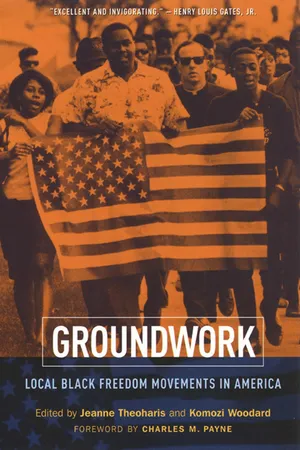
eBook - ePub
Groundwork
Local Black Freedom Movements in America
- 344 pages
- English
- ePUB (mobile friendly)
- Available on iOS & Android
eBook - ePub
Groundwork
Local Black Freedom Movements in America
About this book
Information
Chapter 1
“They Told Us Our Kids Were Stupid”
Ruth Batson and the Educational Movement in Boston
In 1994 community activists in Boston held a conference at Northeastern University to document the history of grassroots struggle for racial justice and educational equity in the city.1 The 1986 publication of J. Anthony Lukas’s Pulitzer Prize–winning book Common Ground had galvanized many in Boston’s black community to put forth their own histories of black families, community organizing, and the city’s turmoil surrounding school desegregation. The dismissing of three decades of black activism and the dysfunctional portrayal of the book’s main black family in Lukas’s book was galling to local activists like Ruth Batson, who had spent the better part of their lives fighting for educational equity in Boston and against these pathologizing images of black families.2 “JOHN ANTHONY LUKAS STOLE OUR MOVEMENT,”3 she declared. Lukas’s book examined Boston’s busing crisis by tracing the experiences of three local Boston families—the working-class black Twymons, the working-class Irish McGoffs, and the middle-class Yankee Divers—from 1968 to 1978. Seven years in the writing, Common Ground still discounted black leaders as key players in this decade and focused on a black family who were not activists and whose children embodied a variety of social ills. Lukas’s portrayal of local blacks as politically passive and culturally deprived bore a dangerous resemblance to the political ideologies that had maintained segregation in the city for decades. Determined that books like Common Ground would not dominate the historical record on Boston, Batson sent out questionnaires to movement participants asking for their recollections as well as any documents they had from the movement and called on them to attend the Northeastern meetings.4 Indeed, the struggle that Batson and other activists now waged to reclaim their history followed from the one they had fought in previous decades to get public officials and local citizens to recognize segregation as a problem in the Cradle of Liberty that had to be addressed.
Lukas’s book embodied a consensus that had emerged among journalists and scholars about the failure of court-ordered “busing” in Boston. The recognized history of Boston’s busing crisis had become one of a benevolent suburban judge, Judge W. Arthur Garrity, whose order to desegregate Boston Public Schools (BPS) in 1974 inflamed working-class white ethnics in the city, who protested “forced busing” in an effort to protect their “neighborhood schools.”5 Led by City Council member Louise Day Hicks, white parents took to the streets and kept their children out of school, sparking some of the largest, most violent protests of desegregation in the nation’s history. Accounts of Boston’s desegregation focused primarily on white resistance, making it a story of poor blacks against poor whites, while ignoring the twenty-five years of civil rights organizing prior to Judge Garrity’s decision, the middle-class interests that had sustained segregation in the city for decades, and the many whites who did not oppose desegregation.6
Angered over the inequities and insufficiencies of her own daughters’ educations, Batson had been one of the leading organizers since the late 1940s who had pressed the city through demonstrations and civil disobedience, lobbied for legislation, and formed independent black educational initiatives to remedy inequity in Boston’s public schools. And throughout those decades Batson and other activists in the Roxbury and Dorchester communities had been met with an intransigent School Committee and other public officials who denied that segregation existed in Boston schools while pouring energy and money into solidifying racially differential education in the city. This activism, and Batson’s story in particular, challenges the prevailing historiographical and sociological schools of thought that marginalize the entrenched and explicit structures of racism in Boston and erase a well-organized, protracted local movement constructed against racial injustice. This story of black women’s activism in Boston counters the pathological view of black motherhood so exemplified in work like the Moynihan Report and taken up in more contemporary “underclass” theory. With their ideologies of righteous motherhood, self-determination, and radical democracy, their organized activism disrupts current assumptions of the disintegrations and dysfunctions of the black community after Northern migration.7 Complicating the dichotomy between integration and Black Power, between the black poor and middle class, these women in Boston sought to claim a public position as black mothers. To do this meant challenging societal expectations grown over centuries of American reliance on black domestic labor that black women would put their own children second. And it meant refuting newer social theories made public through the Moynihan report that cast “the black matriarchy” as the cause of the “tangle of pathology” in the black community, that linked the failures of black children to ghetto culture, and that posited black women’s power as disempowering for black men.8
Sociological theories of “cultures of poverty” and “ghetto behaviors,”9 which were put forth by liberal social scientists and national political figures, and echoed by local citizens and city officials, sat at the heart of the defense of segregation in Northern cities like Boston. While World War II is understood to be a watershed period in terms of American race relations, the postwar period in Boston ushered in increasing segregation and racial inequity. This segregation was shielded from public condemnation by the city’s reputation as the “Cradle of Liberty” where problems in black education were attributed to black students themselves. These theories of cultural deprivation contrasting “mainstream” and “ghetto” behaviors provided a way for school districts like BPS to locate the problem within black communities and avoid systemic change for decades. There was no governor at the schoolhouse door proclaiming “segregation now and forever” in Boston; rather, the School Committee asserted that there were “no inferior schools, just inferior students.” These public officials claimed that what was wrong with the education of black students was their culture and motivation and spent millions of dollars creating special programs to uplift these culturally deprived students. In response, black Bostonians like Batson built a movement not only to unveil the injustices embedded within Boston’s educational system but also to dismantle these formulations of themselves and their children. A study of Boston’s movement reveals that sociological theories highlighting cultural deprivations and poor values had taken hold in Boston by the 1950s and that black community members took up a variety of strategies to counter them.
While many women turned to activism to improve their children’s education, the ideologies that drove their work focused broadly on justice and self-determination for the black community. Ruth Batson is both unique in her unrelenting leadership of this struggle and emblematic of a generation of women in Boston who were taking matters into their own hands, whether to organize and pay for a bus to take their children to a less-crowded school, to call a sit-in at the School Committee building, or to file suit in federal court. As she declared in 1965, “We intend to fight with every means at our disposal to ensure the future of our children.” This public claim to act as mothers was, in itself, an act of resistance because it stood as visible and direct opposition to prevalent ideologies of black community disrepair and declining values. Putting Ruth Batson squarely in the center of Boston’s history, then, reveals that black women’s activism was neither exceptional nor episodic but rather a fundamental and sustained repudiation of the politics and economics of race in the city. Finally, such a study shows the ways in which community leaders like Batson understood popular and scholarly ideologies that posited them as the problem and then self-consciously and systematically sought to repudiate them.
Even before the landmark Supreme Court decision Brown vs. Board of Education—and more than twenty years before Judge Garrity would order the desegregation of the city’s schools—a group of black parents and community activists led by Batson attacked the educational disparities within Boston Public Schools.10 Born on August 3, 1921, to politically active, West Indian parents,11 Ruth Batson grew up in segregated housing in the Roxbury section of Boston. Her mother was active in Marcus Garvey’s Back-to-Africa movement and taught Ruth not to “stand by” in the face of injustice. She also instilled in Ruth a devotion to education.
My mother was a single parent. She constantly lectured my brother and me about the importance of education. She set the example by returning to school herself to complete her grammar school education. I was eleven years old at the time and to this day I cherish the memory of my mother walking to the podium to accept her diploma . . . [at] Everett Grammar School on Northampton Street in Boston. At the time, I was a sixth grader at this very school.12
Batson completed high school, married John Batson at age nineteen, and had three daughters—Cassandra, Dorothy, and Susan.13 In 1949, on the invitation of a friend, she attended a meeting of the Parents’ Federation, a local activist group made up primarily of white women. “I was amazed to learn . . . that the oldest school buildings in Boston were located in the black communities, and these buildings were unsafe. These facilities also lacked the amenities found in other school districts, such as lunch rooms, libraries, and gymnasiums.”14 Black children typically went to overwhelmingly black schools that received less funding, but segregation was not total nor publicly pronounced which made it more difficult to see. The Parents’ Federation politicized Batson’s involvement in her children’s education, “expand[ing] our minds beyond my expectation”;15 it was not enough to encourage her children in their schooling, she now believed, without also fighting to remedy the serious disparities faced by all black children in BPS.16 Batson’s first action with the Parents’ Federation took place on November 30, 1950, when a delegation protested Mayor John Hynes’s opposition to building a new school in the South End, a predominantly black neighborhood “whose children are entitled to as many privileges as any other children living in this city.”17 Soon after this campaign the Parents’ Federation, like many organizations pushing for racial equality in this period, was red-baited and two members accused of being Communist sympathizers. “These disclosures soon forced the end of the Parents’ Federation. . . . In time I came to believe that these were premeditated and organized attempts to plant in the public’s mind a Communist conspiracy.” Thus the politics of anti-Communism played out on the local level as a way to stymie Boston’s interracial movement.
Batson needed to find another political outlet. In 1951 she decided to run for school committee, becoming the first black person to run in the twentieth century.18 Batson’s campaign literature urged voters “for your children’s sake, elect a mother,” promising the replacement of old, unsafe buildings, a hot lunch program for elementary schoolers, better working conditions for teachers, democratic home and school associations, and “interracial understanding and responsible citizenship.” Running in a citywide election with an at-large voting system, she lost. Still, she garnered 15,154 votes, and the black newspaper, the Boston Chronicle, described her “in the vanguard of our political leaders.”19 Batson’s personal experien...
Table of contents
- Cover Page
- Title Page
- Copyright Page
- Contents
- List of Abbreviations
- Foreword by Charles Payne
- Introduction
- 1 “They Told Us Our Kids Were Stupid”: Ruth Batson and the Educational Movement in Boston
- 2 “Drive Awhile for Freedom”: Brooklyn CORE’s 1964 Stall-In and Public Discourses on Protest Violence
- 3 Message from the Grassroots: The Black Power Experiment in Newark, New Jersey
- 4 Gloria Richardson and the Civil Rights Movement in Cambridge, Maryland
- 5 We’ve Come a Long Way: Septima Clark, the Warings, and the Changing Civil Rights Movement
- 6 Organizing for More Than the Vote: The Political Radicalization of Local People in Lowndes County, Alabama, 1965–1966
- 7 “God’s Appointed Savior”: Charles Evers’s Use of Local Movements for National Stature
- 8 Local Women and the Civil Rights Movement in Mississippi: Re-visioning Womanpower Unlimited
- 9 The Stirrings of the Modern Civil Rights Movement in Cincinnati, Ohio, 1943–1953
- 10 “We Cannot Wait for Understanding to Come to Us”: Community Activists Respond to Violence at Detroit’s Northwestern High School, 1940–1941
- 11 “Not a Color, but an Attitude”: Father James Groppi and Black Power Politics in Milwaukee
- 12 Practical Internationalists: The Story of the Des Moines, Iowa, Black Panther Party
- 13 Inside the Panther Revolution: The Black Freedom Movement and the Black Panther Party in Oakland, California
- About the Contributors
- Index
Trusted by 375,005 students
Access to over 1.5 million titles for a fair monthly price.
Study more efficiently using our study tools.
Frequently asked questions
Yes, you can cancel anytime from the Subscription tab in your account settings on the Perlego website. Your subscription will stay active until the end of your current billing period. Learn how to cancel your subscription
No, books cannot be downloaded as external files, such as PDFs, for use outside of Perlego. However, you can download books within the Perlego app for offline reading on mobile or tablet. Learn how to download books offline
Perlego offers two plans: Essential and Complete
- Essential is ideal for learners and professionals who enjoy exploring a wide range of subjects. Access the Essential Library with 800,000+ trusted titles and best-sellers across business, personal growth, and the humanities. Includes unlimited reading time and Standard Read Aloud voice.
- Complete: Perfect for advanced learners and researchers needing full, unrestricted access. Unlock 1.5M+ books across hundreds of subjects, including academic and specialized titles. The Complete Plan also includes advanced features like Premium Read Aloud and Research Assistant.
We are an online textbook subscription service, where you can get access to an entire online library for less than the price of a single book per month. With over 1.5 million books across 990+ topics, we’ve got you covered! Learn about our mission
Look out for the read-aloud symbol on your next book to see if you can listen to it. The read-aloud tool reads text aloud for you, highlighting the text as it is being read. You can pause it, speed it up and slow it down. Learn more about Read Aloud
Yes! You can use the Perlego app on both iOS and Android devices to read anytime, anywhere — even offline. Perfect for commutes or when you’re on the go.
Please note we cannot support devices running on iOS 13 and Android 7 or earlier. Learn more about using the app
Please note we cannot support devices running on iOS 13 and Android 7 or earlier. Learn more about using the app
Yes, you can access Groundwork by Jeanne Theoharis,Komozi Woodard, Jeanne Theoharis, Komozi Woodard in PDF and/or ePUB format, as well as other popular books in Politics & International Relations & Civil Rights in Politics. We have over 1.5 million books available in our catalogue for you to explore.