The first comparative analysis of minority conservatism
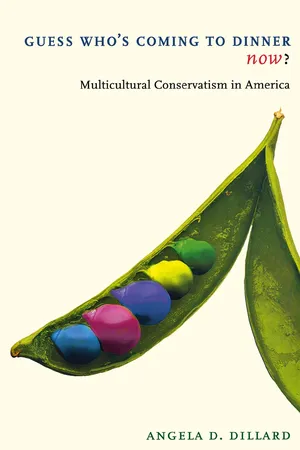
In Guess Who's Coming to Dinner Now? Angela Dillard offers the first comparative analysis of a conservatism which today cuts across the boundaries of race, ethnicity, gender, and sexuality.
To be an African-American and a conservative, or a Latino who is also a conservative and a homosexual, is to occupy an awkward and contested political position. Dillard explores the philosophies, politics, and motivation of minority conservatives such as Ward Connerly, Glenn Loury, Linda Chavez, Clarence Thomas, and Bruce Bawer, as well as their tepid reception by both the Left and Right. Welcomed cautiously by the conservative movement, they have also frequently been excoriated by those African Americans, Latinos, women, and homosexuals who view their conservatism as betrayal.
Dillard's comprehensive study, among the first to take the history and political implications of multicultural conservatism seriously, is a vital source for understanding contemporary American conservatism in all its forms.
eBook - ePub
Guess Who's Coming to Dinner Now?
Multicultural Conservatism in America
- 266 pages
- English
- ePUB (mobile friendly)
- Available on iOS & Android
eBook - ePub
Guess Who's Coming to Dinner Now?
Multicultural Conservatism in America
About this book
Information
CHAPTER 1
Malcolm X’s Words in Clarence Thomas’s Mouth
Black Conservatives and the Making of an Intellectual Tradition
A voice on the bare heights is heard/ the weeping and pleading of/Israel’s son,/ because they have perverted the way,/ they have forgotten the Lord/ their God./ Return, O faithless sons,/ I will heal your faithlessness.
—Jeremiah 3:21–22
I don’t see how the civil rights people today can claim Malcolm X as one of their own. Where does he say black people should be begging the Labor Department for jobs?
—Clarence Thomas, 1991
I want to begin with a sustained exploration of black conservative thought, primarily because black conservatives have played such a central role in the development of a multicultural conservative style. While distinctive in many respects, the black conservative critique of liberalism and the federal government is not extraordinarily new or innovative, particularly in its appeal to tradition and to Americanism. Emergent social and political movements often seek to legitimate themselves and their ideologies by appealing to historical precedents and forerunners. Throughout U.S. history, a diverse array of groups (women, workers, immigrants, African Americans, homosexuals) have pushed for their rights by inserting themselves into national narratives and by depicting themselves as good sons and daughters of the founders. Given the persuasive power of this rhetorical style, it is not surprising, for instance, that, when early women’s rights crusaders gathered at Seneca Falls in 1848, they devised a political manifesto and call to arms that mirrored the Declaration of Independence in both form and philosophical content. “We hold these truths to be self-evident,” the Seneca resolution states, “that all men and women are created equal; that they are endowed by their Creator with certain inalienable rights.”1
This endeavor to press for inclusion by citing the sacred texts of the nation on the one hand and the unfinished business of American democracy on the other has been an enormously successful strategy for reform; it has helped to transform the country while strengthening America’s “civil religion.”2 This strategy derives its moniker—the American jeremiad—from seventeenth-century New England Puritan sermons that depicted America as a wilderness or harsh testing ground bestowed upon God’s chosen people, who had a special destiny to erect a City upon a Hill to serve as a beacon of hope to the world.3 If America is to succeed, then it must live up to its initial promise; America must muster the will to continuously reform itself when it falls into sin and transgression. Thus, the jeremiad is best thought of as a form of prophecy, warning of the consequences of God’s vengeance if repentance is not forthcoming. Generations of reformers have defined the sins of the nation in secular terms, including slavery, various forms of discrimination and exclusion, and policies and practices that circumscribe individual liberty and equal opportunity. For those populations defined as outside or marginal to the national community, the jeremiad was and remains a fruitful way to demonstrate loyalty and to secure rights.
African Americans have been exceptionally adept at crawling inside the jeremiad form and appropriating its twin appeals to the judgement of God and to the Declaration of Independence and the Constitution. In the late eighteenth and the first half of the nineteenth century, slavery was interpreted as the seminal sin: an offense in the eyes of God, an abuse of natural liberty, and, perhaps most significant, contrary to the meaning of American democracy. In the hands of Frederick Douglass the jeremiad was elevated to a political art form. Speaking before an antislavery audience on the Fourth of July, 1852, Douglass railed against the present generation for falling away from the course laid out by the founding fathers, who “loved their country better than their own private interest.”
Your fathers have lived, died, and done their work, and have done much of it well. You must live and die, you must do your own work. You have no right to enjoy a child’s share in the labor of your fathers, unless you do your work. You have no right to wear out and waste the hard-earned fame of your fathers to cover your indolence.4
Douglass begins his address using pronouns—you, your—emphasizing the distance between himself, an ex-slave, and his audience, but he subtly closes the gap by invoking the right to call himself a “fellow citizen” and to use the collective “we.”
In the course of his speech, Douglass cites the Declaration of Independence, the Bible, and the Constitution (which does not, he argues, support or condone slavery) to expose the hypocrisy of a free, yet slave-holding nation. “At a time like this,” Douglass expounds, “scorching irony, not convincing argument is needed.”
O! had I the ability, and could reach the nation’s ear, I would today pour out a fiery stream of biting ridicule, blasting reproach, withering sarcasm, and stern rebuke.... We need the storm, the whirlwind, and the earthquake. The feeling of the nation must be quickened; the conscience of the nation must be roused; the propriety of the nation must be startled; the hypocrisy of the nation must be exposed; and its crimes against God and man must be proclaimed and denounced.5
As the social theorist Michael Walzer points out, the jeremiad “begins with revulsion but ends with affirmation.” The aim of prophecy, accordingly, is to arouse remembrance, recognition, indignation, and repentance.6 “Return, O faithless sons,” Jeremiah wails at his audience. The prophet distances himself from his stiff-necked people but in the end reaffirms his bonds with his community: “I will heal your faithlessness.” Douglass’s text follows this paradigm perfectly. For, while he charges the sons and daughters with slandering the memory of the founders, he nonetheless closes on a note of hope.
“I do not despair of this country,” Douglass concludes. “I, therefore leave off where I began, with hope. While drawing encouragement from the Declaration of Independence, the great principles it contains and the genius of American institutions, my spirit is also cheered by the obvious tendencies of the age.” Douglass expresses no doubt that redemption (abolition) is possible. Nor does he question that America will reform itself and act in accordance with its millennial obligation to bring the light of freedom to the world, including Africa. At the very end of the speech Douglass couples American exceptionalism with African messianism: “Africa must rise and put on her yet unwoven garment. Ethiopia shall stretch out her hand unto God.” It’s a nice twist, a rhetorical flourish that contains a blatantly racial, internationalist perspective that in no way detracts from the uniquely American quality of the speech.7
Black conservatives have struggled to reinvent this jeremiad form, appealing not only to God and country but also to heroic figures from America’s and Afro-America’s past. Like Douglass, they too strive to speak as prophets to the nation and urge a return to America’s hallowed principles before we are destroyed. Again like Douglass, they have devised a style that speaks simultaneously to their dual heritage as African Americans. Uniting Douglass with Abraham Lincoln, “the Great Emancipator” and the consummate Republican, black conservatives position themselves as rightful heirs of two deeply intertwined traditions. They have a pronounced tendency to claim Lincoln as their own—the premiere black conservative think tank, the Lincoln Institute, bears his name; the Republican Party is often referred to as the Party of Lincoln—yet they have been equally willing to access African American traditions. Herein lies the rub.
Efforts by black conservatives to create an intellectual tradition from within the African American canon have been far more controversial. Clarence Thomas was on far safer ground when he asserted his affinity to Lincoln than he was when he did the same with Malcolm X.8 His statement challenging the right of “civil rights people today” to claim Malcolm X as “one of their own” brought forth ringing denunciations from black leftists and liberals. Equating Thomas’s stance with a stylized marketing ploy, the Columbia law professor and Nation columnist Patricia J. Williams wrote that “Clarence Thomas is to Malcolm X what ‘Unforgettable. The perfume. By Revlon’ is to Nat King Cole,” thereby suggesting that Thomas is little more than an in-substantive simulacrum of the Real Thing.9
In this, Williams was hardly alone, as she and others continuously emphasized the political stakes of Thomas’s (mis)appropriation of African American political culture. Linking Thomas with other black conservatives, Amiri Baraka has chastised “The Sowells, Walter Williams, Crouches, Playtoy Beenyesmen, Glenn Lourys, Roy Innises, Melvin Williams, Juan Williams, and Thomas Ass Clarences” as “racists,” and as “pods growing in the cellars of our politics.”10 Although not all opinions were as extreme (at least in print), the general climate of opinion among leftist African American intellectuals appears to be that Thomas and other “neoaccomodationist-conservative black spokespersons,” to borrow a phrase from Manning Marable, represent a crisis of contemporary black political culture.11
Marable, along with other black leftists such as Adolph Reed, has been especially vigilant in denouncing the efforts of black conservatives to seek legitimation in the past. They claim, overall, that black conservatives have no organic relationship to the African American past and no real political, cultural, or emotional ties to African Americans in the present. Instead, Marable and Reed claim, black conservatives have simply inserted themselves into a predominately white discourse on race, a move for which they have been duly compensated by various forms of patronage; they are nothing more than the black face of the white Right.12 The larger question of what it means to misappropriate the past as well as how one adjudicates a proper from an improper solicitation has been subtly relegated to the background of this debate. What is much less remarked upon, and what Baraka’s assessment of Thomas and others only alludes to, is that this “crisis” is also part of an ongoing confrontation over the meaning of African American liberation, and indeed the meaning of race, especially since the 1960s.
Thomas’s attempt to wrap himself in the mantle of Malcolm X is but one small indication of black conservative canon building. Responding to the charge that they have no philosophy, no authenticity, and no relevance to African American political culture, black conservatives have sought to substantiate their ideas (and their very existence) by enlisting prominent figures, including not only Malcolm X but also Booker T. Washington, Frederick Douglass, Marcus Garvey, Zora Neale Hurston, and Martin Luther King, Jr. As Elizabeth Wright, editor of the black conservative newsletter Issues and Views, has put it, “making claim to historic figures in order to promote a position or cause is an age-old practice.”13 It is also a practice that makes a good deal of strategic sense as they struggle to legitimate their views. For the would-be prophet is always bound by tradition and counts on the immediacy of a shared history in the minds of her listener.
Where African American leftists see misappropriation and crisis, black conservatives see opportunity. Striving to turn the tables on the “black liberal establishment,” Alan Keyes writes:
Ironically, in the efforts to damn Thomas as an ingrate biting the hand that feeds him, the [African American] leadership revealed the posture they think most appropriate for black Americans: on our knees thanking ‘massah gubmit’ for benefits and favors. ... His [Thomas’s] main offense was simply that he never promoted the agenda of the union bureaucrats and left-liberal Democrats who seem to control the elite voices that are supposed to speak for black Americans.14
Such pronouncements, which incorporate the quasi-populist rhetoric of a “silent majority” as well as the rhetoric of “Uncle Tomism,” are exceedingly common in the efforts of black conservatives to discredit their adversaries. Indeed, no single figure has been as maligned as Uncle Tom, whose very name has come to symbolize race traitors, sellouts, and those who pursue their own self-interest over the collective interest of the “race.”15 That liberals and leftists as well as conservatives all appeal to this rhetorical tradition is odd but understandable, since no other figure has been as politically serviceable in the realm of ad hominem attack. Further, “Uncle Toming” one’s opponent has played a role in the various intraracial debates that have structured black political thought and activism since Uncle Tom was first created in the pages of Harriet Beecher Stowe’s novel.
Ultimately, this struggle among contending African American intellectual and political forces extends far beyond the debates about the Thomas-Malcolm X connection and draws in some of Afro-America’s most noted nineteenth- and twentieth-century thinkers and activists. Although no African American version of The Portable Conservative Reader exists,16 we can certainly begin to chart and evaluate the efforts of some black conservative thinkers to define what amounts to a distinctively accented, and for them politically useful, canon. African American conservatism is still a relatively small tendency, as opposed to a cohesive movement, and there is a good deal of ideological difference among self-identified conservatives. In fact, the variations within black conservatism are as complex as those within the mainstream conservative movement, incorporating libertarianism, anticommunism, and economic nationalism, as well as social and religious strains, among others. Such variations do, however, coalesce into a broadly shared style of thought.
Black conservatives are knitted together first and foremost by racial identity, even when that identity is paradoxically rejected in the name of an extreme individualism or in the name of achieving the goal of a color-blind society. Libertarians and conservative integrationists, for example, tend to view racial consciousness and racial practices as barriers to assimilation for African American individuals. This version of black conservatism privileges a universal (and “American”) vision over a more parochial and particular one.17 In perhaps the most strident formulation of this idea, black libertarian Anne Wortham, a frequent contributor to the Lincoln Review, has argued that racial consciousness is damaging to individuals, to the very concept of individualism, and to society. In her study of the “new ethnicity,” she maintains that the “tragedy of the most recent phase of intergroup relations in American history is that ethnic and racial minorities—particularly Blacks who have known the worst sort of oppression and exploitation by the state—chose to institutionalize the primacy of group rights over individual rights.”18 In fact, Wortham launched her academic career denouncing the dangers of “ethnoracial consciousness.” For her, this form of group consciousness, inspired by the social fiction of race, is both racist and profoundly hostile to individual self-consciousness. “What links consciousness and ethnocentricity,” she writes, “is the basic attitude that one’s ethnic and/or racial group is the center of everything, and all others scaled with reference to it.”19 In sum, ethnoracial consciousness is a flight from the reality of one’s own being, a form of escape motivated by a deep-seated fear of individual freedom.
Into this “integrationist” category one could also insert a fairly wide range of authors and critics, including Stanley Crouch, Orlando Patterson, Randall Kennedy, and Shelby Steele. With the exception of Steele, they have been generally hesitant to identify with conservative political causes or with the New Right. Their various critiques of racial consciousness, however, have strengthened the conservative discourse around the necessity of color blindness. Here, too, one finds an occasional appeal to African American canonical figures, especially Ralph Ellison and Frederick Douglass, even though these fellow travelers have been less engaged in conservative canon building as a political project. While Wortham offers us a philosophical exploration of the pitfalls of group consciousness, Crouch displays more of a cultural one. In his nod to tradition, he has placed Ellison at the very center of his perspective about race and identity. In his 1994 eulogy of Ellison, he says:
Ralph Ellison, alone of the world famous Afro-American novelists, never denied his birthright, his complex responsibilities ...
Table of contents
- Cover page
- Title page
- Copyright page
- Dedication
- Contents
- Preface: The Problem of Definition
- Introduction
- 1 Malcolm X’s Words in Clarence Thomas’s Mouth: Black Conservatives and the Making of an Intellectual Tradition
- 2 Toward a Politics of Assimilation: Multicultural Conservatism and the Assault on the Civil Rights Establishment
- 3 “I Write Myself, Therefore I Am”: Multicultural Conservatism and the Political Art of Autobiography
- 4 Strange Bedfellows: Gender, Sexuality, and “Family Values”
- Conclusion: A Multicultural Right? Prospects and Pitfalls
- Notes
- Bibliography
- Index
- About the Author
Trusted by 375,005 students
Access to over 1.5 million titles for a fair monthly price.
Study more efficiently using our study tools.
Frequently asked questions
Yes, you can cancel anytime from the Subscription tab in your account settings on the Perlego website. Your subscription will stay active until the end of your current billing period. Learn how to cancel your subscription
No, books cannot be downloaded as external files, such as PDFs, for use outside of Perlego. However, you can download books within the Perlego app for offline reading on mobile or tablet. Learn how to download books offline
Perlego offers two plans: Essential and Complete
- Essential is ideal for learners and professionals who enjoy exploring a wide range of subjects. Access the Essential Library with 800,000+ trusted titles and best-sellers across business, personal growth, and the humanities. Includes unlimited reading time and Standard Read Aloud voice.
- Complete: Perfect for advanced learners and researchers needing full, unrestricted access. Unlock 1.5M+ books across hundreds of subjects, including academic and specialized titles. The Complete Plan also includes advanced features like Premium Read Aloud and Research Assistant.
We are an online textbook subscription service, where you can get access to an entire online library for less than the price of a single book per month. With over 1.5 million books across 990+ topics, we’ve got you covered! Learn about our mission
Look out for the read-aloud symbol on your next book to see if you can listen to it. The read-aloud tool reads text aloud for you, highlighting the text as it is being read. You can pause it, speed it up and slow it down. Learn more about Read Aloud
Yes! You can use the Perlego app on both iOS and Android devices to read anytime, anywhere — even offline. Perfect for commutes or when you’re on the go.
Please note we cannot support devices running on iOS 13 and Android 7 or earlier. Learn more about using the app
Please note we cannot support devices running on iOS 13 and Android 7 or earlier. Learn more about using the app
Yes, you can access Guess Who's Coming to Dinner Now? by Angela D Dillard,Angela D. Dillard in PDF and/or ePUB format, as well as other popular books in Politics & International Relations & Political Parties. We have over 1.5 million books available in our catalogue for you to explore.