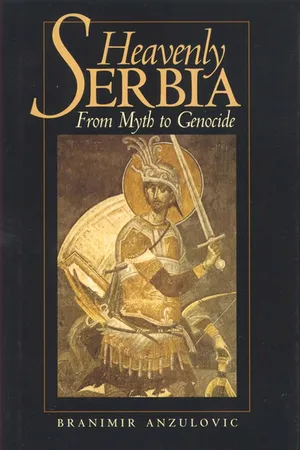
Traces Serbia's nationalist and expansionist impulses to the legendary battle of Kosovo in 1389
As violence and turmoil continue to define the former Yugoslavia, basic questions remain unanswered: What are the forces behind the Serbian expansionist drive that has brought death and destruction to Croatia, Bosnia and Herzegovina, and Kosovo? How did the Serbs rationalize, and rally support for, this genocidal activity?
Heavenly Serbia traces Serbia's nationalist and expansionist impulses to the legendary battle of Kosovo in 1389. Anzulovic shows how the myth of "Heavenly Serbia" developed to help the Serbs endure foreign domination, explaining their military defeat and the loss of their medieval state by emphasizing their own moral superiority over military victory. Heavenly Serbia shows how this myth resulted in an aggressive nationalist ideology which has triumphed in the late twentieth century and marginalized those Serbs who strive for the establishment of a civil society.
Author interview with CNN: http://www.cnn.com/chat/transcripts/branimir_chat.html
- 256 pages
- English
- ePUB (mobile friendly)
- Available on iOS & Android
eBook - ePub
About this book
Information
1
Heavenly Serbia
The Birth of the Myth
Folk singers played a very important role in the illiterate and eliteless Serbian society following the Turkish conquest. Accompanying their chanting with a one-stringed fiddle called the gusle, they were not merely entertainers but bards who transmitted to their audiences a vision of the nation’s past and future. However, they were not necessarily the creators of the myths propagated by their songs. The story of how Prince Lazar opted for the heavenly kingdom in the 1389 battle on the Field of Kosovo seems to have originated with the Narration about Prince Lazar by Serbian Patriarch Danilo III (who transferred the relics of the slain prince from the church of St. Spas in Priština to Ravanica Monastery in 1391), the noblewoman Jefimija’s embroidered Encomium to Prince Lazar, and several texts by anonymous authors, written within thirty years after the battle.1 These texts all interpret Prince Lazar’s fate at Kosovo as a martyr’s victory and a triumph of the commitment to the “heavenly kingdom” over the “earthly kingdom.” Very few people have read the actual texts, but the folk songs based on their theme have had huge audiences over the centuries.
The best-known song about Prince Lazar’s choice of the heavenly kingdom is “The Downfall of the Kingdom of Serbia.” It tells of the prince’s decision after a messenger sent by Saint Elias presented him with a choice:
Oh, Tsar Lazar, of honorable descent,
which kingdom will you choose?
Do you prefer the heavenly kingdom,
Or do you prefer the harthly kingdom?
If you prefer the earthly kingdom,
saddle the horses, tighten the girths!
You knights, belt on your sabers,
and charge against the Turks:
the entire Turkish army will perish!
But if you prefer the heavenly kingdom,
build a church at Kosovo,
do not make its foundation of marble,
but of pure silk and scarlet,
and make the army take Communion and prepare;
your entire army will perish,
and you, prince, will perish with it.2
which kingdom will you choose?
Do you prefer the heavenly kingdom,
Or do you prefer the harthly kingdom?
If you prefer the earthly kingdom,
saddle the horses, tighten the girths!
You knights, belt on your sabers,
and charge against the Turks:
the entire Turkish army will perish!
But if you prefer the heavenly kingdom,
build a church at Kosovo,
do not make its foundation of marble,
but of pure silk and scarlet,
and make the army take Communion and prepare;
your entire army will perish,
and you, prince, will perish with it.2
The prince chose the heavenly kingdom, built a tent-church, “and called the Serbian patriarch / and twelve grand bishops, / and made the army take Communion and prepare.”3 The song then describes the ensuing fierce battle, in which the Serbian army perished together with its leader.
Another important folk song about the Kosovo legend is “The Prince’s Supper” (“Kneževa večera”), which tells about Prince Lazar’s supper with his knights on the eve of the battle. The analogy with Christ’s Last Supper is obvious, as a commentator observes: “What is the Kosovo Supper but a repetition of the Last Supper? The Sacrificial Victim presides over both. At the Last Supper it is Christ, God, who sacrifices himself; at the Kosovo Supper, a ruler and a people sacrifice themselves.”4 In more than one figurative representation of the Kosovo Supper in Serbian churches and monasteries, Lazar appears as though seated at the Last Supper, surrounded by twelve apostle warriors. The analogy with the Last Supper is further enhanced by the presence of an alleged traitor among the twelve.5
The original—and perfectly normal—function of the legend of Prince Lazar’s choice of the heavenly kingdom was to transform an alleged military defeat into a moral victory. The legend was gradually expanded to portray people who at every decisive turn in their history opt for the heavenly kingdom by taking the moral high ground. Archimandrate Justin Popović (1894–1979), a prominent theologian and university professor, is one of the modern proponents of this idea:
The greatness of our people consists in the fact that they have, through Saint Sava, adopted evangelic justice and transformed it into their own. In the course of centuries they have developed such an affinity with this justice that it became their everyday, customary gospel. Only this can explain why our people have in all fateful moments of their history always preferred the heavenly to the earthly, the immortal to the mortal, the eternal to the transitory.6
Unheavenly Heroes
The Kosovo legend contains a contradiction. On the one hand, it praises Prince Lazar, the leader of the Serbian army at Kosovo, for choosing the heavenly kingdom, even at the cost of defeat and slavery. On the other hand, the most admired hero of the Kosovo cycle—Miloš Obilić—is guided by a pagan-heroic rather than Christian ethic.
Obilić is celebrated for a single action, which combined trickery with heroic self-sacrifice.7 According to one version of his legend, Obilić came to see Sultan Murad I during the Battle of Kosovo pretending that he wanted to become his vassal, but when he was granted an audience he pulled out a knife hidden in his clothes and slaughtered the Ottoman chief. Some versions of the legend feature different locations, but the hero always uses a ruse to approach the sultan and kill him.
The extent of the Obilić cult is attested by the fact that he is sometimes represented as a saint. For example, in Grabovac Monastery, south of Niš, “[o]n the wall at the altar there is a picture of Prince Lazar, and Miloš Obilić next to him. Around Miloš’s head there is the traditional saintly halo and the inscription: Saint Milošs Obilić!”8 Hilandar, a prestigious Serbian monastery on Mount Athos in Greece, also holds a picture of Miloš Obilić as a saint.
While Obilić is the most admired legendary Serbian hero, Prince Marko is the most popular one. Hundreds of folk songs describe his many feats, often involving cunning and extraordinary strength. But unlike Obilić’s deceitfulness and violence, which can be justified as acts of war, Marko’s violent acts often serve no purpose other than the venting of his rage. In comparison with other legendary heroes, Prince Marko displays an astonishing number of negative traits, such as duplicity, brutality, and collaboration with the conqueror of his country. Ruse has been used by many famous heroes ever since Ulysses devised the famous horse, and some of them are occasionally very cruel, but none match Marko in the scope of his deceitfulness and brutality against the weak. Women, even those who love and help him, are not spared.
In the folk song “Marko Kraljević and the Daughter of the Moorish King,” Prince Marko tells his mother about the Moorish princess who saved him from prison. She fell in love with Marko while he was imprisoned by her father, and helped him escape after he had sworn that he would marry her. But the prince did not meet the princess’s expectations. Instead, he killed her when he regained his freedom:
And the Moorish maiden took me,
Encircling me with her black arms,
And when I looked on her, mother,
On her black face and white teeth,
A loathing gat hold of me;
I drew the rich-wrought sabre,
And smote her on the silken girdle,
That the sabre cut clean through her.9
Encircling me with her black arms,
And when I looked on her, mother,
On her black face and white teeth,
A loathing gat hold of me;
I drew the rich-wrought sabre,
And smote her on the silken girdle,
That the sabre cut clean through her.9
Such treatment of women is not unusual for Prince Marko. D. H. Low’s collection of twenty-nine popular songs about the legendary prince contains several in which the hero’s violent temper is directed against women. In one of them, “A Damsel Outwits Marko,” the woman is spared from the sabre only by her wit, but in another the victim is brutally maimed. The protagonist of “The Sister of Leka Kapetan,” the beautiful and outspoken Rosanda, enrages Marko by rejecting his offer of marriage:
Liever had I remain unwed,
In this our realm of Prizren
Than go to Prilep castle,
And be called Marko’s wife.
For Marko holds of the Sultan,
He fights and smites for the Turks,
. . . . . . . . . . . . . . . . . . . .
Wherefore with all my beauty should I be wife to a
Turkish minion?
In this our realm of Prizren
Than go to Prilep castle,
And be called Marko’s wife.
For Marko holds of the Sultan,
He fights and smites for the Turks,
. . . . . . . . . . . . . . . . . . . .
Wherefore with all my beauty should I be wife to a
Turkish minion?
Marko decides to punish Rosanda. In order to do so he entices her to come closer to him:
O damsel, O proud Rosanda,
I beseech thee of thy youthfulness,
Send from thee thy maidens
And turn thy face to me!
For I was sore abashed, Rosa,
Before thy brother in the čardak [closed balcony]
So that I saw thee not well.
And when I go to Prilep castle,
My sister will weary me
Asking: “Was Rosa fair to look upon?”
Turn thee, that I may see thy face.
I beseech thee of thy youthfulness,
Send from thee thy maidens
And turn thy face to me!
For I was sore abashed, Rosa,
Before thy brother in the čardak [closed balcony]
So that I saw thee not well.
And when I go to Prilep castle,
My sister will weary me
Asking: “Was Rosa fair to look upon?”
Turn thee, that I may see thy face.
When Rosanda complies with the request, she is brutally attacked:
Marko raged and was wroth out of wit,
One step he made and a mighty spring,
And by the hand he seized the damsel,
He drew the sharp dagger from his girdle,
And cut off her right arm;
He cut off her arm at the shoulder,
And gave the right arm into her left hand,
And with the dagger he put out her eyes,
And wrapped them in a silken kerchief,
And thrust them into her bosom.10
One step he made and a mighty spring,
And by the hand he seized the damsel,
He drew the sharp dagger from his girdle,
And cut off her right arm;
He cut off her arm at the shoulder,
And gave the right arm into her left hand,
And with the dagger he put out her eyes,
And wrapped them in a silken kerchief,
And thrust them into her bosom.10
Rosanda’s rejection of Prince Marko points to still another negative feature of the hero: he was a collaborator. Several songs in the same collection refer to Marko serving the sultan and being rewarded for it. This trait of the legendary Prince Marko reflects the behavior of his historical prototype, King Marko Mrnjavčević (1335?–94). The real Marko, who became king in 1371, was a Turkish vassal who put himself and his army at the service of the Turks and died in the Battle of Rovine on May 17, 1394, fighting for the sultan against the Wallachian Prince Mircea.
The literary historian Svetozar Koljević states that Marko appears as an “ideal figure,” noble and generous, in only three or four poems, in which he does not deal with human beings but with hawks or eagles.11 Yet even in these instances, Marko’s choice of a predatory animal that consumes human flesh and blood involves violence. An eagle saved by Marko relates how it became incapacitated on the Kosovo battlefield:
Up to the stirrups of the steed that day the red blood ran,
Unto the silken girdle of many a fighting man;
Horses and heroes swam, steed by steed, and hero hero by,
And we flew up hungry and thirsty, the vultures of the sky;
We fed on human flesh, we drank our fill of human blood.12
Unto the silken girdle of many a fighting man;
Horses and heroes swam, steed by steed, and hero hero by,
And we flew up hungry and thirsty, the vultures of the sky;
We fed on human flesh, we drank our fill of human blood.12
As the sun dried the blood in its feathers the eagle could no longer fly, but Prince Marko put it on his horse and saved it from death. In another version of the song, the grateful bird reminds Marko that he himself gave it human flesh and blood: “you fed me the flesh of heroes, / you gave me red blood to drink.”13
The legends of Prince Marko and Miloš Obilić followed different paths. The songs about Prince Marko were most popular during the first centuries of the Ottoman occupation, when the Serbian Orthodox Church enjoyed a privileged position in the Ottoman Empire and many Serbs served as martologues—Christian soldiers in the Ottoman army. During the same period the Obilić legend was cultivated mainly in the south Slavic areas not conquered by the Turks and farther west. The Obilić cult was revived in Serbia when the tension between the Serbian raya (the poor non-Muslim population in the Ottoman Empire) and the Turkish authorities began to grow. At that time, and particularly during the nineteenth-century Serbian struggle for independence, folk singers made Marko less brutal and more patriotic, so that both Marko and Obilić were seen as heroes of Serbian resistance against the Turks.
Serbian Patriarch Gavrilo (1881–1950) embraced the two heroes (together with a few other characters equally associated with violence in the service of the nation, as will later be demonstrated) as pillars of what he calls the “Kosovo ethics.” In a text celebrating a 1941 Belgrade coup d’état, he glorified them as models to be followed:
[T]he Kosovo ethics . . . has elevated our past and exalted the spirit of Obilić, who became an ideal and a model of heroism, as well as the scope of Prince Marko, a protector of justice and a hero who defeated the enemy. All of this is best formulated in the characters of Bishop Danilo and his heroes as presented in The Mountain Wreath, where Njegoš’s genius vividly and accurately describes the drama of the Serbian people in their fall and eventual rise in full victory over the enemy. The same Kosovo spirit inspired Karađorđe and Miloš [Obrenović] to build a new foundation for the Serbian state, which rose ever higher, and this clearly proves that the entire ascent of the Serbian people in history was won only and exclusively by the sword, in a sea of spilled blood and countless victims, which means that without all of this there is no victory, as there is no resurrection without death.14
The Byzantine Heritage
The Byzantine Empire provided the model for medieval Serbia’s institutions and culture. It is therefore tempting to explain the violence and the cult of blood among the Serbs as a part of their Byzantine heritage. There is no difficulty in finding examples of extreme violence in the long history of that empire, such as the blinding in 1014 of an entire fifteen thousand-man Bulgarian army by the order of the Byzantine emperor Basil II, nicknamed the Bulgar-slayer (every hundredth soldier was left with one eye so he could lead the others home), or the fate of many Byzantine rulers:
Of the 109 sovereigns twenty-three ended by being assassinated. Twelve died in a convent or prison. Three died of starvation. Eighteen were mutilated by castration, or had their eyes gouged, or nose or hands cut off; and, apart from the thirty-four who died in their beds, and eight that were killed in a war or accident, the others were poisoned, suffocated, strangled, stabbed, hurled from the top of a pillar, or driven away ignominiously. Altogether, within 1058 years there were sixty-five palace-, street-, or barracks revolutions, and sixty-five dethronements.15
Harsh punishment stipulated by the law, which often involved cutting off noses, putting out eyes, and tearing off ears, were additional manifestations of cruelty in the Byzantine civilization.
However, it is no less difficult to compile a list of atrocities committed by Western Europeans in the struggle for power or in the service of state and church. The orgy of killing, rape, and looting unleashed by the Crusaders in Jerusalem and Constantinople upon the conquest of these cities, or the burning of heretics, sorcerers, and witches at the stake over several centuries are just a few pages of Western history that could justify a view of Western civilization as an extremely violent one. The traditional Western view of Byzantium as a corrupt and violent empire has been facilitated by the general inclination of every group to see its own crimes as aberrations, and those of the rival as paradigmatic. As for violence at the top of the power pyramid, the Ottoman Empire—where a newly elected sultan customarily killed all the relatives who might challenge his position—provides additional evidence that a high level of violence at the top does not necessarily mean that the other strata of the society are equally violent.
The Byzantine Empire, as the surviving half of the Roman Empire, was the center of civilized life in the then-known world, and it performed an important civilizing function. At a time when Western Europe was plunged into chaos and poverty, the empire based in Constantinople, the “New Rome,” preserved the rich heritage of Hellenic and Roman cultures, and combining them with Christianity, achieved great results in the arts and crafts, philosophy, theology, jurisprudence, and other realms of culture. The architectural marvel of Hagia Sophia in Istanbul still stands as a testimony to the glory of Byzantine culture. The empire had an excellent civil service, the status of women was higher than in other contemporary civilizations, and the care of the poor and weak was well organized.
In addition to preserving and building on many achievements of Greco-Roman civilization, Constantinople extended its civilizing function to barbarian tribes that settled in central and eastern Europe during the era of migrations. It sent missionar...
Table of contents
- Cover Page
- Title Page
- Copyright Page
- Contents
- Acknowledgments
- A Note on Pronunciation, Transliteration, and Translation
- Introduction
- 1 Heavenly Serbia
- 2 The Encounter with the Turks
- 3 Dinaric Highlanders and Their Songs
- 4 The Dilemmas of Modern Serbian National Identity
- 5 A Vicious Circle of Lies and Fears
- 6 The Outsiders’ Myth-Calculations
- Conclusion
- Notes
- Selected Bibliography
- Index
Trusted by 375,005 students
Access to over 1.5 million titles for a fair monthly price.
Study more efficiently using our study tools.
Frequently asked questions
Yes, you can cancel anytime from the Subscription tab in your account settings on the Perlego website. Your subscription will stay active until the end of your current billing period. Learn how to cancel your subscription
No, books cannot be downloaded as external files, such as PDFs, for use outside of Perlego. However, you can download books within the Perlego app for offline reading on mobile or tablet. Learn how to download books offline
Perlego offers two plans: Essential and Complete
- Essential is ideal for learners and professionals who enjoy exploring a wide range of subjects. Access the Essential Library with 800,000+ trusted titles and best-sellers across business, personal growth, and the humanities. Includes unlimited reading time and Standard Read Aloud voice.
- Complete: Perfect for advanced learners and researchers needing full, unrestricted access. Unlock 1.5M+ books across hundreds of subjects, including academic and specialized titles. The Complete Plan also includes advanced features like Premium Read Aloud and Research Assistant.
We are an online textbook subscription service, where you can get access to an entire online library for less than the price of a single book per month. With over 1.5 million books across 990+ topics, we’ve got you covered! Learn about our mission
Look out for the read-aloud symbol on your next book to see if you can listen to it. The read-aloud tool reads text aloud for you, highlighting the text as it is being read. You can pause it, speed it up and slow it down. Learn more about Read Aloud
Yes! You can use the Perlego app on both iOS and Android devices to read anytime, anywhere — even offline. Perfect for commutes or when you’re on the go.
Please note we cannot support devices running on iOS 13 and Android 7 or earlier. Learn more about using the app
Please note we cannot support devices running on iOS 13 and Android 7 or earlier. Learn more about using the app
Yes, you can access Heavenly Serbia by Branimir Anzulovic in PDF and/or ePUB format, as well as other popular books in History & Middle Eastern History. We have over 1.5 million books available in our catalogue for you to explore.