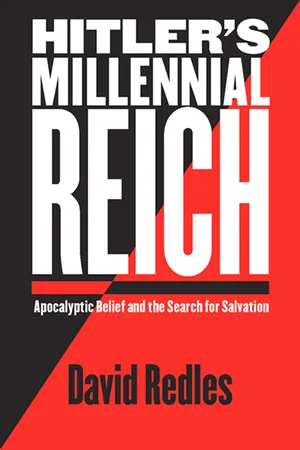
After World War I, German citizens sought not merely relief from the political, economic, social, and cultural upheaval which wracked Weimar Germany, but also mental salvation. With promises of order, prosperity, and community, Adolph Hitler fulfilled a profoundly spiritual need on behalf of those who converted to Nazism, and thus became not only Führer, but Messiah contends David Redles, who believes that millenarian sentiment was central to the rise of Nazism.
As opposed to many works which depersonalize Nazism by focusing on institutional factors, Redles offers a fresh view of the impact and potential for millenarian movements. The writings of both major and minor Nazi party figures, in which there echoes a striking religiosity and salvational faith, reveal how receptive Germans were to the notion of a millennial Reich such as that offered by Hitler. Redles illustrates how Hitler's apocalyptic prophecies of a coming "final battle" with the so-called Jewish Bolsheviks, one that was conceived to be a “war of annihilation,” was transformed into an equally eschatological “Final Solution”
- 272 pages
- English
- ePUB (mobile friendly)
- Available on iOS & Android
eBook - ePub
About this book
Information
1
A World Turned Upside Down
Weimar Chaos and the Culture of Apocalypse
Before his untimely passing, the historian Detlev Peukert noted perceptively that the Weimar period (1918–1933) should not be seen solely as marking the end of one era (the Wilhelmian) or as the beginning of another (the Nazi). Rather, he pointed out, it should be studied as an era “in its own right.”1 And, I would add, as an era, Weimar was a culture of apocalypse. While certainly not beset by the natural disasters that have generated millennial movements elsewhere, post–World War I Germany nonetheless saw changes take place in political, economic, social, and cultural spheres that were pervasive, profound, and irreversible.2 It is more than ironic that the word “Weimar” has become synonymous with the very concept of modernity, for it is the process of modernization, more than any other factor, that wrought the severe structural changes in all aspects of German society that in turn sparked the chiliastic fires that loosed the demons of Nazism. While most of the structural changes brought on by modernization were rooted in the industrialization of the nineteenth century (and the urbanization that it generated), and while the significant cultural changes that mark modernity generally had begun around the turn of the century, it was during the Weimar years that this rapid change was most profoundly experienced by a broad mass of people.3 Postwar German society, therefore, appeared as far removed culturally from the prewar times as the twentieth century was from the nineteenth.4 The convergence of catalysts that generates the rapid and radical change necessary to collapse perceptions of order and thereby elicit the apocalypse complex was not only present in Weimar society, it all but defined it.5
Political Chaos
World War I was greeted in Germany with a feeling of national euphoria, much as it had been in other countries. The war was viewed by many individuals as a holy mandate. One veteran and future Nazi believed that “it signified a holy duty to be followed through until its consummation.” Another man saw “the outbreak of war as salvation.” It was a divine fate that necessitated for many the ultimate sacrifice—one’s life. A popular war motto, later taken over by the Nazis, was “Germany must live and so we must die.” Some men even felt chosen for this duty. Another soldier and future Nazi explained that “we were chosen by destiny so that we could experience the front.”6 It was an experience that many yearned for, as one young man described it,
I felt in me the draw to the front. The desire to be permitted to actively participate finally in this holy struggle grew stronger and rose mightily to pathological proportions. Beginning in October 1914 my wish found its fulfillment. With thousands of young volunteers I left for Flanders. A great bloodbath and dying had begun. All misery and danger, however, could not possibly result in the destruction of young Germany’s power and will.7
Many Germans believed that from the bloodshed and martyrdom a social regeneration or rebirth could occur, as all classes and social groups pulled together in a Volksgemeinshaft, or “people’s community.” Kaiser Wilhelm’s call for a Burgfrieden (domestic or civil truce) whereby all political parties, and the class interests they represented, would join in a common cause for Greater Germany only bolstered this enthusiasm. Yet, the truce was short-lived and the utopian dream of a community of unified Germans left unfulfilled. By 1917–18, disenchantment and disillusionment had become the norm among the various groups involved in the Burgfrieden. As the war dragged on, class conflict escalated, and, with the war’s abrupt end in November 1918, the threat of Russian-style civil war appeared more a certainty than a possibility. After the war, the soldiers, after experiencing the organized chaos of war, returned home from the front to a chaos of a different sort. Roman Pornschlegel, a veteran and an eventual Nazi, recalled of his return: “but what did I find before me? A poor, bled to death Germany—divided and fragmented.”8 It was a world that appeared to be in a chaos of apocalyptic proportions. Another veteran remembered that “when I came from the field at the end of 1918 the situation which dominated Germany made it completely clear to me that under this system our Fatherland must go to the abyss.”9
For many Germans, the most significant event that marked this “collapse” was the “evil revolt of 1918.”10 In contrast to the euphoria that greeted the outbreak of war, the collapse of 1918 and the many revolts of 1919 were seen, in the words of one future Nazi, as the “the pure antithesis of August 1914.”11 Another Nazi, Hans Neff, remembered that “the World War had ended, there followed a horrible time in German history: betrayal, infamy and economic decline were the consequence of that gray November day in 1919.”12 The contrast of perceptions of postwar chaos with the euphoria of the prewar Burgfrieden was especially hard for returning veterans, many of whom looked for scapegoats. The recollections of the veteran and Nazi Friedrich Schott reflect this tendency, linking the loss of the war with the infamous “stab-in-the-back” myth:
When I returned home to my family circle after the war in the winter of 1918/1919, I was filled with a profound bitterness. I had experienced the war from the first day, with all its horrors and suffering, participating in many engagements and massacres. But I had endured all of this gladly, as I always had the unwavering hope that Germany would emerge victorious from these frightful battles. And now I had to experience in these dark November days, as a band of traitors, led by Jews, snatched the fruit of victory from the hands of our Fatherland and delivered us to the caprice of our enemies. So it was natural that I fed from the beginning on a profound hatred for the unscrupulous December men.13
Workers’ rebellions, mutinies, and outright communist revolution were commonplace immediately after the war. One Nazi remembered these events with obvious disgust, using typical metaphors of sexual depravity and filth:
With a bleeding heart I lived through the circumstances of the day, saw the worthless traitors stir up masses of men to storm upon the streets, saw them plunder stores, rummage through occupied houses, saw this more and more bestial mass orgy celebrated as everything holy was dragged into the mud.14
Many veterans of the front experienced the revolt “back home” as a betrayal. They were hurt by the lack of a hero’s welcome. They quickly looked for a scapegoat, as one Nazi remembered, “the revolution was rampaging, the front suffered from behind. The veteran was scoffed at and derided, the International triumphed, Jews and Jewish servants seized power in the state.”15 The rising importance of the Räte (worker’s councils) movement, the Syndicalists, and the Communist party frightened and confused many Germans. Similarly, Spartacist uprisings presented a threat of a Russian- or Hungarian-type revolution from the extreme left. The Nazi Heinrich Völker interpreted the lack of civil peace as a result of class conflict rather than the social unity that he believed would bring peace:
I felt sad and disheartened when I saw the revolutionaries with their arm bands roaming about the streets. In my circle of comrades I searched with all my power to make clear that one cannot promise a people bread when in Germany itself none was on hand. Peace could not come if men and families inside Germany could not be as one.16
Another veteran and future Nazi described his experience similarly. His use of metaphors of darkness and light and his sense of an inversion of order, as well as the localizing of blame for the chaos on a perceived Evil Other, in this case the Jews, are typical of the Nazi apocalyptic mentality. He wrote:
Barely 18 years old, I went to the field to defend our homeland against a world of instigating enemies. Twice I was wounded. Then in November 1918 the Marxist revolution broke out—dark thunderclouds descended over Germany that for fifteen years allowed no rays of light and no sunshine upon the earth. In Germany everything went upside down. The Spartacists, clothed in sailor’s uniforms, devastated and destroyed everything they could lay a finger on. The Jew rose to the pinnacle.17
The German Revolution of November 1918 therefore made the specter of communist revolution seem all too real. Street violence was rampant as the extreme left and right battled over the fate of the nation. One Nazi remembered the times in vivid fashion. His reference to “unknown forces,” most likely referring to Jews, working against the Volk hints at the conspiratorial mentality so typical of the apocalyptic movements in general, and Nazism, in particular:
In March of the year 1919 there dawned in Germany the freest republic in the world, and yet unknown forces did not permit the Volk to rest. Spartacists marched through the streets with blood red flags and murdered and plundered. Civil forces and Noske-troops stood powerless against the goings on and were set upon and slaughtered.18
To battle the rising communist threat, right-wing paramilitary groups, called Freikorps, formed to battle the leftists. One Freikorps member and future Nazi, Josef Schulz, explained his decision to join:
1918—collapse. Instant unemployment. There was no assistance. The “victor” marched in. The Rhineland occupied. Americans in Linz. In unoccupied Germany Spartacists raged. I came as a volunteer orderly with a medical transport to Stettin in early 1919. Upon the return journey I saw on a placard in Berlin a proclamation: “Who will save the Fatherland? Freikorps Lützow! Join Freikorps Lützow!” Rootless and jobless, without even returning home, I joined Freikorps Lützow in Berlin.19
This man, having lost the sense of meaning and direction he had had during the war, found it anew in the paramilitary group. He would find it again with the Nazis.
The Kapp and Hitler putsches, or coups, which proposed to “save” the Fatherland from the leftists, were supported by many Germans (including many civil servants). Whereas the “revolts” from the left were seen as “betrayals,” the putsches, though no less divisive and revolutionary, were viewed by many as a sign of hope. As Hans Haster interpreted the putsch, “Kapp is in Berlin, the Red government flees to Stüttgart. Anxiously I hope: has the turning point finally come?”20 Similarly, another man said of the Hitler putsch, “Yet in Berlin one knew little of the Hitler movement. As with the Kapp putsch in 1920, so were the happenings in Munich a cause for my heart to rise higher—hope awakened. Yet also in this case it was again not fulfilled. It was again still.”21 Others, however, were more optimistic. Wilhelm Schuchman explained that while he had studied politics a good deal in the early 1920s, he had found that “nothing could inwardly liberate me. Then information of the Hitler putsch penetrated our region and caused me to prick up my ears.”22 Yet, despite this support, the putsches had the effect of making the threat of all-out civil war seem a very real possibility. As one man recalled, “the year 1920 was characterized by the Kapp putsch and the communistic Ruhr revolts. It was a year of domestic chaos, a year of civil war. All of Germany stood opposing one another in two armed encampments.”23 Another man concluded, as many others did as well, that “all the difficult sacrifices at the front were done for nothing, and the camaraderie of the front was replaced in our Volk with fraternal strife and civil war.”24 The dream of the Burgfrieden was dead, but it would be resurrected in Hitler’s National Socialism.
The political situation, therefore, was anything but stable. Decisions made at the Paris Peace Conference only made Germany’s fragile condition worse. In an effort to weaken Germany and to provide buffer zones in the east and the west, the Allies decided that Germany should lose territories on the continent and abroad. For many Germans, this territorial reduction was a ghoulish dismembering of the Volk body, designed to further weaken an already sick nation. The Allies further decided that the German military should be dramatically weakened in arms and people. While this was supposed to be the first step in a general European reduction of arms, it was, for many Germans, a needless emasculation. The infamous war-guilt clause, which forced Weimar leaders to accept German responsibility for the war, was another point of national humiliation. Not only did this indict the leaders of the fledgling democracy, but also it flew in the face of the opinion held by most Germans that their country had been forced to defend itself against “a world of enemies.” It is perhaps not surprising, then, that the “insane dictate of Versailles,” as one Nazi referred to it, became the focus of grievance.25 Roman Pornschlegel recounted with bitterness,
The unholy Peace Treaty and the inflation squeezed us like a lemon. Many people had to live out their lives in the postwar time poor and hopeless. The promised silver lining remained out on the horizon. The former enemies were ever insolent and thoughtlessly used German land and exploited us yet more.26
This linking of Versailles to the perceived apocalyptic chaos of the postwar years was common, as one Old Guard Nazi recalled,
The nightmare of the degradation of our Fatherland, which through the Versailles Treaty nearly had its breath stolen, hindered the free development of industrious German working men. Everything that was created by hand was stolen by the Versailles Treaty. Hunger and deprivation swept over Germany like an epidemic. It appeared to us nearly unthinkable that such a treaty, one that led an entire nation to the edge of an abyss of destruction, could be created in a civilized world.27
Any political system that arose from such a hated treaty was faced with the near impossible task of winning supporters from a suspicious and frightened populace. The Weimar democracy encountered such a challenge.
Perhaps most important, in the view of many of its citizens, Germany was forced to yield a say in its political determination. Deeming German monarchism one of the prime agents responsible for the war, the Allies believed, rather naively, that the institution of true parliamentary democracy in Germany would prevent a recurrence of such a conflict. Unfortunately, the democracy that developed, the Weimar Republic, was viewed by many as an un-German, “Judaized” system forced on the German people. Many dedicated their lives to its destruction, such as Jakob Buscher, who explained that “now more than ever my solution was to fix everything upon the destruction of this murder-state, this Jewish-Republic.”28
The confusion and indecision that parliamentary democracy can create, particularly in a society unfamiliar with it, led to the perception of a “parliamentary quagmire” at exactly the time when a clear and decisive policy appeared sorely needed.29 The proliferation of competing parties created what many termed pejoratively the “Parteisystem.” This “system” became a symbol of the disunity and chaos that were bringing Germany to the verge of apocalypse. It was a common complaint that “party quarrels and squabbles splintered the Volk.”30 Hans Otto observed that parties “grew like a fungus upon the earth.”31 Another Nazi agreed:
one government alternated with another. Marxist mass gatherings! The citizenry was splintered into smaller and smaller parties. Program upon program swirled through the air. A completely uniform and clear direction was lacking. It appeared impossible in this witch’s temple to find one’s way from one slogan or another. The Volk was fissured in interests and opinions, in classes and estates—a plaything of enemy powers and nations.32
Once again, metaphors of filth, depravity, and decomposition are associated with the disunity that was bringing Germany to the abyss. What they called for were purity and a regeneration of society, something the Nazis would make a fundamental tenet of their beliefs.
Economic Chaos
If the political situation seemed chaotic, economic conditions during most of the Weimar years were nothing less than catastrophic. Prior to the war, the German economy, powered by rapid industrialization, had been marked by almost continuous growth. It was this expansion that, in many ways, made modernity possible. It raised the possibility of a broad spectrum of social welfare reforms while simultaneously providing the monies necessary to fund them. Yet, thirty years of industrial expansion ended abruptly with the beginning of World War I. The war itself played a large role in the sudden change in economic good fortune. Germany’s first real inflation began during the wartime e...
Table of contents
- Cover Page
- Title Page
- Copyright Page
- Dedication
- Contents
- Acknowledgments
- Introduction: Nazism, Myth, and Meaning
- 1 A World Turned Upside Down: Weimar Chaos and the Culture of Apocalypse
- 2 The Turning Point: Racial Apocalypse or Racial Salvation
- 3 Seeing the Light: The Nazi Conversion Experience
- 4 Hitler as Messiah
- 5 The Messiah Legitimated: Linking the Leader and the Led
- 6 Final Empire, Final War, Final Solution
- Appendix: The Hitler Gospels and Old Guard Testimonials: Reconstructing a Mythical World
- Notes
- Index
- About the Author
Trusted by 375,005 students
Access to over 1.5 million titles for a fair monthly price.
Study more efficiently using our study tools.
Frequently asked questions
Yes, you can cancel anytime from the Subscription tab in your account settings on the Perlego website. Your subscription will stay active until the end of your current billing period. Learn how to cancel your subscription
No, books cannot be downloaded as external files, such as PDFs, for use outside of Perlego. However, you can download books within the Perlego app for offline reading on mobile or tablet. Learn how to download books offline
Perlego offers two plans: Essential and Complete
- Essential is ideal for learners and professionals who enjoy exploring a wide range of subjects. Access the Essential Library with 800,000+ trusted titles and best-sellers across business, personal growth, and the humanities. Includes unlimited reading time and Standard Read Aloud voice.
- Complete: Perfect for advanced learners and researchers needing full, unrestricted access. Unlock 1.5M+ books across hundreds of subjects, including academic and specialized titles. The Complete Plan also includes advanced features like Premium Read Aloud and Research Assistant.
We are an online textbook subscription service, where you can get access to an entire online library for less than the price of a single book per month. With over 1.5 million books across 990+ topics, we’ve got you covered! Learn about our mission
Look out for the read-aloud symbol on your next book to see if you can listen to it. The read-aloud tool reads text aloud for you, highlighting the text as it is being read. You can pause it, speed it up and slow it down. Learn more about Read Aloud
Yes! You can use the Perlego app on both iOS and Android devices to read anytime, anywhere — even offline. Perfect for commutes or when you’re on the go.
Please note we cannot support devices running on iOS 13 and Android 7 or earlier. Learn more about using the app
Please note we cannot support devices running on iOS 13 and Android 7 or earlier. Learn more about using the app
Yes, you can access Hitler's Millennial Reich by David Redles in PDF and/or ePUB format, as well as other popular books in History & German History. We have over 1.5 million books available in our catalogue for you to explore.