As we approach the 21st century, we also approach the third decade of the AIDS epidemic. Mental health care providers must face the crucial fact that the human immunodeficiency virus (HIV) and the condition it causes, Acquired Immune Deficiency Syndrome (AIDS) is the leading cause of death among Americans aged 25-44 years.
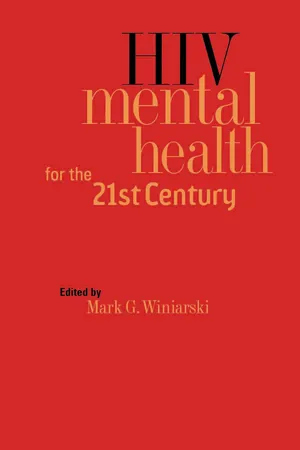
HIV Mental Health for the 21st Century provides a roadmap for mental health professionals who seek to develop new strategies aimed at increasing the longevity and quality of life for people living with HIV/AIDS, as well as at controlling the future spread of the disease. Divided into five sections, this volume covers basic concepts in HIV/AIDS mental health; specialized aspects of HIV/AIDS clinical care; models of clinical care; program evaluation; and HIV mental health policy and programs. Chapters treat issues such as feelings of caregivers, the role of spirituality in mental health care, rural practice, mental health home care, and working with children.
- 392 pages
- English
- ePUB (mobile friendly)
- Available on iOS & Android
eBook - ePub
HIV Mental Health for the 21st Century
About this book
Information
I Basic Concepts in HIV/AIDS Mental Health
1 Understanding HIV/AIDS Using the Biopsychosocial/Spiritual Model
• A woman, divorced after seven years of marriage and now in her thirties, says she refuses to date because she is afraid of AIDS.
• A fourteen-year-old high school student drinks a “40” (beer in a forty-ounce bottle) and then fails to use barriers during sexual intercourse.
• A Long Island executive, with a wife, a lively four-year-old son and a $300,000 house, dies of HIV-related illness, and the widow keeps the cause of death a secret.
• A man, proud to have stopped his habit of intravenous drug twelve years ago and having worked continuously since, is hospitalized for pneumocystis carinii pneumonia.
Our everyday lives are complicated enough and, too often, painful and hard to understand. Imagine, then, being faced with a condition that in the early 1980s manifested itself through a quick and unexplained illness and death. Then, within a decade and with medical progress, the condition became a long-term chronic condition, rather than a death sentence rendered quickly. Now we know this condition as Acquired Immune Deficiency Syndrome (AIDS), which is also called human immunodeficiency virus-related disease, named for the virus (HIV) that causes the disorder.
Imagine, also, as HIV/AIDS comes to public consciousness, mental health providers having to learn to respond with skill and compassion to a life-threatening situation that involves a complex constellation of personal and community considerations. As with heart disease, cancer, or a disabling injury, great emotional trauma is involved. But with HIV/AIDS, the emotional trauma is compounded by a societal reaction that judges the HIV-infected person very harshly, unlike current public reactions to those with heart disease or cancer. Often that severe reaction is internalized, creating a loathing of self.
If someone were asked to create a condition that would test our society where it was most vulnerable—on issues such as mortality and morality, compassion and judgmentalism—it is unlikely one could create anything more challenging than HIV/AIDS. Consider these issues:
• Because the human immunodeficiency virus is spread through exchange of bodily fluids—during sex, in artificial insemination, when sharing contaminated syringes during injection drug use, in transfusions and infusions of blood and blood products, and from mother to baby in utero and during breastfeeding—HIV and AIDS is a taboo topic for many.
• Because HIV is most often spread during sex and drug use, large portions of American society judgmentally regard persons with HIV/AIDS as moral degenerates who are to blame for their illness. The judgment is evident in the allowance made for infected children and for persons who were infected by contaminated blood products, who are viewed as “innocent” victims.
• Irrational fears of contamination have deprived many of adequate medical and other care, and even from basic human contact. As late as 1995, White House guards donned rubber gloves during a visit by a gay contingent.
Many people still believe that their communities, their family members, and they themselves are immune to HIV. The strength of this belief indicates the effects of the virus on our society. Too many claim immunity because they cannot acknowledge their fears or confront the implicit judgment, which is, “I am immune because I am not like those others.”
But now, and especially for the next century, no individual and no community can afford to dismiss HIV as a condition that happens to others. HIV threatens all our communities and all our clients, in ways overt and in ways subtle, hidden, and complex.
Mental health practitioners, especially, cannot be so dismissive or unaware. Each of the clinical anecdotes that began this chapter is HIV-related, and each person described is a mental health practitioner’s client. The woman who refuses to date because she fears AIDS may not be HIV-positive, but she is HIV-fear-positive, and that phobia can significantly affect her life. Or, perhaps, she may be using HIV fear as a plausible excuse that covers fears of intimacy. The secrecy that surrounded the death of the Long Island executive is fairly typical in suburban areas and is one reason that people in these communities are not aware of their incidence of HIV infection.
If a mental health practitioner believes HIV infection doesn’t occur in his or her community and therefore fails to learn how to address it appropriately with clients, he or she does clients a grave disservice. In fact, many would argue that discussion of HIV issues should be a part of every mental health practice. The practitioner must be able to respond empathically and skillfully:
• Whether a client is infected with HIV or is a family member or neighbor of someone with HIV/AIDS
• When a client says a fear of HIV is preventing a desired relationship
• When a client is sexually active and doesn’t fear HIV sufficiently to have safer sexual attitudes
These clients include us all.
The HIV-related tasks for mental health practitioners, then, are many and complicated. They involve constant self-scrutiny of our feelings and reactions (see chapter 3). They also involve constant learning.
Too often, however, practitioners confuse the collecting of facts with development of understanding. Certainly, the realm of HIV/AIDS knowledge is broad and can be confusing. But understanding HIV entails much more than assembling a headful of facts, be they medical or psychological, to be pronounced to oneself or to a client. Skillful practice requires, foremost, a conceptualization of HIV in which many interlocking and complicated pieces of knowledge may come together and be unified.
Think of this process as similar to assembling a jigsaw puzzle. Most of us look at the puzzle’s boxtop, which depicts the finished product, before we tackle the assembly of individual pieces. This chapter is the boxtop for the HIV/AIDS puzzle. It provides a conceptual framework that will help the reader piece together the many complicated aspects of HIV. Using this template, the practitioner can skillfully integrate the many facts that he or she will gather from reading this book and from other sources. This conceptualization enables the practitioner to make a comprehensive assessment of the HIV-affected client. The assessment findings and the model then guide the practitioner in planning care that is far-reaching. Finally, the model informs interdisciplinary practice, which will be a hallmark of the next decade of care.
The Biopsychosocial/Spivitual Model
Fortunately, this author does not have to create this comprehensive view. A metamodel, which means a more comprehensive model or one that enfolds several other models, already exists that will illuminate the way. It is called the biopsychosocial model, developed by Engel and modified by this author to include spiritual aspects.
The biopsychosocial/spiritual model acknowledges that all persons have many aspects and that these aspects all interact. Figure 1.1 may help explain the model. In this figure, each circle represents an aspect of our lives. These broad, interlocking aspects have the following general definitions:
• Biological or biomedical—pertaining to flesh, blood and bone, organisms, and such entities as viruses.
• Psychological—having to do with the inner life of the individual, including emotions, self-judgments, motivations for relatedness with others, and internal reasons for behaviors, generally.
• Social—the person’s participation or lack of participation in family, community and society (including the therapist), and the effects of family, community, and society on the person. One’s culture resides in this realm, although one’s reactions to the culture may be psychological.
• Spiritual—not necessarily an attachment to organized beliefs or religious institutions, although that certainly may be present. Spiritual aspects often include an internal belief or sense that acknowledges an “other,” a reality beyond normal experience, which may be a presence or meaning that surpasses current reality. In this realm we include belief in God, “higher power,” “the seed,” and particular cultural expressions of spirituality.
Generally, our Western society views each of these aspects separately. When “health care” is mentioned, for example, most people think “medical care,” an indication of our overemphasis on biomedical responses, to the exclusion or neglect of care of other aspects of ourselves. In the biopsychosocial/spiritual model, the different realms may be separated out for purposes of distinguishing major components and for planning our assessment and interventions. Yet, the sophisticated provider realizes that all these aspects interplay; they all affect one another.

Figure 1.1. The Biopsychosocial/Spiritual Model
Consider application of the model to the situation of a person who, after testing, is told that she is HIV-positive.
Since the recognition of AIDS and HIV, and in many institutions still, the person who receives a test result that indicates HIV infection is immediately drawn into a Whitewater torrent of months of laboratory tests, visits with medical providers, prescriptions for prophylactic (preventative) medicines, and discussions about the newest medical interventions. While the body may generally be well cared for, other aspects require attention, such as:
• The person’s psychological reaction. Many patients, still unfamiliar with HIV, react with the belief they have been given a death sentence. (An unknowledgeable mental health provider may collude by joining in the client’s hopelessness.) Even those who cognitively “know” that HIV/AIDS is chronic are likely to have a strong psychological response that may include despair, fear, dread, guilt, shame, or even relief that comes with knowledge.
• The reactions of those who love that person, who make love with the person, go to church with the person, or are estranged from the person.
• The spiritual reaction of the person, who may or may not have a system of beliefs or feelings about God, “higher power,” or meanings of life. When Kubler-Ross (1969) suggested that one step in dealing with terminal illness is bargaining, she also suggested that most persons in that situation bargain with a God-type figure.
Two exercises may help you understand the interplay of our many aspects.
First, if your community has anonymous HIV testing—that is, a place where you do not have to give your name and where you will not be recognized—go and be tested. Regardless of your sexual history and your risk of having HIV, you are likely to have many emotional reactions to the experience, which will include a wait of up to two weeks for the results. Very few individuals, even those with no risks of transmission, escape the anxiety that ensues. In addition, consider telling others that you took the test. Take time to ponder your feelings and to consider what others’ reactions may be. Record your thoughts and feelings in a journal. If you are anxious and have no potential for infection, then imagine the anxiety of a person who has a high risk of being infected with HIV, and imagine the courage it takes for that person to be tested. If you fear telling someone, such as a parent or sibling, about your HIV test, imagine the fear of someone with actual risk of being infected.
To this exercise I must add several important cautionary notes. If you cannot be tested anonymously or at a place where you will not be recognized, it may be better to bypass this exercise. Too often a stigma is attached even to those who are tested, regardless of the results. Furthermore, some readers may be at risk for HIV infection, and testing may yield a positive result. A counselor competent in HIV/AIDS can help you assess your risk before testing. If you believe the risk may be significant, you should be confident that you understand all the consequences of a positive result and know about the availability of competent medical and psychological care, whether anonymity or confidentiality will be preserved, and the psychological consequences for yourself. Do not conduct this exercise if you do not understand its possible consequences.
To do the second exercise, sit with a friend in a quiet place, at a time during which you won’t be interrupted, and let the friend play the role of a physician or nurse who tells you something like this: “Two weeks ago, we took blood from you and sent it to a laboratory to be tested for HIV. I know you were concerned about the results because you had sex about six months ago with someone you didn’t know. The results have come back, and they show that you are HIV infected.” Take careful note of your emotional reactions, and imagine what the reactions of you friends, family members, and acquaintances will be. Discuss them with your friend.
Your reactions may include feeling that you should see a medical specialist, that you should pray, that you should be retested, that you should tell family members and friends or hide the fact. Your family and friends might respond with love and consolation, or they could respond with anger and shame. Personal reactions are varied—but all spring from people who are not just biological specimens but who have psychological aspects (emotions), who live in a community that has a culture (social environment), and who likely have considered the spiritual aspects of existence. Clearly, the knowledge that one is infected has significant psychological, social, and spiritual consequences.
Similarly, much that is psychological, social, and spiritual has led to behavior that carries with it the risk of introducing HIV into the body.
Take the case of the fourteen-year-old female high school student, who drank a “40,” became intoxicated, and failed to negotiate the use of a condom prior to intercourse. What factors may have led up to this unfortunate situation? A biological factor may be that she had too much alcohol in her bloodstream, which may have impaired her judgment. A psychological factor, such as low self-esteem, may have contributed to her decision to drink or to have sex. Many social factors may be implicated, including her peer group’s norms. A spiritual factor may also be involved: Perhaps she grew up in a traditional church and is oppositional and defiant to the church’s attitudes regarding sex. Many more issues may be involved here, and a skillful mental health practitioner is likely to pursue many hypotheses regarding what is involved in the young woman’s risky behaviors.
And what about the man who stopped intravenous drug use twelve years ago and has worked steadily since? His bout with pneumocystis carinii pneumonia, an opportunistic infection that takes advantage of a declining immune system, has serious psychological, social, and spiritual consequences. Psychological consequences may include depression and a feeling of being cheated. Social consequences may include loss of salary and of the ability to support his family, which may also affect his emotional well-being. Being sick, the man may seek a closeness to his God, or he may curse God for his situation. And what of the effects of the illness on his family, and its response? The interplay of all these aspects is what the HIV-infected person presents to the mental health practitioner, and what must be understood as such.
The biopsychosocial/spiritual model is useful because it allows us to think through what we know intuitively. Every aspect of HIV affects and is affected by others. (If we think it through, in fact, it seems that every aspect of life has biomedical, psychological, social, and spiritual components that affect one another.) But how does this awareness affect our mental health practice? It allows a sophisticated response to a client who learns that he or she is HIV-positive. The practitioner who views a client as a dynamic interaction of many different aspects assumes a professional stance that responds to each component. This response is a more comprehensive assessment that takes into account the various aspects and a treatment plan that derives from that comprehensive assessment.
Background Reading
Arguments for viewing the person as a biopsychosocial system are decades old, although authors have differed in their interpretation of the concept. The addition of the spiritual element as an important part of the model is newer, and somewhat controversial.
In the medical field, Engel in 1960 articulated a “unified concept of health and disease” (459) that, he said, derived from work as early as 1951. He calls “a concept of antiquity” the view that “disease is a thing in itself, unrelated to the patient, the patient’s personality, bodily constitution, and mode of life” (460). Rather, he suggests that object relations, among other factors, affect health.
In 1977 Engel used the term “biopsychosocial” and listed arguments for its adoption in medicine and psychiatry. A year later Engel (1978) alluded to an...
Table of contents
- Cover Page
- Title Page
- Copyright Page
- Contents
- Foreword
- Introduction
- I Basic Concepts in HIV/AIDS Mental Health
- II Specialized Aspects of HIV/AIDS Clinical Care
- III Models of Clinical Care
- IV How Do We Know It Works?
- V HIV Mental Health Policy and Programs
- Afterword: New Treatments, New Hopes, and New Uncertainties
- Appendix A: Medical Primer
- Appendix B: Resources — Obtaining HIV/AIDS Information Fast
- Contributors
- Index
Trusted by 375,005 students
Access to over 1.5 million titles for a fair monthly price.
Study more efficiently using our study tools.
Frequently asked questions
Yes, you can cancel anytime from the Subscription tab in your account settings on the Perlego website. Your subscription will stay active until the end of your current billing period. Learn how to cancel your subscription
No, books cannot be downloaded as external files, such as PDFs, for use outside of Perlego. However, you can download books within the Perlego app for offline reading on mobile or tablet. Learn how to download books offline
Perlego offers two plans: Essential and Complete
- Essential is ideal for learners and professionals who enjoy exploring a wide range of subjects. Access the Essential Library with 800,000+ trusted titles and best-sellers across business, personal growth, and the humanities. Includes unlimited reading time and Standard Read Aloud voice.
- Complete: Perfect for advanced learners and researchers needing full, unrestricted access. Unlock 1.5M+ books across hundreds of subjects, including academic and specialized titles. The Complete Plan also includes advanced features like Premium Read Aloud and Research Assistant.
We are an online textbook subscription service, where you can get access to an entire online library for less than the price of a single book per month. With over 1.5 million books across 990+ topics, we’ve got you covered! Learn about our mission
Look out for the read-aloud symbol on your next book to see if you can listen to it. The read-aloud tool reads text aloud for you, highlighting the text as it is being read. You can pause it, speed it up and slow it down. Learn more about Read Aloud
Yes! You can use the Perlego app on both iOS and Android devices to read anytime, anywhere — even offline. Perfect for commutes or when you’re on the go.
Please note we cannot support devices running on iOS 13 and Android 7 or earlier. Learn more about using the app
Please note we cannot support devices running on iOS 13 and Android 7 or earlier. Learn more about using the app
Yes, you can access HIV Mental Health for the 21st Century by Mark G. Winiarski in PDF and/or ePUB format, as well as other popular books in Psychology & Psychotherapy. We have over 1.5 million books available in our catalogue for you to explore.