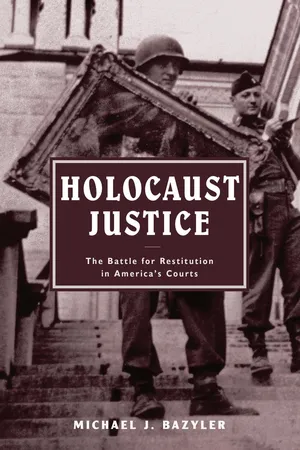
The first book to tell the complete story of the American attempt at restitution for victims of the Holocaust
The Holocaust was not only the greatest murder in history; it was also the greatest theft. Historians estimate that the Nazis stole roughly $230 billion to $320 billion in assets (figured in today's dollars), from the Jews of Europe. Since the revelations concerning the wartime activities of the Swiss banks first broke in the late 1990s, an ever-widening circle of complicity and wrongdoing against Jews and other victims has emerged in the course of lawsuits waged by American lawyers. These suits involved German corporations, French and Austrian banks, European insurance companies, and double thefts of art—first by the Nazis, and then by museums and private collectors refusing to give them up. All of these injustices have come to light thanks to the American legal system.
Holocaust Justice is the first book to tell the complete story of the legal campaign, conducted mainly on American soil, to address these injustices. Michael Bazyler, a legal scholar specializing in human rights and international law, takes an in-depth look at the series of lawsuits that gave rise to a coherent campaign to right historical wrongs. Diplomacy, individual pleas for justice by Holocaust survivors and various Jewish organizations for the last fifty years, and even suits in foreign courts, had not worked. It was only with the intervention of the American courts that elderly Holocaust survivors and millions of other wartime victims throughout the world were awarded compensation, and equally important, acknowledgment of the crimes committed against them.
The unique features of the American system of justice—which allowed it to handle claims that originated over fifty years ago and in another part of the world—made it the only forum in the world where Holocaust claims could be heard. Without the lawsuits brought by American lawyers, Bazyler asserts, the claims of the elderly survivors and their heirs would continue to be ignored.
For the first time in history, European and even American corporations are now being forced to pay restitution for war crimes totaling billions of dollars to Holocaust survivors and other victims. Bazyler deftly tells the unfolding stories: the Swiss banks' attempt to hide dormant bank accounts belonging to Holocaust survivors or heirs of those who perished in the war; German private companies that used slave laborers during World War II—including American subsidiaries in Germany; Italian, Swiss and German insurance companies that refused to pay on prewar policies; and the legal wrangle going on today in American courts over art looted by the Nazis in wartime Europe. He describes both the human and legal dramas involved in the struggle for restitution, bringing the often-forgotten voices of Holocaust survivors to the forefront. He also addresses the controversial legal and moral issues over Holocaust restitution and the ethical debates over the distribution of funds.
With an eye to the future, Bazyler discusses the enduring legacy of Holocaust restitution litigation, which is already being used as a model for obtaining justice for historical wrongs on both the domestic and international stage.
- 411 pages
- English
- ePUB (mobile friendly)
- Available on iOS & Android
eBook - ePub
About this book
Information
1
Suing the Swiss Banks
THE HOLOCAUST RESTITUTION MOVEMENT had a curious beginning. While the major perpetrator of crimes against the Jews during World War II was Germany, the movement for restitution began with accusations against Switzerland, a country that had remained neutral in the war.
Suddenly a nation that had both cultivated and maintained an image of evenhandedness and neutrality—to the point of not even joining the United Nations—was being accused of engaging in terrible financial misdeeds during the war. Switzerland no longer was viewed as a “land populated by peace-loving burghers and peasants, watchmakers, bankers and hoteliers, committed to upholding Switzerland’s ‘everlasting neutrality,’” wrote Amos Elon in a New York Times Magazine article; the image of Switzerland as “the land of Heidi and the home of the International Red Cross, ‘Europe’s pharmacy’ and perpetual aid first-aid station” was disintegrating.1 Rather, it now was being viewed as a nation that, as a result of its financial dealings with the Nazis, was guilty of profiting from the death and misery of others as well as prolonging the war. As chillingly put by one commentator: “History has caught up with William Tell and exposed him as a pimp.”2
In June 1999, Switzerland unexpectedly lost its bid for the 2006 Winter Olympics. The loss was blamed on negative publicity generated by its Holocaust-era events. Swiss Sports Minister Adolf Ogi complained, “I never even dreamed that we had such a bad reputation. I heard delegates say they wanted the Swiss to lose. People don’t like Switzerland.”3
How did the Swiss get into such a mess? Accusations that neutral Switzerland had profited from trade with the Nazis had surfaced even during the war. Immediately following the cessation of hostilities, researchers working for the Allied armies came across records of the Swiss government’s nefarious dealings with the Nazis. As a consequence, Switzerland and the Allied nations signed the Washington Accord in 1946 which forced a reluctant Switzerland to return a portion of the gold that the Nazis had stolen from the treasuries of the nations they conquered and that they either had deposited in Switzerland for safekeeping or sold directly to the Swiss. For Switzerland, the Washington Accord ended the matter of its wartime complicity.
Destitute Holocaust survivors whose families had deposited money with private Swiss banks for safekeeping on the eve of the Nazi onslaught and who demanded its return were easier to ignore. Letters from survivors living abroad inquiring about the fate of the deposited funds were never answered. After being liberated from the death camps, some of the survivors traveled to Switzerland, showing up at the banks’ doorsteps seeking the return of their deposited funds. But the banks set up bureaucratic obstacles. A favorite method was to ask the survivor to produce a death certificate confirming that the parent who had deposited the funds was indeed dead. The Nazis, of course, did not issue death certificates for the six million Jews they killed. Most survivors, eager to get on with their lives, simply gave up, and the Swiss banks ended up keeping the funds. The dormant accounts became a forgotten footnote of World War II.
New rumblings about the Swiss erupted in the mid-1990s. After researchers working for the World Jewish Congress (WJC) made him aware of the issue, Edgar Bronfman Sr., the billionaire scion of Seagram’s liquor empire and head of the WJC, first approached the Swiss banks in 1995 about the dormant accounts. Then in 1996, the U.S. Senate Banking Committee, headed by Senator Alfonse D’Amato, began holding hearings on the matter.
Investigative journalists launched the story, and books exposing the tawdry details of Swiss complicity began to appear. The book titles themselves revealed the new, negative image of the Swiss:
Nazi Gold: The Full Story of the Fifty-Year Swiss-Nazi Conspiracy to Steal Billions from Europe’s Jews and Holocaust Survivors
Hitler’s Silent Partners: Swiss Banks, Nazi Gold and the Pursuit of Justice
Hitler’s Secret Bankers: The Myth of Swiss Neutrality during the Holocaust
The Last Deposit: Swiss Banks and Holocaust Victims’ Accounts Swiss Banks and Jewish Souls
The Swiss, the Gold and the Dead: How Swiss Bankers Helped Finance the Nazi War Machine4
The last title was particularly painful to the Swiss, since it was written by one of their own, Swiss sociologist Jean Ziegler, who also happened to be a member of the Swiss parliament. After the book was published, calls were issued in Switzerland to strip Ziegler of his parliamentary immunity and try him for treason.5
The popular media riveted the public’s attention to the issue. Time magazine ran a cover story, “Echoes of the Holocaust,” detailing the stories of Holocaust survivors whose claims for deposited funds were being rejected by Swiss banks.6 Its evocative cover depicted gold bars shaped in the form of a swastika, imposed on a background photo of emaciated death camp survivors. PBS aired a Frontline documentary describing the accusations against the Swiss, and A&E’s Investigative Reports devoted two hours to the emerging story.
Even more damaging to the Swiss was a report issued in May 1997 by the U.S. government, which had begun reexamining its own archives the year before for a fresh look at Switzerland’s behavior during the war. Eleven government agencies participated in the study, including the State, Treasury, and Defense Departments; the CIA; and the National Security Agency. Commonly known as the first Eizenstat report,7 for Stuart Eizenstat, the assistant secretary of state selected by President Bill Clinton to head a commission to examine the issue, the 212-page report accused Switzerland and the other neutral nations of “profit[ing] handsomely from their economic cooperation with Nazi Germany, while the Allied nations were sacrificing blood and treasure to fight one of the most powerful forces of evil in the annals of history.”8
The Eizenstat report was a bombshell, highly publicized in both the United States and Europe.9 Focusing on the issue of gold stolen by the Nazis (the so-called Nazi gold) and its subsequent fate, the report estimated that the Nazis looted approximately $580 million ($5.8 billion in today’s dollars)10 of gold from the nations they conquered. This consisted of both gold taken from the treasuries of the Nazi-occupied nations (“monetary gold”) and an unknown amount taken from individual victims, including gold coins, wedding rings and other jewelry, and gold tooth fillings from Holocaust victims, some of it removed from the remains of death camp victims and therefore known as “victim gold.”
While the Eizenstat report found no evidence that the Swiss bankers knew the gruesome origins of victim gold, the report concluded that the bankers were well aware of the source of the Nazis’ monetary gold transfers made within Switzerland.
The Swiss National Bank and private Swiss bankers knew, as the war progressed, that the Reichsbank’s own coffers had been depleted, and that the Swiss were handling vast sums of looted gold. The Swiss were aware of the Nazi heists from France of Belgian gold, as well as from other countries.11
The report estimated that the total amount of gold the Nazis funneled through Switzerland amounted to $185 million to $289 million (approximately $1.8 billion to $2.8 billion in today’s dollars). It also found that at the end of the war, Switzerland held approximately $500 million in other German assets. Examining the efforts by the United States after the war to have Switzerland return the Nazi-stolen assets to their rightful owners, the report stated, “The Swiss raised one objection over another” to such demands.
When the Washington Accord was finally signed in 1946, Switzerland agreed to return $58 million, thereby keeping more than half its wartime booty. But even then, Switzerland failed to abide by its promise. The report continued: “U.S. negotiators concluded by 1950 that the Swiss had no intention of ever implementing the 1946 Washington accord. Secretary of State Dean Acheson remarked that if Sweden was an intransigent negotiator, then Switzerland was intransigence ‘cubed.’”12
The Eizenstat report further acknowledged that the Truman administration missed a critical opportunity to enforce the agreement by unfreezing Swiss assets in the United States shortly after the war. “Most leverage was lost before Switzerland had met its obligations,” the report affirmed. The Truman administration could have imposed sanctions on Switzerland for failing to honor the agreement but chose not to do so. By 1952, in the face of Switzerland’s stonewalling, the United States and other allies agreed to a total payout of “only $28 million—far less than the agreed [-upon amount].”
The Swiss were caught by complete surprise by these attacks, and their initial responses made matters even worse. They made their first mistake in December 1996, when Jean-Pascal Delamuraz, the economics minister and the outgoing Swiss president, labeled the attacks as “blackmail” by Jewish groups to extort money from Switzerland. Delamuraz later apologized for his remarks.
A month later, Switzerland’s ambassador to the United States, Carlo Jagmetti, resigned because of a leaked document in which he likened the accusations to a “war” against Switzerland being conducted by Jewish organizations in the United States. Such Swiss missteps eventually led one commentator to charge that the Swiss “never miss an opportunity to miss an opportunity.”13
I personally encountered the Swiss’s inability to come to grips with the issue in late 1997 while organizing a symposium at Whittier Law School concerning a broad spectrum of issues associated with Nazi gold. This was the first academic conference to deal with the subject.14 Since the program was being held at a law school, where debate and critical discourse are the norm, I wanted all sides to be represented. My letters to the Swiss banks, inviting them to send a speaker, at first went unanswered. Finally, one of their attorneys called in response to my invitation letter. He was scheduled to make a presentation on the controversy at the Holocaust museum in Houston and said that he was eager to appear on our program. But his enthusiasm faded the moment he learned that lawyers for the claimants would also be present. At that point, he curtly declined.
The Swiss government initially agreed to send a representative but then changed its mind as well. I forwarded two complimentary admissions to high-ranking representatives of the Swiss government, with the suggestion that they at least send someone to participate in our question-and-answer sessions. To my surprise and relief, they did and were so pleased with the conference that they asked me to organize an event in which they could make a formal, albeit late, appearance.15 Eight months later, in November 1998, Ambassador Thomas Borer, the Swiss envoy for Holocaust-era issues, along with a Swiss government historian, appeared at an all-day program to present the Swiss side of the story.16 The most interesting part of the November postscript was Borer’s appearance at Friday night services at a local synagogue where, with a yarmulke on his head, he delivered a passionate defense of the Swiss.
The appointment of Borer as a special envoy on these issues in October 1996 and the creation of a special World War II task force headed by Borer were important steps for the Swiss government to show that they were now taking the issue seriously. Another was the creation of a humanitarian fund in 1997 totaling approximately $180 million (to which the Swiss banks contributed $70 million) to aid destitute Holocaust survivors worldwide.17 Officially called the “Swiss Fund for Needy Victims of the Holocaust,” this goodwill and public relations gesture did not address the issue of stolen assets and did not stop the emerging restitution movement. The Swiss took two other important steps to deal with their wartime record.
In May 1996, the Swiss Bankers Association (SBA), the trade body of the Swiss banks, created the so-called Independent Committee of Eminent Persons (ICEP) and convinced Paul Volcker, the former chairman of the U.S. Federal Reserve Bank, to become its head.18 The SBA then gave the ICEP an open-ended budget to audit the records of the Swiss banks to ferret out the wartime dormant accounts. In December 1996, the Swiss government created a nine-member historical commission, headed by Swiss historian Jean-François Bergier, which included historians from the United States, the United Kingdom, Poland, and Israel. The Bergier Commission’s agenda was to assess anew the role of Switzerland during World War II.19 By that time, however, it was a matter of too little too late. The Swiss were now coming face-to-face with the weapon that would prove the most effective for resolving not just the allegations against the Swiss but all other ensuing Holocaust-era claims: the American class action lawsuit.
OCTOBER 1996:THE BEGINNING OF HOLOCAUST RESTITUTION LITIGATION
The first lawsuit was filed by Edward Fagan, the most colorful and controversial of the attorneys involved in Holocaust litigation. But Fagan’s high profile and irascibility made him a prime target for negative and, at times, unfair reviews by the media.20 His full-time engagement with the Holocaust restitution campaign came about through sheer coincidence. In the mid-1990s, Fagan did some unrelated legal work for Gizella Weisshaus, an energetic Holocaust survivor born in Romania. The grateful Weisshaus became a mother figure, delivering homemade food to Fagan’s office every week. During one of her visits, Weisshaus told Fagan about her attempts to collect the money deposited by her father in Switzerland before the war.
Weisshaus was nine years old when the war began. She and her family, all Hasidic Jews, lived in Romania, initially an ally of Nazi Germany but later occupied by it. In 1944, Weisshaus’s father was arrested by the Nazis. Before he was shipped off to the camps, he informed the then fourteen-year-old Gizella and her six siblings that he had opened a Swiss bank account a few years earlier at the Union Bank of Switzerland (UBS).
After the war, Weisshaus, who herself was a survivor of Auschwitz, made three trips to Switzerland seeking the return of the funds, all without success. The UBS demanded documentation, including an account number, which she did not have. In 1950, she immigrated to the United States.
Fagan had been reading about the criticism of the Swiss banks over the wartime deposits and showed Weisshaus an article from the New York Times on the subject. Listening to her story, Fagan became excited. Always ready to venture into new legal territory, as he explained later, he realized, “Oh my God, I have a plaintiff. I don’t know if she’s real, but I have a plaintiff.”21
Almost two weeks later, Fagan filed the first class action lawsuit against the Swiss banks, seeking $20 billion in damages and listing Gisella Weisshaus as the lead plaintiff. The Weisshaus lawsuit, filed on October 3, 1996, marked the beginning of the Holocaust restitution movement in the U.S. courts.
A solo practitioner in New York City, Fagan had little previous experience with international matters or class action litigation. He therefore turned to two experienced practitioners for assistance: New York University Law School professor Burt Neuborne and Philadelphia attorney Robert Swift. Neuborne is a constitutional and human rights scholar with impeccable credentials, and in the 1980s, he served as a legal director of the American Civil Liberties Union (ACLU). Neuborne agreed to come on board as a tribute to his deceased daughter, a rabbinical student who in September 1996 had died suddenly from a congenital heart defect. Swift had acquired experience in international human rights litigation in the early 1990s when he sued former Philippine dictator Ferdinand Marcos, after Marcos went into exile in Hawaii, for human rights abuses committed on Philippine citizens when Marcos was ruling the country.
At the same time that Fagan was readying the Weisshaus lawsuit, another lawyer was busy preparing his own lawsuit against the Swiss banks. Michael Hausfeld had a law practice quite different from Fagan’s. Hausfeld is a name partner in a Washington, D.C., firm described by the Corporate Legal Times as “probably the most effective class-action firm in the country for lawsuits dealing with a strong social and political component.”22 Hausfeld is one of the firm’s shining stars. In 1996, he concluded what was at that time the largest class action settlement in the United States, $141 million paid by Texaco to settle accusations of race discrimination in its workforce.
Hausfeld’s involvement in Holocaust litigation came through a friendship with Martin Mendelsohn, a partner in a powerful Washington, D.C., firm which lists Bob Dole and George Mitchell as senior counsels. For many years, Mendelsohn had been representing the Los Angeles–based Simon Wiesenthal Center, led by two dynamic and politically connected rabbis, Marvin Hier and Abraham Cooper. In the mid-1980s, Hausfeld and Mendelsohn were part of a team of lawyers working with the center on behalf of Leon Handel, a Holocaust survivor from Yugoslavia. Handel filed a civil lawsuit in a Los Angeles federal court against a former high-ranking official of fascist Croatia, a puppet state created by the Nazis after their conquest of Yugoslavia. The official, Andrija Artukovic, had immigrated to the United States after the war and, like Handel, was living in Southern California. As a prelude to the work they would be doing fifteen years later, the lawyers styled the suit as a class action and sought compensatory and punitive damages from Artukovic for his involvement in persecuting Jews in wartime Croatia. But in the 1980s, A...
Table of contents
- Cover Page
- Title Page
- Copyright Page
- Contents
- Dedication
- Acknowledgments
- Preface: In Defense of Tort Law
- 1 Suing the Swiss Banks
- 2 German Industry and Its Slaves
- 3 Reclaiming Prewar Insurance Policies
- 4 Confronting the French Banks
- 5 Litigating Holocaust Looted Art
- 6 The Distribution Controversies
- 7 The Legacy and Consequences of Holocaust Restitution
- 8 The Post–Holocaust Restitution Era: Holocaust Restitution As a Model for Addressing Other Historical Injustices
- Notes
- Relevant Web Sites
- Bibliography
- Index
- About the Author
Trusted by 375,005 students
Access to over 1.5 million titles for a fair monthly price.
Study more efficiently using our study tools.
Frequently asked questions
Yes, you can cancel anytime from the Subscription tab in your account settings on the Perlego website. Your subscription will stay active until the end of your current billing period. Learn how to cancel your subscription
No, books cannot be downloaded as external files, such as PDFs, for use outside of Perlego. However, you can download books within the Perlego app for offline reading on mobile or tablet. Learn how to download books offline
Perlego offers two plans: Essential and Complete
- Essential is ideal for learners and professionals who enjoy exploring a wide range of subjects. Access the Essential Library with 800,000+ trusted titles and best-sellers across business, personal growth, and the humanities. Includes unlimited reading time and Standard Read Aloud voice.
- Complete: Perfect for advanced learners and researchers needing full, unrestricted access. Unlock 1.5M+ books across hundreds of subjects, including academic and specialized titles. The Complete Plan also includes advanced features like Premium Read Aloud and Research Assistant.
We are an online textbook subscription service, where you can get access to an entire online library for less than the price of a single book per month. With over 1.5 million books across 990+ topics, we’ve got you covered! Learn about our mission
Look out for the read-aloud symbol on your next book to see if you can listen to it. The read-aloud tool reads text aloud for you, highlighting the text as it is being read. You can pause it, speed it up and slow it down. Learn more about Read Aloud
Yes! You can use the Perlego app on both iOS and Android devices to read anytime, anywhere — even offline. Perfect for commutes or when you’re on the go.
Please note we cannot support devices running on iOS 13 and Android 7 or earlier. Learn more about using the app
Please note we cannot support devices running on iOS 13 and Android 7 or earlier. Learn more about using the app
Yes, you can access Holocaust Justice by Michael J. Bazyler in PDF and/or ePUB format, as well as other popular books in History & Holocaust History. We have over 1.5 million books available in our catalogue for you to explore.