While the United States cherishes its identity as a nation of immigrants, the country's immigration policies are historically characterized by cycles of openness and xenophobia. Outbursts of anti-immigrant sentiment among political leaders and in the broader public are fueled by a debate over who is worthy of being considered for full incorporation into the nation, and who is incapable of assimilating and taking on the characteristics and responsibilities associated with being an American.
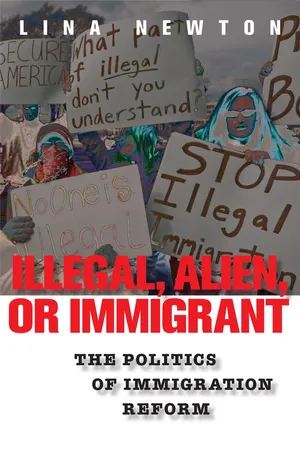
In Illegal, Alien, or Immigrant, Lina Newton carefully dissects the political debates over contemporary immigration reform. Beginning with a close look at the disputes of the 1980s and 1990s, she reveals how a shift in legislator's portrayals of illegal immigrants—from positive to overwhelmingly negative—facilitated the introduction and passing of controversial reforms. Newton's analysis reveals how rival descriptions of immigrant groups and the flattering or disparaging myths that surround them define, shape, and can ultimately determine fights over immigration policy. Her pathbreaking findings will shed new light on the current political battles, their likely outcomes, and where to go from here.
- 240 pages
- English
- ePUB (mobile friendly)
- Available on iOS & Android
eBook - ePub
About this book
Information
Subtopic
Politica pubblica1
Considering Unlikely Outcomes
The Peculiar Politics of Immigration
This is a study of the public face of congressional lawmaking that focuses on the official function of imagery, stories, and symbolism in the policy process. It employs specific methods of discourse analysis and Anne Schneider and Helen Ingram’s social constructions of target populations theory to explore how public officials use these stories and images in defending legislative solutions to immigration problems.1 The research focused on two policy periods (1981–1986 and 1994–1996) characterized by significant policy changes. Such significant policy changes include alterations in approaches to dealing with a problem (mechanisms referred to as policy tools) and redefinitions of which parties (target populations or groups) should be implicated in these new approaches. I am specifically interested in revealing how legislators justify pursuing policies that narrowly favor very unpopular groups.
Viewed from a historical perspective, policy change is a recurring feature of immigration administration. The criteria and regulatory tools utilized to control immigration have shifted from the establishment of qualitative criteria designed to keep out those unable to support themselves (1875–1917), to overt restriction by race and national origin (1880s–1960s), to the post-1965 system that emphasizes family reunification, labor force needs, and humanitarian considerations. Furthermore, the 1986 Immigration Reform and Control Act (IRCA) represented a significant departure from past policies, marking the first time businesses faced federal penalties for their role in encouraging illegal immigration. It was also the first time that the United States offered resident unauthorized immigrants the chance to regularize their status. By contrast, the 1996 Illegal Immigration Reform and Immigrant Responsibility Act eased compliance requirements for employers while restricting access to public benefits such as housing, food stamps, and Temporary Aid to Needy Families (or TANF) available to legal and illegal immigrants.
In reviewing our history of immigration restriction efforts, we may find the reason public officials regularly target immigrants with restrictive or punitive policy tools fairly obvious: the public often blames immigrants for social ills, and elected officials can expect to mobilize public opinion against immigrants in support of policies reflecting immigrant unpopularity. However, it is less obvious why Congress would offer a consistently maligned group like illegal immigrants the option to correct their status and enter the social mainstream, as occurred in 1986. In fact, given that the political payoffs for supporting policies favoring a non-voting, criminalized population are indirect or elusive, we might ask why Congress would ever pass policies that undo discriminatory immigrant policies, let alone one that would extend full legal protections to people who, by definition, are law-breakers.
Immigration scholarship has mined the trends of conflicting goals, particularized benefits, and codified xenophobia that characterize this complex issue; the range of explanations for the peculiarity of immigration politics and policies reveal the influence of the various disciplines that researchers have brought to bear on the subject. Within the discipline of political science, the scholarship on immigration policy is quite diverse. Political theorists, for example, have explored the challenge of immigration to Americans’ definition of the nation and its people as well as its civic culture and unity, and they have studied the specific challenges that illegal immigration poses to the liberal democratic order.2 Political economists and security specialists have focused on immigration control as the assertion of security and market-driven prerogatives of American and European nation states.3 Only more recently have scholars of American politics attempted to pry apart the various interests, actors, ideologies, and political circumstances that impel policy outcomes. While an evaluation of existing approaches shows important progress toward explaining why certain interests and ideological strains dominate immigration policymaking, the evaluation also reveals that important questions about the specific nature of group power and its influence on policy outcomes remain unanswered.
Influence of Interest Groups
Change in interest group power is a common explanation for change in policy. Policies that reward groups provide evidence of that group’s political power; thus, a change in policy that favors previously ignored or sidelined groups would indicate a change in their ability to influence the legislative process. For example, immigration policy scholars often point to the influence of business groups on the policy process, invoking this influence to explain the weakness of restrictive policies amidst demands for control from American labor unions or other restrictionist interests.4 Evidence of business influence abounds in analyses of agricultural lobbies that have had disproportionate abilities to secure labor for their industry, even when the goal of Congress has been to restrict labor migrants.5 More recently, the activities of the high-tech industry in securing highly educated skilled workers has captured attention as the arrival of a new interest intent on shaping guest-worker policies in 1990 and 1996.6
However, while business would enjoy unfettered access to foreign labor, Congress has repeatedly taken steps to regulate access to such labor. This suggests, contrary to the assertions above, or those of neo-Marxist analyses of policymaking, that business interests do not reign exclusively in the policymaking process.7 New analyses of policymaking after the passage of the 1965 Immigration and Nationality Act are emphasizing the growing power of other pro-immigration interest groups such as the American Immigration Lawyers Association, ethnic and religious organizations, and, more recently, certain labor unions, which have been increasingly successful in achieving and maintaining expansive admissions policies and ensuring that laws account for immigrants’ rights.8 In fact, the alliances these groups have forged with business interests help explain why Congress has not acted to restrict such immigration despite public demands to do so.9
One example that illustrates the influence of pro-immigration interests emerged during immigration reform efforts in the 1990s. Senator Alan Simpson (R-WY) fought to ensure that immigration reform would cut down family reunification visas, which constitute the largest number of immigration visas issued to foreigners each year. However, the proposed cuts never made it to the final bill. Simpson found his efforts defeated by an alliance between business interests (fighting for access to foreign workers) and various ethnic and legal pro-immigration interest groups that had benefited since 1965 from the family reunification preference system.10
Even earlier, the legalization component of the 1986 IRCA represented a substantive victory for Hispanic interest groups, signaling their arrival on the scene as advocates for liberal immigration policies.11 Carolyn Wong’s research on immigrant advocacy suggests that a combination of non-profit advocacy groups and growing, ethnic-based electorates in key congressional districts has ensured that legal immigration policies remain progressive, rights-oriented, and inclusive, much in the traditions of the 1964 Civil Rights Act and the 1965 Immigration and Nationality Act.12 For Wong and others who document the rise of the pro-immigration lobby, the fact that the later, 1990 Immigration and Nationality Act increased legal immigration and that 1996 policy reforms did not reduce caps is solid evidence of the influence enjoyed by this powerful coalition of immigration advocates. However, the other components of the 1996 Illegal Immigration Reform and Immigrant Responsibility Act (IIRAIRA), such as border fortification and benefits restriction for legal and illegal immigrants and their children, represent a substantial loss of the protections for immigrants instated with IRCA. Many of the immigrants who had benefited from legalization in the late 1980s would face substantive rollbacks in their entitlements as legal permanent residents under the 1996 reforms. An estimated 935,000 legal immigrants, many of whom were either minors or had been admitted legally as refugees, were cut off from food stamps.13 Although a portion of these benefits was re-instated for some immigrants in 1998 and again for others in 2003, these policy corrections occurred under the radar, and without the political spectacle that accompanied the passage of the IIRAIRA.14 By contrast, business interests faced no parallel restrictions or sanctions for their role in encouraging immigration.
The Latino voting population has only grown since the 1986 IRCA, and the type of pressure tactics that Wong and James Gimpel and James Edwards attribute to the growth of Latino political clout and ethnic group lobbying ought to have increased. Yet the numerous immigrant restrictions of the IIRAIRA and the difficulty Latinos and ethnic lobbyists have had recently in securing a new legalization program for the estimated ten to twelve million resident illegal immigrants in the United States imply that policy victories for Latino immigrants are not only tenuous, but also do not necessarily provide a solid base upon which to build further victories. Business interests, by contrast, have not witnessed such rollbacks or challenges to their policy victories, and compromise does not erode their foundation for securing further victories.
Contextual Change and Ideological Ruptures
The competition among interests and alliances forged by immigration policy offers a strong explanation for differences in policy outcomes, but explanations driven by their focus on interest groups often overlook contextual shifts and accompanying ideological changes that activate new approaches to intractable social issues. During the periods under study here, Congress changed its explanations for why illegal immigration occurs, and in doing so, lay the blame on different factors. Most significantly, this change occurred without any significant alteration in scientific knowledge about the social phenomenon of illegal immigration, why the problem occurs, or why it persists.
A change in contexts such as external shocks to the political system can force political actors to approach an old issue in a new manner, or it can open opportunities for previously sidelined interests to find an audience or influence policy design.15 Thus, a change in party control of Congress can impel untried alternatives to social problems, or create an institutional environment that favors approaches that are in keeping with the ideology of the ruling party. To illustrate, the 99th Congress, which was controlled by Democrats, would have been open to an immigrant civil rights agenda; it also supported measures such as employer sanctions to regulate businesses. But when the 1994 midterm elections gave partisan control to the Republican Party, this change created an opening for new approaches to the problems of illegal immigration. The 1996 Illegal Immigration Reform and Immigrant Responsibility Act fit with the new Republican governing philosophy set forth in the “Contract with America.” The so-called Republican Revolution signified a shift in how all groups viewed as “dependents” of the national government stood in relation to federal policy—an ideological expression of fiscal conservatism pitting “taxpayers” against “tax recipients” that had been gaining traction among white middle class voters since the 1970s.16 Under the leadership of House Speaker Newt Gingrich (R-GA), the 104th Congress would pass a more punitive welfare reform bill than that originally proposed by President Bill Clinton, and the IIRAIRA in many ways overlapped with the 1996 Personal Responsibility and Work Opportunity Reconciliation Act (PREWORA).17 In this new policy context, immigrants (legal and illegal) were no different from citizens relying on federal assistance: they were not pulling their weight, and, more significantly, they were doing so at taxpayers’ expense.
However, there were limits to how far advocates of the “Contract with America” could go in applying its reform prescriptions to immigration policy: even though public opinion polls in the 1990s showed a public in favor of restriction on all immigration, and the new Republican Congress was amenable to restrictive approaches to immigration, an alliance of business and pro-immigrant lobby groups successfully checked efforts to cut family reunification visas (as discussed earlier). Such particular outcomes suggest that even under conditions of systemic shock, differences in the nature of group power still matter; they also suggest that some forms of immigration may be beyond the reach of restriction.
Daniel Tichenor, whose longitudinal study of immigration policy shifts from laissez-faire style openness to restrictionism based on nationality and then to a rights-based openness, offers an explanation for the combined consequence of ideology and policy context in enabling group power. He argues that different institutional contexts have produced conditions that can facilitate policy victories for groups wielding different types of power.18 Demonstrating a trend since the 1960s towards expansionist legal immigration and refugee policies, Tichenor suggests that the legacy of the Civil Rights movement and growing political activism among pro-immigrant lobbies (including a relatively recent about-face by some key labor unions) have provided ideological as well as institutional contexts more favorable to immigrants and their advocates in all branches of government. Likewise, he argues that increasing naturalization and new voter registration rates have thus far served as disincentives to officials who would otherwise pursue extreme restrictionist agendas. The fact that Governor Pete Wilson, a champion of California’s Proposition 187, found himself ousted in 1998 by Democrat Gray Davis suggests that overt anti-immigration stances alienated a growing block of voting Latinos. Tichenor finds further proof of limits to the Republicans’ restrictionist agenda in the election of President George W. Bush, who took a decidedly less anti-immigrant position than typically associated with Republicans at the time. As close as the 2000 election was, there is no question that George W. Bush enjoyed a significant increase in support from Hispanics.19 Furthermore, while contemporary restrictionism parallels past efforts to initiate immigration bans, the practice of banning immigrants from particular nations is no longer a feature of U.S. immigration policy. Tichenor argues that the ideologies of civil and human rights have taken a firm hold in American politics, creating an infertile environment for restrictionists who pursue policies that single out groups by race or nation or who would institute across-the-board cuts in family immigrant admissions.
What is alluring about context-driven explanations of policy change is their collective acknowledgement that arenas of policymaking are not open to all groups, interests, or ideologies at all times, and that different issues and policymaking institutions (or venues) lend distinctive advantages to groups seeking influence.20 Tichenor’s study of immigration policy change recognizes that in addition to organization and access, policy contexts can favor different ideological commitments or definitions of social problems that can, in turn, produce changes in immigration law. However, when the 1986 IRCA and 1996 IIRAIRA are viewed in their entireties, it appears that contextual changes, whether external to the system or internal to institutions, seem to affect some groups more profoundly than others. When contrasted with the proliferation in the 1990s and early 2000s of state and municipal legislation devised to restrict the movement and behaviors of foreigners living in U.S. communities, Gary Freeman’s characterization of the expansionist bias in contemporary U.S. immigration policy appears overstated. For a despised group like illegal immigrants to be deemed worthy of consideration for full membership at one point, and then emerge vilified once again within the span of ten years, suggests that human rights or minority civil rights approaches to immigration may have more limited traction in the legislative arena than does restrictionism. This, in turn, implies that some immigrants and their advocates are simply more vulnerable to contextual changes than are employers, who are also implicated ...
Table of contents
- Cover Page
- Title Page
- Copyright Page
- Contents
- Acknowledgments
- A Note on Terminology
- Introduction: The Power of a Good Story
- 1 Considering Unlikely Outcomes: The Peculiar Politics of Immigration
- 2 Cases, Contexts, and the Puzzle of Policy Change
- 3 Contesting Illegalities: The 1986 Immigration Reform and Control Act
- 4 Immigrants versus Taxpayers: The 1996 Illegal Immigration Reform and Immigrant Responsibility Act
- 5 Problem Mexicans: Race, Nationalism, and Their Limits in Contemporary Immigration Policy
- Conclusion: Power and Image in Immigration Policymaking
- Epilogue
- Notes
- References
- Index
- About the Author
Trusted by 375,005 students
Access to over 1.5 million titles for a fair monthly price.
Study more efficiently using our study tools.
Frequently asked questions
Yes, you can cancel anytime from the Subscription tab in your account settings on the Perlego website. Your subscription will stay active until the end of your current billing period. Learn how to cancel your subscription
No, books cannot be downloaded as external files, such as PDFs, for use outside of Perlego. However, you can download books within the Perlego app for offline reading on mobile or tablet. Learn how to download books offline
Perlego offers two plans: Essential and Complete
- Essential is ideal for learners and professionals who enjoy exploring a wide range of subjects. Access the Essential Library with 800,000+ trusted titles and best-sellers across business, personal growth, and the humanities. Includes unlimited reading time and Standard Read Aloud voice.
- Complete: Perfect for advanced learners and researchers needing full, unrestricted access. Unlock 1.5M+ books across hundreds of subjects, including academic and specialized titles. The Complete Plan also includes advanced features like Premium Read Aloud and Research Assistant.
We are an online textbook subscription service, where you can get access to an entire online library for less than the price of a single book per month. With over 1.5 million books across 990+ topics, we’ve got you covered! Learn about our mission
Look out for the read-aloud symbol on your next book to see if you can listen to it. The read-aloud tool reads text aloud for you, highlighting the text as it is being read. You can pause it, speed it up and slow it down. Learn more about Read Aloud
Yes! You can use the Perlego app on both iOS and Android devices to read anytime, anywhere — even offline. Perfect for commutes or when you’re on the go.
Please note we cannot support devices running on iOS 13 and Android 7 or earlier. Learn more about using the app
Please note we cannot support devices running on iOS 13 and Android 7 or earlier. Learn more about using the app
Yes, you can access Illegal, Alien, or Immigrant by Lina Newton in PDF and/or ePUB format, as well as other popular books in Politica e relazioni internazionali & Politica pubblica. We have over 1.5 million books available in our catalogue for you to explore.