In her compendious study, [of the folktale of the runaway wife] Leavy argues that the contradictory claims of nature and culture are embodied in the legendary figure of the swan maiden, a woman torn between the human and bestial worlds.
--The New York Times Book Review
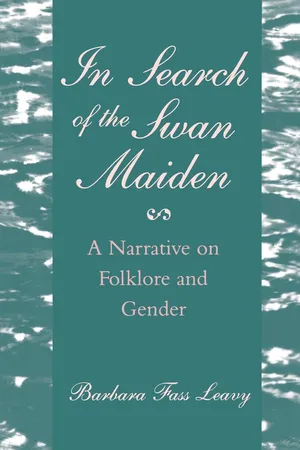
This is a study of the meaning of gender as framed by the swan maiden tale, a story found in the folklore of virtually every culture. The swan maiden is a supernatural woman forced to marry, keep house, and bear children for a mortal man who holds the key to her imprisonment. When she manages to regain this key, she escapes to the otherworld, never to return.
These tales have most often been interpreted as depicting exogamous marriages, describing the girl from another tribe trapped in a world where she will always be the outsider. Barbara Fass Leavy believes that, in the societies in which the tale and its variants endured, woman was the other--the outsider trapped in a society that could never be her own. Leavy shows how the tale, though rarely explicitly recognized, is frequently replayed in modern literature.
Beautifully written, this book reveals the myriad ways in which the folktales of a society reflect its cultural values, and particularly how folktales are allegories of gender relations. It will interest anyone involved in literary, gender, and cultural studies.
- 388 pages
- English
- ePUB (mobile friendly)
- Available on iOS & Android
eBook - ePub
About this book
Trusted by 375,005 students
Access to over 1.5 million titles for a fair monthly price.
Study more efficiently using our study tools.
Information
CHAPTER 1
Introduction: The Dangerous Adventure
He would not write with imperfect materials, and to
him the materials were always imperfect.1
him the materials were always imperfect.1
—Lord Acton
My subject is the interplay between stories about a fairy captured by a mortal man and forced into a tedious domestic existence and, obversely, about a mortal woman courted by a demon lover who offers her escape from that same mundane world. Other paradigms in the mortal-immortal matings have been discussed in the preface, where the swan maiden tale was summarized. Its obverse, the demon lover story, frequently describes a trap the wife stumbles into in her flight from her traditional role, and the tale is thus more prone than the swan maiden one to be laden with themes of guilt and retribution. Both story groups contrast the pleasures of a magic realm with the harder facts of real life, which for woman include minimal (if any) autonomy in her existence. In folk narratives the dreams of a magic otherworld are given form. As Peter Kennedy and Alan Lomax have said about the ballads they collected in the British Isles, the “past speaks through their lips, but if you listen with attention you will discover fantasy patterns important to the present as well.”2
It is consistent with the fantasy elements in these stories that an important narrative motif attached to the winning and rewinning of the supernatural spouse is that of the so-called impossible task.3 A superhuman effort becomes a prerequisite for the union. Bereft or hopeful humans undergo arduous trials and attempt herculean feats to prove themselves: men must climb glass mountains, and Psyche and her sisters must carry water in sieves or wear out iron shoes to find some vaguely defined place, such as the country of beautiful gardens. In Apuleius, a Venus hostile to her daughter-in-law Psyche “took a great quantity of wheat, barley, millet, poppy-seed, pease, lentils, and beans, and mingled them all together on a heap,” ordering Psyche to “separate all these grains one from another, disposing them orderly in their quality” and demanding she complete the task “before night.”4 To win his father’s kingdom, a prince must rely on his enchanted frog wife to produce a fine cloth that will encircle the palace seven times.5
For the scholarly study of these themes, the motifs themselves become almost parodically autoreferential, for saying anything about the stories that will satisfy all those who have studied them becomes a truly impossible task. The cloth that encircles the palace is a reminder of the culture-specific nature of folklore and the importance of locating a tale in its social context. In contrast, the iron shoes that must be worn out and journeys to castles east of the sun and west of the moon, to what W. M. S. Russell calls an “indeterminate address,”6 suggest the universality of human predicaments. The stories of supernatural spouses, moreover, seem to be about the freedom from cultural necessity as well as about the requirement that such necessity eventually prevail. A collector of Bengali tales, for instance, puzzles over a female folklore character who terrifies her father with her insistence that she choose her own husband. So contrary to custom is her demand that the story collector feels compelled to explain that the prospective bride was a fairy and therefore was not bound by woman’s usual constraints.7 But demon lovers throughout the world seem to have an uncanny ability to single out those women in rebellion against patriarchal restrictions. Psyche’s need to separate heaps of grains and legumes seems, in addition, a task very much like that of the folklorist who endeavors to sift through matters of classification and definition. Indeed, Psyche’s is the easier task insofar as a lentil can be differentiated from a poppy seed. The problem for folklore studies, writes Holbek, is “not lack of knowledge, but lack of coherent knowledge. There are innumerable investigations of the origins, history, diffusion, variation and adaptation of motifs, themes, types and clusters of types, of genres and the relations between genres; of performers and of the art.”8 But even if all of these could be sorted out, the end to which the task should be directed remains a matter of controversy. Holbek has deplored the lack of significant interpretation of folk narratives that would make the prodigious efforts at theoretical clarity meaningful.9 In short, after years of folklore studies in an academic culture in which I have received, perhaps, my green card but not naturalization, I seem to be proclaiming the impossibility of my venture at the very moment that I begin it. But matters are perhaps not that bad. The husbands and wives who embark on journeys to find and win back lost spouses encounter not only hostile figures intent on thwarting them but also cooperative ones who help the searchers achieve their goals. And so have I.
Anthropologists can be both helpful and obstructionist for literary scholars endeavoring to interpret folk tales. They at least take folklore seriously, and treat folktales as legitimate “texts” for study.10 Moreover, their ideas about folklore’s function is often consistent with literary theories about how art acts as an emotional catharsis for artist, audience, or both. J. L. Fischer argues that folk narratives serve the needs both of the society that pragmatically allows its members outlets for subversive impulses, and also of the individuals who find themselves suffering keenly the discontents of civilization.11 Anthropologists also have begun to pay close attention to woman’s role in the societies they study, and from their work it becomes obvious that terms such as “patriarchy” and “patriarchal culture” need qualification. Woman’s status varies from society to society; indeed, it has been argued that where her status is relatively high, she will be more likely to resist a demon lover than where her status is relatively low.12 Nonetheless, “patriarchy” is a useful designation for male-dominated societies, and male domination was and remains a fact of universal life. Finally, from the commentaries of anthropologists has emerged an essential paradox: believed to be more quickly prone than man to revert to a state of nature, woman is nonetheless entrusted with the task of rooting man in culture and raising her children in such a way as to prevent behavior threatening to the society as a whole.13 This paradox is useful for interpreting woman’s role in swan maiden and demon lover tales.
Anthropologists resist, however, the universalist approach to folklore, focusing instead on its culture-specific elements—especially since, again, folklore can supply data for the study of a particular group. For them, the relationship is reciprocal: the tale helps explain the group, the group the tale. For the stories to be discussed in this book, the work of James M. Taggart—particularly his book Enchanted Maidens—stands as an excellent example of an approach to folklore and gender that relies on an ethnological analysis of people and their stories. But as will later be seen, in order to explain some narrative motifs, Taggart is virtually forced to fall back on a generalized view that women per se are better able than men to sustain in marriage the illusion of love, and that this capacity can account for the supernatural strength of the female character who performs extraordinary feats in Tale Type 313 (The Girl as Helper in the Hero’s Flight). In chapter 6, it will be clear that I have a vastly different view of this story motif.
There is another, compelling reason to respect the uniqueness of the environment in which a version of a story flourishes. A people’s folklore is intrinsically bound to its culture and is therefore part of its identity and self-esteem, which some of the folk may not be ready to surrender to the abstraction of universal human problems. But to concede this is also to run into the theoretical question of what is or who are the folk? Linda Dégh and Alan Dundes have supplied similar answers, the former defining a group of “people united permanently or temporarily by shared common experiences, attitudes, interests, skills, ideas, and aims,” the latter invoking “any group of people whatsoever who share at least one common factor. It does not matter what the linking factor is—it could be a common occupation, language or religion—but what is important is that a group formed for whatever reason will have some traditions which it calls its own.”14
Can women per se constitute a group and hence a “folk”? Certainly the concept of uniquely female traditions that are being defined by folklore feminists implies an affirmative answer.15 Dundes’s reference to language and religion, however, is a reminder of how naive it would be to think that ethnic differences do not interfere with the idealistic notion of universal sisterhood. Still, occupation and tradition provide support for the idea of an exclusive as well as inclusive female folk. In her novel Up the Sandbox, Ann Roiphe’s female protagonist abhors her daily drudgery and wonders about the native women who had in earlier ages occupied her New York City neighborhood:
Eat, eliminate, prepare food, clean up, shop, throw out the garbage, a routine clear as a geometric form, a linear pattern that seems almost graceful in its simplicity. Despite computers and digit telephone numbers, nuclear fission, my life hardly differs from that of an Indian squaw settled in a tepee on the same Manhattan land centuries ago. Pick, clean, prepare, throw out, dig a hole, bury the waste—she was my sister.16
The difficult question is whether a native woman would recognize that sisterhood. As Coffin points out, different assumptions about the marital relationship would render different the meanings of tales that appear similar. So would vastly different expectations concerning personal happiness. Some common idiom would be necessary for Roiphe’s heroine and the women who narrated or were characters in the widespread star husband tales to share similar fantasies and secure some essential sisterhood.
But as Bynum has noted, human beings do communicate with each other “in a narrative manner”:17 Roiphe’s very novel extends the themes of old, widely told tales. One of my premises, arrived at inductively as I gathered these tales, is that folk narratives reveal feminist themes when their subject is woman’s role in culture and fantasies about escaping that role. And if a story with such a theme is told or heard by a man, it will probably reflect an anxious assumption that his wife does indeed strive to separate from him (see chapters 6, 7). Moreover, I have rarely encountered an anthropological analysis of a swan maiden or demon lover story that was not applicable to societies outside the one being studied.18 Bynum has criticized those social scientists who confine the interpretation of narrative traditions “to the immediate ethnic context where the traditions are found,” as if, for example, the “Oedipal typology of a tale indigenous to New Guinea” bore no relationship to “the import of the Oedipus story anywhere else.” There is, he argues, “no necessary contradiction between a comparative and an ethnically delimited approach to the criticism” of folklore.19
Originally part of an oral storytelling tradition, swan maiden and demon lover tales were later collected and translated by persons whose knowledge of folklore and fidelity to what they heard varied widely. Today folktales are gathered by rigorously trained fieldworkers whose methodology has become increasingly scientific, while artists unconcerned with methodology continue to render folklore into literature. But literary scholars and even some folklorists have been frustrated by the reluctance of most folklorists to go beyond the data, the ‘“what”’ of folklore, to consider the ‘“why”’ and thus enter “the ever treacherous area of interpretation.”20 The matter goes beyond the clash of methodologies in disciplines that otherwise share interests. Literary critics can often trace their love for story to folk and fairy lore heard from others’ lips before the prized gift of reading was acquired. Stories were first read for the sake of story itself, meaning and power perhaps impressing themselves at some unconscious level before—much later—the task of analysis was begun and mastered. That story has meaning, whether that story be part of an oral tradition or written by a known author, is assumed by literary critics, who take for granted that some interpretation is already going on—consciously or otherwise—in any storyteller’s retelling of an orally transmitted tale. Fortunately, the gap between folklore studies and literary analysis shows signs of narrowing.
This does not mean, however, that folklore methodology is thereby rendered unimportant for interpretation. But rather than continuing to survey abstractly the problems of imperfect material, I will focus on one story collection to illustrate both the difficulties and the potential insight into a subject that can be gained when one knows what questions are being asked (even if the answers remain subject to debate), and will use that collection as a point of departure for further discussion and other examples. For those unfamiliar with folklore studies, my analysis of this collection is intended as an introduction. For those who need no such introduction, the example is intended to contribute to a developing subject among folklorists—the relationship of folklore to gender.
In the 1930s, Ethel Stefana Drower, daughter of a clergyman, educated at home and in private schools and married to the British adviser to the Iraqi minister of justice,21 decided that after a residence of more than ten years, she wished to contribute to the world’s knowledge of her host country, whose folklore she had long been in the habit of recording. Her Folk-Tales of Iraq was published in a scholarly form, including notes and explanations of language and culture, and appeared under the pseudonym E. S. Stevens.22 Because of her self-consciousness as a woman story gatherer with an ambiguous relationship to the Iraqi women she collected tales from, and because her pseudonym suggests a deliberate vagueness concerning her identity, I will refer to Stevens by her gender-emphatic title, Lady Drower.
For an amateur folklorist, Lady Drower was quite knowledgeable about methods of research, aware, for example, that nuances of language could not survive translation. She assures her readers that she has striven for accuracy even though some Arabic words have no connotative equivalents in English and, in addition, differ in meaning depending on whether they are used by Moslem, Christian, or Jew. She says that when a story was told slowly enough, she took it down verbatim; however, this was not always possible and she was necessarily dependent upon memory. On the subject of editing she remains silent and does not acknowledge that even rendering a story grammatically correct is effectively another kind of translation.
Lady Drower was sensitive to the relation of tales to tellers, providing information about whom she heard each story from as well as brief descriptions of those who supplied variants. As her informants varied from illiterate servants to educated teachers and government officials, she acknowledges that the way they told the same stories might differ according to their position in society. She recognizes, moreover, that some are better tale tellers than others and that gesture, voice intonation, and facial expression are very important. These qualities, of course, are not described or reproduced in her written texts, which as a result cannot include the meanings that narrators can convey through extra-verbal signals. For it is presently acknowledged that even the most scrupulous verbal transcription does not convey a story in its entirety, does not provide the “ideal folklore text,” which “must record the aesthetic transaction (manifested through observable behaviors) between the performer and audience.”23
That performance conveys meaning is not a new idea. More than fifty years ago, a collector of Tibetan folktales described how, “Notebook in hand, I would sit on the ground with my little Tibetan maid [her interpreter] beside me and watch the face of the one who was telling the story. Watch every shade of expression that flitted over his features—Tell me why he laughs and is amused there. Why does he look sad here? Why does he speak seriously now? What prompted that action? What prompted that thought?’—and so on; and I would make careful notes.”24 To what specific end, however, is not revealed. Roger Abrahams has argued that individual performance is actually a rhetorical tool in the hands of the storyteller, folklore thus able to serve as an instrument of social change instead of a medium through which traditional values are perpetuated.25 It can be added that the imprint of a unique personality also helps expand a narrative pattern, which enlarges not only by an accretion of story detail but also because of the differing perspectives of individual storytellers. Lady Drower was particularly interested in the relationship between her tales and their culture; she stood, that ...
Table of contents
- Cover Page
- Title Page
- Copyright Page
- Dedication
- Contents
- Preface
- Chapter 1 Introduction: The Dangerous Adventure
- Chapter 2 Urvaśī and the Swan Maidens: The Runaway Wife
- Chapter 3 The Devil’s Bride
- Chapter 4 The Animal Groom
- Chapter 5 Swan Maiden and Incubus
- Chapter 6 The Animal Bride
- Chapter 7 Orpheus’s Quest
- Chapter 8 Etain’s Two Husbands: The Swan Maiden’s Choice
- Notes
- Bibliography
- Index of Selected Names and Titles
Frequently asked questions
Yes, you can cancel anytime from the Subscription tab in your account settings on the Perlego website. Your subscription will stay active until the end of your current billing period. Learn how to cancel your subscription
No, books cannot be downloaded as external files, such as PDFs, for use outside of Perlego. However, you can download books within the Perlego app for offline reading on mobile or tablet. Learn how to download books offline
Perlego offers two plans: Essential and Complete
- Essential is ideal for learners and professionals who enjoy exploring a wide range of subjects. Access the Essential Library with 800,000+ trusted titles and best-sellers across business, personal growth, and the humanities. Includes unlimited reading time and Standard Read Aloud voice.
- Complete: Perfect for advanced learners and researchers needing full, unrestricted access. Unlock 1.5M+ books across hundreds of subjects, including academic and specialized titles. The Complete Plan also includes advanced features like Premium Read Aloud and Research Assistant.
We are an online textbook subscription service, where you can get access to an entire online library for less than the price of a single book per month. With over 1.5 million books across 990+ topics, we’ve got you covered! Learn about our mission
Look out for the read-aloud symbol on your next book to see if you can listen to it. The read-aloud tool reads text aloud for you, highlighting the text as it is being read. You can pause it, speed it up and slow it down. Learn more about Read Aloud
Yes! You can use the Perlego app on both iOS and Android devices to read anytime, anywhere — even offline. Perfect for commutes or when you’re on the go.
Please note we cannot support devices running on iOS 13 and Android 7 or earlier. Learn more about using the app
Please note we cannot support devices running on iOS 13 and Android 7 or earlier. Learn more about using the app
Yes, you can access In Search of the Swan Maiden by Barbara Fass Leavy in PDF and/or ePUB format, as well as other popular books in Literature & Literary Criticism. We have over 1.5 million books available in our catalogue for you to explore.