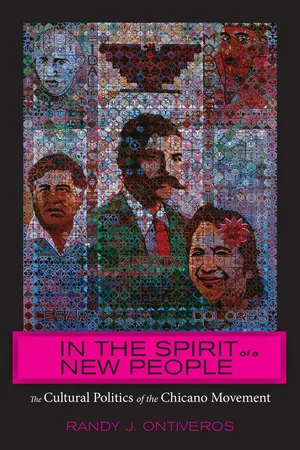
Reexamining the Chicano civil rights movement of the 1960s and 1970s, In the Spirit of a New People brings to light new insights about social activism in the twentieth-century and new lessons for progressive politics in the twenty-first. Randy J. Ontiveros explores the ways in which Chicano/a artists and activists used fiction, poetry, visual arts, theater, and other expressive forms to forge a common purpose and to challenge inequality in America.
Focusing on cultural politics, Ontiveros reveals neglected stories about the Chicano movement and its impact: how writers used the street press to push back against the network news; how visual artists such as Santa Barraza used painting, installations, and mixed media to challenge racism in mainstream environmentalism; how El Teatro Campesino’s innovative “actos,” or short skits,sought to embody new, more inclusive forms of citizenship; and how Sandra Cisneros and other Chicana novelists broadened the narrative of the Chicano movement. In the Spirit of a New People articulates a fresh understanding of how the Chicano movement contributed to the social and political currents of postwar America, and how the movement remains meaningful today.
eBook - ePub
In the Spirit of a New People
The Cultural Politics of the Chicano Movement
- 241 pages
- English
- ePUB (mobile friendly)
- Available on iOS & Android
eBook - ePub
In the Spirit of a New People
The Cultural Politics of the Chicano Movement
About this book
Information
1 / Antennas and Mimeograph Machines: Postwar Mass Media and the Chicano/a Street Press
On August 30, 1972, a small group of young Chicano/a activists invaded Catalina Island. Their move was part of what they called the Marcha de la Reconquista, a three-month “Reconquest March” aimed at drawing attention to the long history of discrimination against Mexicans in America. Dressed in combat boots, khaki uniforms, and their signature cap, the contingent of Brown Berets raised a Mexican flag over the Avalon harbor and claimed to retake the popular American locale on behalf of Mexico. Anxious to avoid a televised confrontation, local authorities initially tolerated the group. After several weeks, though, on September 23, the Berets obeyed a police order to leave the island or face trespassing changes. The Chicano invasion of Catalina was over.1
This largely forgotten moment in the history of the Chicano movement is suggestive of the ambiguous legal, cultural, and political position that Mexican Americans occupy within the imaginary of the United States, an uncertain “third space” of a population at once not quite native and not quite alien. Ascending the hillside in their military garb, the young radicals looked the part of Cuban-style invaders. And yet they recalled a time on this same soil when the United States was the conqueror, and Mexicans the conquered. The Catalina episode also says something about mass media, for it illustrates the shortcomings of the network news in a period that many celebrate as television’s golden age. During the 1950s and early 1960s, NBC and CBS earned a reputation for quality journalism through their coverage of the postwar black civil rights movement.2 The two major networks said close to nothing, though, about the Mexican American civil rights movement happening at exactly the same time. Journalists ignored important stories such as the massive school walkouts in Los Angeles in 1968 and the 1969 Chicano Youth Liberation Conference in Denver. Yet the Catalina story—a minor episode in the chronology of the Chicano movement by any measure—was broadcast on the August 31, 1972, episode of the CBS Evening News. At the close of that night’s program, Walter Cronkite reported that “a group of militant Mexican-Americans” had “staged a peaceful invasion of Catalina Island.”3 He seemed to fight back a dismissive smirk as he reassured his audience that “everybody at least so far seems to be taking the invasion quite peacefully.”4
CBS’s refusal to explore the issues surrounding this event was consistent with the generally flawed coverage of the Chicano movement during the 1960s and 1970s. Footage of Chicano/a activism during this period has never been examined before, partly because much of it has been lost or is locked up in network vaults, but also because the Chicano movement is only now becoming part of the narrative of left activism in the mid-twentieth century. Incomplete though it is, the archive raises crucial questions about how mass media shaped the cultural politics of the Chicano movement, for good and for bad.5 What informed network decision making about which stories involving Chicanos/as to cover and which to ignore? How did viewers at home respond to the images of the Chicano movement that were available to them? What was the impact of commercials on network representation of the Chicano movement? How has the historical memory of the movement been shaped by the camera? And, centrally, how did Chicanos/as respond to their consistent marginalization in mainstream media?
Television was introduced to the American public in 1939 at the World’s Fair in New York. Between that moment and 1965—when César Chávez drew unprecedented media attention with his announcement of the historic farmworker strike in California—there was a near “brownout” on televised news about Mexican Americans. This was an era that saw bold and insightful coverage of civil rights activism in the South. Yet the networks gave scant attention to similar patterns of activism in the Southwest. This failure emerged from the ideological and geographical limitations of the media machine, but it also reflected a cultural tendency to view Chicanos/as as intruders to the nation’s primordial conflict between black and white.
It was a cause for celebration that the networks began to cover the story of the UFW grape strike in 1966. But as important as the media attention was for the cause, it became part of a visual contrast that represented Mexican Americans not as complex human subjects, but as suffering saints or as dangerous radicals. Historically, whites had used this kind of contrast to legitimize slavery and segregation, depicting blacks either as lawless savages or as naïve children. Television modified the template in its coverage of Chicano/a activism, but the distorting effect was largely the same. Because of the labor leader’s skillful manipulation of the television industry’s desire for a hero figure, Chávez became a widely respected public icon and helped win new economic and political rights for agricultural laborers. However, things changed quickly. By the end of the 1960s and into the 1970s, audiences wanted more sensational television. Nixon was remaking the political landscape, convincing whites that the civil rights movement had been hijacked by violent extremists. Footage of the Chicano movement was soon dominated by images of riot and rebellion.
Chicano/a activists were increasingly represented as threats to a nation defined not as the people in the streets exercising their democratic rights, but as a “silent majority” sitting its living room amid the comforts of American abundance. The effect of this ideological contrast was profound. Television was not the only medium to shape public understanding of the Chicano civil rights movement, but the nightly news enjoyed unparalleled power when it came to setting the news agenda and framing public opinion. Between 1965 and 1975, television advanced the farmworker cause by exposing the miserable labor conditions at the nation’s food factories, and also by persuading the public that the lives of farmworkers mattered. But shallow coverage of the Chicano movement left most viewers unaware of the rich complexity of Mexican American history and politics. It also kept the Chicano movement from becoming part of the popular narrative of postwar civil rights activism.
During the 1960s and 1970s, the Left was developing a sophisticated critique of the media industry and its place in U.S. society. SDS’s Port Huron Statement, for example, had sophisticated commentary on how communication technologies were being used to head off real reform in an unequal society. Mexican Americans followed this discussion because it spoke to their experiences. Blocked from participation in the dominant public sphere by racism, they developed a grassroots Chicano/a media that answered stereotypes and allowed individuals to become cultural producers. This independent media universe included film, TV, and radio, but its most vital medium was print. The mimeograph machine and the offset printer became essential tools in the struggle for cultural rights and economic justice.
Television journalists then as now touted their product as the official “first draft” of the American experience, but a retrospective look at footage of the Chicano movement gives reason to reconsider the idealized narrative about the broadcast news. Films like Good Night, and Good Luck perpetuate the myth of the 1960s as a journalistic Eden, a time when mass media was more than the idle gossip and partisan yelling that dominates today’s corporate media universe. Certainly there were examples of real insight during this period. But because of the technical limits of a twenty-three-minute program and the political limits of a monopoly system funded by corporate advertisers and supervised by government regulators, it was rare for producers during the 1950s, 1960s, and 1970s to stray beyond consensus viewpoints.
Coverage of the Chicano movement shows how television can shape public perception, sometimes for the better, but often for the worse. However, the significance of this archive lies ultimately in what it says about political priorities. Visibility is often equated with power in our “society of the spectacle,” but there are limits to defining what is meaningful as what can be seen. Racism is often defined in its most spectacular forms: dead and wounded bodies, segregated facilities, or unbearable labor conditions. These are deplorable, but many forms of social injury are woven into the fabric of everyday life, and their banality makes them hard to communicate through the surface of the television screen. Likewise, television cannot picture many of the things for which progressives fight: the opportunity to do meaningful work; the freedom for communities and individuals to live where they want; control over the health of our own bodies; and the chance to learn. Network coverage of the Chicano movement teaches a great deal about the cultural politics surrounding civil rights struggles. Its most important lesson, though, might be that what matters most in politics, as in life, is what happens when cameras are not around.
“Uncle Walter” and Postwar Chicano/a Activism
The television news made an inauspicious start at the dawn of the television age. The newsreel had shown the enormous journalistic potential of the moving image, but inaugural programs like the Camel News Caravan on NBC or Douglas Edwards with the News on CBS were dry and superficial bulletin services. News divisions were understaffed. The broadcasts were given only fifteen minutes on the programming grid. Oversized camera equipment and a lack of on-location staff made it impossible for crews to catch late-breaking stories. Broadcasts were comprised mostly of recycled newsreel footage or coverage of preplanned events. However, by 1965—the year that the National Farm Workers Association launched its historic grape strike and the year sometimes cited as the beginning of the Chicano movement—the network news had become a driving force in politics.6 The television industry had achieved major advances in technology, including satellite broadcasting and slow motion. Newsmen like Walter Cronkite and Edward R. Murrow had been transformed into trusted personalities. Producers were experimenting with new camera techniques and more dramatic storytelling so they could compete with print journalism.
The story that established the evening news as the nation’s journalistic authority was the struggle for integration in the South. There was a painful irony in this fact, since the networks had largely ignored the story of black civil rights activism during the 1940s and the early part of the 1950s. TV producers typically followed the editorial lead of the printed press, and since white newspapers ignored post–World War II organizing among African Americans, so did television.7 Not until the mid-1950s did the networks pick up the story of the emerging civil rights movement, but when they did, they changed the course of American law and history. Producers were committed enough to the dramatic story of the 1955 trial of Emmett Till’s killers that they turned a field not far from the courthouse into an airstrip so they could fly footage to New York for broadcasting.8 Two years later, images of the violent drama surrounding the integration of Little Rock schools attracted an even larger audience, becoming the first news story in television history to become a nationwide media spectacle.9 In 1963, television coverage of the March on Washington for Jobs and Freedom made MLK’s “I Have a Dream” speech an instant classic of American rhetoric. Television coverage of civil rights was a complex dance. Sasha Torres argues that civil rights workers and network news producers reached something of an unspoken agreement with each other. Television provided the spotlight needed for activists to resist southern bigotry. In exchange, African American leaders provided the compelling visuals that networks needed to demonstrate their gravitas and to become the new record of the nation’s history.10
Civil rights activism in the South was crucial to the formation of the Chicano movement, as many young Chicanos and Chicanas who were first moved to get involved in politics through the example of King, Rosetta Parks, Bob Moses, and other black leaders.11 There are no transcripts of how Mexican Americans reacted in their living rooms to the March on Washington, but activists have described coverage of black activism as a catalyst for their involvement in postwar Chicano/a politics. F. Arturo Rosales writes that he was stationed at a U.S. Air Force base in Birmingham, England, when he read newspaper coverage of what was going on in the South:
I had dropped out of high school and was not particularly politicized. But I read in British newspapers and in the Stars and Stripes that, back home Black children were killed when a church was bombed, that civil rights workers were slain and that Bull Conners [sic] turned dogs loose on peaceful demonstrators. To my dismay and discomfort, some white sergeants openly delighted in this terrorism.12
Rosales identified with the black civil rights movement. He saw the inherent fairness of the cause, and he also saw parallels between what was happening to African Americans and what happened to Chicanos/as in his native Arizona. Rosales’s experience speaks to the important and still underexplored connections between black and Chicano/a activism after World War II. But the connections Rosales saw were ignored by the news industry.
The archives of the early decades of television are incomplete. Not fully aware of the archive’s value to history, networks recycled film to lower costs. Some material is available, though, via print description, spotty preservation by the networks, and good luck. A search of CBS and NBC records indicates that only a small handful of reports involving Mexican Americans were aired before the September 1965 farmworker strike. These reports typically involved alleged drug smuggling at the border, the controversial Bracero Program, or unauthorized immigration by Mexican nationals. Exceptions did exist. For example, the September 27, 1960, premier of the ABC series Bell and Howell Close Up! examined discrimination against blacks, Jews, Puerto Ricans, Japanese, Chicanos, and Native Americans in selected communities across the United States.13 But apart from one or two isolated examples, the first two decades of television history saw a “brownout” on coverage of Chicano/a and Latino/a affairs.14 A person watching television in the 1950s and early 1960s was more likely to see news about Mexicans in Mexico than about Mexicans in the United States. The State Department had considerable clout in setting the news agenda and frequently used television to project an image of concern to nonaligned countries in Latin America. Chicanos/as were treated as cultural foreigners but not legal ones, which meant the State Department had no interest in them.15
Why was media coverage of Chicano/a issues so poor during the early years of television, especially given the networks’ success with the black civil rights movement? The causes of this failure were both institutional and cultural. Stories about Mexican Americans were excluded from what Gaye Tuchman calls “the news net,” the collection of wire services, bureaus, and other news-gathering practices that provide media organizations with their material and create the audience perception of what is newsworthy.16 With its promise of “catching” all of the meaningful stories on any particular day, the news net makes an implicit claim to universality. Yet in the 1940s and 1950s—and even today—the major networks lacked reporters with experience in covering Chicano stories. Few, if any, Mexican Americans worked as journalists or producers in mainstream media outlets, and white journalists—especially those on the East Coast, away from large concentrations of Chicanos/as—had slender exposure to Mexican American issues during their schooling. Newsmakers therefore didn’t recognize Chicano/a stories as newsworthy. At best they were interpreted as regional items or as human-interest stories. The news industry is more proactive now that the Latino/a population is growing, but coverage still tends toward cultural exoticism.
These institutional dynamics were bound up with larger social realities. News organizations generally treated the eastern seaboard as the locus of national news, even as the nation’s economy and demography was shifting west. This tendency reflects the simple fact that the news industry is headquartered in New York and looks at power from a top-down perspective, but it is also reflects the colonial habit of seeing the Southwest as empty space. Mary Pat Brady argues that nineteenth-and early-twentieth century fiction, poetry, and journalism depicted the former Mexican territories of the United States as barren land.17 In order to clear the way for capitalist development of the region’s natural resources, Native American and mexicano communities were culturally and sometimes physically eradicated. Television’s failure to cover postwar Mexican American politics emerges from this history. Newsmakers knew that the black civil rights movement would make for captivating television because the story could be sutured into the nation’s psychosocial drama of black versus white, freedom versus slavery—a drama that Toni Morrison says is only related by indirection to the lives of actually existing African Americans.18 Coverage of the black civil rights movement allowed viewers to indulge in the fantasy of U.S. exce...
Table of contents
- Cover Page
- Title Page
- Copyright Page
- Contents
- Acknowledgments
- Introduction: The Art and History of the Chicano Movement
- 1 Antennas and Mimeograph Machines: Postwar Mass Media and the Chicano/a Street Press
- 2 Green Aztlán: Environmentalism and the Chicano/a Visual Arts
- 3 Immigrant Actos: Citizenship and Performance in El Teatro Campesino
- 4 After Words: Sandra Cisneros’s Caramelo and the Evolution of Chicano/a Cultural Politics
- Notes
- Index
- About the Author
Trusted by 375,005 students
Access to over 1.5 million titles for a fair monthly price.
Study more efficiently using our study tools.
Frequently asked questions
Yes, you can cancel anytime from the Subscription tab in your account settings on the Perlego website. Your subscription will stay active until the end of your current billing period. Learn how to cancel your subscription
No, books cannot be downloaded as external files, such as PDFs, for use outside of Perlego. However, you can download books within the Perlego app for offline reading on mobile or tablet. Learn how to download books offline
Perlego offers two plans: Essential and Complete
- Essential is ideal for learners and professionals who enjoy exploring a wide range of subjects. Access the Essential Library with 800,000+ trusted titles and best-sellers across business, personal growth, and the humanities. Includes unlimited reading time and Standard Read Aloud voice.
- Complete: Perfect for advanced learners and researchers needing full, unrestricted access. Unlock 1.5M+ books across hundreds of subjects, including academic and specialized titles. The Complete Plan also includes advanced features like Premium Read Aloud and Research Assistant.
We are an online textbook subscription service, where you can get access to an entire online library for less than the price of a single book per month. With over 1.5 million books across 990+ topics, we’ve got you covered! Learn about our mission
Look out for the read-aloud symbol on your next book to see if you can listen to it. The read-aloud tool reads text aloud for you, highlighting the text as it is being read. You can pause it, speed it up and slow it down. Learn more about Read Aloud
Yes! You can use the Perlego app on both iOS and Android devices to read anytime, anywhere — even offline. Perfect for commutes or when you’re on the go.
Please note we cannot support devices running on iOS 13 and Android 7 or earlier. Learn more about using the app
Please note we cannot support devices running on iOS 13 and Android 7 or earlier. Learn more about using the app
Yes, you can access In the Spirit of a New People by Randy J Ontiveros,Randy J. Ontiveros in PDF and/or ePUB format, as well as other popular books in Social Sciences & Cultural & Social Anthropology. We have over 1.5 million books available in our catalogue for you to explore.