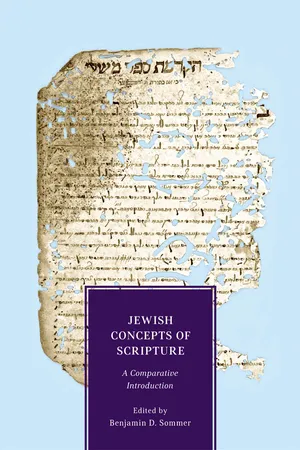
What do Jews think scripture is? How do the People of the Book conceive of the Book of Books? In what ways is it authoritative? Who has the right to interpret it? Is it divinely or humanly written? And have Jews always thought about the Bible in the same way?
In seventeen cohesive and rigorously researched essays, this volume traces the way some of the most important Jewish thinkers throughout history have addressed these questions from the rabbinic era through the medieval Islamic world to modern Jewish scholarship. They address why different Jewish thinkers, writers, and communities have turned to the Bible—and what they expect to get from it. Ultimately, argues editor Benjamin D. Sommer, in understanding the ways Jews construct scripture, we begin to understand the ways Jews construct themselves.
Scriptures in Jewish Tradition, and Traditions as Jewish Scripture
Benjamin D. Sommer
On one level, there is a simple answer to the question “What is scripture for the Jews?” For roughly the past two thousand years, Jews have had a canon of twenty-four books that form the Jewish Bible,1 starting with Genesis and ending with Chronicles.2 Some Jewish groups up until about two thousand years ago accepted additional books as scripture, but by the end of the first century CE the canon used by Jews today was more or less universally accepted by all Jews. In this respect, Jews differ from Christians, since to this day there are books regarded by Orthodox Christians and Catholics as scripture that Protestants either reject or regard as less than fully scriptural.3 The anthology containing these twenty-four books is known to Jews by several names: Kitvei Ha-qodesh (“sacred texts”), Miqra (“Reading”), and Tanakh (an acronym for the three sections of the Jewish canon: Torah, Nevi’im, and Ketuvim).4
On a deeper level, however, Jews of different times, places, and sects would answer the question “What is scripture?” in profoundly different ways. However much they agree on what books and even what precise words, consonants, and vowels constitute scripture, they have a wide range of views regarding the nature and purpose of these texts. The chapters in this volume attempt to answer the questions: How have various Jewish thinkers and movements conceptualized scripture? What is scripture for? What type of information does one get from it—historical, scientific, theological, moral, or something else? Is one primarily supposed to get information or guidance from it, or does it have some other purpose altogether? For example, are copying it, decorating it, or marching around a sacred space with it commendable ways to show reverence to God? By chanting it, can one acquire merit or perhaps alter the Godhead or even perform magic? Answering these questions involves not so much studying how various Jews have read scripture (that is, examining the interpretive methods Jews have used to derive meaning from it) but asking prior questions: Why do they read it, or perform rituals with it, in the first place? For what reasons have Jews turned to this anthology?
The varied answers to these questions in the chapters that follow will speak for themselves. Before turning to them, however, it is useful to consider an overview of certain core ideas regarding scripture that almost all Jewish groups have assumed for the past two thousand years. We will see that these ideas differentiate Jewish conceptions of scripture from Christian ones in fundamental ways. To be sure, all twenty-four books of Jewish scripture are part of the Christian Bible in its various forms. Nonetheless, in many respects these texts function so differently in the two traditions that one can rightly say that the books in question are not the same books at all but entirely different works that happen to have the same words.
The Primacy of Torah
We should begin by noting that the twenty-four books of the Jewish canon are not all equal. The first five books (Genesis, Exodus, Leviticus, Numbers, and Deuteronomy, often referred to in Hebrew as the Torah or the
umash and in English as the Five Books of Moses or the Pentateuch) are by far the most important, the most authoritative, and the most familiar to Jews. The remaining books are traditionally divided into two groups, the Nevi’im, or Prophets (a category that includes not only prophetic books such as Isaiah and Jeremiah but historical works such as 1–2 Samuel), and the Ketuvim, or Writings (sometimes called the Hagiographa). On a practical level, however, it would be more helpful to say that the Jewish Bible has two parts: First and foremost, there is the Torah—the T in the acronym Tanakh. Also, there is the rest of the Bible—the Nakh of the acronym; in fact, one does sometimes hear the term Nakh used among Jews to refer to “the part of the Bible coming after the Torah.” Only the Torah is chanted in its entirety in the course of synagogue worship (usually, over the course of a year); only a fraction of the remaining material is chanted in the synagogue. Jewish schools tend to give much more attention to the Torah than they give to the Nakh. While Jewish beliefs flow from and to some degree claim to be based on the whole Tanakh, Jewish law—the core of Jewish practice and identity—claims to be based on the Torah alone.
Scripture and Tradition
One can justly wonder whether it is accurate to equate “scripture” in Judaism solely with the Tanakh. The historian of religion William Graham writes in his very useful article on scripture in The Encyclopedia of Religion that the term “scripture” designates “texts that are revered as especially sacred and authoritative in . . . religious traditions,” and he goes on to describe a number of characteristic roles and attributes of scriptures in religious traditions from around the world.5 As one thinks about Graham’s definition from the point of view of Judaism, one quickly realizes (as Graham himself notes)6 that the classical works of rabbinic literature—that is, the Mishnah, the Talmuds, and the midrashim7—fit the definition almost as well as the Bible, and in some ways even better. For example, Graham writes that “the written scriptural text symbolizes or embodies religious authority in many traditions (often replacing the living authority of a religious founder such as Muhammad or the Buddha).”8 This sentence applies to both the Bible and rabbinic literature in Judaism; more specifically, we might say that the Bible symbolizes religious authority, while rabbinic literature embodies it, for on a practical level Jewish religious authorities seeking directives regarding Jewish law and ritual turn not to the Bible but to rabbinic texts. Similarly, Graham points to the importance of scripture both in public ritual (where it may be recited aloud or it may serve as a ritual object) and in private study (which shapes devotional and spiritual life). It is true that the Torah and, to a lesser degree, passages from the Prophets and the Writings play roles in public ritual in a way that rabbinic texts do not: they are chanted in synagogue worship according to highly formalized rules, for instance—and in this respect, the Bible is more typically scriptural than rabbinic literature is. Nonetheless, in many forms of Judaism (especially in the culture of ultra-Orthodoxy), studying as a devotional act focuses on the Talmud and not on the Bible9—and in this respect, the Talmud is more scriptural for many Jews than the Bible is. “Every text that achieves scriptural status in a religious community elicits extensive popular and scholarly exegesis and study of its contents,” Graham points out, and this exegesis tends to stress what Graham calls the “unicity” of the scripture, its wholeness and its lack of self-contradiction.10 Here again, rabbinic literature fits the description just as much as the Bible does; whole literatures emerged in medieval and modern Judaism that comment on the Bible and the Talmud, and these literatures often stress the unity of the texts they interpret, focusing on harmonizing what appear to be contradictions between different parts of the biblical or talmudic whole. In the case of the Babylonian Talmud, a whole literature of commentaries, known as Tosafot, arose whose main concern is to emphasize this harmony of the whole talmudic corpus. Graham asserts that “a text is only ‘scripture’ insofar as a group of persons perceives it to be sacred or holy, powerful and meaningful, possessed of an exalted authority, and in some fashion transcendent of, and hence distinct from, other speech and writing.”11 This sentence fits the Mishnah and also, for many Jews, the Zohar, the central work of Jewish mysticism; but it is even truer of the Tanakh, or at least of the Torah (indeed, the Zohar itself makes claims about the exalted, transcendent, and ontologically distinct nature of the Torah that it does not make about itself).
One senses, then, that in Judaism scripture is not an either/or category. Biblical books and some postbiblical texts are scriptural, but in different ways and to different extents. Within the Tanakh, the Torah is more scriptural than the Prophets and Writings are. Within rabbinic literature, the Babylonian Talmud is more scriptural than the Jerusalem Talmud is, and some, but not all, Jews accept the Zohar as having what Graham identifies as scriptural attributes. One can even argue—and some classical Jewish thinkers have argued—that in many ways some works of rabbinic literature are more canonical than the biblical Prophets and Writings are.12 Thus, for Judaism, the whole category of scripture is more fluid than it is in Christianity (especially in Protestant Christianity). In this regard, Judaism has much more in common with, say, Hinduism or Buddhism. In a magisterial work titled What Is Scripture? (whose probing analyses underlie the whole project of the book you are now reading), the historian of religions Wilfred Cantwell Smith shows that a “theoretically somewhat informal scripture” exists in Hinduism, an amorphous or polymorphous set of texts that are variously sacred, authoritative, transcendent, and/or influential.13 Much the same can be said of the manifold scriptures of Mahayana Buddhism and even of the more restricted, but still polymorphous, scriptures of Theravada Buddhism.14 Precisely the same situation exists in Judaism. Pausing to examine the ways that several types of literature (biblical, rabbinic, and otherwise) are variously sacred, authoritative, transcendent, and/or influential will be worth our while.
The modern Jewish thinker Moshe Halbertal distinguishes between two types of canon, which he calls normative and formative. Texts that are canonical in the normative sense are obeyed and followed; they provide the group loyal to the text with guides to behavior and belief. Texts that are canonical in the formative sense are “taught, read, transmitted and interpreted. . . . They provide a society or a profession with a shared vocabulary.”15 For Jews, both the Bible and rabbinic literature function as canon in the formative sense. Both are studied, taught, transmitted, and interpreted, and consequently both help to form Jewish identity.16 Halbertal suggests in passing that the Bible is canonical in the normative sense, but I think that in practice this is not the case. In Judaism, the Bible is taught and read, transmitted and interpreted, but it is not the location of legal norms that are followed on a practical level. When one wants to know whether a pot is kosher or whether a business transaction is acceptable or what time the Passover Seder must begin, one does not open up a Bible. One turns instead to works of rabbinic literature. Crucial beliefs regarding messianism, resurrection, and the nature of God are also articulated in rabbinic and postrabbinic texts rather than in the Bible.17 Judaism’s normative canon is found primarily within rabbinic literature rather than in the Bible.
In short, one can make a very strong argument that the religious category “scripture” applies in Judaism to both the Bible and rabbinic literature, even though the latter has usually been thought of as belonging in the extrascriptural category that theologians and scholars of religion refer to as “tradition.” For Jews, however, the categories of “scripture” and “tradition” overlap; the very distinction between them is a Protestant one, and its application to Judaism can lead to misunderstanding.18 Many Jewish texts apply the Hebrew term torah to both the Bible and rabbinic literature. As Steven Fraade explains in his chapter in this volume, rabbinic texts use the term “Written Torah” to refer to the Bible and “Oral Torah” to refer to works of rabbinic literature. Both, according to classical rabbinic thought, were revealed at Sinai.19 The classical rabbis often stress the unity of these two Torahs, effectively denying that there is an ontologically significant difference between them at all.20
All this raises the question: if this volume is concerned with Jewish conceptions of scripture, should it limit itself to describing how various Jewish thinkers and movements view the Bible? Perhaps in our discussions we should include rabbinic literature under the rubric “scripture”; some works of Jewish philosophy and mysticism might come under this rubric as well. A strong argument can be made that in focusing on the Bible, this volume imports a Protestant Christian notion of scripture into Judaism and thus misrepresents the tradition it is attempting to explicate.
Nonetheless, several arguments, both theoretical and practical, support the decision to limit this volume’s discussion to Jewish conceptions of what might—without redundancy—be termed “biblical scripture.” First, for all the emphasis in some rabbinic texts on the close relationship and underlying unity of the Written Torah and the Oral Torah, Jewish tradition does distinguish between them. As a ritual object, the Written Torah has a status that the Oral Torah lacks. Scrolls of Written Torah used in synagogue worship (especially scrolls of the Pentateuch, but also of the book of Esther and in some synagogues of other works from the Writings and the Prophets as well) serve as rule-bound loci of holiness in a way that editions of rabbinic texts do not. Jewish law regulates and ritualizes the chanting of biblical texts in liturgy, but it does not do so for rabbinic texts. (Here we should recall that Judaism is a religion of law, and thus the highest honor Judaism bestows on a person or thing is to subject it to rules. That biblical texts are rule bound to a far greater degree than rabbinic ones is therefore significant.) On a more theoretical level, Jewish thinkers and movements have invested considerable time and effort into conceptualizing both the Written Torah and the Oral Torah, but they do so in different ways; and thus it makes sense to focus our discussions on one or the other. A book that attempted to treat conceptions of the Bible as scripture as well as conceptions of rabbinic literature as scripture would either be too long or too shallow. The chapters that follow focus therefore on the Bible, but the reader will always need to keep in mind the scriptural characteristics of some post-biblical teachings in traditional Judaism.21
The Term “Scripture”
The English term “scripture” is misleading in a discussion of Judaism for two reasons. First, this term focuses our attention on the Bible as a written document and may lead us to forget that the Bible was both a written and an oral/aural text for ...
Table of contents
Cover Page
Title Page
Copyright Page
Dedication
Contents
Acknowledgments
Chapter 1 Introduction
Chapter 2 Concepts of Scripture in the Synagogue Service
Chapter 3 Concepts of Scripture in Rabbinic Judaism
Chapter 4 Concepts of Scripture in the Schools of Rabbi Akiva and Rabbi Ishmael
Chapter 5 Concepts of Scriptural Language in Midrash
Chapter 6 Concepts of Scripture among the Jews of the Medieval Islamic World
Chapter 7 Concepts of Scripture in the School of Rashi
Chapter 8 Concepts of Scripture in Maimonides
Chapter 9 Concepts of Scripture in Nahmanides
Chapter 10 Concepts of Scripture in Jewish Mysticism
Chapter 11 Concepts of Scripture in Martin Buber and Franz Rosenzweig
Chapter 12 The Pentateuch as Scripture and the Challenge of Biblical Criticism
Chapter 13 Concepts of Scripture in Yehezkel Kaufmann
Chapter 14 Concepts of Scripture in Moshe Greenberg
Chapter 15 Concepts of Scripture in Mordechai Breuer
Chapter 16 Scripture and Modern Israeli Literature
Chapter 17 Scripture and Israeli Secular Culture
Glossary
About the Contributors
Index
Trusted by 375,005 students
Access to over 1.5 million titles for a fair monthly price.
Study more efficiently using our study tools.
Frequently asked questions
Yes, you can cancel anytime from the Subscription tab in your account settings on the Perlego website. Your subscription will stay active until the end of your current billing period. Learn how to cancel your subscription
No, books cannot be downloaded as external files, such as PDFs, for use outside of Perlego. However, you can download books within the Perlego app for offline reading on mobile or tablet. Learn how to download books offline
Perlego offers two plans: Essential and Complete
Essential is ideal for learners and professionals who enjoy exploring a wide range of subjects. Access the Essential Library with 800,000+ trusted titles and best-sellers across business, personal growth, and the humanities. Includes unlimited reading time and Standard Read Aloud voice.
Complete: Perfect for advanced learners and researchers needing full, unrestricted access. Unlock 1.5M+ books across hundreds of subjects, including academic and specialized titles. The Complete Plan also includes advanced features like Premium Read Aloud and Research Assistant.
Both plans are available with monthly, semester, or annual billing cycles.
We are an online textbook subscription service, where you can get access to an entire online library for less than the price of a single book per month. With over 1.5 million books across 990+ topics, we’ve got you covered! Learn about our mission
Look out for the read-aloud symbol on your next book to see if you can listen to it. The read-aloud tool reads text aloud for you, highlighting the text as it is being read. You can pause it, speed it up and slow it down. Learn more about Read Aloud
Yes! You can use the Perlego app on both iOS and Android devices to read anytime, anywhere — even offline. Perfect for commutes or when you’re on the go. Please note we cannot support devices running on iOS 13 and Android 7 or earlier. Learn more about using the app
Yes, you can access Jewish Concepts of Scripture by Benjamin D Sommer,Benjamin D. Sommer in PDF and/or ePUB format, as well as other popular books in Theology & Religion & Jewish History. We have over 1.5 million books available in our catalogue for you to explore.