Winner of the 2013 New York Book Show Award in Scholarly/Professional Cover Design
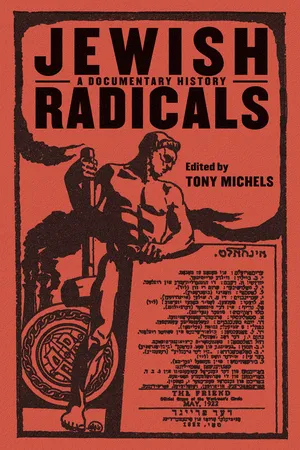
Jewish Radicals explores the intertwined histories of Jews and the American Left through a rich variety of primary documents. Written in English and Yiddish, these documents reflect the entire spectrum of radical opinion, from anarchism to social democracy, Communism to socialist-Zionism. Rank-and-file activists, organizational leaders, intellectuals, and commentators, from within the Jewish community and beyond, all have their say. Their stories crisscross the Atlantic, spanning from the United States to Europe and British-ruled Palestine.
The documents illuminate in fascinating detail the efforts of large numbers of Jews to refashion themselves as they confronted major problems of the twentieth century: poverty, anti-semitism, the meaning of American national identity, war, and totalitarianism. In this comprehensive sourcebook, the story of Jewish radicals over seven decades is told for the first time in their own words.
- 360 pages
- English
- ePUB (mobile friendly)
- Available on iOS & Android
eBook - ePub
About this book
Information
Part I
Awakenings
How did young men and women first encounter socialism? What did socialism mean to them? To shed light on these questions, this section features excerpts from the autobiographies of five prominent radicals. The Communist leader Alexander Bittelman became radicalized as a thirteen-year-old boy in his hometown of Berdichev in the Russian Empire. His father, although a pious man, had grown close to the Bund and enrolled the young Usher, Alexander’s given name, in the local party organization. Bittelman originally perceived socialism as “dream-images of some bright and joyful future, something like what would happen when the Messiah arrived.” He soon discarded his religious beliefs and became a wholehearted revolutionary, a process familiar to many eastern European Jews who made the leap from traditional Judaism to socialism.
Unlike Bittelman, who immigrated to the United States in 1912, most of the Jewish labor movement’s early participants became radicalized in the United States. The seminal event was the Great Upheaval of 1886, the largest strike wave hitherto in America’s history. One person swept up by the unrest was a young cloak maker in Chicago named Abraham Bisno. From German-immigrant radicals Bisno learned about capitalism and the capacity of ordinary workers to change the system. Bisno converted to socialism and went on to become a union activist in Chicago. A different narrative of discovery comes to us from the anarchist firebrand Emma Goldman. According to her autobiography, she turned to the radical movement not out of economic misery but in search of emotional and intellectual fulfillment. Anarchism “offered an escape from the grey dullness” of her life in Rochester, New York, where she felt stifled by “the everlasting talk about money and business.” Another anarchist, Lucy Lang, discovered in Chicago’s radical circles access to interesting people, opportunities for education, and a means to protest social injustices. Lang describes her political awakening as a product of the inequities of work and family life.
Paul Jacobs’s account departs from the conventional trope of conversion. The only native-born American included in this group of autobiographers, Jacobs encountered socialism not on a picket line or in the streets or in an underground movement but among classmates in his Bronx high school. Those intellectually precocious sons of eastern European immigrants led Jacobs to the Young Communist League and, later, the Trotskyist Socialist Workers Party. Jacobs experienced socialism not as a sudden discovery but as a gradual coming of age. Many more autobiographies exist, and they undoubtedly describe various trajectories. If the five accounts included here contain a common theme, it is a sense of awakening to a world of new ideas and possibilities, initiating a process of self-discovery that would lead to an understanding of themselves as actors in a world-historical movement for liberation.
1
“When I Went Home I Was Aflame” (memoir; c. 1925)
Born in Russia, Abraham Bisno (1866–1929) immigrated to Chicago in 1881. He worked as a cloak maker and joined the local labor movement in 1886 amid the massive, nationwide strike wave known as the Great Upheaval. Bisno later worked as a factory inspector for the state of Illinois and as an official in the Chicago Cloakmakers’ Union, among other unions. His autobiography appeared posthumously in 1967.
One fine day—it must have been in the month of April [1886]—Mother came from the butcher shop and informed us all at the shop that there was going to be a meeting in De Koven Street Hall. I asked her what the meeting was and she said she didn’t know but it was her understanding that everybody would come together in that hall on Saturday afternoon. I asked her who told her and she said she didn’t know except the women in the butcher shop spoke about it.
On the next Saturday afternoon I went over along with other people from our shop and a few other shops to that meeting. When I came there I found that there were a great many people assembled around the hall, that the hall was closed and the Bohemian who owned the saloon and the hall was at the door explaining to everybody that nobody rented a hall and that he knew nothing about the meeting. Some of us assembled thought that we had better make up a purse of a few dollars to rent the hall. He said he wouldn’t open the door for less than three dollars, that that was cheap but that he figured that we were going to patronize the saloon downstairs in addition to that. We chipped in a nickel apiece and had three dollars and even more on short notice. The man opened the hall and within fifteen or twenty minutes we packed the hall to capacity, standing room, mainly. The hall was ordinarily used for a Bohemian dance-hall so there was only standing room.
There was a great tumult; everybody was talking and nobody knew quite what this whole thing was about until one of our men asked everybody to be quiet and began to speak. He thought that the price for labor was very low; that the treatment we were receiving in the shops was very undignified; that the examiners were exacting very fine work and were sending the work back over and over again; and that the operators wanted too much money for their work and since he was a contractor, he couldn’t pay it because the employers downtown wouldn’t pay him enough to pay it; that he didn’t know who called this meeting together and intimated that even if he did know, he wouldn’t say, because he believed that somebody would carry the message to the employers. But anyway he didn’t know, but no matter who called it, it is good that we are here to jointly talk matters over and see if we can’t find any way to remedy conditions as they are.
Next to him another man got up, said that he was a sewing-machine operator, that all he was able to earn was seven dollars a week, that it was hard to support his family on that income, that he didn’t have steady work, that in between seasons there was a great deal of slack,1 that he hardly earned enough in busy seasons to be able to live during the slack seasons. He assaulted vigorously the conduct of the contractors. “Who tells you to bring work home when it don’t pay enough?” he asked. “Why do you bring work home without knowing how much you are going to be paid for it; don’t take that kind of work; never mind about the independence of the employers; if they don’t need you, they’ll give you no work anyway. Since they are giving you work, they evidently need that work and if they need it, you can be independent too. Tell them just how much you want for the work, don’t take it unless you get your price; then you will not kick if we want a decent wage for our work.”
An old presser got up to talk. He described how hard he worked; he made motions with his hands showing how hard it was to work with a twenty-two-pound iron, that he was all in after a day’s work, that the hours were too long, that those operators wanted to eat up everything, that nothing was enough for them, and that unless they worked for less there wouldn’t be enough left for the presser, and that he was afraid he was going to contract consumption like other people that he knew from the charcoal gas in the burner and from too hard work.
To make a long story short, we continued that meeting all along until very late at night. I remember I got up, too, to say something, but when I noticed everybody looking at me my knees began to bend, blood rushed into my head and I would have collapsed right then and there if it wasn’t for a friend of mine who evidently sensed my predicament and got ahold of me, led me to a chair, and sat me down. One of the men, an operator, finally took the floor. He was a very healthy-looking chap, rather raw and rough in appearance, and in a loud voice shouted something to this effect, that tomorrow nobody goes to work and that Monday we will select a committee to visit the manufacturers and tell them that the foremen and superintendents should treat us decently and that the examiners should not be so “stuck up.”
Someone in the audience asked him what we were going to do in case some of our people would not abide by the decision and would work tomorrow. He answered in an even louder voice than before, raising his first, “If they work we’ll break their heads for them.” Our young fellows thought it would be quite fun to have a fight with those that would work and before very long there was quite an understanding amongst the young fellows as to where and when they would meet, early in the morning, to visit shops and see whether or not they were closed.
On Sunday morning I got up quite early and with quite a mob we spread out to the numerous shops in the neighborhood. Most of them did not work, but we did find some that did; they were afraid that if they stopped working the employers would not give them any work at all, and we threatened with violence, took off the thread from the machine, shut off the fire in the coal grates, abused them very vigorously, made fun of them, and stationed a committee there to watch right in the shop and see that nobody worked. In those days there were not shops separated from the homes; they were all in homes; homes and shops were all together. The casual entrance of strangers into one of these shops was quite a normal proceeding; we had as yet not acquired the habit of knocking at the door before we went in.
Later on Sunday we met again in the same hall and selected spokesmen to visit the manufacturers. I remember that we had great difficultly in selecting the spokesman; everybody was afraid that he would be considered by the manufacturers as the ringleader of the fight and, therefore, wished to be excused from the appointment. Those that were the most vigorous spokesmen, though, were the men who did not get work to do directly from the manufacturer but were working for the contractors in their outside shops. They did not mind going because the manufacturers would not reach them individually by boycotting them.
After great efforts a committee was constituted; it wasn’t appointed by anybody nor was it self-appointed. Simply the consensus of opinion formed itself on a group of men who, while they represented the people and knew the interests of the people, were at the same time not within the reach of the employers for purposes of employers’ retaliation. The point that the committee itself might be bribed by the manufacturers was quite an item of discussion in our group. It was said that, as for the contractors, they might be offered more work and better work and be induced to line up on the side of the manufacturers. The element of personal honestly was an item of consideration, and after a great deal of haggling and discussion, the committee was formed.
By that time the manufacturers themselves organized into a group to fight the strikers, and when the committee appeared before the manufacturers, they were told that in the judgment of the manufacturers the people had no grievance to complain of, that they had better go back to work. And after that report was brought back to our mass meeting we felt quite forlorn and bitter, and resolved to continue the strike. When I say resolved, I don’t mean that a vote was taken, not even a pro-and-con discussion. It was simply a sort of consensus of opinion to continue the strike without anyone in the group questioning its being so.
This situation took place in the month of April, 1886. By that time the preparation of the Knights of Labor2 for the eight-hour strike in May [had begun] and the agitation was conducted very rigorously. Someone in our group had invited the authorities of the Knights of Labor to appear before our meeting and advise us to join the Knights of Labor. A delegation from the Knights of Labor did appear before our meetings and advised us to join their organization, and we did join their organization. All I then knew of the principles of the Knights of Labor was that the motto of the Knights of Labor was, One for All, and All for One. I think they did require us to pay a dollar per man for membership and when we paid our membership we were all initiated with great ceremony, took an oath of allegiance to the organization, and were made full-fledged members.
All this was done while the strike was going on and we had plenty of time to elect our officers, formulate our demands for the manufacturers, and establish some kind of an organization. As I think of the matter now, I am still very much puzzled. As I said before, nobody knew who called the first meeting, nor did anyone know who called the Knights of Labor to send us a delegation. Prior to our entry as members of the Knights of Labor we had not even selected a secretary or a chairman of our meetings. None of us knew that an organization must have a chairman, a secretary, rules of order, a mode of proceeding by which one man will get the floor while the other man will have to sit quietly and wait until he is through—all of that was unbeknown to us. When we went out on strike we didn’t have a vote; when we agreed to join the Knights of Labor we didn’t have a vote; when we sent a committee to the manufacturers we didn’t have a vote. This whole thing was done in a way that appeared to us spontaneous with no objecting voice. In rare cases somebody did say something; nobody knew whether he agreed or dissented with the established public opinion, but there were no men or issues discussed. As I think it over now after so many years have elapsed, I am satisfied that there must have been someone who did, with premeditation and intent, help to cause that whole movement; first causing the rumor to be spread that the meeting was to be held; after that meeting was held, he must have so informed the authorities of the Knights of Labor and caused them to send a delegation to our meeting. It must also have been the same party that suggested that we join the Knights of Labor, but if anyone did all these things at all, he did it very cleverly, because up to now, our people do not know how it all came about.
Under the rules of the Knights of Labor, the only people authorized to negotiate with the employers were those selected by the Knights of Labor themselves, members out of their own central committee. It was those appointed who undertook the job of visiting the employers again and negotiating with them the settlement of our strike. I remember the personnel in that committee, a bricklayer and an Irish blacksmith and a man that was in business of some kind, not a working man at all. The rules of the Knights of Labor were that every man was entitled to membership except a saloon-keeper and a lawyer, so that there did belong to the Order, storekeepers, landlords, clergymen, and all kinds of people. It was not a labor organization in the strict sense of the word. Its claim was not made based purely on the claim of labor and their interests, but it was based on the claim of ethics, morality, justice, etc.
When this commission went over to our employers, they were received very well, but were informed that we were being led by a lot of anarchists, men who do not know what they want, and since this commission didn’t understand our trade nor the nature of our complaint, they came back quite converted to the side of the employers. There was a complete misunderstanding between ourselves and the committee of the Knights of Labor. As I can formulate it now after so many years have passed, I think the following would set this complicated situation in order. We wanted to establish a regular day’s work; while there was some movement for an eight-hour day, we would have been glad to agree with the manufacturers for a ten-hour day, because we were working unlimited hours and we would even give in to a comprehensive regulation of overtime, but we knew we couldn’t do it ourselves, we couldn’t establish a uniform work day by our own authority and wanted the manufacturers to agree on the justice of our claim and co-operate with us to enforce that regulation by failing to send or give work to the shop that failed to live up to that standard.
The manufacturers made fun of us and the delegation of the Knights of Labor saw it in the same light. They claimed, which was true, that we were not working directly for them at all; they said, we give work to a contractor and he can do what he darn pleases; he can work four hours a day so far as we are concerned. But we knew that unless there was an agreement between manufacturers, contractors, and working men on this standard of ours, competition among ourselves would cause in the future, as it did in the past, a condition making for an unlimited working day. On that point this committee of the Knights of Labor ridiculed us, saying, “Can’t you fellows take care of yourselves, establish your own rules in your shops?” so that they even made some of our own people believe it was true. The argument was: if you want to work ten hours, work ten hours; don’t work any more if you don’t want to. But since the work was distributed in a large number of separate shops, especially homes where a union cannot possibly keep control on the time their members work, we knew we were right, but at the same time, we could not possibly convince the authorities in the Knights of Labor of the justice of our claim.
Substantially the same argument was made in reference to wages. The argument was made by the employers in something of the following manner: it isn’t us that make you work cheap; you’re working piecework. If you don’t want to make a certain garment for a certain price, don’t take it out from the shop; we don’t force you to take it. And that was true. They couldn’t force us; this was a free country. But our poverty, our want, and our need did force us and we ourselves competing with each other reduced our wages below a living point. It was the intention, through the organization, to enter into an understanding with the employers to mutually cause contractors and working people to set the price for labor before the merchandise left the factory so that the price for the labor would not be subjected to competition between ourselves, but that a standard of wages would be set and maintained in the interests of all concerned. It was this point that the manufacturers would not agree to and made our committee themselves believe they were right.
There was another point at issue and that was, we claimed that work should not be given to anyone in a shop that did not belong to the union. The manufacturers maintained that meant they were to become organizers for our union and they said to the committee, if these fellows want to organize a union they can do it themselves without calling on us to organize them. On this point we were even more vitally interested than on both of the previous points because we sensed the intent of the employers. We knew that unless that point was acquiesced to on the part of the employers, shops that didn’t belong to the union would get all the work; union shops would be left in the cold, which would disintegrate our organization and destroy whatever we had accomplished. On this point, too, the committee agreed with the employers. They said, if you fellows want to belong to the Knights of Labor, nobody interferes with you—this is a free country. And it is. Except that freedom to starve militates against freedom to belong to a union, and that the right to be a member of a union must be accompanied by the right to get work and earn one’s living while he is a member.
The Knights of Labor commission did not convince us, but did encourage materially the scab element amongst our people; it encouraged the contractors; it encouraged such relatives of the contractors who were working in the shops and constantly, by agitation and persuasion, threw cold water ...
Table of contents
- Cover Page
- Title Page
- Copyright Page
- Contents
- Acknowledgments
- Introduction: The Jewish-Socialist Nexus Tony Michels
- Part I: Awakenings
- Part II: In Struggle
- Part III: Life of the Mind
- Part IV: The Russian Revolution
- Part V: The Question of Zionism
- Recommended Reading
- Index
- About the Editor
Trusted by 375,005 students
Access to over 1.5 million titles for a fair monthly price.
Study more efficiently using our study tools.
Frequently asked questions
Yes, you can cancel anytime from the Subscription tab in your account settings on the Perlego website. Your subscription will stay active until the end of your current billing period. Learn how to cancel your subscription
No, books cannot be downloaded as external files, such as PDFs, for use outside of Perlego. However, you can download books within the Perlego app for offline reading on mobile or tablet. Learn how to download books offline
Perlego offers two plans: Essential and Complete
- Essential is ideal for learners and professionals who enjoy exploring a wide range of subjects. Access the Essential Library with 800,000+ trusted titles and best-sellers across business, personal growth, and the humanities. Includes unlimited reading time and Standard Read Aloud voice.
- Complete: Perfect for advanced learners and researchers needing full, unrestricted access. Unlock 1.5M+ books across hundreds of subjects, including academic and specialized titles. The Complete Plan also includes advanced features like Premium Read Aloud and Research Assistant.
We are an online textbook subscription service, where you can get access to an entire online library for less than the price of a single book per month. With over 1.5 million books across 990+ topics, we’ve got you covered! Learn about our mission
Look out for the read-aloud symbol on your next book to see if you can listen to it. The read-aloud tool reads text aloud for you, highlighting the text as it is being read. You can pause it, speed it up and slow it down. Learn more about Read Aloud
Yes! You can use the Perlego app on both iOS and Android devices to read anytime, anywhere — even offline. Perfect for commutes or when you’re on the go.
Please note we cannot support devices running on iOS 13 and Android 7 or earlier. Learn more about using the app
Please note we cannot support devices running on iOS 13 and Android 7 or earlier. Learn more about using the app
Yes, you can access Jewish Radicals by Tony Michels in PDF and/or ePUB format, as well as other popular books in History & Jewish History. We have over 1.5 million books available in our catalogue for you to explore.