- 368 pages
- English
- ePUB (mobile friendly)
- Available on iOS & Android
eBook - ePub
About this book
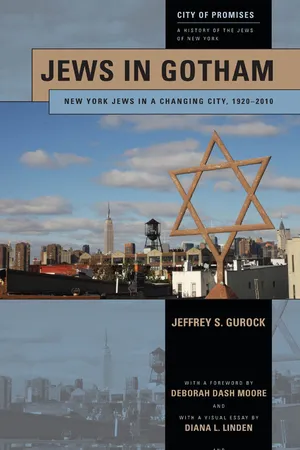
Jews in Gotham follows the Jewish saga in ever-changing New York City from the end of the First World War into the first decade of the new millennium. This lively portrait details the complex dynamics that caused Jews to persist, abandon, or be left behind in their neighborhoods during critical moments of the past century. It shows convincingly that New York retained its preeminence as the capital of American Jews because of deep roots in local worlds.
Information
Topic
HistoriaSubtopic
Historia judíaCHAPTER 1
Building and Sustaining Common Ground
New York had always been a walker’s city. Strollers loved passing friends on neighborhood avenues. Window shopping, a favored pastime, drew crowds during holiday seasons. Customers journeyed by foot in and out of stores across wide expanses of commercial districts in search of bargains. Residents and visitors enjoyed perambulating as they took in the sights and sounds of the metropolis’s entertainments even if a bus, trolley, or in more recent decades, a subway had brought them close to their destinations. But, in 1919, a disgruntled New Yorker told state officials that “her shoes had been worn out” beating the pavement in a totally unsuccessful quest. She had marched all around town in search of decent housing for her family and was “unable to find better quarters.” Her husband, children, and so many others were stuck together “crowded in dark, ill-smelling apartments.”1
At the close of World War I, New York—so often renowned for its excitement, advantages and opportunities—teetered on the brink of failing to fulfill a most basic promise to its citizenry: to provide decent and safe places to live. Housing authorities reported dolefully that “over twenty thousand of the worst dwellings in the city that were not in use in 1916 were back on the market” because there were “practically no unoccupied apartments” that were “fit for human habitation.” Even apartments in the better class of buildings were “unobtainable” as “rents ... were rising and families were ‘doubling up.’” War industries had attracted hundreds of thousands of workers, many of them African Americans from the South, and governmental restrictions during the European hostilities on all but essential construction had severely constricted new housing starts. Both new settlers and immigrants who arrived right under the restrictionists’ wire as quotas became the law in the early 1920s struggled with Gotham’s longtime residents for limited space. From 1915 to 1920, the population within the five boroughs rose by 600,000. Overcrowded Manhattan acquired an additional net growth of 146,000. Squeezed within tight residential quarters, the metropolis might have shared the fate of twenty-five other American cities during the so-called Red Summer of 1919 where tensions boiled over into race riots. Living cheek to jowl on heated streets and coming into close contact at crowded beaches and other public accommodations, whites and blacks violently confronted each other.2
Fortunately, New York legislators—with a discerning eye on what had happened elsewhere—spared their city calamitous outbreaks. In 1921, the Board of Estimate passed a tax-exemption ordinance that galvanized new safety-valve construction. The law, extended several times during the 1920s, basically freed “all new buildings planned for dwelling purposes” from ten years of real estate taxes. Attractive neighborhoods soon rose in Manhattan and the outer boroughs. This far-reaching solution to New York’s most pressing dilemma profoundly affected how its Jews lived, worked, and in many cases prospered during the next two decades.3
Energized by this mandate, local builders and real estate operators, with Jews prominently among them, immediately sprang into action. In Brooklyn alone, during the first nine months of 1921, plans were filed for 6,303 new multiple dwellings with 22,338 apartments. Many of the buildings differed little from prewar construction of four- and five-story “walk-ups,” even if promoters said that they were “up-to-date . . . with spacious interior courts for light and air.” But in the Bronx in 1922, the first “million dollar apartment house” signaled a new era of housing. This nine-story edifice on Kingsbridge Road and the Grand Concourse boasted “modern, fire proof apartments arranged so that each living unit occup[ied] an entire wing of the structure, equipped with high speed elevators, intercommunication system, [and] a steam laundry in the building.” Such construction set a pattern for new developments for the entire decade in the city until the Great Depression. The previously underpopulated borough of Queens sprouted new neighborhoods in Long Island City, Astoria, and Jackson Heights. While Manhattan, in the 1920s, lagged behind in the number of new housing starts, its relatively few new luxury apartment houses were usually more expensive than those built elsewhere in the city. Riverside Drive, Central Park West, Park Avenue below Ninety-Sixth Street, and to a lesser degree, Washington Heights emerged as elegant communities.4
Prospective tenants—with Jews again heavily part of the mix—appreciated these houses’ location within “subway suburbs.” The mass movement of New Yorkers to suburbia beyond the city’s legal limits was still a generation away. The notion that a merchant, a manufacturer, or even a worker could relocate the family to a wholesome setting and commute quickly and cheaply to Manhattan offices, factories, or stores represented a promise fulfilled—that is, if they possessed the economic wherewithal to make a move. And in the good-times decade of the 1920s, “labor was never as prosperous as it is today,” reported one tenement-house official. He continued, “The American worker has always been desirous of bringing up his family in the best possible surroundings. He has tried to get away from the sordidness and the present prosperity has afforded him an opportunity of which he has taken full advantage.” Sometimes, children convinced parents to seek these better neighborhoods. The impressionable would “go to school and visit the homes of their classmates and see how much better they are living in the Bronx, Brooklyn and Queens, with all modern improvements at a little more rent.” They would then persuade their parents to move to apartments with “electric light, bath rooms, hot and cold water and clean rooms.”5 But the ability to commute every workday easily and inexpensively from home to job was critical. As “long as dwellings are within the 5 cent zone, such as new rapid transit routes afford,” a real estate journal observed early in 1921, “tenants are willing to go to the [outer] boroughs.”6
Whole new communities coalesced within walking distance of the rapid-transit lines. The South Bronx had elevated railroad links to downtown as early as the 1880s, and in 1906, the Lenox Avenue subway was extended under the Harlem River. However, after 1917, Bronx Park, White Plains Road, Jerome Avenue, and Pelham Bay Park lines made much larger regions readily accessible. In the late 1910s-early ’20s, subway lines were constructed over and under the East River, bringing Brooklyn and Queens neighborhoods into close contact with Manhattan. By the same token, locales just beyond the subway’s reach, such as Forest Hills, Queens, experienced much less growth. Only when the Independent Subway line (IND) was built in the 1930s, providing fifteen-minute service to Manhattan, was the neighborhood transformed.7
As backers, beneficiaries, and builders of a refashioned New York, Jews in the 1920s continued longstanding patterns of group economic, industrial, and social behavior in the city. In Abraham Cahan’s famous novel The Rise of David Levinsky, the renowned Yiddish newspaper man and downtown man of letters described the real estate fever that had gripped the Lower East Side at the turn of the century, when ambitious immigrants hoped to make their fortunes in that neighborhood and on Harlem properties. He wrote about how a “boom” was “intoxicating a certain element of the population” of “Jewish carpenters, house-painters, bricklayers, or installment peddlers,” emerging, in true rags-to-riches style, as “builders of tenements or frame dwellings.” His central character, Levinsky, depicted as a real estate aspirant, spoke of “huge fortunes … growing like mushrooms”: “I saw men who three years ago had not been worth a cent and who now were buying and selling blocks of property.” Real-life success stories, such as those of Harry Fischel and David A. Cohen, emerged as major communal figures. In Cohen’s case, this erstwhile housewares peddler from Suwalk, Russo-Poland, rose to the presidency of Gold and Cohen Realtors. As owner of several large parcels in Harlem, he even harbored the fantasy that the uptown neighborhood to which he and his family relocated in the early years of the twentieth century would replace downtown as the foremost center of Jewish religious life. When he died suddenly in 1911, he was battling to have his former home synagogue, Kehal Adath Jeshurun of Eldridge Street, shift from the Lower East Side of Manhattan to 113th Street to be part of a communal complex that would include elementary and secondary schools, a Talmud Torah, and a yeshiva.8

“The Authentic New York Transit Map.” (Published for the Universal Jewish Encyclopedia, circa 1939)
That same era of widespread construction also provided important employment opportunities for Jewish skilled laborers. To gain a foothold in those industries, painters, plasterers, paperhangers, and decorators worked as scabs, agreeing to salaries considerably less than those of other tradesmen. Predictably, these maneuvers earned Jews the enmity of the Irish-dominated construction-trades unions. But then again, the ethnically exclusive labor brotherhood denied membership to Jewish construction workers. Meanwhile, once upscale apartments were available, Harlem attracted “a great Jewish bourgeoisie made up entirely of East Siders who ha[d] outgrown their station.” The quest for “greater privacy and larger quarters” had begun. Conventional wisdom claimed “the further uptown” the Jew moves, “the larger, one may be sure is his bank account.”9
Now, in the 1920s, Jewish realtors and laborers capitalized on even greater opportunities. At the same time, their upwardly mobile coreligionists settled where fellow Jews built and worked. The ethnic connection that largely determined where those capable of moving to new neighborhoods would live was stronger than ever before. A historian of New York Jews in the 1920s has explained that “the bonds of ethnicity supported ethnically separate construction industries catering to an ethnically distinct housing market.”10 Once more, aggressive Jewish entrepreneurs “ran lustily when they heard the bell of opportunity tolling its promise.” A contemporary observer of a new generation of real estate speculators further reported that “aflame with schemes, plans and ambitions for bigger things,” they had “grown rich, prosperous, financially independent, ... strutting in front of their skyscrapers and breathing freely with their chests out.”11
To get the job done, through informal networking, Jewish builders typically turned to a Jewish architect to draw up plans and relied on a mix of Jews and other ethnic groups to perform the construction. Once the building was ready to rent, the entrepreneurs who owned and operated the apartment houses got the message out to fellow Jews—either through word of mouth or local advertising—that some of the most commodious housing going up in the city was available. For an advancing class of Jews who had risen out of factory work to owning a small business, an apartment on the Grand Concourse in the Bronx or on Eastern Parkway in Brooklyn or even on the Upper West Side of Manhattan signaled success in America. Economic and social calculi called for them to invest heavily in their shop or industry while setting aside enough money to rent an appropriate home. Buying a house appealed neither as a personal desideratum nor a measure of achievement. A spacious apartment would more than do. Once word got back to friends and relatives in older neighborhoods, a chain migration began.12
Very often, the children of Jewish immigrants led their parents on the exodus out of the old environment. A longtime downtown resident told a survey taker, “I lived on the east side all those years which was very uncomfortable because my earnings were too small to afford a higher rental.” But then, fortunately, when “my children started to work,” the family was able to seek out an “apartment with at least the toilet in the apartment and also steam heat and a bath tub.”13
The resourceful flocked from densely populated Jewish enclaves, including not only from the Lower East Side. As late as 1917, that renowned neighborhood still housed approximately 300,000 Jews, but some 200,000 departed in less than a decade. Their destinations included the Bronx and newer parts of Brooklyn, such as Boro Park, Flatbush, and Bensonhurst; some even migrated across the Hudson to sections of northeastern New Jersey. But Jews also moved rapidly out of Central Harlem, once the home of the rising Jewish bourgeoisie. Tens of thousands, possessed of considerable means, escaped the uptown area’s overcrowding for the Grand Concourse and for the Upper West Side of Manhattan, settling as far north as Washington Heights, as poor African Americans moved in. Left behind were aspiring African Americans, Harlemites too of long standing. The city extended its promises discriminately. They who once lived among Jews were trapped in this ever-deteriorating neighborhood either by their own lack of comparable economic mobility or by racist conventions and covenants. A federal study concluded in 1931 that while the children of immigrants possessed the “possibility of escape, with improvement of economic status to more desirable sections of the city,” among “Negroes ... certain definite racial attitudes favorable to segregation interpose difficulties to ... breaking physical restrictions in residential areas.” Such was the case in Washington Heights, where Jews could settle but a Neighborhood Protective Association pressured landlords, many of them Jews, to sign racially restrictive agreements. Meanwhile, as blacks, regardless of class, were “jammed together” in Harlem, many Jews from the Lower East Side who had spilled over into working-class areas of prewar Williamsburg in Brooklyn set their sights on new Brooklyn enclaves. By 1930, Brooklyn’s 800,000 Jews constituted a full one-third of that borough’s population. Less commanding, though certainly noticeable, was the new presence of Jews in sections of Queens, such as Jamaica, Astoria, Whitestone, Woodhaven, Laurelton, and Forest Hills. Its newly successful residents came from older sections of Brooklyn, such as the poorer areas of Brownsville and East New York. By the end of the 1920s, the Bronx housed some 585,000 Jews, up from the some 200,000 who lived there in 1917.14
During this decade of extensive relocations, working-class Jews moved to their own substantial, if less elegant, locales in the city. In the Bronx, particularly, Jewish labor unions and radical organizations built cooperative apartment complexes for their members. In the case of the Amalgamated housing development, home by 1931 to some seven hundred families in the Van Cortlandt section of the northwest Bronx, workers benefited from another important piece of state legislation. The Limited Dividend Housing Companies law of 1926 granted tax breaks to builders who limited dividends to 6 percent, established moderate rents, and opened their doors to tenants with low incomes. The Amalgamated Clothing Workers Union, among the largest predominantly Jewish labor groups in the 1920s, with a rank and file of some 175,000, secured mortgages from the Metropolitan Life Insurance Company, the Yiddish-Socialist newspaper the Jewish Daily Forward, and its own Amalgamated Bank. When the Amalgamated’s cooperative doors opened around Thanksgiving of 1927, a family could occupy an apartment in a six-floor walk-up, for a modest $500 investment per room—$150 down payment with monthly installments spread out over the next ten years—and a carrying charge of $11 per month. By contrast, that same year, just to rent a three- to five-room apartment on the Grand Concourse near Tremont Avenue cost $55-$85 a month. The luckier co-op residents lived on the lower floors, with “a view of Van Cortlandt Park, the waters of the city reservoir, and the palisades of the Hudson,” as well as access to the “tennis courts, ice skating and other outdoor recreation made available by the park facilities.” Subsequent construction completed from 1928 to 1931 offered the added convenience of elevators. Everyone enjoyed the “landscaped gardens” around the buildings and took full advantage of the “new subway and elevated lines [that] provided a quick and easy commute to jobs in Manhattan’s garment district.”15
The 1920s also witnessed more ideologically committed Jewish laborers, such as the Jewish Communist garment workers, find homes together in the United Workers’ Houses, a few miles east from the Amalgamated in the Bronx Park East section. This radical project found its financial footing not from government incentives but through loans extended by its party’s Yiddish newspaper, the Morgen Freiheit. Still, through pooled resources, the cooperative offered deals to its residents comparable to the Amalgamated’s. Concomitantly, and also in the Bronx, on Sedgwick Avenue, Yiddishists established their Cooperative Heim Geselschaft, which bore the popular name of the Sholom Aleichem Houses. Socialist Zionists gathered within the Farband Houses on Williamsbridge Road in the Bronx. In each project, developers did more than provide housing. They built libraries, auditoriums, day-care nurseries, classrooms, and gymnasia all aimed at creating and nurturing an ideological community.16
Elsewhere in the Bronx, other Jews of limited means relied not on union or political group initiatives but on pooled family incomes to pay rents that were only slightly higher than those charged by Manhattan tenement landlords. For example, Jews of East Harlem realized that while the Grand Concourse was economically beyond them, for just...
Table of contents
- Cover Page
- Title Page
- Copyright Page
- Contents
- Foreword
- General Editor’s Acknowledgments
- Author’s Acknowledgments
- Prologue: Neighborhood Dreams and Urban Promises
- Chapter 1 Building and Sustaining Common Ground
- Chapter 2 Friends or Ideologues
- Chapter 3 During Catastrophe and Triumph
- Chapter 4 Élan of a Jewish City
- Chapter 5 Crises and Contention
- Chapter 6 Amid Decline and Revival
- Chapter 7 Renewed Activism
- Epilogue: In a New Millennium
- Visual Essay An Introduction to the Visual and Material Culture of New York City Jews, 1920-2010
- Notes
- Bibliography
- Index
- About the Author
Trusted by 375,005 students
Access to over 1.5 million titles for a fair monthly price.
Study more efficiently using our study tools.
Frequently asked questions
Yes, you can cancel anytime from the Subscription tab in your account settings on the Perlego website. Your subscription will stay active until the end of your current billing period. Learn how to cancel your subscription
No, books cannot be downloaded as external files, such as PDFs, for use outside of Perlego. However, you can download books within the Perlego app for offline reading on mobile or tablet. Learn how to download books offline
Perlego offers two plans: Essential and Complete
- Essential is ideal for learners and professionals who enjoy exploring a wide range of subjects. Access the Essential Library with 800,000+ trusted titles and best-sellers across business, personal growth, and the humanities. Includes unlimited reading time and Standard Read Aloud voice.
- Complete: Perfect for advanced learners and researchers needing full, unrestricted access. Unlock 1.5M+ books across hundreds of subjects, including academic and specialized titles. The Complete Plan also includes advanced features like Premium Read Aloud and Research Assistant.
We are an online textbook subscription service, where you can get access to an entire online library for less than the price of a single book per month. With over 1.5 million books across 990+ topics, we’ve got you covered! Learn about our mission
Look out for the read-aloud symbol on your next book to see if you can listen to it. The read-aloud tool reads text aloud for you, highlighting the text as it is being read. You can pause it, speed it up and slow it down. Learn more about Read Aloud
Yes! You can use the Perlego app on both iOS and Android devices to read anytime, anywhere — even offline. Perfect for commutes or when you’re on the go.
Please note we cannot support devices running on iOS 13 and Android 7 or earlier. Learn more about using the app
Please note we cannot support devices running on iOS 13 and Android 7 or earlier. Learn more about using the app
Yes, you can access Jews in Gotham by Jeffrey S. Gurock in PDF and/or ePUB format, as well as other popular books in Historia & Historia judía. We have over 1.5 million books available in our catalogue for you to explore.