While sex work has long been controversial, it has become even more contested over the past decade as laws, policies, and enforcement practices have become more repressive in many nations, partly as a result of the ascendancy of interest groups committed to the total abolition of the sex industry. At the same time, however, several other nations have recently decriminalized prostitution.
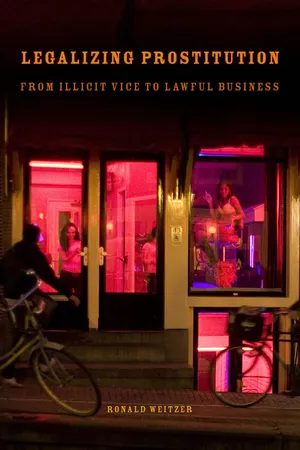
Legalizing Prostitution maps out the current terrain. Using America as a backdrop, Weitzer draws on extensive field research in the Netherlands, Belgium, and Germany to illustrate alternatives to American-style criminalization of sex workers. These cases are then used to develop a roster of “best practices” that can serve as a model for other nations considering legalization. Legalizing Prostitution provides a theoretically grounded comparative analysis of political dynamics, policy outcomes, and red-light landscapes in nations where prostitution has been legalized and regulated by the government, presenting a rich and novel portrait of the multifaceted world of legal sex for sale.
- 288 pages
- English
- ePUB (mobile friendly)
- Available on iOS & Android
eBook - ePub
About this book
Information
Sex Work
1
Understanding Prostitution
It is taken for granted by most people that buying and selling sex is degrading, dishonorable, or despicable, and there is a deep-rooted belief that prostitution has always been and will forever remain taboo. Mention prostitution to someone and you will usually see them react with disgust, while any mention of legalizing prostitution is often met with laughter, incredulity, or shock. There is a widespread sense that prostitution simply cannot be taken seriously or ever achieve the status of other service occupations. Yet this folk wisdom is just that—a narrow, surface understanding that does not come close to recognizing the myriad dimensions of sex for sale, how it is experienced by workers and clients, and the value of considering policy alternatives “outside the box” of criminalization and marginalization.
There are many myths about prostitution—myths that shape both the popular imagination and public policies throughout the world. This chapter examines these myths, as well as the facts. I show that many popular assumptions about prostitutes, their clients, and their managers are either entirely fictional or valid for only a segment of the trade.1 I begin by sketching the basic dimensions of the sex industry.
Contours of the Sex Industry
The sex industry refers to the workers, managers, owners, marketers, agencies, clubs, and trade associations involved in sexual commerce, both legal and illegal varieties. Sex work involves the exchange of sexual services for material compensation as well as the selling of erotic performances or products. It includes acts of direct physical contact between buyers and sellers (prostitution, lap dancing) as well as indirect sexual stimulation (pornography, stripping, telephone sex, live sex shows, erotic webcam performances).
Sex for sale is a lucrative growth industry. In 2006 alone, Americans spent $13.3 billion on X-rated magazines, videos and DVDs, live sex shows, strip clubs, adult cable television films, computer pornography, and commercial telephone sex,2 and the estimated earnings for these sex sectors in the 16 nations where data were available in 2006 was $97 billion.3 In just one decade, the number of X-rated films released annually in the United States more than doubled, from 5,700 in 1995 to 13,588 in 2005, but these figures are now eclipsed by the ubiquity of porn on the Internet.4 The number of strip clubs in the United States has also risen over the past two decades, to around 3,500 today.5 Prostitution is another booming sector, though its size and earnings are unknown due to its illegality.
There are many consumers. In 2008, one-quarter of Americans (34 percent of men, 16 percent of women) reported that they had seen an X-rated video in just the past year.6 Many Americans also visit strip clubs or call a phone-sex number. And more people buy sex from prostitutes than is commonly recognized. The General Social Survey reports figures on the number of men who say that they had ever paid for sex—between 15–18 percent in ten polls from 1991 to 2008 (with about 3–4 percent saying that they had done so in the past year).7 Remarkably similar figures are reported for Australia (16 percent) and the average within Europe (15 percent).8 Given the stigma of prostitution, the real figures may be significantly higher.9 An unusual question was included in a recent British survey: respondents were asked whether they would “consider having sex for money if the amount offered was enough”: 18 percent of women and 36 percent of men said yes.10 This does not imply that they would consider a career in prostitution, but it is clear that a sizeable number of people would be amenable to engaging in an act of prostitution.
Over the past three decades, there has been a steady trend toward the privatization of sexual services and products. Instead of having to buy a copy of an adult magazine in a store, today one can view thousands of nude photos online. Adult theaters are a thing of the past, supplanted by the abundant videos on cable television and the Internet, and the peep show has given way to the live webcam broadcast. The advent of telephone-sex agencies and escort services also has contributed to the privatization of commercial sex. And the Internet has changed the landscape tremendously—providing a wealth of erotic services, information, and connections for interested parties. Internet-facilitated sex work has mushroomed as a sector of the market, while street prostitution has remained relatively stable over time or has declined in some places.11
It is often claimed that prostitution is growing exponentially and that the Internet has driven this increase. These claims may be true, but we lack baseline data (from, say, two decades ago) and have no current, reliable data to compare to a baseline. The Internet has certainly made it easier for sex workers to advertise their services and for clients to locate them, which might indeed translate into an increasing number of transactions, but that is only speculative. What about arrest data? In the United States, the number of arrests for prostitution offenses has declined over the past three decades, dropping steadily from a peak of 125,600 in 1983 to 56,600 in 2009.12 We might expect arrests to increase if the number of transactions has increased, but since arrest patterns can be influenced by extraneous factors (such as police department priorities) arrests are a problematic measure of transactions. Surveys asking respondents about their own involvement in prostitution are another measure. As noted earlier, the number of American men saying they have bought sex has been quite stable (15–18 percent) for about twenty years, suggesting that the number of paid sex transactions has not increased significantly during that time.
For the past decade, the adult industry has sponsored annual trade shows in Las Vegas. The four-day event (the Adult Entertainment Expo) attracts about 300 exhibits featuring porn stars and sex-toy and video companies, and the attendees include industry moguls, producers and directors, the media, and thousands of fans. The Expo has many dimensions—the marketing of products and brands, on-site entertainment, networking among industry people, fans lining up for autographs and photographs with porn stars, outreach to the media, and a huge awards show for adult entertainers.13 Similar conventions have been held in Berlin, Germany (Venus), Vancouver, Canada (Taboo), Moscow, Russia (Eros-Expo Russia), and other cities around the world.
These trends might suggest that the sex industry is steadily becoming normalized, but this conclusion would be premature. Despite its size, profits, numerous customers, and (gradual and partial) mainstreaming, commercial sex continues to be viewed by many people as deviant and disreputable. In 1973, 56 percent of Americans felt that pornography leads to “a breakdown in morals,” a figure that remained fairly stable over the next two decades, with 61 percent subscribing to this opinion in 1994 (the last year this question was asked).14 In 2008, fully half the population deemed viewing porn as “sinful behavior.”15 Almost half the American public thinks that pornography is “demeaning towards women” (a quarter disagreed, and the remainder were undecided),16 and even in liberal New Zealand, only a minority of the public condones viewing porn on the Internet: just 41 percent thought that it was “morally acceptable” for a single person to do so, falling to 21 percent for a married person.17
Prostitution is even more taboo. Two-thirds of the British population believes that “paying for sex exploits women,” and despite the usual pattern in which young people are more tolerant of vices than are their elders, in this poll young adults were less liberal than were older cohorts: 80 percent of those aged 18–24 subscribed to the exploitation view.18 A somewhat different question was asked in another British poll: 49 percent believed that “most prostitutes are only in that role because they are victims of exploitation.” At the same time, 59 percent thought that “prostitution is a perfectly reasonable choice that women should be free to make.”19 In other words, even if most prostitutes have been exploited, this does not mean that others should be prevented from freely choosing this kind of work. With regard to public policy, 51 percent said that it should be legal for a woman to sell sex. The morality of prostitution is a separate issue, however. Only 39 percent of Britons thought that it was “acceptable” for a man to purchase sex from a woman, and 38 percent felt it was acceptable for a woman to sell sex to a man.20
Americans also hold fairly negative views of prostitution, although the number viewing it unfavorably seems to have lessened in recent years. A 1977 poll found that 61 percent thought that the idea of “men spending an evening with a prostitute” was morally wrong.21 Similarly, in 1981, 64 percent of Americans felt that prostitution can “never be justified.”22 But the proportion taking the “never justified” view has declined in recent years, falling to 47 percent in 1999 and 43 percent in 2006. Still, Americans remain less tolerant of prostitution than most Europeans are (see chapter 4).
Many Americans favor either more controls or a total ban on most types of commercial sex. Prostitution should remain illegal, according to between 45 and 70 percent in the most recent polls (the differences reflect question wording).23 In 2008, one-third felt that pornography should be banned outright—down only slightly from two decades earlier.24 Stripping and commercial telephone sex also carry substantial stigma. In 1991, almost half the American public believed that strip clubs should be illegal, while three-quarters thought telephone numbers offering sex talk should be illegal.25
What we have, in sum, is a very mixed picture—a lucrative industry that employs many individuals and attracts numerous customers but is regarded by many people as immoral or harmful and in need of either stricter control or total elimination. The sex industry continues to be widely stigmatized. That some individuals buy sex, go to strip clubs, or watch porn precisely because it is transgressive or even risky—the “forbidden fruit” dimension—does not detract from the central fact that the sex industry remains socially marginal even where it is legal.
Competing Paradigms
Sex work is just as controversial in academia as it is in the wider society. Three perspectives in academic writings view sex work through radically different prisms.
The Empowerment Paradigm
The empowerment paradigm highlights the ways in which sexual services qualify as work, involve human agency, and may be potentially validating or empowering for workers.26 This paradigm holds that there is nothing inherent in sex work that would prevent it from being organized for mutual gain to all parties—just as in other economic transactions. This kind of work may enhance a person’s socioeconomic status and can offer greater control over one’s working conditions than do many traditional jobs. Analysts who adopt this perspective draw parallels to kindred types of service work (physical therapy, massage, psychotherapy) but also emphasize the ways in which the work may benefit the worker. Sex workers can acquire professional expertise, business savvy, proficiency at customer relations, valuable interpersonal skills, and ways of taking control of a situation. It may have other benefits as well: “Many prostitutes emphasize that they engage in sex work not simply out of economic need but out of satisfaction with the control it gives them over their sexual interactions.”27 Empowerment theorists also argue that most of the problems associated with prostitution are traceable to its criminalization and not intrinsic to sexual commerce. They advocate alternatives to criminalization that have the potential to enhance workers’ control over working conditions, job satisfaction, and socioeconomic status.
Some writers who adopt the empowerment paradigm go further and make bold claims that romanticize sex work. Wendy Chapkis describes a “sex radical” version of empowerment in which sex workers and other sexual outlaws “embrace a vision of sex freed of the constraints of love, commitment, and convention” and present “a potent symbolic challenge to confining notions of proper womanhood and conventional sexuality.”28 Camille Paglia echoes this view when she argues that the prostitute is the “ultimate liberated woman, who lives on the edge and whose sexuality belongs to no one.”29 Shannon Bell describes her book Whore Carnival as “a recognition and commendation of the sexual and political power and knowledge of prostitutes.”30 Sex expert Annie Sprinkle lists “Forty Reasons Why Whores Are My Heroes,” which include claims that they “challenge sexual mores,” “teach people how to be better lovers,” “make lonely people less lonely,” are playful, independent, multicultured, creative, and entertaining, and “are rebelling against the absurd, patriarchal, sex-negative laws against their profession.”31 Former prostitute Dolores French proclaims that prostitutes are “the world’s most interesting women”:
They are tougher, smarter, quicker, and more resilient than other women. … I tried to explain to her [French’s mother] that I wasn’t doing it for the money. I was doing it because I believed in it, because I didn’t think it was dirty or shameful but instead something noble and helpful. I was improving the quality of my clients’ l...
Table of contents
- Cover Page
- Title Page
- Copyright Page
- Contents
- List of Tables and Figures
- Preface
- Part I Sex Work
- Part II Policies: America and Beyond
- Part III Case Studies: Three Red-Light Cities
- Conclusion
- Notes
- Bibliography
- Index
- About the Author
Trusted by 375,005 students
Access to over 1.5 million titles for a fair monthly price.
Study more efficiently using our study tools.
Frequently asked questions
Yes, you can cancel anytime from the Subscription tab in your account settings on the Perlego website. Your subscription will stay active until the end of your current billing period. Learn how to cancel your subscription
No, books cannot be downloaded as external files, such as PDFs, for use outside of Perlego. However, you can download books within the Perlego app for offline reading on mobile or tablet. Learn how to download books offline
Perlego offers two plans: Essential and Complete
- Essential is ideal for learners and professionals who enjoy exploring a wide range of subjects. Access the Essential Library with 800,000+ trusted titles and best-sellers across business, personal growth, and the humanities. Includes unlimited reading time and Standard Read Aloud voice.
- Complete: Perfect for advanced learners and researchers needing full, unrestricted access. Unlock 1.5M+ books across hundreds of subjects, including academic and specialized titles. The Complete Plan also includes advanced features like Premium Read Aloud and Research Assistant.
We are an online textbook subscription service, where you can get access to an entire online library for less than the price of a single book per month. With over 1.5 million books across 990+ topics, we’ve got you covered! Learn about our mission
Look out for the read-aloud symbol on your next book to see if you can listen to it. The read-aloud tool reads text aloud for you, highlighting the text as it is being read. You can pause it, speed it up and slow it down. Learn more about Read Aloud
Yes! You can use the Perlego app on both iOS and Android devices to read anytime, anywhere — even offline. Perfect for commutes or when you’re on the go.
Please note we cannot support devices running on iOS 13 and Android 7 or earlier. Learn more about using the app
Please note we cannot support devices running on iOS 13 and Android 7 or earlier. Learn more about using the app
Yes, you can access Legalizing Prostitution by Ronald Weitzer in PDF and/or ePUB format, as well as other popular books in Social Sciences & Sociology. We have over 1.5 million books available in our catalogue for you to explore.